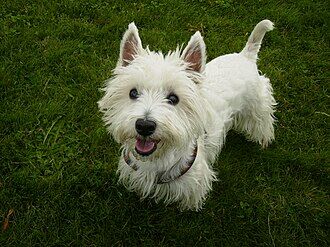
The West Highland White Terrier, the unmistakable “Westie” with white hair and a wakeful look, is a small terrier with the character of a much larger dog. Born in the West Highlands of Scotland to hunt alligators among the rocks, today he’s one of the world’s most beloved companion terriers. In this guide you will find everything you need to know about the West Highland White Terrier: His temperament, his care, his health and his history, told in no uncertain terms so you can decide if he’s the dog you’re looking for.
Is the West Highland White Terrier for you?
The Westie is a two-faced dog: adorable and docile at home, stubborn and temperamental when you touch his morale. It is ideal for those who want a small companion, cheerful and with personality, able to live on the floor, but who is not afraid of a dog with his own opinion. It is not a passive stuffed animal: it is a working terrier tucked into the body of a saloon dog.
In favour .
- Small and adaptable, comfortable in a flat or house with a garden.
- Sociable and cheerful, it is the friendliest of the Scottish terriers.
- Robust, long-lived, and full of energy to play with.
- Excellent alarm dog, warns of anything that moves.
- Smart and quick to learn when well motivated.
To be taken into account
- Stubborn and very independent: it requires firm and patient education.
- Barking and territorial; can annoy neighbors if you don’t work.
- High prey pulse: beware of cats and small animals.
- The coat requires periodic brushing and stripping.
- He doesn’t tolerate rough treatment; watching with very young children.
Character and temperament
If there’s one phrase that defines the West Highland White Terrier, it’s “a big dog in a small body”. He is courageous, self-assured, and full of confidence, even to the point of standing up to dogs three times his size. That audacity comes from his past as an almanac hunter: It was bred to crawl into burrows alone and fight off rabbits, foxes and rodents, so determination is in the genes.
At the same time, he’s surprisingly sociable. In fact, it is considered the friendliest of all Scottish terriers. He is faithful and strongly attached to his family, although he always maintains a certain air of independence: He likes to be on the move, research, and occasionally claim his time alone. Nor does he lack character; he can be possessive about food and toys, hence the importance of training him from puppyhood.
As for intelligence, Stanley Coren’s well-known study places him in the middle of the list of obedience and work capacity. That does not mean he is clumsy, but he combines a good head with a legendary stubbornness: he understands quickly what you ask, but he will decide for himself whether it pays to obey.
Coexistence: children, other pets, flat and loneliness
- With children: can be a great playmate, sociable and energetic. Of course, it does not tolerate abrupt treatment (ear or hair pulls), so it is advisable to teach the little ones to respect it and always supervise the first encounters.
- With other pets: here you have to go carefully. Its hunting instinct is very alive and it can see rodents, rabbits or even cats as prey. An early and constant socialization is the key for it to live in harmony with other domestic animals.
- On the floor: is one of the smallest breeds most suitable for apartment thanks to its size and energy level that, although high, can be channeled with walks and play.
- In the face of loneliness: is independent and gets along better than other breeds when alone, but it is still a companion dog that needs its family. If you are going to leave it alone for many hours each day, give it toys, routines and stimuli to avoid boredom and behaviors such as digging or excessive barking.
Education and training
Raising a Westie is an exercise in patience. It is smart and learns quickly, but its terrier stubbornness makes it test the limits again and again seeking to be the one who carries the singing voice. Therefore, training should begin the same day the puppy enters the house: the sooner he internalizes the rules, the more harmonious the coexistence will be.
The formula that works is positive reinforcement: awards, play and cuddle. The Westie responds enthusiastically to good treatment and closes in on harshness or punishment. Short, varied, and entertaining sessions keep him hooked, while monotonous repetition gets him bored right away. It is advisable to reinforce what you have learned from time to time, because it is a dog that likes to “renegotiate” the rules throughout its life.
Exposing him as a puppy to people, noises, environments, and other animals reduces his tendency to be reactive and bark, and brings out the best in his sociable side.
Exercise and activity
Don’t be fooled by its size: the West Highland White Terrier is a small but energetic puppy. For reference, an adult needs about an hour of exercise a day, although it is so active that it will gladly accept anything you offer. Walks, ball-seeking and sniffing are its glory.
He keeps his “earthdog” instincts intact: He loves digging and snooping and exploring every corner. If you have a garden, make sure that it is well fenced, for your curiosity and your eagerness to dig may lead you to look for the way out. Activities that stimulate his mind and sense of smell, such as searching games or burrowing tests, make him especially happy and help to burn off that terrier energy that, without an exhaust valve, ends up in mischief.
Care: fur and hygiene
The vestment of the Westie is its seal of identity and also its main requirement. It has two layers: One inside is soft and dense, and the other outside is rough and hard, about two inches long, which gives it that spongy appearance and protects it from the elements. To maintain the correct texture, it’s not enough just to cut your hair: The ideal is stripping, the manual pulling of dead hair, a painless technique that preserves the hardness and shine of the coat and is usually done by a professional dog hairdresser.
Regular brushing, almost daily, keeps the hair healthy and prevents tangles. Instead, it is advisable not to abuse the bath: Westies are prone to dry skin and too frequent baths can aggravate irritations. A monthly bath or more spaced, with soft or hypoallergenic shampoos, is usually enough; and then you need to dry it well, paying special attention to the ears.
Being a white dog, hygiene is very noticeable. The Westie has to clean the eye area to avoid unsightly tear stains, comb the nose hair after eating or digging, and check the ears every week to remove wax and prevent infections. With a simple but consistent routine, the Westie wears that impeccable white that makes it so recognizable.
Foodstuffs
The West Highland White Terrier has no exotic requirements, but its small size and tendency to be possessive with food set some guidelines. It is advisable to eat a complete, high-quality diet, adjusted to your age, weight, and activity level, divided into two daily servings to keep your energy stable. Since it is an active but compact dog, it is wise to monitor its diet so that it does not gain excess weight, which would harm its joints and its general health.
Since it is a breed with a certain predisposition to skin problems and atopic dermatitis, many veterinarians advise to take care of the quality of the fats and, in sensitive specimens, to value diets designed for sensitive skin or limited ingredient. Any change in diet or suspicion of food allergy should be discussed with your veterinarian, who is best able to adjust the guideline for each dog.
Health and life expectancy
The Westie is a robust and remarkably long-lived dog: the most recent studies place its average life expectancy between 12.9 and 13.4 years, and it is not uncommon for well-kept specimens to exceed it.
The most characteristic is the cerebral palsy and other disorders, popularly known as “Westie’s jaw”: an abnormal growth of the jaw bone that occurs in puppies, usually before the year of life, and which makes it difficult to chew or swallow. It is an autosomal recessive genetic disease, so it only affects the puppy if both parents are carriers; it usually slows down when it reaches the anus and is treated with anti-inflammatories and soft food.
The skin is his other delicate spot. About a quarter of Westies suffer from atypical dermatitis, a chronic hereditary allergy, and there is also a serious condition unique to the breed, hyperplastic dermatosis(nicknamed “Westie armadillo syndrome”). liver disease due to copper deposition must also be monitored, which can lead to chronic hepatitis, and other less common ailments such as globoid cell leukodystrophy or white dog tremor. The good news is that a responsible breeder, who performs genetic and health testing on the breeders, drastically reduces the risk of most of these problems.
Physical appearance
The West Highland White Terrier is a small-sized, compact and well-planted terrier, with legs somewhat longer than other Scottish terriers. It measures about 25 to 28 cm at the withers and weighs approximately 6.5 to 10 kg, with a body that should be shorter than its height at the shoulders, giving it a square and athletic silhouette.
Its most distinctive feature is its shiny, white, double coat, which fills its face and gives it its characteristic round head. It has dark, almond-shaped and very expressive eyes, sunken under crowded eyebrows, and small, pointed, erect ears always alert. The nose is black, the bite is scissor-like, and the legs open slightly outward, giving it better grip on rocks. The tail, short and firm, is carrot-shaped (thicker at the base), usually measures between 13 and 15 cm and is never cut. Although most are pure white, some specimens have slight wheat-colored shades or small “brandy” spots that are not considered desirable on display.
Origin and history
The Westie is essentially a white Scottish terrier bred from the selection of hunters in the West Highlands of Scotland. The most repeated legend tells that the fixation on the white color responded to a practical motive: clearly distinguish the dog from its dark prey (rabbits and foxes) so as not to confuse it during hunting. Already in the time of James VI of Scotland, in the 16th and 17th centuries, Scottish white terriers are documented, to the point that the king ordered a dozen of these dogs to be sent to France as a gift.
The modern breed descends from the Cairn Terrier and was forged throughout the 19th century from several lines of white terriers. The name that rings most is that of Colonel Edward Donald Malcolm, 16th Laird of Poltalloch, considered the breed’s chief artifice with his “Poltalloch Terrier”; according to the story, he decided to breed white dogs after one of his red terriers was mistaken for a fox and killed by mistake. In parallel there were other lines, such as the “Roseneath Terrier” of the 8th Duke of Argyll and the “Pittenweem Terrier” of Dr. Americ Edwin Flaxman. In fact, for a time they were known as Poltalloch Terriers, Roseneath Terriers or even as the white variety of the Scottish Terrier.
The current name, West Highland White Terrier, first appears in 1908, in the work Otters and Otter Hunting. The first club of the breed was founded in 1904, the British Kennel Club recognized it in 1907 and that same year debuted at Crufts. Almost at the same time I crossed the Atlantic: He arrived in the United States in 1907-1908 and the American club, initially called the Roseneath Terrier Club, was renamed the West Highland White Terrier Club of America in 1909. Since then it has enjoyed success in major exhibitions on both sides of the ocean and has remained one of the most popular terriers.
Curiosities
- It is a first cousin of the Cairn Terrier, from which it descends directly; for years British pedigrees admitted crosses with Cairn and Scottish Terrier until 1924.
- Its “carrot-shaped” tail is not an aesthetic whim – it was a practical handle to help the dog out of its burrows during hunting.
- A legend associates their ancestors with Spanish white dogs who survived a shipwreck of the Invincible Armada on the Isle of Skye in 1588.
- He keeps his “hound dog” instincts intact: he snoops, researches and digs with true passion, a direct inheritance of his original work.
- He has won several times the prestigious Crufts Best in Show, the UK’s largest dog show, which gives an idea of his success in the ring.
If you are attracted to the sparkling character of the West Highland White Terrier, you may want to compare it to other breeds in the same family. Its closest relative is the Cairn Terrier, from which it comes directly, and shares Scottish roots with the Scottish Terrier. If you are looking for another small terrier with a lot of personality, check out the Yorkshire Terrier or the balanced Border Terrier, all of them small dogs with a hunter’s soul.
Frequently Asked Questions about the West Highland White Terrier
Is the West Highland White Terrier a good dog for beginners?
It is small, robust, and adaptable to the floor, but it is also stubborn and very independent, so it does not forgive permissiveness. An engaged beginner, who socializes and educates the puppy with patience and positive reinforcement, would coexist wonderfully with a Westie.
How much exercise does a Westie need a day?
As a guideline, an adult West Highland White Terrier needs about an hour a day of activity, divided into walks and play. It is an energetic terrier that loves to chase the ball, sniff and dig, so it will appreciate more time if you can give it to it.
Does the West Highland White Terrier shed a lot of hair?
It sheds relatively little compared to dual coat breeds that change seasonally, because its coat is maintained primarily by stripping (ripping from dead hair) and brushing.
Do you get along with children and other pets?
It is sociable and can be a good companion for children, but does not tolerate harsh treatment such as being pulled by the ears or hair, and is sometimes possessive with food and toys.
How long does a West Highland White Terrier live?
It is a long-lived breed for its size, and recent studies place its average life expectancy between 12.9 and 13.4 years, and many well-kept specimens easily exceed that.
Why are the Westies white?
Scottish hunters selected white terriers to clearly distinguish them from their dark-colored prey, such as rabbits and foxes, and to avoid accidents during hunting.
Is that a barking dog?
It tends to be. It is an alert and territorial terrier that warns of any noise or visit, which makes it an excellent alarm dog despite its size.
What health problems are typical of the Westie?
Among the most common diseases associated with the breed are craniomandibular osteopathy (the so-called Westie’s mandible), skin diseases such as atopic dermatitis and hyperplastic dermatosis, and liver problems due to copper deposition.