The American Cocker Spaniel is the smallest of the hunting dogs recognized by the American Kennel Club and probably one of the most expressive family companions in existence. His rounded head, his big, dark eyes and, above all, that tail that seems to keep moving have made him the “Merry Cocker”, the cheerful cocker. Behind its silky coat is a sensitive, sociable dog deeply attached to its people. Here’s the complete guide to whether the American Cocker Spaniel is a good fit for you.
Is the American Cocker Spaniel for you?
The American Cocker Spaniel is a dog of manageable size, affectionate and adaptable, but its coat and sensitivity demand a real commitment. These are the lights and shadows.
In favour .
- Comfortable size: fits well on the floor and in the house with garden.
- Cheerful, balanced and very people-oriented.
- Good with kids and, well socialized, with other pets.
- Intelligent and willing to learn; performs in obedience and agility.
- Moderate energy: Good daily walks are enough.
To be taken into account
- High maintenance of the coat: frequent brushing and periodic hairdressing.
- Long ears and falls prone to infection; constant checking.
- He is sensitive: he does not tolerate harsh treatment or shouting.
- Very attached; suffers from prolonged loneliness.
- Predisposition to eye, heart and skin problems.
Character and temperament

If we had to sum up the American Cocker Spaniel in one word, it would be “cheerful”. The breed standard describes the ideal dog as temperamentally balanced, without the slightest trace of shyness, and that near-permanent happiness is translated into a tail that never seems to stop. It is a confident, playful and deeply sociable dog, preferring to be close to its family rather than alone in a yard.
As for intelligence, it occupies a respectable place: It ranks 20th in the famous Stanley Coren ranking, indicating a good capacity for work and obedience. Interestingly, classic behavioral tests showed that it excelled especially in self-control and delayed response to a stimulus, a trait it inherited from its hunter past, when it had to stand still when it spotted a bird until it was ordered to pick it up.
The reverse of this sensitivity is that it does not fit into harsh methods. It is a “soft” dog that is blocked or frightened by rough treatment and loud noises. The explosion in popularity of the breed has brought with it irresponsible breeding and, with it, specimens with fearful or reactive behaviors; therefore, choosing a serious breeder that primes the balanced character makes a huge difference.
Coexistence: children, other pets, flat and loneliness
- With children: is one of his greatest assets: well socialized since puppyhood, he gets along great with the little ones, always with the usual supervision and respect from both parties.
- With other pets: with good early socialization coexists smoothly with other dogs and even other pets.
- On the floor:‘s moderate size makes it perfectly suited to apartment living, as long as you cover his walks and his need for companionship and encouragement.
- In the face of loneliness: here is its weak point. It is a dog that lives for its people and does not like to be left alone for long hours. Long and repeated absences can lead to stress and unwanted behavior.
- Noise and environment: is easily stressed by loud noises and chaotic environments; it appreciates a quiet, predictable home.
Education and training
The American Cocker Spaniel learns quickly and enjoys collaboration, an ideal combination for training. The key is to respect its sensitivity: positive reinforcement, short sessions and play work; yelling and harsh hand, no. A harshly corrected cocker tends to shut down, distrust or become defensive.
Early socialization is, without a doubt, the most profitable investment. Exposing a puppy to people, children, other dogs, noises, surfaces and varied situations builds the safe and sociable adult that defines the breed.
His past as a show dog gives him natural self-control that you can use in obedience exercises and canine sports. Of course, don’t expect dexterity with his paws: classic tests pointed to him as one of the least skilled at manipulating objects with his limbs, so he directs challenges toward smell, obedience, and cooperation.
Exercise and activity

Although today it looks mostly like a companion and exhibition dog, inside it is still a sporting dog. It needs its daily dose of exercise: quality walks, playtime and, if possible, opportunities to use its sense of smell and brain. It is not an extreme athlete that requires miles of running, but neither is it a couch dog that just takes a moment out.
With moderate and constant physical activity, he maintains a healthy weight and mental balance that is noticeable at home. Canine sports such as agility or tracking fit him perfectly: they combine movement, concentration and, what he values most, doing things together with his person.
Care: fur and hygiene
This is where the American Cocker Spaniel demands the most from you. Its silky, medium-length hair, with abundant fringes on the ears, chest, belly and legs, is spectacular but demanding. Without regular maintenance it tangles and knots easily, so frequent brushing (ideally several times a week) and periodic visits to the canine hairdresser are part of the package.
The most important chapter is the ears. Being long, fallen and hairy, they retain moisture and dirt, which favors otitis and infections. It is advisable to check and clean them regularly and keep the hair cut in its contour so that they ventilate better.
Complete the routine with the usual: hair control around the eyes (the breed tears easily), dental hygiene, nail trimming and skin checking, which in this breed is sensitive.
Foodstuffs
The American Cocker Spaniel benefits from a complete and balanced diet, adjusted to its age, weight and activity level. Being a gluttonous dog and of contained size, it tends to overweight easily, so it measures rations well, controls rewards and avoids table excesses. Keeping it at its ideal weight protects its joints and heart.
There is one nutritional detail of the breed that deserves attention: cases of dilated cardiomyopathy associated with low levels of the amino acid taurine have been reported, a form which in many cases is reversible with taurine supplementation. That is why choosing quality food and consulting your veterinarian about any questions about your diet is not a luxury but part of caring for your cardiovascular health. And, as always, fresh, clean water at your disposal.
Health and life expectancy

The life expectancy of the American Cocker Spaniel is good: a study conducted in the United Kingdom in 2024 attributed to it an average of 13.3 years, above the 12.7 of breed dogs in general.
The most relevant are the eyelashes: it stands out as one of the races most affected by progressive retinal atrophy and is among those with the highest prevalence of glaucoma; cataracts may also appear.
In the heart disease plane is the aforementioned dilated cardiomyopathy linked to taurine. The skin and ears are another front: the breed is prone to skin allergies, dermatitis, otitis externa and other dermatological problems, in addition to hypothyroidism. On a positive note, it has a lower than average incidence of hip dysplasia. The prevention commands: regular veterinary checks, ear hygiene, weight control and selection of healthy breeding lines.
Physical appearance
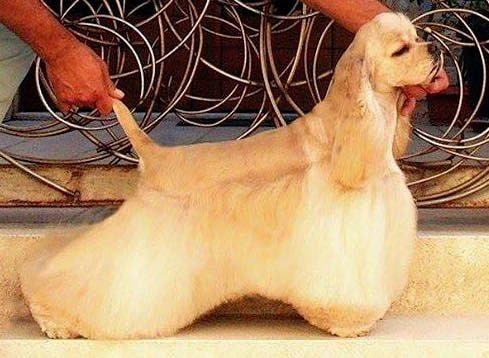
The American Cocker Spaniel is unmistakable. It is the smallest of the AKC sport dogs, with an average height between 34 and 39 cm at the withers; the males are around 37-39 cm and the females 34-36 cm. In weight it moves approximately between 9 and 14 kg, with the females slightly lighter than the males.
His signature is the head: rounded and domed skull, well-marked stop, square and deep snout, and large, round, dark front-looking eyes. The ears, long, of low insertion and covered with silky hair, hang on either side framing the face. The neck is long and muscular, the body robust, and the tail, historically, has been subject to amputation (caudectomy), a practice now restricted or banned in many countries.
The coat is silky in texture, flat or slightly wavy, short and thin at the head and medium length at the body, with abundant undercoat and generous fringes. As for colours, the standard groups them into three broad varieties: black(solid or with fire marks), ASCOB(any solid colour other than black, from light cream to dark red, including the characteristic ‘buff’ hue) and multi-coloured or multi-coloured(white with other coloured spots, including ruans). The merle pattern exists but is not recognized by the AKC.
Origin and history
The American Cocker Spaniel was born, as its name suggests, in the United States, from English cocker spaniels brought from the United Kingdom. The history of the spaniel in North America goes back a long way: The first Spaniel would have arrived aboard the Mayflower in 1620. However, the first Cocker Spaniel registered in the AKC was a specimen called Captain, in 1878, and in 1881 the breed club was founded, today considered the oldest canine club in the United States.
The dog considered the ancestor of the modern breed is Ch. Obo II, born of English lines but raised already on American soil. Throughout the first decades of the 20th century, American breeders were molding a different dog from the English: smaller and lighter, with the shortest snout, the most arched head and the softest and most abundant hair. The differences became so evident that in 1946 the AKC officially recognized the English Cocker Spaniel as a separate breed from the American. In the UK, the formal separation of American from English did not come until 1970.
The breed’s popularity was overwhelming: The American Cocker Spaniel was the number one dog in AKC records during the 1940s and 1950s, and again between 1984 and 1990. He has won the Westminster Best in Show four times and Crufts in 2017. His success also had a B-side: Mass breeding to satisfy demand has left scars on health and character that responsible breeders are still working to correct.
Curiosities
- The Disney star. Lady, the protagonist of “The Lady and the Tramp”, is an American Cocker Spaniel; in the live-action remake she was played by a cocker named Rose.
- The breed has been linked several times to the White House. Richard Nixon’s famous “Checker speech” in 1952 revolved around his cocker, and other presidents such as Harry S. Truman or Rutherford B. Hayes had specimens of the breed.
- The most photographed cocker in the world. Ch. My Own Brucie, winner of the Westminster in 1940 and 1941, became known as the most photographed dog of his time.
- “Merry Cocker”. The standard itself enshrines its nickname: the cheerful cocker, for that smiling character and that tail in perpetual motion.
- The name says it all.“Cocker” comes from its use to hunt woodcock in England, and “spaniel” refers to its origin linked to Spain.
If you are attracted to the American Cocker Spaniel, you may want to compare its character and care with those of other spaniel and related hunting breeds. We recommend that you take a look at its closest relative, the English Cocker Spaniel, as well as the Cocker Spaniel, the energetic English Springer Spaniel, and the sweet Cavalier King Charles Spaniel. Comparing sizes, energy, and fur needs will help you confirm which is the ideal companion for your home.
Frequently Asked Questions About the American Cocker Spaniel
Is the American Cocker Spaniel a good choice for living in a flat?
Yes. Its moderate size (9-14 kg) makes it perfectly suitable for an apartment, as long as you cover its daily walks and, above all, its great need for company. It is a dog that lives for its family and does not take well prolonged solitude.
How much exercise do you need?
A moderate but consistent amount: quality walks, playtime, and, if possible, activities that stimulate his sense of smell and his head.
Is it hard to take care of your hair?
Its silky hair with fringes tangles easily, so it needs frequent brushing (several times a week) and periodic hairdressing.
Do you get along with children and other pets?
Very good in both cases, always with good early socialization. It is affectionate, sociable and less conflicted, which makes it an excellent family dog that coexists without problems with children, other dogs and other pets.
What are the most common health problems?
Eye problems (progressive retinal atrophy, glaucoma, cataracts), ear infections due to drooping ears, skin problems and allergies, hypothyroidism and a form of dilated cardiomyopathy linked to taurine are highlighted.
How long does an American Cocker Spaniel live?
Their life expectancy is good: a UK study from 2024 estimated an average of 13.3 years, above the average for purebred dogs.
What’s the difference with the English Cocker Spaniel?
The American is smaller and lighter, with a shorter snout, more arched head, more marked eyebrows, and smoother and more abundant hair.
Is it easy to train?
Yes, it is intelligent and collaborative, with a good capacity for obedience. The condition is to respect its sensitivity: it works with positive reinforcement, short sessions and play, and is blocked by harsh treatment or yelling. Early socialization is essential.