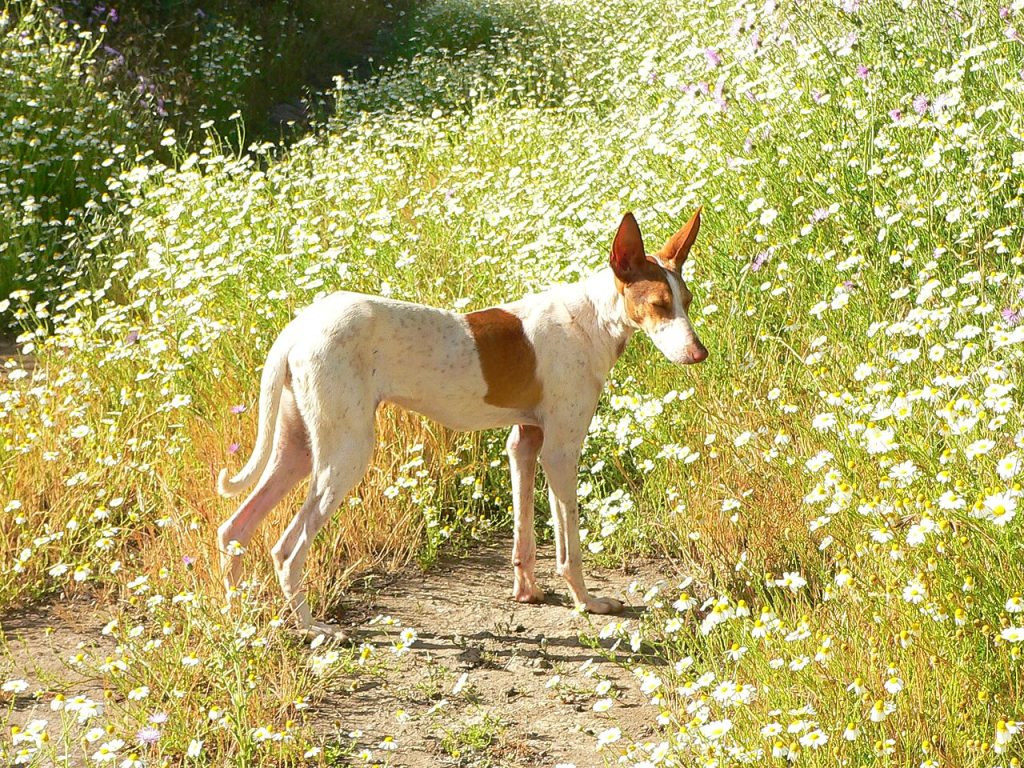
The Canary power is a burrowing dog native to the Canary Islands, bred for centuries to hunt rabbit on the volcanic slopes of the archipelago. Light, tireless and of almost disarming nobility at home, it is a dog that combines a ferocious hunting instinct with a calm and sociable character indoors. If you are looking for an athletic companion, healthy and without the pretensions of a guardian, the Canarian Podenco deserves your attention, but it is advisable to understand well what he needs before taking the step.
Is the Canary Powerhouse for you?
The Canary Poodle is not a dog for everyone, and that’s a big part of its charm. It’s a natural-born hunter tucked into the body of a gentle companion: it can spend hours on the couch like a puppy, but as soon as it steps on the field it transforms. Before you fall in love with those huge ears and that amber look, be honest about what you can offer it.
In favour .
- Very healthy and rustic, with few known hereditary problems.
- Short coat that barely requires maintenance.
- Noble, affectionate and not aggressive with people.
- Clean, quiet at home and adaptable, even to the city.
- Athletic and resistant: ideal companion for active people.
To be taken into account
- Very strong hunting instinct: safe release is a challenge.
- Independent and somewhat stubborn; not a dog of blind obedience.
- He needs real daily exercise, not just a walk.
- It does not serve as a guard dog: it welcomes strangers as friends.
- The cold affects him: he’s a warm-weather dog.

Character and temperament
Those who live with a Canarian Podenco usually describe the same paradox: a two-speed dog. Inside the house it is serene, discreet and deeply loyal to its family; once it goes out into the countryside and detects a trail, the millenary hunter it carries inside emerges and completely changes registration.
It is an animal smart, hardworking and tireless, but also independent and stubborn. It thinks for itself, because for centuries it has hunted making decisions without waiting for orders.
It stands out for its nobility. It does not usually show aggression and is extremely loyal to its own. The counterpart is that it lacks instinct for guarding and defense: in its own house it is, as they say on the islands, “friend of all strangers”. If you are looking for a dog that barks at the postman, this is not your dog.
Coexistence: children, other pets, flat and loneliness
Sociable and balanced, he gets along well with children as long as his times are respected and games are supervised, especially for his energy and his slender and delicate body.
The problem with small animals is that rabbits, rodents, birds, and even hardy cats can awaken their prey instinct. Early socialization helps, but it is never advisable to rely entirely on small game.
Does it work for floor? Yes, and it’s becoming more common to see it in the city. At home it’s quiet and clean, with a serene charisma that makes it a good indoor dog… whenever it’s out it gets the exercise it needs. About the loneliness, it tolerates being alone better than many close-knit breeds, but a boring, unspent-energy pudding can become restless.

Education and training
Educating a Podenco canary is an exercise in humility for one who comes from obedient breeds. It is intelligent and learns quickly, but its independence makes if it compensates you decide to listen to you. The key is in positive reinforcement: rewards, food and play work much better than imposition, before which a Podenco simply shuts down.
The called is the pending subject of the race. When it starts after a trail, it enters a state in which the world disappears and your voice ceases to exist. So you have to work the “here” from a puppy, with great constancy, and be realistic: letting go in unfenced areas and with the presence of minor prey is a risk that many poodles never completely overcome.
Begin as early as possible. The puppy shows hunting instinct as early as a few months, and his first year is of remarkable hyperactivity. Socialize him with people, dogs, noises and varied environments during this period: it will be the basis of a balanced adult.
Exercise and activity
The Canarian Podenco is an athlete built to run at high speed behind a dam on rough terrain, and needs intense daily exercise: running, free galloping in a safe zone, hiking, canicross or canine sports that combine head and body.
A quiet walk around the block isn’t enough. Without enough physical exercise, their energy turns into nervousness, destructiveness, or repetitive behavior. The good news is, when that need is met, they become the calm, grateful dog that rests at your feet the rest of the day. Their resilience is proverbial: they’ll keep up with your pace and, almost always, a little longer.
Care: fur and hygiene
The short and shallow hair requires little maintenance: a weekly brushing with a rubber glove removes the dead hair and keeps the coat shiny.
The bathrooms, only when really needed, because it does not give off a strong smell. Pay attention to its large erect ears (check and clean them to prevent infections), to the nails and to dental hygiene. An important note: its thin skin and its scarce fur make it sensitive to the sun and, above all, to the cold. In winter or in cold climates it will appreciate a warm coat and shelter.
Foodstuffs
The canary Podenco is a slender dog by nature, with barely marked ribs and an athletic silhouette; its structural slenderness should not be confused with lack of weight.
Divide the ration into two daily servings and adapt it to your dog’s age, activity and physical condition. Being a deep-chested and slender dog, it is advisable to avoid intense exercise right after eating. Fresh water is always available, especially after galloping. If you have any doubts about quantities or type of diet, your veterinarian is the best reference.

Health and life expectancy
The Canarian Podenco is a rustic and healthy breed, the result of centuries of natural selection in a demanding environment and with little artificial human intervention.
A genetic disorder of sexual development (testicular/ovotesticular type) has been documented in the breed which may affect some genetically female individuals, although it is a point anomaly and not a frequent disease. Like any athletic and slender dog, its joints, its sun-sensitive skin, and its cold skin should be taken care of. With regular veterinary checkups, vaccinations and daily deworming, it is a companion that gives little scare.
Physical appearance
The Canarian Podenco is the imprint of the Mediterranean hound: a dog agile, slender and slightly elongated, lightly built but surprisingly muscular and resistant.
Its head is longer than it is wide, crowned by very mobile big ears and always upright s. The neck is long and the tail, low-inserted, is carried down at rest and can rise in action, without arching excessively when moving. The coat is short and dense (with the aforementioned variety of long hair), in shades ranging from intense cinnamon red and yellow, with or without white spots, depending on the island and even the area. A curious detail: There should be no other color on the body, and even the nose, nails and skin pull to reddish tones. Its characteristic movement is an extended and elegant jog that denotes its speed.
Origin and history
The Podenco canario is found in all the Canary Islands and is part of the identity of the archipelago. According to popular legend, it descended from very ancient dogs brought to the islands from North Africa by the first settlers, hence its “primitive” air and its resemblance to dogs of ancient Egypt. It’s a beautiful story, but science clouds the myth: Genetic studies conclude that the Podenco is a type of dog more closely related to the other European hunting breeds and no more primitive than them.
A 2019 study on the genetic distance between Mediterranean hounds found three well-differentiated groups: the four Spanish podancos (Andalusian, Canarian, Iberian and Valencian), the Etna Cirneco in Sicily and the Kelb tal-Fenek in Malta. The Canarian Podenco was definitively accepted by the International Canine Federation in 1987 and recognized in Spanish legislation in 2001; it is also recognized by the Royal Canine Society of Spain. In 2026 it was among the sixteen Spanish races considered vulnerable by the RSCE, a reminder that this Canarian treasure needs defenders.
Curiosities
- El “latir”. When it discovers or pursues prey, the Canary Podenco emits a short, repetitive, and very characteristic bark that hunters know as a “bark” or “rabbit song”.
- He blushes. Because their skin and nose pull in reddish tones, these dogs are said to “blush”, blushing even more when excited or happy.
- Early hunter. There are puppies as young as three months old that already show strong hunting instinct, although others take up to a year to fully develop it.
- It hunts in packs. traditionally works in a group, combining smell, hearing and sight, a versatility uncommon among hunting dogs.
- One color, without exception. The standard is so strict with the reddish coat that any other color is considered a gross misdemeanor.
If the Canarian Podenco has conquered you but you want to compare it to other athletic, primitive or hunting dogs, take a look at related breeds like the Greyhound, the Whippet, the fast Vizsla or the elegant Pointer.
Frequently asked questions about the Canary Islands
Is the canary Podenco a good family dog?
Yes. It is noble, faithful and not aggressive with people, and gets along very well with children if the games are supervised. At home it is quiet and clean. Its only family “but” is that it does not serve as a guard dog, because it welcomes strangers as friends.
Can you have a canary Podenco in a flat?
Yes, and it’s increasingly common in the city. Inside it’s serene, quiet and pleasantly treated. The condition is that outside it gets intense daily exercise: without sufficient physical expenditure, its energy turns to nervousness.
How much exercise do you need?
He’s an athlete built for high-speed running, so he needs running, free galloping in a safe zone and real daily activity, not just a short walk.
Do you get along with cats and other small animals?
With cats, rabbits, rodents or birds you have to be careful: their prey instinct is very strong. Early socialization helps, but it is never advisable to rely entirely on small animals.
Is it hard to educate?
It is intelligent, but independent and stubborn: it decides whether it pays to obey. It works with positive reinforcement (rewards, food, play) and a lot of patience. The call is the most expensive, because when it follows a trail it tends to disconnect from the environment.
What kind of hair care do you need?
Their short hair is maintained by weekly brushing and occasional bathing, but their ears, nails, and teeth should be checked, and they should be protected from the cold and sun because their thin skin and scanty coat make them sensitive.
Is it a healthy breed?
Yes, it’s a rugged, rugged breed with few known hereditary problems thanks to centuries of natural selection.
Where does the Canary Power come from?
It is an indigenous breed of the Canary Islands, bred to hunt rabbits. Although the legend relates it to dogs from North Africa brought in antiquity, genetics places it close to the rest of European hunting breeds.