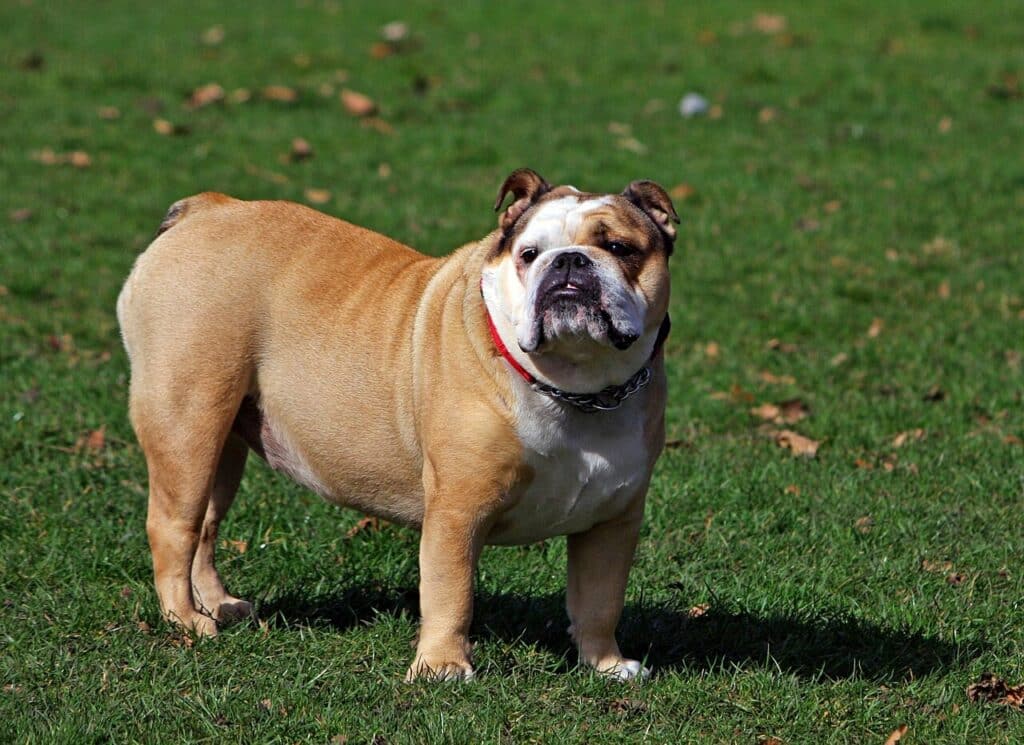
The Bulldog Inglés is one of the most recognizable dogs on the planet: head, broad shoulders, wrinkled face and wobbly gait. Behind that rough appearance is a quiet, affectionate companion who is very close to his family. Here is an honest and complete guide to know what it’s really like to live with this breed, what care it requires and if it fits you.
Is the English Bulldog for you?
The English Bulldog is a companion dog par excellence: homey, balanced and not much of a barker. But its very particular anatomy brings with it needs and limitations that you should know before falling in love with that face. It is not a dog for everyone, and being honest about it avoids displeasure.
In favour .
- Sweet character, patient and very familiar.
- It needs little exercise – ideal for quiet people.
- It adapts wonderfully to floors and small spaces.
- He usually gets along well with children and other pets.
- He barks a little: good neighbor.
- It doesn’t require barely brushing for its short hair.
Against
- Breathing problems due to his flat face (brachycephaly).
- Very sensitive to heat: real risk of heat stroke.
- Tendency to obesity and joint problems.
- Potentially high veterinary costs.
- Snoring, drooling and snoring.
- Wrinkles need regular cleaning.
Character and temperament
If the English Bulldog stands out for anything, it is for its gentle temperament. The American Kennel Club’s standard describes it as a dog “equanimous and gentle, resolute and courageous, neither vicious nor aggressive”, of peaceful and dignified behavior.
Generations of breeders have worked to eliminate the aggressiveness of their ancestor, and the result is a quiet, patient, deeply sociable companion who forms very strong bonds with his people, especially children, and enjoys a nap on the couch glued to you more than anything else.
Of course, do not be fooled by that British phlegm: the English Bulldog is famous for its obstinacy. It is intelligent, but stubborn. When it decides not to move, it seems to weigh twice as much. Whoever is looking for a servant dog and willing to obey the first will not find it here; whoever is looking for a loyal and calm friend with his own personality, yes.
Coexistence: children, other pets, flat and loneliness
- With children: is one of its great virtues. Its tendency to create close bonds and its patience make it an excellent family pet. As with any dog, it is advisable to supervise play and teach the little ones to respect it.
- With other pets: generally gets along well with other dogs and pets, especially if socialized as a puppy.
- On the floor: is probably one of the best medium breed dogs to live in an apartment. It needs little space, barks little and its activity level is low.
- In the face of loneliness: is very attached, so it prefers company. It tolerates moments alone, but it is not a dog designed to spend the whole day without anyone. The heat in the house is a critical point: never leave it in a poorly ventilated or hot space.
Education and training
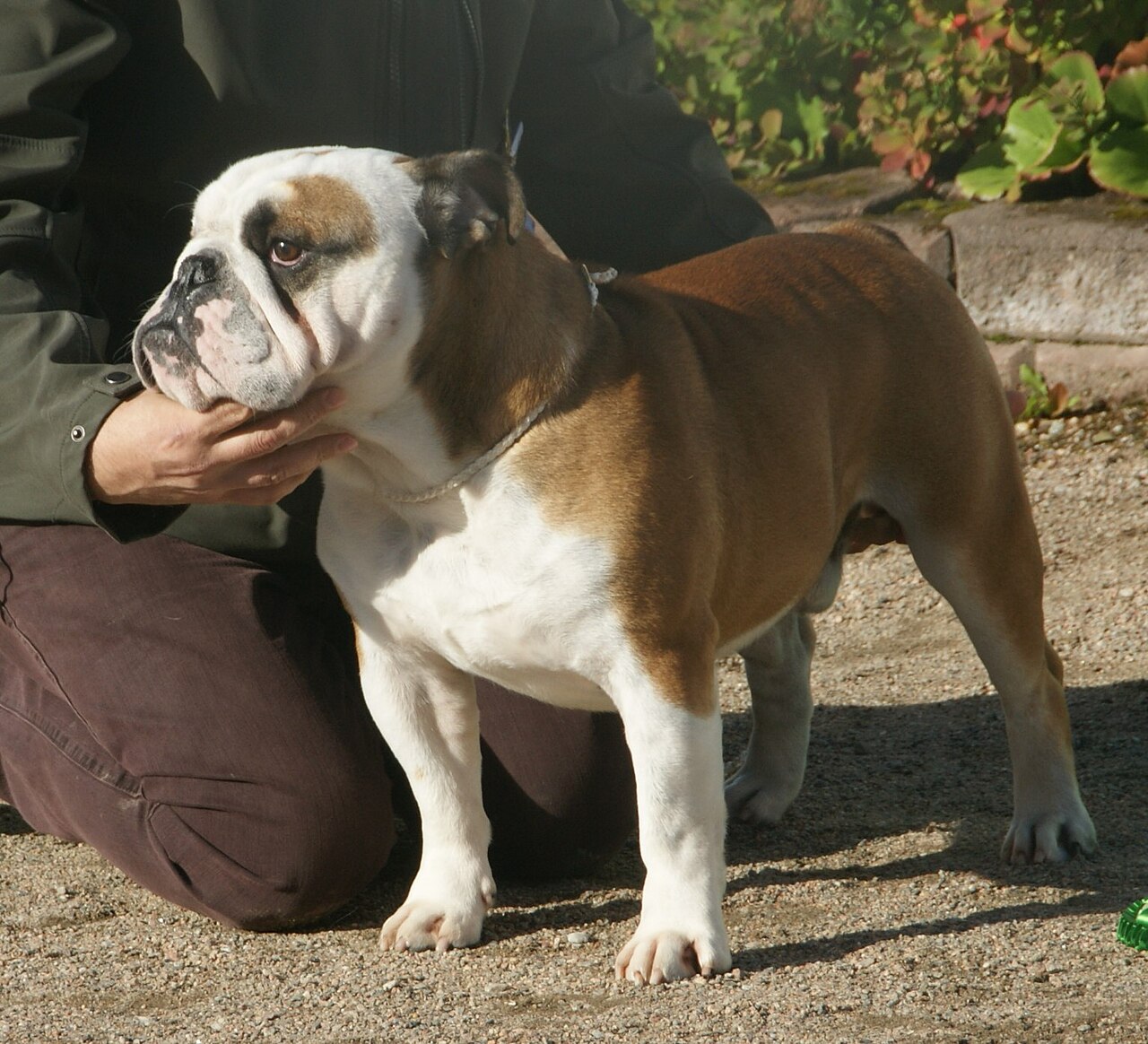
Training an English Bulldog is an exercise in patience. It’s smart and quick to catch what you ask, but its stubbornness makes motivation the key to everything. Forget military discipline: with this dog, positive reinforcement, short sessions and, above all, food as a reward work (it’s a born glutton).
Socialization begins early, exposing him to people, dogs, noises and different environments during the puppy stage. Work from the ground up on basic commands and behavioral boundaries, and review them often: Perseverance makes up for stubbornness. It’s also good to get him used to you manipulating his face, ears, legs and wrinkles from a young age, because you’re going to have to do that for the rest of your life.
Don’t expect a dog of competition obedience or an athlete of agility. The English Bulldog learns what it needs to live happily, and that’s enough.
Exercise and activity
Here we have to be very clear: the modern English Bulldog it’s not made for intense physical exertion.. Its flat face limits its breathing and its ability to regulate temperature, so excessive exercise can be dangerous, not just tired.
It is advisable to walk gently for 20 to 30 minutes a day, or at least on alternate days, at a moderate pace (without jogging) and always in the coolest hours. Avoid exercising in the sun or in the heat, and allow time before and after meals to reduce the risk of digestive problems. A little daily play at home, brief and effortless, does wonders to keep you fit and strengthen your bond.
A separate mention for water: Many bulldogs swim poorly or directly do not float by their constitution, so never leave them unattended near a pool.
Care: fur and hygiene
Its coat is short, smooth, and attached to the body, so brushing every two or three days is enough to remove the dead hair and keep it shiny.
The demanding part is on the wrinkles. The folds of the face and muzzle accumulate moisture, food residue, and dirt, and if not cleaned, they can lead to dermatitis and infections. The recommended routine includes thoroughly checking and cleaning the creases, bathing and cutting the nails every three to four weeks (or whenever needed), and maintaining good dental hygiene. After cleaning the wrinkles, always dry them thoroughly: Humidity is your skin’s main enemy.
Also watch the eyes and ears, areas where this breed tends to cause problems.
Foodstuffs
The English Bulldog loves to eat, and that’s precisely the problem – its marked tendency to obesity forces you to control your rations with discipline, because every extra pound aggravates your hip dysplasia, recharges your joints and makes your already delicate breathing worse.
Provide quality food appropriate to your child’s age and weight, divide the food into several portions, and adjust the amounts according to their activity level (which, remember, is low). Watch out for the prizes: Use them for training, but discount their daily rations. And a key detail for your digestive health: take a break between eating and walking, before and after, to reduce the risk of discomfort and gastric torsion.
Health and life expectancy
Let’s be honest: health is the great Achilles heel of this breed, and it is advisable to assume it before adopting. The origin of much of its problems is the brachycephaly, that is, its flattened skull and its very short snout. This conformation deforms the respiratory tract and causes the so-called brachiocephalic syndrome, which translates into snoring, snoring and difficulty breathing.
Other major risks arise: an enormous sensitivity to heat(it cannot cool itself by panting effectively, which makes it very prone to heat stroke), sleep apnea and digestive problems.
The list of frequent conditions is long and includes hip dysplasia (the breed has one of the highest rates), kneecap dislocation, dermatitis in the skin folds, eye problems such as entropy and ectropion, and increased predisposition to atopic dermatitis and demodicosis. In addition, because of the shape of their pelvis and the size of their heads, more than 80 percent of litters are born by caesarean section, and reproduction usually requires artificial insemination.
As for life expectancy, British studies give figures ranging from about 7.4 years to about 9.8 years, with medians around 8 years. Good genetics, a balanced weight, avoiding the heat, and regular veterinary checkups (ideally every six months) make a huge difference. This concern for their welfare is so serious that countries such as the Netherlands and Norway have gone so far as to restrict or ban their breeding, and since 2009 they have been working on revised standards to achieve healthier bulldogs: Slightly smaller heads, fewer folds, longer muzzles and higher legs.
Physical appearance
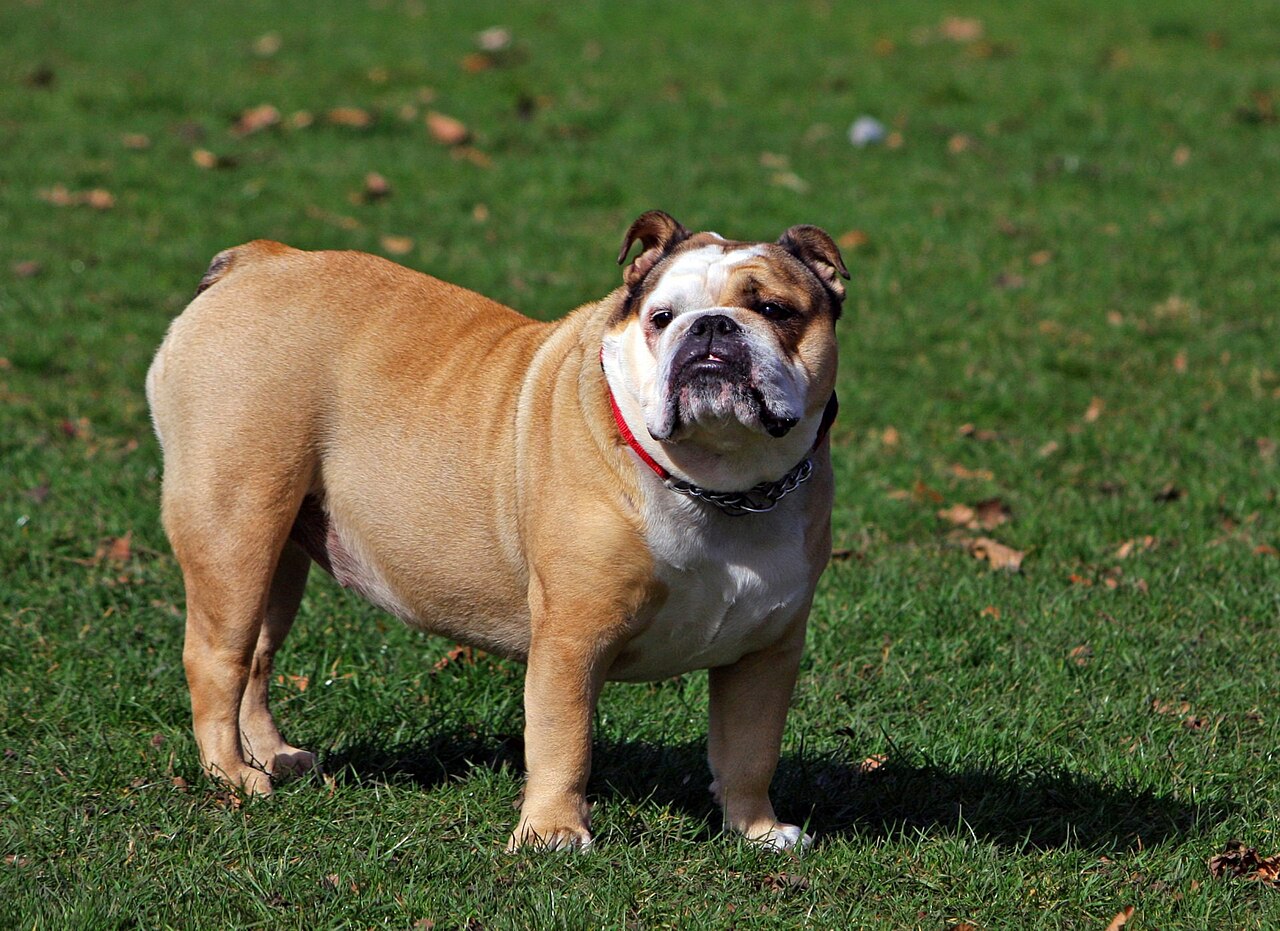
The English Bulldog is a medium-sized, short, wide and very muscular dog, with a center of gravity attached to the ground that gives it that characteristic gait.
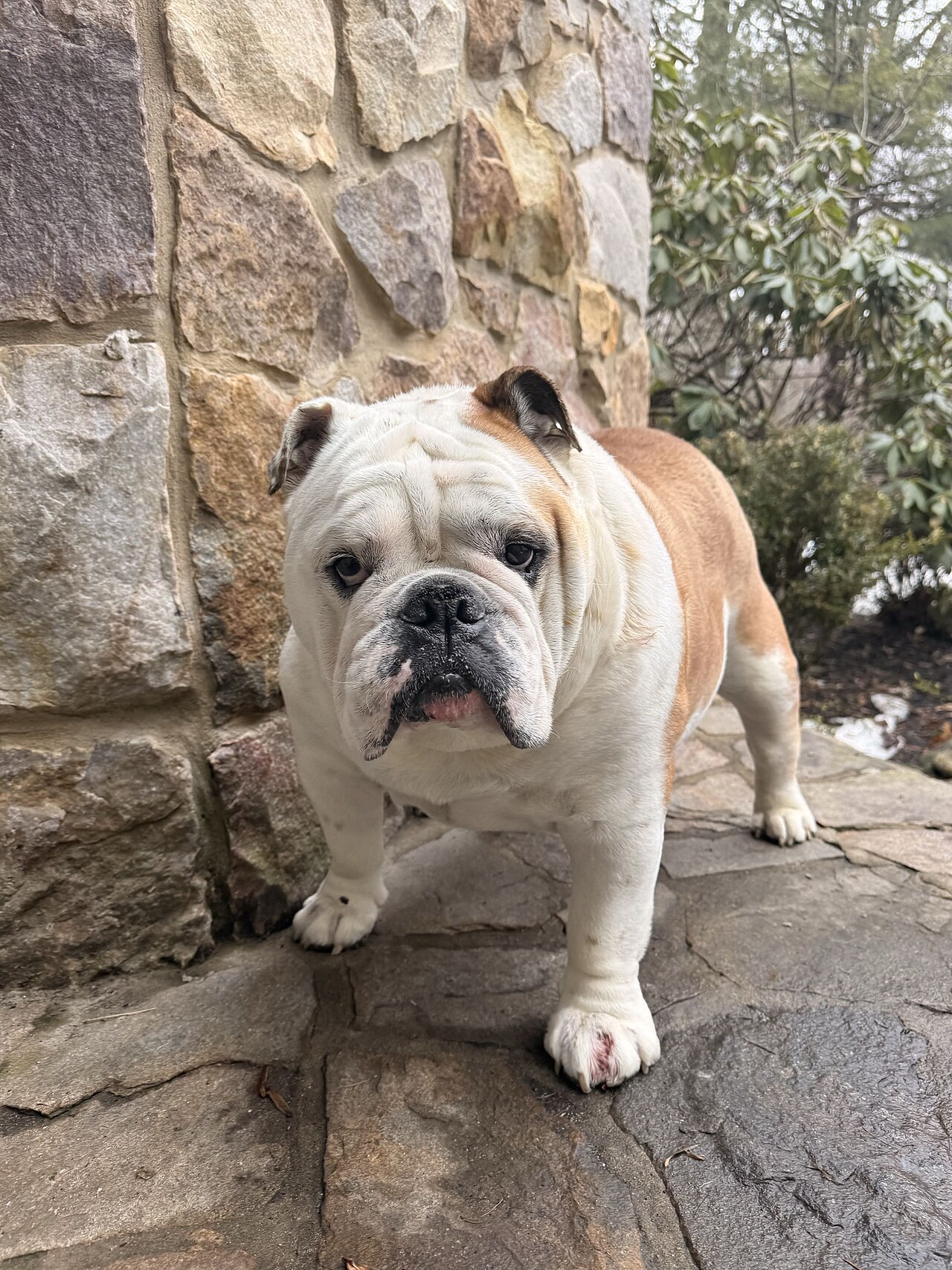
His face is unmistakable: thick folds of skin on the forehead, black, round, large and widely separated eyes, a short snout with a marked fold above the nose, dangling paw under the neck, drooping lips and the typical prominent lower bite (mandibular prognatism), with the jaw slightly upward. The tail is naturally short and may fall straight or curl into the shape of corkscrews; a long, erect tail is considered a defect.
The coat is short, smooth, and thin, in colors such as red, fawn, white, brindle, and piebald, as well as combinations of these. Black as the predominant colour is not accepted. In terms of weight, in their native United Kingdom the standard puts males at around 25 kg and females at around 22-23 kg, while in the United States the figures are somewhat lower (about 23 kg for males and 18 kg for females).
Origin and history
The English Bulldog is native to England and belongs to the molose group, mastiff-type dogs. His name, which means “bull dog”, says all about his past: Their ancestor, the Old English Bulldog, was employed in the bull-baiting, a cruel “sport” in which the dog was thrown against a tied bull to be held by the muzzle. The first written mention of the word “bulldog” dates back to the early 16th century.
It should be pointed out that the bulldog of old did not look like the bulldog of today: it was a lighter, athletic and longer-legged animal, much closer to a boxer than the chubby dog we know today.
Everything changed in 1835, when bull-baiting was banned in England by the Animal Welfare Act. The bulldog lost its original function and, instead of disappearing, was transformed. By crossing with other breeds – including the pugs, from which it inherited its flat snout and compact musculature – the modern companion dog was shaped. In 1875 the club of the breed that still exists today was founded, in 1886 it was recognized by the American Kennel Club and by the end of the 19th century it was already fully established as a pet. Along the way, the bulldog left its genetic imprint on breeds like the the bullmastiff, the boxing and the bull terrier.
Curiosities
- It is one of the national symbols of England, associated with courage and determination.
- During World War II, Prime Minister Winston Churchill was compared to a bulldog for his firm stand against Nazi Germany.
- It is the favorite pet of countless universities and sports teams: Handsome Dan (Yale), Uga (University of Georgia) or Chesty (U.S. Marine Corps), among many others.
- Movies and TV are full of bulldogs: Spike, the dog from Tom and Jerry; Hector, from Looney Tunes; or Luiz, from the movie Rio.
- It is one of the few breeds with a naturally short and curly tail, without the need to cut it off.
- Despite its reputation for toughness, today’s bulldog could no longer do the job it was born to do – it could neither race nor grab with such a short snout.
If you are attracted to the molosoid character and want to compare before deciding, take a look at other related or similar-looking breeds: the Bulldog Francés, its small and also brachycephalic cousin; the Bulldog Americano, more athletic and larger; the Bóxer, a direct descendant of those ancient bulldogs; and the Carlino, which shares with it the flat face and the camping character.
Frequently Asked Questions About the English Bulldog
Is the English Bulldog an aggressive dog?
No. Although its ancestor was a fighting dog, the modern English Bulldog has been bred to be quite the opposite: gentle, peaceful and not aggressive. The standard describes it as an equitable dog, brave but neither vicious nor violent, and usually gets along well with people, children and other animals.
How long does an English Bulldog live?
British studies place its life expectancy between about 7.4 and about 9.8 years, with a median of about 8 years.Keeping it at its weight, avoiding heat and having regular veterinary checkups helps it live longer and better.
Can he live in a flat?
Yes, it is one of the best breeds to live in an apartment. It needs little space and little exercise, and barks little. The main thing is that the house is well ventilated and cool, because the heat affects it very much.
Why is he snoring and breathing so loud?
Because of their brachycephaly: the flattened skull and very short snout deform their airways and cause snoring, snoring and difficulty breathing.
Is he good with kids?
It is one of his greatest qualities: he forms very strong bonds with children and is patient and affectionate.
How much exercise do you need?
It is not a dog for running or heavy exertion, since its breathing limits intense activity and increases the risk of heat stroke.
Why are so many bulldogs born by C-section?
Because of the shape of their pelvis and, above all, the large size of the head of the cubs, which can get stuck in the birth canal, more than 80% of the litters are born by cesarean section, and reproduction usually requires artificial insemination.
What care do your wrinkles need?
The creases of the face accumulate moisture and dirt, so you need to check and clean them regularly, always drying them thoroughly afterwards. If neglected, dermatitis and skin infections appear. It is the most demanding part of your hygiene.