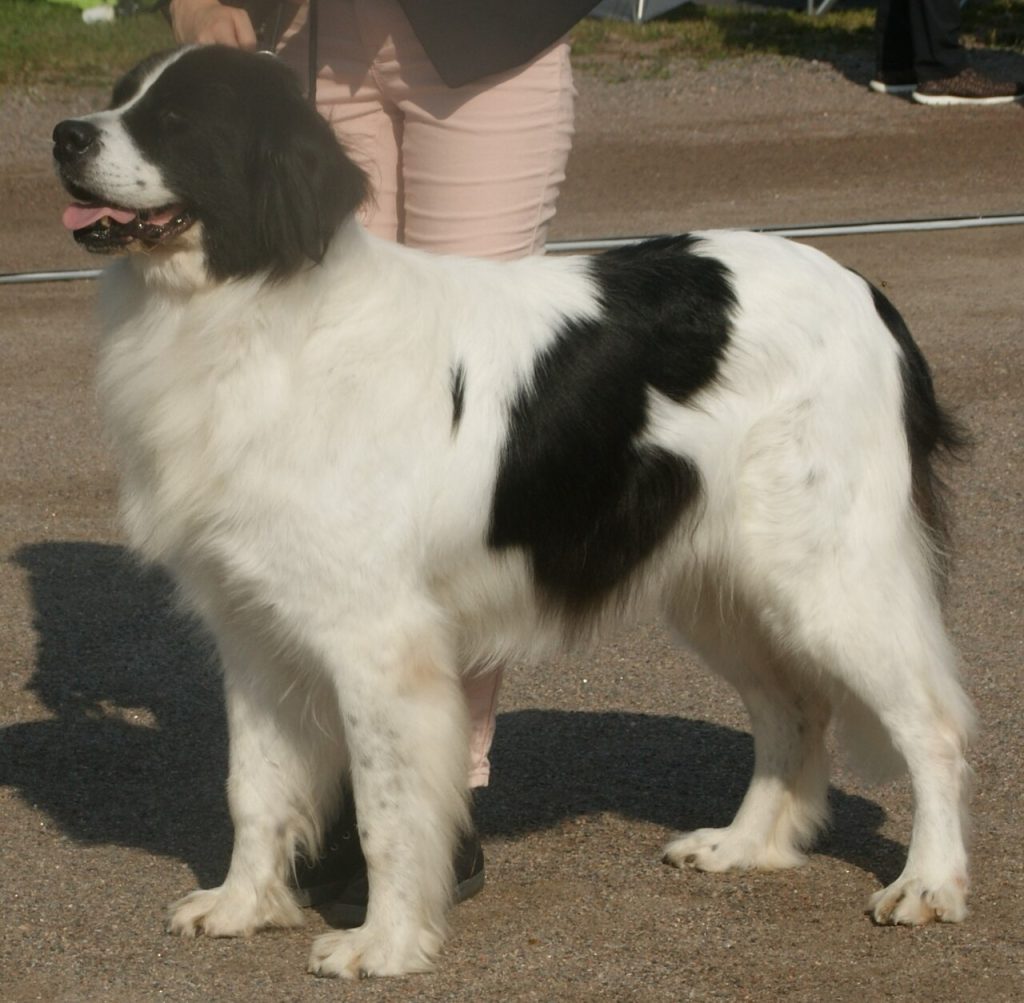
The Landseer is a giant, black and white dog with an imposing appearance and a kind heart. Descended from Newfoundland and recognized by the International Canine Federation (FCI) as an independent breed, it combines an aquatic rescuer’s physique with a calm, family temperament. If you’re looking for a companion who’s huge, docile and a good swimmer, this is one of the most noble dogs out there, but first you need to know what you’re committing to with a 60-pound giant.
Is the Landseer for you?
The Landseer is a wonderful dog, but it’s not for everyone. Its gigantic size, its need for space and its drooling condition very much the coexistence. Before you fall in love with its image, look honestly at the two sides of the coin.

In favour .
- Sweet, balanced temperament and very patient with children.
- Huge rescue instinct and natural affinity for water.
- Little barking and no nerves in the house.
- Very loyal and devoted to his family, without being overly dependent.
- Tolerant of other dogs and pets if socialized well.
To be taken into account
- Giant size: it needs space and doesn’t fit in small floors.
- It drools and sheds a lot of hair, especially on the seedlings.
- Short life expectancy, typical of giant breeds.
- High costs of food, veterinary and medication.
- He’s hardly heat-tolerant because of his double coat and his size.
Character and temperament
If we had to sum up the Landseer in one word, it would be kindness. It is a calm, self-confident and deeply balanced dog, without the slightest gratuitous aggressiveness. Its fame as a “nanny” is no accident: the painter Edwin Landseer, who gave the breed its name, portrayed it again and again pulling children out of the water, and that protective and lifesaving character is still very much alive in the dog today.
He’s a quiet giant who goes unnoticed indoors, at the feet of his people, and rarely barks for no reason. That doesn’t mean I’m apathetic. Outside the home, he is alert, curious and courageous, and in a situation of real danger, he reacts calmly. He enjoys being close to his family and suffers if he is confined to the garden or left alone for too many hours. It is not a watchdog in the classic sense – its instinct is to protect by saving, not by attacking – although its mere presence may deter anyone.
Coexistence: children, other pets, flat and loneliness
With children: is probably one of the best family dogs that exists. Patient, careful and aware of its strength, it tolerates childlike traits with admirable calmness. The only caveat is obvious: a dog of this size can accidentally pull or overturn a small child, so supervision is indispensable, more by accident than by bad intention.
With other pets: has been well socialized since puppyhood, coexisting smoothly with other dogs and cats.
Floor and solitude: here is its big limitation. The Landseer is not a small-floor dog. It needs space to move around and, above all, easy access to walks and stretches. It tolerates life in a house with a garden better, as long as it is part of the family and does not live isolated outside. As for solitude, it’s a dog that needs company: It holds up better than other breeds, but it’s not designed to spend the entire working day alone day after day.
Education and training
The Landseer is intelligent and wants to please, which greatly facilitates its education. It learns quickly with positive reinforcement, rewards, and short sessions; instead, harshness and yelling block it, because it is a sensitive dog that needs trust more than imposition.
The key with a giant is not so much the circus obedience as the management of its size: Teaching him from puppyhood not to jump, to walk on a leash without pulling and to answer a reliable call is non-negotiable, because correcting those habits in a 60-pound adult is very complicated. early socialization– people, noises, surfaces, other animals – is equally important for its balanced character to flourish. With patience and consistency, you will have a polite and pleasant dog; without clear boundaries from the start, a well-meaning elephant difficult to handle.

Exercise and activity
The Landseer has moderate energy, neither high nor low. It is not a dog that needs to run for miles or do high-impact sports – in fact, vigorous exercise during growth harms its joints – but it does require constant daily activity – a couple of long, quiet walks, with opportunities for sniffing and exploring, keep it happy and fit.
Where it really shines is on the water. As a good descendant of Newfoundland, he is an exceptional swimmer, with padded feet and a coat that protects him from the cold. Swimming is the ideal exercise for him: It burns energy, strengthens your muscles and takes care of your joints without straining them. If you can offer him regular access to a lake, a quiet river or the sea, he’ll enjoy it like few. Watch the heat: In summer, you should avoid exercise in the middle of the day.
Care: fur and hygiene
The Landseer’s coat is long, dense, finely textured and undercoated, requiring constant maintenance. brush it two or three times a week. is suitable to avoid knots and tangles, and daily during spring and autumn mowing, when it loses hair in abundance. Pay attention to areas prone to shedding: behind the ears, armpits and the back of the thighs.
It does not need frequent bathing; with its self-cleaning coat, it is enough to bathe it when it is really dirty, using specific shampoos and drying it well to prevent moisture on the skin. Complete hygiene with regular ears checkup (large and drops, retain moisture), toenails cutting and dental care. And an important warning: the Landseer babies, especially after drinking or eating, so having a cloth on hand is part of life with this breed.
Foodstuffs
During growth, which lasts up to two years, a specific feed for large/giant breeds, with a controlled intake of calcium, phosphorus and energy, is essential; overfeeding a Landseer puppy to grow quickly is one of the worst mistakes, because it favors bone and joint problems.
In the adult, the ration is adjusted to their weight, age and activity level, always divided into two meals a day instead of one copious. This distribution, along with avoiding exercise just before and after eating, helps reduce the risk of gastric torsion, a frequent urge in deep-breasted dogs. Maintaining a balanced weight, not being overweight, is the best investment to protect your joints and prolong your life.
Health and life expectancy
Like all giant breeds, the Landseer has a rather short life expectancy, around 9-11 years of age. It is a generally robust dog, but shares the pathologies typical of its size, so choosing a serious breeder who performs breeder health testing makes a big difference.
Health issues to be monitored are mainly:
- Hip and elbow dysplasia: hereditary joint disorders, strongly linked to puppy development and adult weight.
- Gastric torsion or dilation: urgency of life associated with deep chest; its symptoms should be known.
- Heart problems: as in many giants, the heart deserves regular checkups.
- Muscular dystrophy: has been identified in the breed as a form bound to the COL6A1 gene, which has even served as an animal model of Ullrich’s congenital muscular dystrophy in humans.
Regular veterinary checkups, weight control, moderate exercise during growth and a good breeding line are the best tools for your Landseer to live his years with quality.

Physical appearance
The Landseer is a giant and harmonic dog, of lighter build and longer legs than its relative the Newfoundland. The males measure between 72 and 80 cm to the cross and the females between 67 and 72 cm, with weights usually around 50-70 kg.
The most distinctive feature is its cloak: white with black spots well defined. The ideal according to the standard is a black head with a white stripe on the snout, a white background body with black markings on the back and rump, and white limbs and tail. The hair is long, smooth or slightly wavy, dense and water-resistant, with undercoat. The head is noble, with a sweet expression, medium and low ears, and friendly-looking eyes. He also has the palmed feet s that give up a born swimmer.
Origin and history
The story of the Landseer begins on the shores of Newfoundland and Labrador, Canada, where fishermen used large water dogs to tow nets and assist in seafaring. They are believed to be descended from water and livestock guard dogs carried by Portuguese and Basque fishing boats. In the Victorian era, black-and-white specimens were more popular than solid blacks, and several 19th-century artists immortalized them. The most famous was the British painter Sir Edwin Landseer, whose paintings of these dogs rescuing people from the water were so famous that, as early as 1896, black and white Newfoundlanders began to be called “landeners”.
In the 20th century, the black variety gained ground until it almost supplanted the white-black variety. In the 1930s, a group of breeders on the European continent undertook a conscious effort by recreate the dog from Landseer’s paintings. By crossing black and white Newfoundlanders with livestock guard dogs, they obtained a taller, lighter, longer-headed specimen. In 1960 a specific club for these dogs was created in Germany, soon followed by clubs in Belgium and the Netherlands. The FCI eventually recognized the Landseer (continental-European variety or “ECT”) as separate breed from Newfoundland. In contrast, in Britain, North America, and Canada, landseer dogs are still considered a simple Newfoundland breed, identical in conformation to the black.
Curiosities
- The it owes its name to a painter. breed, Sir Edwin Landseer, and not to a place or breeder: a rare case in canine science.
- Peter Pan‘s dog Nana, according to J. M. Barrie’s original text, was a Newfoundland; the film Descubriendo Nunca Jamás(2004) showed precisely a Landseer as the writer’s pet.
- His palmed feet and his raincoat make him such a capable swimmer that he has historically been employed in water rescues.
- A 2015 study identified in Landseers a form of muscular dystrophy linked to the COL6A1 gene, which turned out to be an animal model very close to a human congenital muscular disease.
- Outside the European mainland, a Landseer and a black and white Newfoundland are officially same dog with two names.
If you are attracted to the Landseer because of its gigantic size and noble character, you may be interested in other large, aquatic or temperamentally balanced breeds. Start with its direct relative, the Terranova, and compare it to the Swiss giant par excellence, the San Bernardo. If you’re looking for a large, white, dense-coated dog but somewhat more manageable, look at the Samoyedo, and if you throw in the rescue instinct and love of water, no dog combines docility and willingness to swim like the Golden Retriever.
Frequently asked questions about the Landseer
Are the Landseer and the Newfoundland the same breed?
The FCI recognizes the Landseer (continental-European variety) as an independent breed, taller and lighter.
How long does a Landseer live?
Like most giant breeds, its life expectancy is relatively short, around 9-11 years.
Is he a good family dog with kids?
Yes, it is one of the best. Its gentle, patient and protective temperament makes it ideal with children. The only precaution is its size: it can accidentally overturn a small child, so supervision is always recommended.
Can he live in a flat?
It’s not ideal. It’s a giant dog that needs space to move around. It can adapt to indoor life if it’s part of the family and has daily walks and places to stretch, but a small floor is not its habitat.
Does the Landseer drool and shed a lot of hair?
Yes to both. It drools mainly after drinking or eating, and sheds a lot of hair, especially during spring and autumn moulting. It needs brushing several times a week and daily during moulting.
How much exercise do you need?
Moderate energy: a couple of long, quiet walks a day are enough. Its ideal exercise is swimming, which takes care of its joints. During growth, intense exercise should be avoided, and in summer the hottest hours.
Where did the name “Landseer” come from?
From the British painter Sir Edwin Landseer, who in the 19th century insistently portrayed these black-and-white dogs rescuing people from the water.
Is he a good guard dog?
Their instinct is to protect by saving, not attacking, so they’re not aggressive guards, yet their imposing size and barking are self-deterrent, and they’re loyal and attentive to what’s going on with their family.