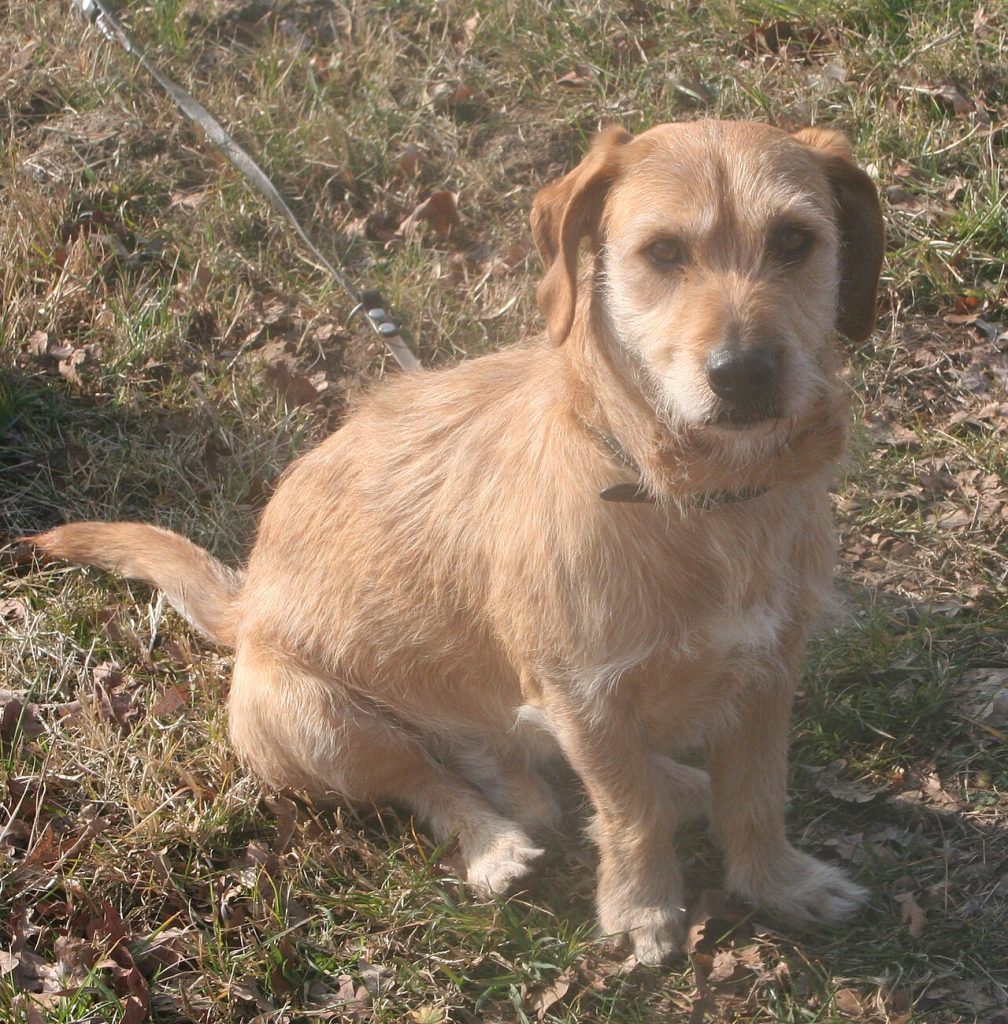
The Basset Leonid of Brittany is a short-legged, hard-coated, lion-colored French hound that hides, in a small, robust body, the heart and nose of a tireless hunter. Originally from Brittany, it combines enormous energy with a cheerful and sociable nature that has made it both a hunting dog and a family companion. If you’re looking for a dog with personality, good sense of smell, and a manageable size, the Leonad Basset of Brittany deserves to be thoroughly introduced.
Is the Basset Leonad of Brittany for you?
Before you fall in love with his gaze and curly hair, it’s good to know which dog you’re about to meet. The Breton Basset Lion is a hunting dog adapted to home life, not a couch dog that casually goes for a walk. This dual nature explains almost all of its virtues and almost all of its challenges.
In favour .
- Comfortable and manageable size, ideal for homes with or without a garden.
- Cheerful, sociable and balanced; good with children and other dogs.
- Rustic breed, hardy and generally healthy and long-lived.
- Hard hair that repels dirt and doesn’t require constant styling.
- Smart, alert and highly motivated by food and smell.
To be taken into account
- Strong hunting instinct: he can shoot out after a trail.
- Independent and stubborn; the so-called anchor ladder.
- Barking and powerful voice, typical of the hound.
- He needs real daily exercise and stimulation.
- Requires stripping a couple times a year to maintain the mantle.
In short, it’s a great companion for someone who enjoys long walks, the outdoors, and sniffing games, and who doesn’t expect a 100% obedient dog outside the house.
Character and temperament

The temperament of the Basset Leonad de Bretagne is one of its greatest attractions. The standard itself describes it as a passionate hunter who, at the same time, is an excellent companion to man: sociable, affectionate and stable in mood. He is a cheerful, alert and curious dog who experiences the world through his nose and enjoys both a field day and a quiet afternoon with his family.
This gentle part of the dog’s personality is strongly marked by its courage, determination and tenacity, qualities that make it uncompromising in the mountains, while at home it is quite stubborn. It is neither afraid nor nervous; on the contrary, it is usually confident and balanced, which makes it pleasant to be around.
As a pack dog, it tends to get along well with other dogs and enjoy company. It is not a one-owner dog or overly dependent, but it is very sociable and participatory: it will want to be where the action is. Understanding that its independence is not disaffection, but heritage of its work, is key to getting along with it.
Coexistence: children, other pets, flat and loneliness
With children. The Breton Lion Basset is usually an excellent family dog. Its cheerful character, tolerance and medium size make it a good playmate, always with the usual supervision and respect for any dog. It is robust and not fragile, something that is appreciated by households with small children.
With other dogs. is a naturally occurring breed that enjoys the company of other dogs and rarely seeks conflict. With cats and other small pets, things change: their hunting instinct can be activated, so early socialization and caution are essential, especially with running animals.
On the floor. can live perfectly in an apartment if it gets the exercise it needs. At home it is quiet and unpretentious. The great nuance is its voice: it is a barking hound, with a characteristic howling, so it is advisable to work early on the management of the barking so as not to have problems with the neighbors.
In the face of solitude. is a sociable dog that prefers not to spend too many hours alone. It tolerates loneliness better if it has canine company and if it is left well tired and entertained, but households that spend the whole day outside should be organized so that it does not get bored or develop anxiety.
Education and training
Training a Basset Leonad of Brittany is an exercise in patience and good humor. It’s an intelligent dog that understands what’s asked of it quickly, but it’s also deeply independent: He’ll decide for himself if it’s worth it to obey him, especially when there’s a stench in the middle. Do not expect the mechanical obedience of a working dog; wait, instead, for a shrewd companion to be convinced.
Positive reinforcement is, without a doubt, the best path. Food is a powerful motivator for this delicious breed, and short, varied, fun sessions work much better than boring repetition or harshness, which only get you locked in a band. Early socialization with people, dogs, noises, and environments is critical for a safe and balanced adult.
The great workhorse is the call. When the Basset Leonad de Bretagne hooks into a trail, its nose commands over its ears, and it can disconnect from the world for quite some time. That’s why many owners choose to work the call very steadily from a puppy and to keep it on a leash or in safe areas when the environment is not fenced.
Exercise and activity
Don’t be fooled by their short legs: the Breton Lion Basset is a hunting dog with remarkable energy and endurance for its size. It needs daily quality physical activity, not a couple of hygienic outings. One or two long walks, with time to sniff and explore at its own pace, are the foundation of its well-being.
In addition to physical exercise, this dog needs mental gymnastics. Smelling games, foraging, sports tracking, and any activity that puts its nose to work leave it satisfied and balanced. A Basset Leonado of Brittany that channels its instinct is a quiet dog at home; a bored one can become barking, destructive, or escapist.
It is an ideal dog for active people who like to walk in the countryside or the mountains. It is not a high-speed long-distance runner, but it is a tireless walker and an enthusiastic tracker.
Care: fur and hygiene
The coat of the Basset Leonad de Bretagne is one of its hallmarks: hard, dense and rough to the touch, the classic wire coat. It has a great practical advantage: it repels dirt and mud and does not soften easily, so it does not require the constant maintenance of other breeds.
To preserve the texture and color of the hard hair, the dead hair must be removed by shaving or stripping a couple of times a year, rather than by machine-shearing, which would soften the coat and fade its color. Many owners learn to do it themselves or resort to a specialized dog barber.
The rest of the hygiene is the usual, with special attention to the ears: being long and fallen, they retain moisture and dirt, so it is advisable to check and clean them regularly to prevent otitis.
Foodstuffs
The Basset Leonado of Brittany is an extraordinarily gluttonous dog, a trait very useful for training but dangerous to its line. As a good hound, it will eat with enthusiasm anything offered to it, so control of rations and prizes is essential to avoid overweight, which in a long-bodied dog especially punishes the back and joints.
A balanced and quality diet, adjusted to your age, weight and activity level, is the best basis. It is advisable to divide the daily ration into two servings and weigh the food instead of calculating by eye. Sweets used in training should be discounted from the total of the day so that they do not become a silent excess of calories.
As with any breed, it is wise to follow the recommendations of the veterinarian and monitor the condition of the body regularly: you should be able to feel its ribs without them sticking out and appreciate a defined waist seen from above.
Health and life expectancy
The Basset Leonad de Bretagne is, as a whole, a rustic, healthy and hardy breed, with a life expectancy that is usually between 12 and 15 years.
The most significant hereditary problem is ocular: the Basset Leonad de Bretagne is among the breeds most affected by primary open-angle glaucoma, a painful disease that can lead to blindness.A recessive mutation of the ADAMTS17 gene has been identified as responsible, allowing responsible breeders to perform genetic and eye tests to reduce its incidence.
In addition, regular prevention is recommended: weight control to protect the puppy’s elongated back, cleaning of dropped ears to prevent otitis, dental hygiene, and a daily schedule of vaccination and deworming.
Physical appearance

The Basset Leonado of Brittany is a small, compact and muscular basset, built with the same lines as the Basset Hound but lighter overall and with slightly longer legs. The FCI standard sets the ideal height of the cross between 32 and 38 cm, and its weight is around 11 to 16 kg. It is, in fact, the shortest back among the bassets, so it is less exaggerated than the British basset.
Its most characteristic feature is the mantle: hard, dense and rough hair, lion-colored throughout its range, from red wheat to gold, sometimes with some small white mark on the chest. The hair on the ears is shorter, finer and darker than that on the body.
The head is elongated, with little marked stop, dark eyes of vivid expression and black truffle. The body is robust and well-anchored, with strong limbs; the standard prefers front legs as straight as possible, without the exaggerated torsion of other bassets. The result is an agile and fast dog for its size, made to move over difficult terrain.
Origin and history

The Basset Leonad de Bretagne comes, as its name suggests, from Brittany, the former duchy of northwestern France, a land of low mountains, heath and spiny terrain that modeled a rustic and resistant dog.
The breed was, according to a widely repeated version, close to extinction after World War II, and would have recovered by crossing the surviving specimens with hard-haired teckels. The French club, however, denies that story and maintains that Basset Leonado of Brittany’s number never got this low. Either way, the race was consolidated: In 2002 there were 1,060 new cases in France alone.
Outside of its country, its range has been more discreet. In the United Kingdom it is known primarily as an exhibition and companion dog, and did not leave the Kennel Club’s rare breed registry until 2007, with fewer than 140 annual registrations.
Within the FCI nomenclature, the Basset Leonad de Bretagne belongs to Group 6 (hound-type dogs and similar breeds), in the section of small-sized hounds, and is used to hunt rabbit, hare, fox, roe deer and even wild boar, proof of its courage and tenacity above what its size suggests.
Curiosities
- Its name says it all: fauve means leonado in French, hence the “leonado” of its Spanish name, in reference to its characteristic reddish color.
- It is the shortest basset back of all, so it is less exaggerated and more functional than other short-legged cousins.
- He is descended from a larger, now extinct hound, the Grand Fauve of Brittany, whose colour and character he retains.
- Despite its size, it is able to follow the trail of wild boar, a larger game normally reserved for much older dogs.
- Their hard hair is almost self-cleaning: the mud dries and falls off by itself, an inherited advantage of their work among the thorny brush.
- It is a relatively rare breed outside France, making it an uncommon and striking dog in parks and exhibitions.
If you are attracted to this French hound, you may want to compare its temperament and care with that of other trail and short-legged breeds. We recommend that you take a look at the Basset Hound, its most famous relative; the inexhaustible Beagle, another sociable and tasty hound; the incomparable tracker Bloodhound; and the versatile Dachshund or dachshund, with whom it shares history and short legs.
Frequently Asked Questions about the Basset Leonad of Brittany
Is the Leonad Basset of Brittany a good family dog?
Yes. The Leonado Basset de Bretagne is a sociable, cheerful and well-balanced hound that enjoys human company and gets along well with children and other dogs, especially if socialized as a puppy. Its manageable size and gentle nature make it a good family companion, as long as its hunting instinct and need for daily exercise are taken into account.
How tall and how much does a Basset Leonad of Brittany weigh?
According to the FCI standard, the ideal height for the cross is 32 to 38 cm, with a tolerance of one centimeter above or below. The weight is around 11 to 16 kg depending on sex and complexion.
How long does a Basset Leonad of Brittany live?
Its life expectancy is usually between 12 and 15 years. It is a rustic breed and, according to a 2006 study, with a low coefficient of consanguinity, which helps its general health.
Is it difficult to train the Basset Leonad of Brittany?
It is intelligent and quick to learn, but also independent and stubborn, like a good tracking dog. It is not the easiest dog for a beginner demanding in obedience, although with positive reinforcement, patience and constancy it responds very well. The main challenge is the call when it catches an interesting smell.
Is the Basset Leonad of Brittany adapted to living in a flat?
Yes, it can live on the floor if it gets enough exercise and daily stimulation. It is quiet at home once its activity is covered. It must be borne in mind that it is a barking dog with a powerful voice, so it is advisable to work on the management of the barking and not leave it alone for too many hours.
How much exercise does the Basset Leonad of Brittany need?
It needs daily activity of good quality: one or two long walks, olfactory games and exploratory moments. It is a hunting dog with a lot of energy and endurance for its size, so a couple of short laps around the apple is not enough for it. Tracking work and mental games satisfy it as much as physical exercise.
What care does the hair of the Basset Leonad of Brittany need?
Its coat is hard, dense, and rough (wire hair). It repels dirt and does not grind easily, but requires weekly brushing and, above all, hand-arranging or stripping a couple of times a year to remove dead hair and maintain texture.
Does the Basset Leonad of Brittany have frequent health problems?
In general, it is a healthy and rustic breed, but it is among the most affected by primary open-angle glaucoma, linked to a recessive mutation of the ADAMTS17 gene.