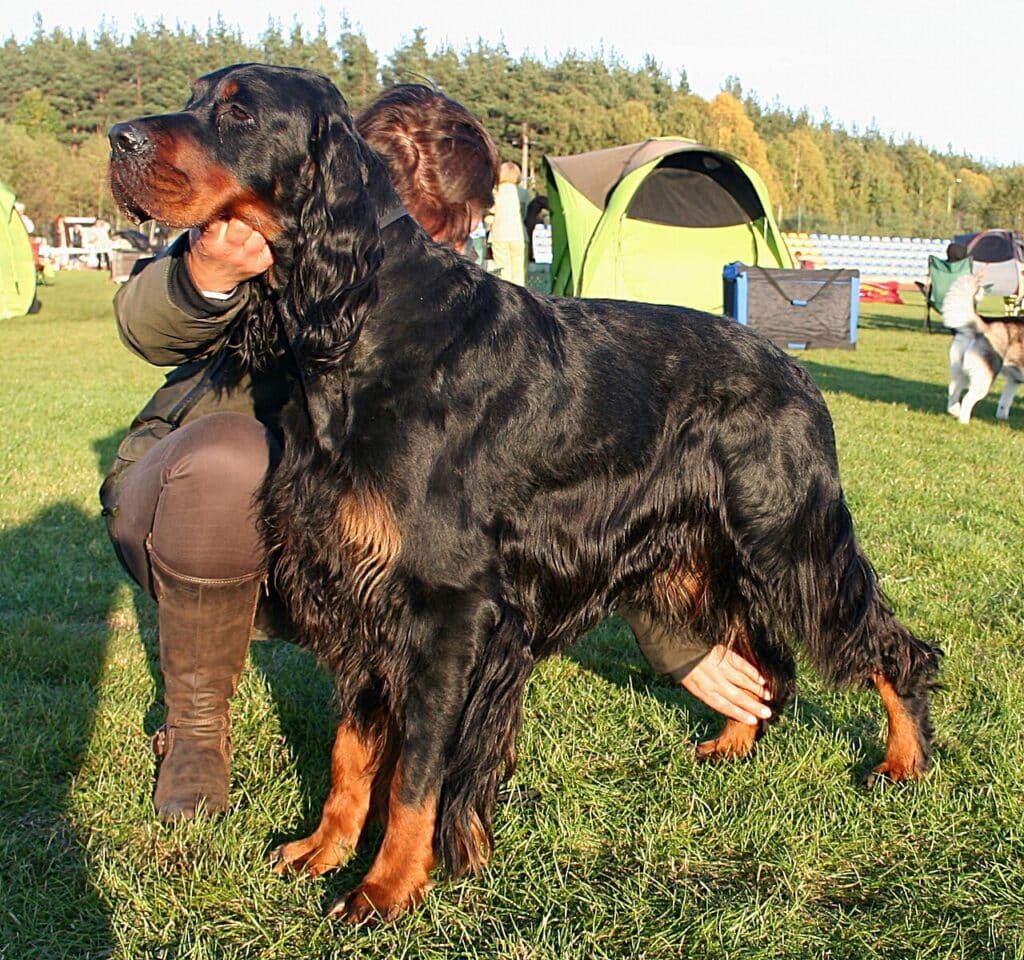
The Setter Gordon is the largest, heaviest and strongest of the three British setters, and the only black dress with fire marks. Born in the Scottish Highlands as a show dog for bird hunting, today he is above all a loyal, sensitive and hardworking family companion. If you’re looking for a dog that’s stylish, athletic and deeply attached to its owners, the Gordon Setter deserves to be thoroughly introduced.
Is the Setter Gordon for you?
The Setter Gordon is not a dog for any household. It is large, energetic and extremely sociable, and needs time, space and movement. Before you fall in love with its elegant black coat and fire, you should be honest about what it asks in return for its devotion.
In favour .
- Uncommon loyalty: He devotes himself completely to his family.
- Smart and eager to please, very rewarding to train.
- Athletic and resistant: great companion for running, routes and canine sports.
- Sensitive and empathetic, he really connects with people.
- Noble and showy cloak, unique among the setters.
To be taken into account
- He needs 60-80 minutes a day of vigorous exercise.
- It matures very slowly: years of puppy-like, boisterous behavior.
- He doesn’t like prolonged solitude; he wants to be with you.
- Strong hunting instinct: tracks and leaves if there’s no fence.
- Long hair with fringes requires constant brushing.
Character and temperament
The American Kennel Club describes the Setter Gordon’s character as “alert, interested, and confident; fearless and willing, intelligent and capable; loyal and affectionate, and strong enough to withstand the rigors of training”.
Above all, the Setter Gordon is intensely loyal. It thrives in a caring and affectionate environment, and returns that affection abundantly. It is a sensitive and empathetic dog, which perceives moods and resists tension or harshness. That sensitivity makes it wonderful as a companion, but it also implies that it is not a dog to be left out.
Another defining trait is its slow ripening: it is one of the dogs that takes the longest to become an adult and does not reach its fullness until three years or more, retaining puppy attitudes until well into maturity.
Coexistence: children, other pets, flat and loneliness
- With children: is patient and affectionate by nature and is usually a good family dog. However, as a puppy and as a youngster it is quite noisy, so with very young children it is advisable to supervise play to avoid pushes or falls.
- With its strong bird instinct, birds and small animals can awaken its hunting impulse, so early socialization helps a lot.
- On the floor: is not its ideal habitat. It is a large dog designed for the countryside; it can adapt to living on the floor if it strictly meets its exercise quota, but it will be much more comfortable in a house with a fenced garden.
- In the face of loneliness: his attachment is so strong that it is not good to spend many hours alone. If he is often left without company or stimulation, he may get bored and frustrated. He needs to be part of the day-to-day of the house.
- Security outside: by its tracking instinct, should not go loose unattended: it can follow a smell and move away until it gets into a dangerous traffic situation.
Education and training
The Gordon Setter is intelligent and eager to learn, which makes it very grateful to train. The key is to understand its character: it is a sensitive dog that needs firm but kind treatment. Positive reinforcement – rewards, play, cheerful voice – brings out the best in it; harsh methods, on the other hand, block it and undermine its confidence.
The early socialization and basic obedience from puppyhood are essential, especially in such a large and active breed.
Patience is your best tool; a well-guided Gordon becomes a well-behaved, reliable, and enjoyable dog.
Exercise and activity
There are no shortcuts here: the Setter Gordon was raised to run and needs between 60 to 80 minutes of vigorous exercise a day. It is not enough for a quiet walk to the block; it wants to gallop, trail, explore and really spend its considerable energy.
Smell games, collecting, training, and mind-body activities keep him balanced. A bored Gordon finds his own entertainments almost never welcome.
An important note with the puppies and young dogs: it is not advisable to over-exercise them or start agility until they are at least 18 months old, so as not to strain some joints that are still forming.
Care: fur and hygiene
The coat of the Setter Gordon is long, soft and shiny, smooth or slightly wavy (never curly), with characteristic fringes in the ears, chest, belly, back of the legs and tail.
The ideal is brush it several times a week to prevent the freckles from entangling and forming knots, paying attention to the ears and rubbing areas. A more thorough review and, if necessary, an occasional arrangement of the areas with excess hair keep the dog comfortable and clean.
Complete the routine as usual – checking and cleaning your ears (hairy ears retain moisture), cutting your nails, taking care of dental hygiene, and monitoring your eyes and pads.
Foodstuffs
As a large, active and athletic dog, the Setter Gordon needs a complete and quality diet, adjusted to its size, its age and its actual activity level. A working or very athletic specimen burns much more than one of a quiet life, and the ration must reflect this to keep it at a healthy weight, without overweight that burdens its joints.
Since the is a large breed with a deep chest, it is advisable to take precautions against the gastric torsion: divide the food into two servings a day instead of one, avoid eating with anxiety and do not exercise vigorously just before or after eating.
Health and life expectancy
The Setter Gordon is, in general, a robust and healthy dog, with a life expectancy of about 10 to 15 years; a British study from 2024 placed the average age of the breed at around 12.4 years.
- Dysplasia of the hip: less common than in other large breeds, but present; good breeders examine the breeders.
- Gastric torsion (swelling): veterinary emergency typical of large deep-chested dogs; its symptoms should be known.
- Hipotiroidismo: a hormonal disorder that is diagnosed analytically and well controlled with treatment.
- For the most common form of APR in the breed (rcd4) there is a DNA test, very useful when choosing a breed.
Choosing a responsible breeder who performs the recommended health tests, keeps updates on vaccinations and check-ups, takes care of your weight, and gives you the exercise you need are the best guarantees of a long, healthy life.
Physical appearance
The Gordon Setter is the biggest and heaviest of the three setters., with a more robust structure and a stronger bone than the English or Irish setter.
Its most recognizable feature is the coat: black witch hazel with fire marks of a thick chestnut or mahogany, perfectly delimited. It carries a fire spot over each eye, on the snout and throat, two spots on the chest and fire in the lower legs. A small white spot is admitted on the chest. The hair is long and silky, with abundant freckles. Its bearing, the standard says, is “intelligent, noble and dignified”.
In terms of size, the female measures about 61-69 cm at the withers and weighs about 25-36 kg; the females, slightly smaller, are around 58-66 cm and 20-32 kg. The set is that of an elegant and athletic dog, clearly more massive than its relatives setters.
Origin and history
The Setter Gordon is a scottish breed , developed as a show dog for bird hunting from the old setters – themselves descendants of the old show spaniels . Its function was to locate the piece by smell and remain motionless “as a sample”, marking its position until the hunter arrived. In Scotland it was used with partridge, urogallo, pheasant, lagopod or beaked, among other birds.
The breed owes its name to Alexander Gordon, 4th Duke of Gordon(1743-1827), who established his famous black and fire setter kennel at Gordon Castle, near Fochabers, in north-east Scotland, popularizing the type in the late 18th century. For a long time they were known simply as “black and fire setters”; in fact, there is evidence that in the time of the duke many of those dogs were tricolor (black, white and fire) rather than pure black and fire.
The breed crossed the Atlantic in 1842, when George Blunt and statesman Daniel Webster bought two specimens, Rake and Rachel, from the Duke’s kennels. The American Kennel Club officially recognized her as 1892, and The British Kennel Club fixed the current name of “Gordon Setter” to 1924. With the modernization of hunting in the 20th century, the role of the show dog was giving way and today the Gordon is, above all, an appreciated companion and exhibition dog, while still preserving its working instinct.
Curiosities
- It is the only one of the three setters with black and fire cover; for years it was simply called the “black and tan setter”.
- It’s also the bigger, heavier and slower of the setters, but that solidity translates into great endurance.
- It is one of the dogs that they mature later.: retains its puppy side until three years or more.
- It came to America from the hand of Daniel Webster, one of the great American political figures of the 19th century.
- Two Gordons have achieved the demanding title of Dual Champion(beauty and track champion): the female Amscot Irresistible Belle, “Trisca”, and her relative Boyers Scarlatti.
- He belongs to the Group 7 of the FCI(sample dogs), section of British and Irish setters.
If you are attracted to the Gordon Setter, you may be interested in other breeds from the same family and cinematic world: the lively Setter Irlandés and the elegant Setter Inglés, its closest relatives; the tireless Pointer, another great show dog; and the English Springer Spaniel, the heir of the spaniels from which all setters descend.
Frequently Asked Questions about the Setter Gordon
Is the Setter Gordon a good family dog?
Yes. It is loyal, affectionate and very attached to its own, and enjoys being part of family life. It is worth noting that as a puppy and as a youngster it is noisy and takes time to mature, so in homes with very young children you have to supervise play. With space, exercise and company, it is an excellent companion.
How much exercise does a Setter Gordon need?
Between 60 and 80 minutes of vigorous exercise a day. It was bred to run and track for hours in the field, so it needs to expend real energy: long walks, running, smelling and playing. Young dogs should not be overloaded or start agility before 18 months to protect their joints.
How long does a Setter Gordon live?
Their life expectancy is around 10 to 15 years. A British study from 2024 placed the average age of the breed at around 12.4 years, a figure very similar to that of all purebred dogs.
What color is the Setter Gordon?
It is the only one of the three setters with this black coat and fire. It is the only one of the three setters with this black coat and fire.
Does the Setter Gordon shed a lot of hair?
It has long, silky hair with abundant freckles on its ears, chest, belly, legs, and tail. It shaves moderately and, above all, those freckles tend to tangle, so it needs brushing several times a week to avoid knots and keep the coat clean and shiny.
Is it easy to train the Setter Gordon?
It is intelligent and eager to learn, but it is also sensitive and slow to mature. It responds very well to positive reinforcement and firm but kind treatment; instead, harshness blocks it. Early socialization and obedience are key, and it is advisable to arm yourself with patience because it retains puppy attitudes for years.
Can the Setter Gordon live on one floor?
It is not his ideal environment. It can adapt to a floor if it is guaranteed its 60-80 minutes daily of intense exercise and companionship, but it is a large, active and thought for the field dog. A house with a fenced garden and easy access to open areas fits much better with its nature.
What health problems does Setter Gordon have?
In general, it is a robust dog, but it is advisable to monitor for hip dysplasia, hypothyroidism, gastric torsion (swelling) and eye diseases such as progressive retinal atrophy and cataracts.
Why is his name Setter Gordon?
For a long time they were known simply as “black and fire setters”; The British Kennel Club fixed the official name of “Gordon Setter” in 1924.