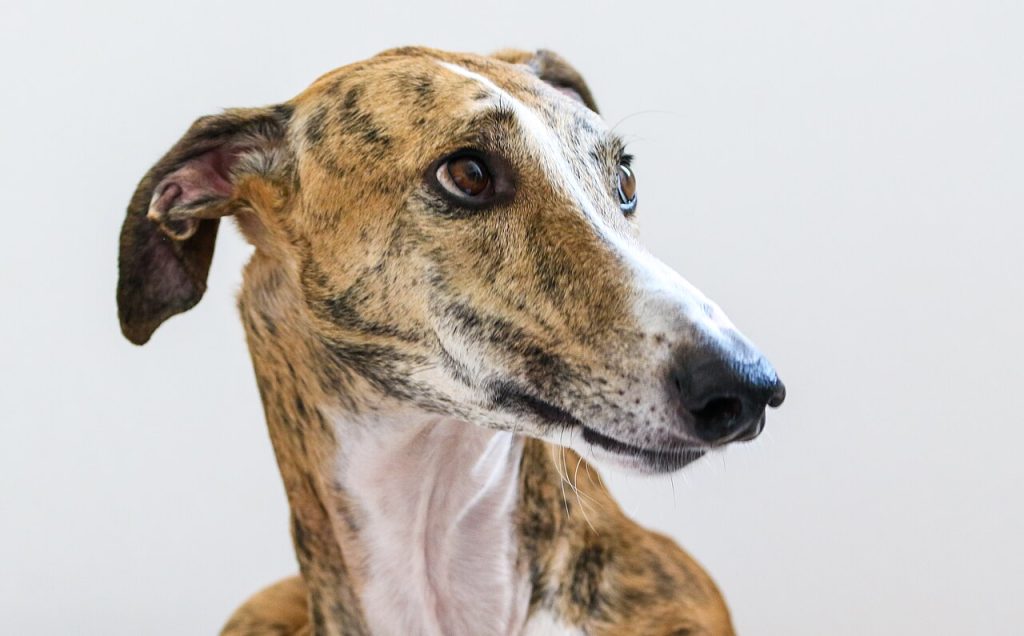
The Galgo Español is the native hare of the Iberian Peninsula: a very old, elegant and fast dog, bred for centuries to chase the hare in the open field and today becoming, more and more, a serene and affectionate household companion.
Is the Spanish Greyhound for you?
The Spanish Greyhound is a dog of contrasts: an athlete capable of reaching dizzying speeds who, however, inside the house is one of the most peaceful large dogs that exist.
In favour .
- Quiet, quiet and very sleepy at home: it fits well on the floor.
- Loving, noble and non-confrontational with people and other dogs.
- Short hair that barely requires brushing and loosens a little.
- Rustic and long-lived breed, with few serious hereditary problems.
- He needs less daily exercise than his physician suggests.
- Adopting an abandoned greyhound gives a great companion a second life.
To be taken into account
- Strong hunting instinct: cannot be released unchecked in open country.
- He’s cold-blooded; he needs a coat in winter and a warm bed.
- He may be shy or reserved with strangers and noises.
- He needs a fenced area where he can run at full speed.
- With cats, it depends on the individual and their hunter past.
- Their natural thinness frightens those unfamiliar with the breed.
Character and temperament

Anyone who lives with a Spanish Greyhound soon discovers a charming paradox: The same dog that in the field turns into an unstoppable arrow is, on the couch, one of the most peaceful and silent animals you can have. The greyhound is noble, sensitive and somewhat reserved., more for calm than turmoil. It is neither a barking nor a heavy dog; it tends to spend much of the day sleeping in a cocoon, and it appreciates quiet company more than noisy play.
To his family he is affectionate and loyal, though of a discreet affection: It follows you from room to room, settles in close to you and enjoys the touch without being intrusive. With strangers it is usually shy or cautious at first, especially greyhounds that have had difficult experiences or come from abandonment. This sensitivity, far from being a defect, makes him a dog that responds wonderfully to gentle treatment and trust given over time.
It’s important to understand that beneath that fragile appearance beats an ancient hunter. The Spanish Greyhound has a very strong instinct to chase everything it runs into – hares, rabbits, sometimes stranger cats – and that impulse is part of its essence. It doesn’t make it a dangerous dog, but it does condition how it walks and how it is given freedom.
Coexistence: children, other pets, flat and loneliness
With children: The greyhound is patient and good-natured, and usually gets along well with children as long as they respect their moments of rest. Being a dog that values calmness, it is advisable to teach the little ones not to disturb him while he sleeps and to treat him gently; in return they will receive a sweet and balanced companion.
With other dogs: is sociable and unlikely to conflict, so coexistence with other dogs is usually easy.
Many greyhounds live comfortably with their own house cats, which they learn to consider part of the family. But a greyhound with a strong hunting past can activate its chase instinct with unfamiliar cats or small animals. Gradual, supervised and unhurried introductions are key.
On the floor: As incredible as it may seem for a dog of this size, the Spanish Greyhound is an excellent floor dog. It is clean, quiet and lies down all day; it only asks for its walks and a comfortable corner.
In the face of loneliness: tolerates being left alone for a few hours reasonably well, especially if it has exercised before and has a comfortable bed.
Education and training
The Spanish Greyhound is intelligent and learns well, but it must be educated by understanding its nature. It is a sensitive who can ‘t stand abruptness dog: screaming and harsh methods block it and erode its confidence. With positive reinforcement, rewards, patience and consistency, on the other hand, it cooperates willingly.
The great subject of their training is the call and control of the hunting instinct. No matter how hard you work on obedience, it is very difficult – and in many cases impossible – to guarantee that a greyhound does not shoot out behind a hare or a cat.
Early and gentle socialization is essential, especially in a dog that tends to be shy. Exposing him from puppyhood (or since his adoption) to people, noises, surfaces and varied situations, always in a positive way, makes him a safe and balanced adult.
Exercise and activity

Here’s one of the big misconceptions about the breed. When you see a greyhound you think it needs hours of exercise, when in fact it’s a a blast runner, not a marathon runner.. It only needs one or two walks a day where it can let loose to gallop for a few minutes at full speed in a safe, fenced area. After that burst of energy, it comes home satisfied and goes to sleep for hours.
This sprint is also an almost physical necessity: the greyhound greatly enjoys running and releasing its athletic power. Activities such as the lure coursing(chasing a lure) it loves and channels its instinct safely. Outside of those running moments, it is a dog of low demand: it does not require exhausting days of activity, but short and intense running opportunities.
A leisurely stroll on a leash, a controlled run, and a good nap – that is the ideal routine for a happy Spanish Greyhound.
Care: fur and hygiene
Its coat is short, smooth and very thin, barely loosens hair and a weekly light brushing – or a rubber glove – is enough to keep it shiny.
There is also the hard hair variety, with rougher and longer hair spread over the body, whiskers and tupé; it is more infrequent in Spain and requires a somewhat more constant brushing, but it is still a low maintenance dog.
The protection against cold is the one to watch out for specifically: because of its scant hair and zero body fat, the greyhound easily passes the cold. A coat for winter walks and a warm, soft bed are not a whim, but a real need.
Foodstuffs
The Spanish Greyhound is, by nature, a thin dog: the last ribs must be slightly marked and the belly very collected. This slender silhouette, which to the uninitiated seems too thin, is actually the correct state of the breed.
It needs a high-quality feed, with good protein intake according to its athletic condition, adjusting the ration to its activity level. Since it is a deep-chested dog, it is advisable to divide the food into two servings and avoid intense exercise just before or after eating, as a precaution against gastric dilation. Water always fresh and available, and weight control to keep you in your healthy thinness without getting too extreme.
Health and life expectancy
One of the best news about this breed is its rusticity. Being a naturally built dog, selected for centuries for its functionality and not for extreme traits, the Spanish Greyhound enjoys robust overall health and relatively few serious hereditary problems.
There are some aspects of hares that are worth knowing. Like all greyhounds, it is sensitive to anesthesia because of its low fat percentage, something any vet with experience in the breed takes into account. Its fine skin is easily injured by cuts and scratches, and its poor coverage makes it vulnerable to cold. Dental health, a common weakness of the breed, is also important. With regular veterinary checkups, good nutrition, and protection from the cold, the Greyhound is usually a healthy, long-lived dog.
Physical appearance

The Spanish Greyhound is the very definition of functional elegance. It has a light and stylized physique, with long, thin legs, a deep, bulky chest that houses a heart and powerful lungs, and a tightly tucked-up belly. Everything in its anatomy is designed for speed.
The males measure between 62 and 70 cm at the withers and females between 60 and 68 cm. The head is long and narrow, the snout sharp and the ears fold back, pink, when the dog is at rest or alert.
The typical coat is short, smooth and very fine, although there is the variety of hard hair. The palette of colours is wide and beautiful: highlights the barcino or atigrado, but also black, barquillo, toasted, cinnamon, yellow, red, white specimens are seen, and the layers creaking or pissing (with spots). This color variety is one of the hallmarks of the breed.
Origin and history
Few breeds can boast a history as long and as intertwined with the culture of their country as the Spanish Greyhound. Their history can be traced back to antiquity: already in the 2nd century BC. In his treatise Cynegeticus, the Roman consul Arrian of Nicomedia described the hunt of the hare with greyhounds in Hispania in a manner almost identical to how it is practiced today, noting that it was a custom common to all social classes and that there were both smooth-haired and hard-haired specimens.
During the Middle Ages, the breed not only survived, but flourished. In the 9th and 10th centuries, the repopulation of the plains of León and Castile multiplied the hunting pieces and consolidated the tradition of hare races with greyhounds, common in the Christian and Andalusian kingdoms. The appreciation for these dogs was such that numerous medieval fortresses– Salamanca, Cuenca, Zorita de los Canes, Molina de Aragón, Usagre – punished their theft or death. A document from 1081 would invent “a black greyhound” as a valuable asset within an inheritance.
Its cultural footprint is immense: it appears in the 12th-century murals of the hermitage of San Baudelio de Berlanga, in popular sayings – “caste comes to the greyhound” – and, above all, in the first sentence of El Quijote, where Cervantes portrays the greyhound with “skinny root and running greyhound”.
In the early 20th century, the canodrome racing fad led to a massive crossing with the English Greyhound to obtain faster dogs, endangering the purity of the breed. Thanks to the efforts of breeders and hunters who preserved pure specimens, it was brought back to life. Officially recognized fairly late by dog associations, the Spanish Greyhound faces the 21st century with a growing appreciation inside and outside Spain.
Curiosities
- The Spanish Greyhound could be the ancestor of the English Greyhound(greyhound), and not the other way around, as is commonly believed.
- The word “greyhound” probably comes from the Latin Canis Gallicus, “Gaulish dog”.
- He appears in the first line of the Quixote, proof of how deeply rooted he was in Spanish life.
- It is framed in the Group 10 of the FCI(lebrels), along with other greyhounds and hares of the world.
- Like the Podenco, it is attributed kinship with the ancient pharaonic type dogs.
- Their instinct and silhouette have hardly changed in more than 2,000 years: the greyhounds of medieval paintings are almost identical to those of today.
If you are attracted to the temperament of the Spanish Greyhound, you may be interested in other breeds of hares and elegant, athletic dogs, such as the Greyhound, its fastest relative; the stylized Whippet, a smaller and highly adaptable version; the energetic Vizsla, a high-endurance hunter; or the sleek Dálmata, another athletic dog with an unmistakable figure.
Frequently Asked Questions About the Spanish Greyhound
Is the Spanish Greyhound a good dog to live on?
Yes, and it often surprises. Despite its size and being a natural sprinter, the Spanish Greyhound is quiet, silent and very sleepy indoors: it spends most of the day resting in its favorite place. It needs one or two daily outings where it can run or gallop for a while, but at home it is one of the most discreet and comfortable large dogs for a flat.
Does the Spanish Greyhound get along with cats and other dogs?
With other dogs it usually coexists without problems, because it is a sociable and less conflicted dog. With cats it depends on the individual and their history: many greyhounds share a sofa with cats without incidents, but a greyhound that has actively hunted can retain a strong instinct of pursuit.
How much exercise does a Spanish Greyhound need a day?
Less than people imagine in quantity, but more intense. Just one or two walks a day will allow the greyhound to run free in a secure, fenced-in area for a few minutes. After his race he comes home satisfied and goes to sleep. It should never be released unchecked into the open because of its strong hunting instinct.
Does the Spanish Greyhound get cold?
Yes. It has very short, fine hair and practically no body fat, so it is sensitive to cold and humidity. In winter, and especially in cold climates, it is advisable to put a coat on it for walks and offer it a warm, soft bed at home, away from currents. In summer, however, it tolerates moderate heat well.
What is the difference between the Spanish Greyhound and the English Greyhound?
The Spanish Greyhound is lighter, stylized and somewhat smaller and stylized than the English Greyhound, with which it is related; in fact, the greyhound could be descended from the Spanish Greyhound. In the early 20th century they were crossed to get faster dogs in dog track races, but that crossbreeding was stopped to preserve the purity and racing beauty of the Spanish Greyhound, which is a more resistant open-field runner.
Is it hard to train the Spanish Greyhound?
It is not difficult, but it is different. It is a noble, sensitive and somewhat shy dog that responds very poorly to harsh methods; with positive reinforcement, patience and confidence it learns well. What you will almost never be able to cancel out completely is its instinct to chase everything that runs, so calling in the presence of stimuli and walking with a long leash in open areas are the priority of its training.
How long does a Spanish Greyhound live?
It is a rustic and long-lived breed for its size: most live between 12 and 15 years. Being a dog of natural constitution and little extreme genetic manipulation, it has relatively few serious hereditary problems, although it is advisable to take care of its food, its teeth and protect it from the cold.
Why are there so many Spanish Greyhounds for adoption?
Unfortunately, each hunting season many greyhounds are abandoned when they are no longer useful for hunting, and therefore the protective enclosures are full of them. The good news is that an adopted greyhound is usually a grateful, calm and loving companion, which adapts quickly to family life.