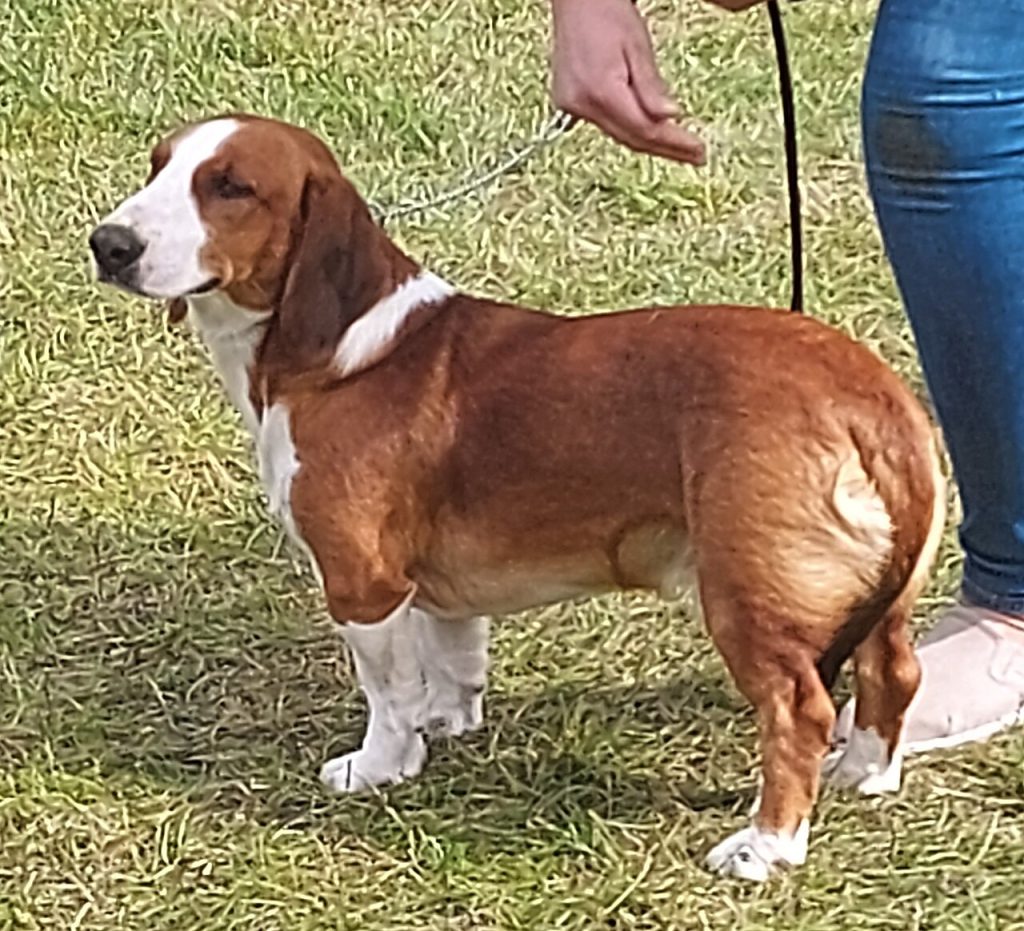
The Drever is a Swedish hound with short legs and an elongated body, bred to track and lift deer, hares and foxes by slowly pushing them towards the hunter. Behind his silhouette of a “little dog” is a tireless worker, with a very fine sense of smell and a balanced character, who in his native Sweden lives mainly in hunting lodges but who, of course, can also be a friendly and sociable family companion. If you’re looking for a medium-sized, robust, vocal dog with a lot of stamina, the Drever deserves a thorough introduction.
Is the Drever for you?
The Drever is a working dog with a hunter’s soul, and that dictates almost everything else. It is not a show dog that is content with two short walks: it needs to use its nose, move and feel that it has a purpose. In return, it gives you a stable temperament, affectionate with its people and an unusual rusticity. Before you fall in love with its dog-like face, weigh the good and the less good.
In favour .
- Balanced character – never anxious, aggressive, or fearful by his standards.
- Very sociable and friendly with the family, including the children.
- Huge strength and toughness; a healthy, functional dog.
- Short hair, easy to maintain.
- Handled size (medium-small) with strong body.
- Exceptional sense of smell: it shines in tracking and hunting.
Against
- It barks and “voices”; it’s not a silent dog.
- High hunting instinct: tends to follow trails and run away.
- Independent and somewhat stubborn; not ideal for beginners.
- He needs real daily exercise and olfactory stimulation.
- Rare breed outside Scandinavia; difficult to find.
- Bored or just too many hours, he can vocalize and get frustrated.
Character and temperament

The Drever combines two worlds that do not always coexist in the same dog: the tenacity of the hound and the gentle calmness of the housemate.
In day-to-day life, it becomes a loving dog, looking for its family and integrating well into domestic life. That friendly face, however, coexists with a very strong tracking instinct: When his nose catches an interesting scent, the Drever concentrates on it with almost obsessive determination. Hence his reputation as something independent and even stubborn. It is not a dog that obeys for pleasure; it obeys when it understands why and when it trusts its guide.
It is also a dog that expresses itself with the voice. Like a good hound of breath, it barks and “sings” when it plays, when it warns or when it follows a trail.
Coexistence: children, other pets, flat and loneliness
With children. The Drever is usually an excellent family dog: patient, tolerant and of good background.
With other dogs. Due to its origin as a pack dog, it tends to get along well with its congeners and enjoy canine company.
It is a hunter with a real prey instinct, designed to chase hares, foxes and roe deer. Coexistence with cats, rabbits or other small animals is not impossible, but requires gradual introductions and, in many cases, constant surveillance.
Flat and lonely. The Drever can live on the floor if given enough exercise, but its tendency to vocalize and its need for activity make it happier in homes with easy access to the outdoors.
Education and training
Let us not be deceived: The Drever is not the easiest dog to train, and therefore not the best choice for a first-time owner. It is intelligent, yes, but also independent and somewhat stubborn; obedience is not “out of the box”. It needs a calm, consistent and firm leader, who sets clear rules from puppyhood and keeps them.
The key is positive reinforcement and harnessing what motivates you most: the food and, above all, the smell. Short, varied, motivating sessions work much better than long, repetitive, boring ones. Working the call (the recall) is a priority and, at the same time, the most difficult: When a Drever catches a trail, his brain goes after the scent. That is why the call should be reinforced from the outset and realistic about releases in unfenced areas.
Early socialization – people, dogs, environments, noises – rounds up an already balanced dog and prevents shyness or reactivity.
Exercise and activity

Here is the heart of the breed. The Drever was bred to work for hours following a trail over rough terrain, even in snow, and that endurance keeps her going even though she lives on a couch. She needs real daily exercise: long walks, exploration and, very importantly, olfactory stimulation. A Drever who doesn’t use his nose is a half-gas Drever.
More than explosive racing, his is sustained activity: hiking, hiking, tracking, food-seeking games and nose work. These activities tire his body and, above all, his mind, which is what really makes him satisfied. Where the law allows it and the owner hunts, he is still a first-class hunting dog for deer, hare and fox.
Keep an eye on the elongated body: Although it is a robust working dog and not exaggerated, it is advisable to avoid repeated jumps from height and overweight to take care of its back.
Care: fur and hygiene
In this the Drever is grateful. His hair is short, dense and attached to the body, designed to withstand the weather. The maintenance is simple: a weekly brushing is enough to remove the dead hair and distribute the natural fat that keeps the mantle healthy and shiny.
Like a good dog with droopy ears, your ears need regular inspection and cleaning to prevent infection, as the dangling ear ventilates worse. Complete the routine with nail trimming when necessary and good dental hygiene.
Foodstuffs
The Drever needs a complete and balanced diet, adjusted to its age, weight, and – above all – activity level. An animal that hunts or trains in trapping uses much more energy than one that leads a quiet family life, and the diet should reflect this.
Your biggest dietary risk is being overweight. It’s a gourmet, long-bodied dog, a combination in which every extra pound punishes the joints and the back. You should measure your rations, watch your snacks (which are very useful as a reward for training), and check your fitness regularly. Water always fresh and available, and split into two meals a day as a reasonable guideline for an adult dog.
Health and life expectancy
The Drever has a well-deserved reputation as a rustic and healthy dog, without a long list of hereditary diseases that define it. Their life expectancy is usually around 12 to 15 years. This optimism should be tempered by a real fact: A 2005 Swedish study of insurance records found that 45 percent of Drevers died before the age of 10, a figure slightly higher than the canine average in that study (35 percent).
As with any dog with droopy ears, the ears deserve monitoring to prevent otitis. Its long body anatomy advises taking care of the back by avoiding overweight and sudden jumps. And there’s a color detail with a genetic basis: wholly white specimens are associated with an increased risk of congenital deafness, which is why the standard always requires white markings but i never an entirely white coat. Regular veterinary checkups, vaccination, deworming and weight control are the best recipe for a long life.
Physical appearance

The Drever is a rectangular-shaped dog with a long body and short legs, but without the extreme proportions of a Teckel or a Basset.
According to the FCI standard (no. 130), the ideal crossing height is about 35 cm in males (range 32-38 cm) and 33 cm in females (range 30-36 cm), with an approximate weight of 14 to 16 kg. The head is typical of hound, with medium-inserted, hanging and moderate-length ears, and a long tail that usually carries something raised in action.
The hair is short, dense and well glued. As for the color, any color is allowed as long as there are visible white marks: the most common mantles are red (lionate) and white and the tricolor (black, fire and white).
Origin and history
The Drever is a genuinely Swedish dog, but its roots are German. It is descended from the Westphalian badger(Westfälische Dachsbracke), a small short-legged hound of the Bracke type, brought from Germany to Sweden around 1910 to track deer.
By the 1940s there were two different sizes of this Dachsbracke in Sweden. To name the variety somewhat larger, a newspaper organized a naming contest in 1947: the chosen one was Drever, derived from the Swedish word drev, which designates the hunting modality in which the dogs lead the piece slowly towards the hunter. That same year, 1947, the Swedish Canine Club recognized it as an independent breed.
The reconnaissance was cross-border: The Canadian Kennel Club admitted it in 1956 and the United Kennel Club of America in 1996. Internationally it is recognized by the FCI within Group 6 (hounds and similar breeds), Section 1.3, small hounds. In the United States it is included in the Foundation Stock Service program of the AKC. Outside Scandinavia it remains a rare breed, promoted primarily as a hunting dog and, to a lesser extent, as a rare pet.
Curiosities
- Its name was born from a journalistic contest in 1947 and comes from drev, “beat” or chase in which the piece is driven.
- In Sweden the Drever is primarily a hunting dog: it is rarely kept alone as a pet.
- The short legs are not an aesthetic whim: they allow the deer – a very nervous prey – to move slowly and without alarm, even in late snow.
- It shares an ancestor, the Dachsbracke, with dogs as distinct in appearance as the Teckel (Dachshund).
- The standard prohibits the all-white coat because of its genetic association with congenital deafness.
- It is a “singing” dog: its hound voice is part of its job and its character.
If you are attracted to the Drever’s profile – compact, nosey, vocal hound – you may also be interested in other related breeds. Check out the Beagle, another sociable, olfactory medium hound; the Basset Hound, the quintessential short-legged tracker; the Dachshund (Teckel), which shares that Dachsbracke ancestor; and the Bloodhound, the king of the olfactory tracker.
Frequently Asked Questions about the Drever
Is the Drever a good family companion dog?
Yes, it can be. It’s affectionate, sociable and balanced, and it usually blends in well in active homes with children, but it retains a strong hunting instinct and a need for exercise, so it’s better suited to families that can give it long walks and daily olfactory stimulation.
How tall and how much does a Drever weigh?
According to the FCI standard, the ideal height is about 35 cm in males (32-38 cm) and 33 cm in females (30-36 cm), with an approximate weight of 14 to 16 kg. It is a medium-small dog with a long body and short legs, but robust and athletic.
Does the Drever bark a lot?
It tends to be vocal. Like a good hound, it barks and “voices” when playing, warning and following a trail. It’s not the ideal dog if you need a quiet companion for a flat with very noise-sensitive neighbors.
Is the Drever easy to train?
Not particularly. It’s intelligent but independent and somewhat stubborn, so not recommended for first-time owners. It responds well to positive reinforcement, short sessions and olfactory work, but requires calm, consistent and consistent leadership.
How long does a Drever live?
Its life expectancy is around 12 to 15 years. It is a rustic and healthy breed, although a 2005 Swedish insurance study noted that 45% died before the age of 10. Weight control and periodic veterinary checkups help to a long life.
Does the Drever get along with other pets?
With cats, rabbits, or other small animals, you have to be careful: their prey instinct is real, so early socialization, gradual introductions, and supervision are appropriate.
How much exercise does a Drever need?
It was bred to work for hours following a trail, so it needs sustained daily exercise and, above all, olfactory stimulation: long walks, hiking, crawling and search games.
Where did the Drever come from?
It is a Swedish breed created from the German Westphalian Dachshund, brought to Sweden around 1910 and crossed with other hounds. It received the name Drever in a contest in 1947, the same year that the Swedish Canine Club recognized it as its own breed.