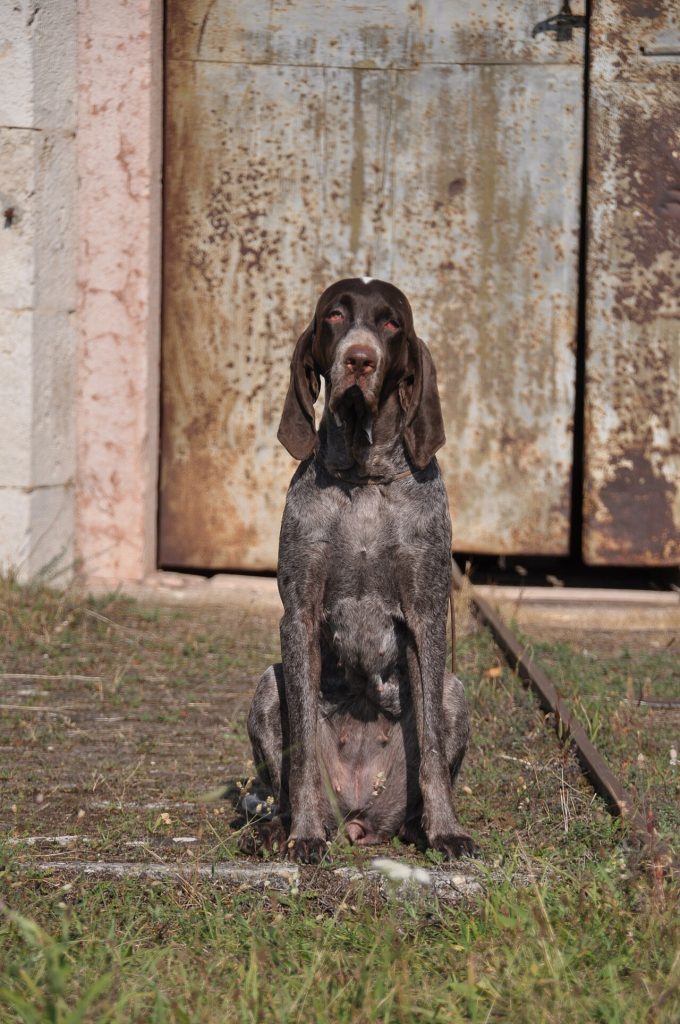
The Perdiguero of Burgos is the Spanish show dog par excellence: a rustic, serene and resistant braco, born in the province of Burgos to accompany the hunter for long days on the harsh Castilian plateau. Sturdy in build, with long ears and a sweet look, it combines an extraordinary scent with a noble and calm character that also makes it an excellent companion for active families and lovers of the countryside.
Is the Burgos Perdiguero for you?
The Burgos Perdiguero is a wonderful dog, but not for every household. First of all it is a breed of hunter, bred for centuries to work outdoors. If you live in the countryside or do sports daily and you are looking for a noble, balanced and resistant dog, it will fit perfectly. If you live in a small apartment and spend many hours outside, this is not your breed.
In favour .
- A docile, noble and very balanced character
- Excellent with kids and family.
- Rustic and resistant: resistant to cold, heat and long working hours
- Outstanding sense of smell and great instinct for sampling and collecting.
- Short hair very easy to maintain
- Little barking and quiet inside the house
To be taken into account
- He needs a lot of daily exercise and space.
- It doesn’t adapt well to city life or prolonged solitude.
- Strong hunting instinct – watch out for other small pets
- Long ears requiring frequent inspection
- Minority breed: breeders can be hard to find
- Bored and frustrated if you don’t have a job or activity
Character and temperament

If anything defines the Burgos Perdiguero is its the balance. It is a docile, calm and predictable reaction dog, rarely frightened or upset. The Royal Canine Society of Spain itself describes it as rustic, balanced, serene and of excellent character.
At home he is quiet and not barking, a pleasant companion who prefers to be close to his own. But this calm temperament goes hand in hand with a strong hunting instinct and a tremendous capacity for work. As soon as you step on the field, it transforms: It sniffs, tracks and concentrates with remarkable intensity. Understanding that dual nature – calm on the inside, tireless on the outside – is the key to living well with it.
It is also an intelligent dog that learns quickly, especially when it comes to hunting. That intelligence, coupled with its docility, makes it grateful to drive; but it demands in return attention, exercise, and a coherent guide that gives it a purpose.
Coexistence: children, other pets, flat and loneliness
With children. is one of its great virtues. Its patient character, its nobility and its predictable reactions make it a very good dog with the little ones. As always, it is advisable to supervise the game and teach children to respect the dog.
With other pets. It usually coexists well with other dogs. The delicate point are small animals: its powerful hunting instinct can be awakened by rabbits, birds or cats that run, so early socialization and caution is advisable.
On the floor. is not their environment. Tradition and standard agree that the Burgos Perdiguero does not adapt well to urban environments.
Soledad. is a working dog used to being with his guide; long hours in solitude make him feel bad and can lead to boredom, anxiety or destructive behaviour.
Education and training
The good news is that it is an intelligent and docile dog, which learns easily and enjoys collaborating with its guide. Education works best with methods in positive, short sessions and a calm and consistent treatment; abrupt modes retract it, because it is a sensitive animal.
Early socialization – people, other dogs, noises, environments – is important for their natural nobility to develop without fear. On the hunting ground, it barely needs to be “turned on”: The instinct to sample and collect comes as standard and is polished with specific training. What is really decisive is not the difficulty of the orders, but to meet their need for activity: A tired and stimulated Burgundian is an easy dog; a bored one will look for something to entertain himself on his own.
Exercise and activity

This is the section that decides if the breed is for you. The Burgos Perdiguero was bred for working full-time travelling great distances, and needs to expend that energy. We’re talking about one or two long hours of intense exercise a day: demanding walks, running, sniffing games, tracking or, ideally, hunting work.
It ‘s not enough for him to walk: He needs to run, smell and use his head. Activities that combine physical and mental effort – mantrailing, object hunting, recovery – suit him especially well for his sample and collector dog profile. Meeting this need is not a whim: It’s what keeps the breed healthy, balanced and happy, and it’s what prevents the behavioral problems that arise when a working dog is out of work.
Care: fur and hygiene
In terms of maintenance, it is a grateful breed. Its hair is short, dense and soft, and with a weekly brushing is enough to remove the dead hair and keep the mantle in good condition; during moults it is advisable to brush it more often.
The point that requires the most attention are your ears: They tend to accumulate moisture and dirt, so they need to be checked and cleaned regularly to prevent infection, especially if the dog is working in the field or bathing. Complete basic hygiene by cutting nails, cleaning teeth and, after each day on the mountain, checking pads, eyes and skin for spikes, ticks or small wounds.
Foodstuffs
As an active dog of medium to large size, the Burgos Perdiguero needs a quality diet, balanced and adjusted to its level of real activity. A specimen that hunts or trains daily has an energy expenditure much higher than that of a sedentary dog, and its ration should reflect this; similarly, in the seasons of less activity it is advisable to moderate the amounts to avoid overweight.
It is advisable to divide food into two daily servings instead of one and, as with other deep-breasted breeds, avoid intense exercise just before and after eating as a precaution against gastric dilation. Fresh water always available, especially after exertion. If you have any questions about quantities, type of feed or supplements, it is best to consult your veterinarian.
Health and life expectancy
The Burgos Perdiguero is a rustic and resistant dog, the result of centuries of adaptation to a demanding environment, and generally enjoys good health.
It does not have a long list of hereditary problems associated with it, but some logical points should be kept in mind for its morphology and size. Its long and sloping ears make it more prone to ear infections, hence the importance of checking them often. As with many medium and large breeds, it is helpful to control the joints (hip and elbows), and for its deep chest it is advisable to keep in mind the basic guidelines against torsion or gastric dilation. Regular veterinary checks, vaccination, deworming and, after field work, a good inspection of the dog are the best prevention.
Physical appearance
The Burgos Perdiguero is a medium-sized dog, robust construction and almost square size, which transmits strength and rusticity more than stylized elegance.
Its head is strong, with long, sloping and medium-inserted ears, and a marked paw that, along with its sweet expression, give it that characteristic Mediterranean arm air. The hair is short, dense and soft. In terms of color, it has a white and brown (liver) coat, often interspersed or mottled, with brown spots of variable size; the roan appearance, with the mixture of white and dark hairs, is very typical of the breed. Traditionally, the tail was amputated to one third of its length, a practice now banned or disused in much of Europe.
Origin and history

The Burgos Perdiguero is a native Spanish breed that has barely changed in centuries. It arose in the province of Burgos, in Castile and León, perfectly adapted to the harsh conditions of the Castilian plateau. Although its exact origin is unknown, it is believed to be descended from the crossing of Sabueso Español with Pachón Navarro, and that it may have participated in the formation of other sample breeds from its group. Its name betrays its function: “partridge”, for his ability to hunt partridges.
The breed was recognized in 1911 by the then Royal Central Society for the Promotion of Canine Races in Spain (today Royal Canine Society of Spain). In 1936 there were only 319 specimens recorded in the genealogical book, and the Spanish Civil War and the Second World War were about to make it disappear: breeding did not resume until 1950. Gradually recovered, it is still a minority breed; in fact, in 2026 it was among the sixteen Spanish breeds considered vulnerable by the Royal Canine Society of Spain.
Curiosities
- It is considered the most complete Spanish show dog, valued for its smell, its calmness and its safety in charging, even in water.
- Its name, “perdiguero”, comes from the partridge, but it also hunts rabbits, hares, quails, pheasants and beetles.
- It has a very thick epidermal layer on its pads, an adaptation that allows it to work in arid, rocky and dry terrain without injury.
- Its characteristic working gait is a powerful and economical trot, allowing it to cover a lot of ground without becoming exhausted.
- He is credited with influencing the development of other show dogs, both within and outside Spain.
- Despite its history and its value, it is a dog little known outside the canine circles, which makes it a real jewel of Iberian canine science.
If you are attracted to the Burgos Perdiguero for its rustic and noble dog profile, you may be interested in other related breeds. You can compare its smell and working style with that of the English Pointer, discover two great European breeds such as the Vizsla and the Weimaraner, or peer into its tracking heritage through the Bloodhound, another dog with long ears and prodigious smell.
Frequently asked questions about the Burgos Perdiguero
Is the Burgos Hound a good companion dog?
It can be if you understand that it is first of all a show dog. It has a docile, noble and calm character at home, gets along very well with children and is not very barking. But it needs a lot of daily exercise and space: on a floor without activity it becomes frustrated. In a country house or with an active family that goes out daily to the mountains, it is a balanced and grateful companion.
How much exercise does a Burgos Perdiguero need?
A lot. It’s a dog bred to work full days on the Castilian plateau, so a couple of short walks aren’t enough. The ideal is one or two long hours a day of intense activity: walking, running, trawling or hunting work. Without that physical and mental expense, it tends to get bored and develop undesirable behaviors.
Do you adapt well to living in a city flat?
Both the standard and the tradition of the breed agree that the Perdiguero de Burgos does not adapt well to urban environments. It tolerates indoor coexistence if it receives a lot of exercise, but gives its best in the field, with open space to run and smell.
Is the Burgos Perdiguero good with children?
Yes. Its balanced temperament, patience and predictable reactions make it very good with children. It is a noble dog that rarely gets scared or reacts abruptly. Nevertheless, it is advisable to supervise play with the little ones and teach them to respect the dog, as with any breed.
How much hair does it shed and what care does its coat need?
It has short, dense and soft hair, easy to maintain. A weekly brushing is enough to remove the dead hair and keep the mantle healthy; in times of moult it is advisable to brush it more often.
How tall and how much does the Burgos Perdiguero weigh?
It is a medium-sized dog with a robust build. The males measure between 62 and 67 cm at the withers and the females between 59 and 64 cm. The weight is around 25 to 30 kg.
Is it an easy breed to train?
It is an intelligent dog that learns easily, especially when it comes to hunting, for which it has a very marked instinct. It responds very well to positive reinforcement and to a calm and consistent handling.
Is the Burgos Perdiguero in danger of disappearing?
It was on the verge of extinction in the middle of the 20th century and, although it recovered, it is still a minority: in 2026 it was among the sixteen Spanish breeds that the Royal Canine Society of Spain considers vulnerable.