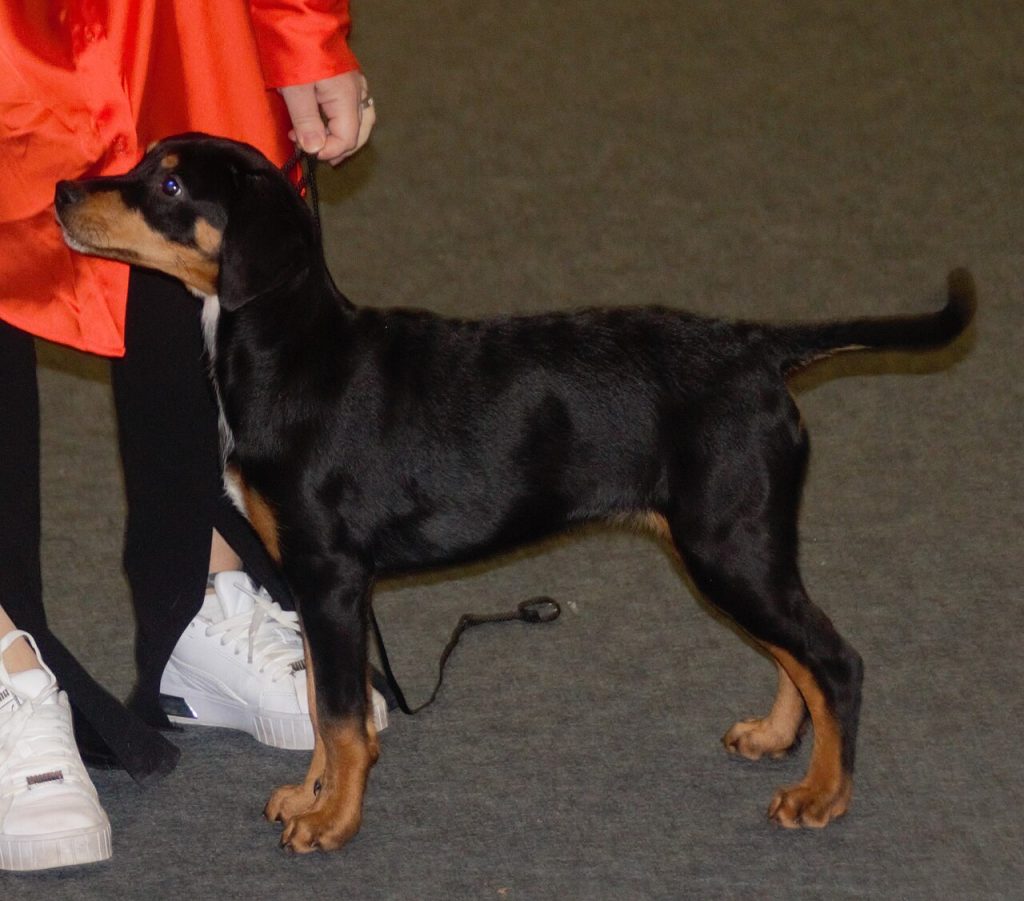
The Transylvanian hound is one of those dogs that has history written all over it: a Hungarian track dog, forged in the forests and mountains of the Carpathians, who was about to disappear forever and today is running after the track again. Strong, resilient, and of a noble and well-balanced character, the Transylvanian Hound combines the purest hunting instinct with a surprisingly quiet home coexistence. If you’re looking for a sturdy, healthy dog with an ice-proof winter loyalty, this rare breed deserves to be thoroughly explored.
Is the Transylvanian Hound for you?
The Transylvanian Hound is not a dog for any household, but for the right person it is difficult to find a better companion. It’s a working dog with centuries of selection for hunting in very rough terrain, so it needs exercise, space and a hand that understands its nature. In return, it offers iron health, steady temperament and a quiet devotion that never tires. Before you fall in love with his black and fire print, look honestly at whether he fits into your life.

In favour .
- Exceptional health and above-average longevity (12-14 years).
- Balanced temperament, obedient and tolerant of children.
- Extremely sociable with other dogs because of their pack origin.
- Short coat with minimal maintenance.
- Extraordinary physical endurance in any weather.
- Good guard, discreet: reserved and attentive to strangers.
Against
- It needs plenty of daily exercise: it’s not a small-floor dog.
- Very strong tracking instinct: tends to follow smells and ignore the call.
- A high-pitched, high-powered bark that he uses to work and alert.
- Very rare breed: difficult to find outside Hungary and Romania.
- He gets bored and suffers if he spends too many hours alone.
- It requires an experienced and consistent owner.
Character and temperament
Those who know a Transylvanian Hound usually describe it with the same word: balanced. It is not a nervous or explosive dog, but one that knows how to reserve its energy for the moment of work. At home it is calm, good-natured and surprisingly tolerant, while in the countryside it wakes up and transforms into a brave, determined and with an admirable sense of direction hunter.
It is a naturally obedient dog, which makes coexistence much easier, but it also has an introspective and somewhat reserved side. With strangers he is slightly suspicious and observant, without getting aggressive: He warns you, assesses the situation and then decides. This mixture of nobility and prudence makes him a reliable companion, one who does not constantly seek prominence but who is always attentive to his family.
The Transylvanian Hound is genetically predisposed to get along with other dogs, to work in groups and to respect hierarchies. It is a strong bonded animal: it is deeply attached to its people and responds better to affection and consistency than to imposition.
Coexistence: children, other pets, flat and loneliness
With children: is one of its great virtues. The standard and those who breed it agree that it is a patient and tolerant dog with small ones, of stable temperament and without brusqueness. Always under supervision, like any large dog, it fits very well in families with children.
With other pets: with other dogs is excellent, the result of centuries of life in a pack. With cats and small animals you have to be realistic: it is a hound with a very marked hunting instinct, so coexistence with rodents, rabbits or cats requires socialization from a puppy and is not always reliable.
On the floor: is not its ideal habitat. It is a medium-sized dog, with a lot of resistance and need to move, bred to walk through entire forests. It can live in a large floor if it is guaranteed plenty of daily exercise, but really shines in a house with a garden or in the countryside.
Soledad: is its weak point. A Transylvanian Hound that spends many hours alone is bored, frustrated and may develop undesirable behaviors or excessive barking. It needs companionship, activity and purpose. It is not a dog for someone who spends the whole day outside the house.

Education and training
The good news is that the Transylvanian Hound is an easy dog to train. Its natural predisposition to obedience and intelligence make it receptive to learning, and it responds especially well to positive reinforcement, patience, and consistency. It is not a dog that requires complicated techniques: it just needs a constant owner who sets clear boundaries and gives it a reason to collaborate.
The great challenge is not general obedience, but his nose. We’re dealing with a very high-level tracking hound, and when it catches an interesting scent, it can forget about the world. That is why the call work (the turn when it is called) must be trained from a puppy and with a lot of patience, and it is advisable to keep it controlled or for a long time in unfenced areas. Never expect a hound to completely ignore a fresh trail: It’s against their nature.
Early socialization is key to softening his reserved tendency to strangers and for him to grow up confident and balanced. Exposing him as a puppy to people, noises, other animals and different environments will make him a confident adult. As a sensitive dog, he does not tolerate harsh methods well: punishment turns him off or suspicious, while play and reward bring out the best in him.
Exercise and activity
There are no half-measures here: the Transylvanian Hound is a long-distance athlete. It was selected for centuries to hunt wild boars, deer, lynxes and even bears through the Carpathians, traversing forests and mountains in hot summers and snowy winters. That resistance remains intact, and without a proper exhaust valve the dog accumulates frustration.
You need at least one or two hours a day of vigorous exercise: long walks, running, hiking, canine cycling or, ideally, activities that stimulate your sense of smell such as sports tracking (mantrailing) or search games.
It is a perfect companion for active people, mountain sportsmen, hunters, and families who live outdoors. For a sedentary lifestyle, however, it is a poor choice: an unexercised Transylvanian Hound is an unhappy dog and almost certainly a coexistence problem.
Care: fur and hygiene
In terms of maintenance, this breed is a relief. Its hair is short, smooth and very attached to the body, slightly longer in the long-legged variety. A weekly brushing with a rubber glove or bristle brush is enough to remove the dead hair and keep the mantle shiny; in moult season, two or three brushes a week help control the fall.
Bathing should be sporadic, only when you get really dirty, so as not to alter your skin’s natural protection. Like all dogs with droopy ears, your dog’s ears should be checked and cleaned regularly to prevent infection, especially if he works or wets in the field. Complete the routine with nail trimming when necessary and good dental hygiene. None of this is complicated: is undoubtedly one of the least aesthetically pleasing dogs within its size range.
Foodstuffs
As a muscular, resilient and very active dog, the Transylvanian Hound needs a high-quality diet, rich in animal protein, that supports its muscle mass and energy level. The amount should be adjusted to its actual activity: a dog that hunts or trains daily burns many more calories than one that lives a quieter life, and the same rations would give very different results.
Ideally, divide food into two servings a day and avoid strenuous exercise just before or after eating, a sensible precaution in broad-breasted dogs. Watch your weight: Although it is a healthy and athletic breed, overweight punishes the joints and deprives it of the agility it needs. Water always fresh and available, especially after long days of activity, and any questions about specific diets or life stages are best consulted with the veterinarian.
Health and life expectancy
If there’s one thing that sets the Transylvanian Hound apart, it’s its robustness. It is a remarkably healthy breed, with no specific known hereditary diseases and an above-average life expectancy for its size: between 12 and 14 years. This fortress is not by chance, but the result of centuries of harsh natural selection in the Carpathians, where only the most hardy specimens survived and reproduced.
As with any active, medium-sized dog, regular veterinary checkups, an up-to-date schedule of vaccinations and deworming, and attention to droopy ears prone to infection are recommended. It is also wise to take care of your joints throughout your life because of the intense exercise you do. With proper nutrition, exercise, and routine checkups, it is a dog that usually enjoys a long and active old age.
Physical appearance
The Transylvanian Hound is a strong, medium-sized dog, with an athletic, well-proportioned silhouette that conveys endurance rather than bulk. The long-legged variety – the only one recognized today by the International Kennel Federation – measures between 56 and 66 cm to the cross and weighs around 30 to 35 kg. The historical short-legged variety, now virtually extinct, was shorter (46-51 cm) and lighter (22-25 kg).
Its head is typical of a hound: elongated but not pointed and without wrinkles. The ears, of medium size, hang from the sides, wide in the center and tapering towards a rounded tip. The body is relatively long but square in appearance, with a broad chest and a low insertion tail, which is not cut and which in full hunting is usually curved to the height of the back.
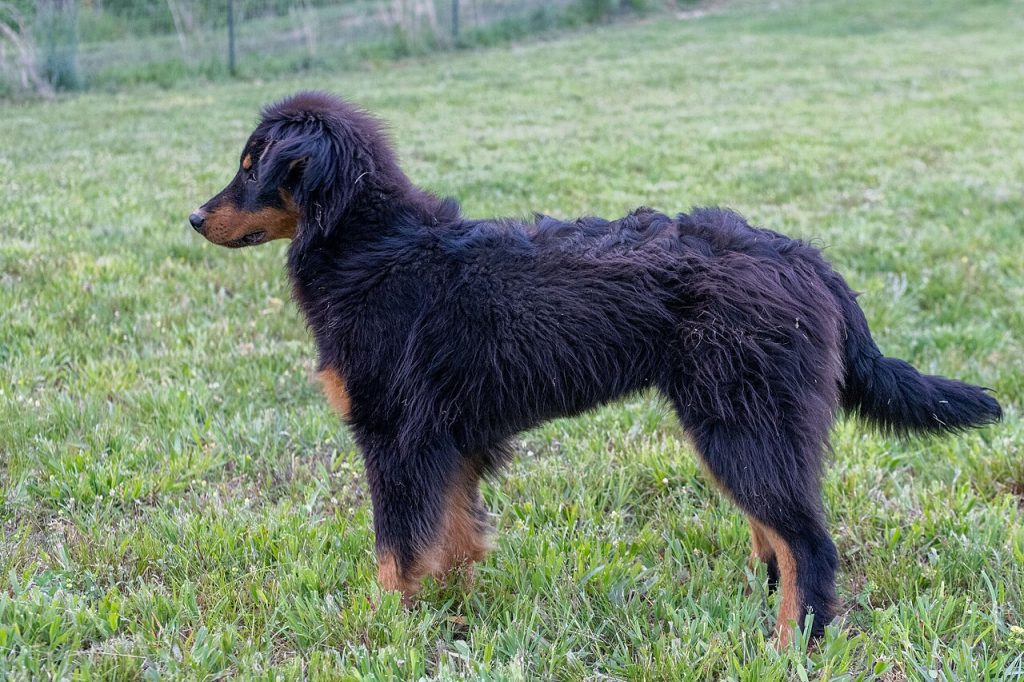
The cloak is short, smooth and sticky. Its most characteristic color – that of the variety that has come down to us – is the black and fire, often tricolor with white markings on the snout, chest and extremities, and unmistakable fire-colored spots over the eyebrows. The former small variety featured a dark red base and fire. A curious detail: For its size, it has a surprisingly high barking.

Origin and history
The story of the Transylvanian Hound is that of a race that narrowly survived extinction. Its origins date back to the 9th century, when the Magyar tribes crossed the Carpathians and settled in the Pannonian plain. They brought with them hunting dogs that were crossed with the local breeds and with dogs of Polish origin, and from that mixture emerged the founding trunk of the breed. During the Middle Ages it became the favorite dog of the Hungarian aristocracy for big hunting.
At that time, there were two varieties that were kept together and used for different prey: the long-legged, for larger game in the forest and plain – European bison, brown bear, wild boar, lynx – and the short-legged, for fox, hare, and wildebeest in rocky or enclosed terrain.
The decline came with the advance of agriculture and forestry, which cornered the breed in the Carpathian forests. At the beginning of the 20th century, it was almost extinct. The Second World War was about to end, and after 1947, when Transylvania was fully reintegrated into Romania, the Romanian government exterminated the surviving specimens to erase the memory of their Hungarian past. Some survived in Hungary and Slovakia.
Recovery was a decades-long job. The first official registration began in 1886 with the Genealogical Book of the Hungarian Hound; in 1941 it was registered as a Hungarian hound and a recovery began with just 27 specimens, halted by the war. A new rescue operation began in the 1960s. The International Kennel Federation recognized and standardized the breed in 1963, and from 1968 breeding efforts bore fruit. Today the long-legged variety has considerable numbers in Hungary and Romania.
Curiosities
- It is called Erdélyi knocked in Hungarian and Copoi ardelenesc in Romanian; “kopó” and “copoi” literally mean “sawdust”.
- It has a remarkably sharp bark for its size, a feature that helped hunters locate it in the forest.
- It was so close to extinction that, at one point, the breed depended on only 27 specimens for recovery.
- Of the two historical varieties, the short-legged is now considered extinct: only the long-legged survives.
- The FCI standard, finally approved on 30 March 1963, describes only the high variety.
- Its fire-colored spots over its eyebrows are one of its most recognizable features.
- Outside Hungary, Romania is practically the only country where the breed maintains a significant presence.
If you are attracted to the profile of the Transylvanian Hound – a hardy, sociable dog with a prodigious sense of smell – you may also be interested in other tracking and working breeds with similar characteristics, such as the veteran Bloodhound, the most legendary sniffer, the popular tracker Beagle, the unmistakable short-legged Basset Hound, or the sleek and versatile Vizsla, Hungary’s other canine pride.
Frequently Asked Questions About the Transylvanian Hound
Is the Transylvanian Hound a good family dog?
Yes. It is a dog of balanced temperament, obedient and very tolerant of children, and extremely sociable with other dogs. The condition is to give it the exercise it needs and not leave it alone for too many hours; with that, it is an excellent family companion.
How much exercise do you need a day?
As a high-endurance hunting dog, it requires at least one or two hours of vigorous activity a day: long walks, running, hiking, or better yet, scent work like tracking.
Is it a healthy breed?
It is one of the healthiest breeds in existence, with no known specific hereditary diseases, thanks to its harsh natural selection.
Can you have it on one floor?
It is not ideal. It is a medium-sized, high-energy dog, bred to roam through entire forests. It can adapt to a large floor if it is guaranteed plenty of daily exercise, but enjoys it much more in a house with a garden or in the countryside.
Is it hard to educate?
No, it is intelligent, obedient by nature, and responds very well to positive reinforcement. The main challenge is its powerful tracking instinct, which makes it essential to work the call from a puppy and control it in unfenced areas.
Do you get along with other dogs and cats?
With cats and small animals you have to be careful: their hunting instinct is strong and coexistence requires socialization from puppy, without absolute guarantees.
How much hair does it shed and what care does it need?
Their short, sticky hair is of very low maintenance. A weekly brushing (two or three in moult season), sporadic baths and a periodic check of the fallen ears to prevent infections are all that is needed.
Why is it such a hard breed to find?
Because it was on the brink of extinction during the 20th century and its recovery came to depend on just 27 specimens.