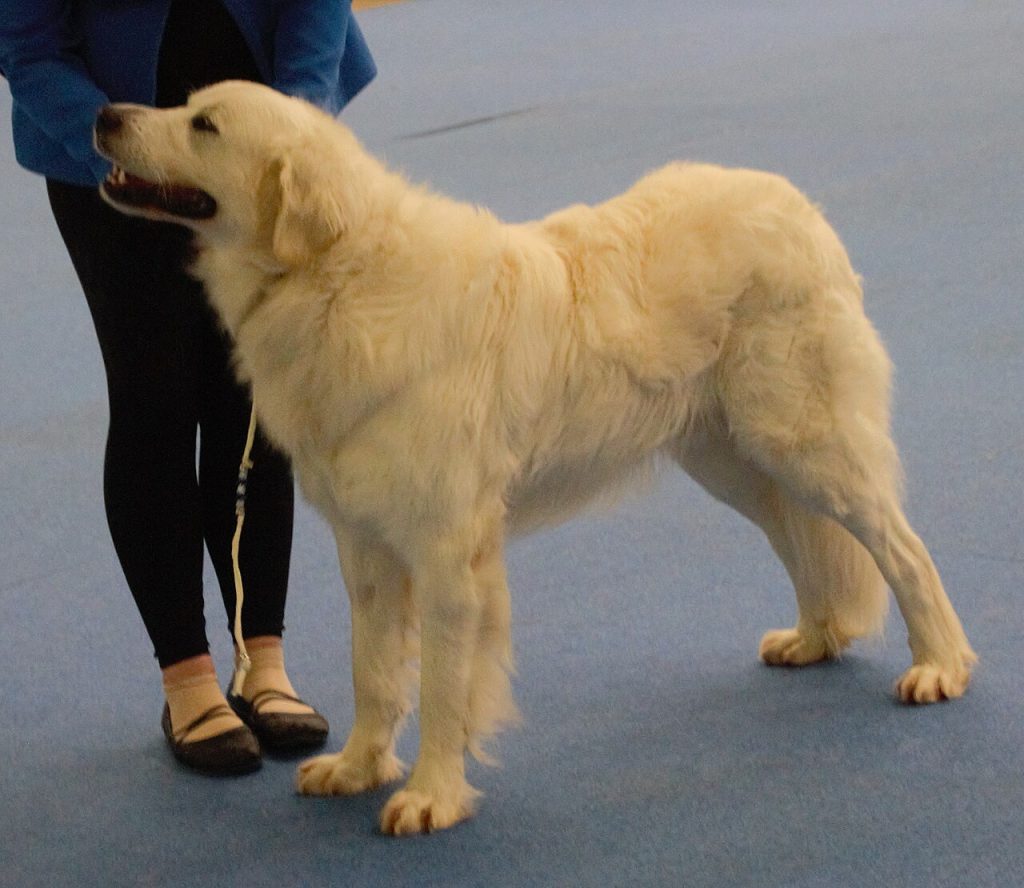
The Slovak Cuvac is an imposing white mountain dog, bred for centuries in the Slovak Carpathians to guard herds and homes from wolves and bears. Big, robust and deeply loyal, he’s a guardian of ancestral instinct who needs a committed family, space and patient training. If you’re looking for an urban, easy-going companion dog, this isn’t your dog; if you want a noble, devoted sentry for a house with land, the Slovak Cuvac can be an extraordinary choice.
Is the Slovak Cuvac for you?
The Slovak Cuvac is not a dog for any household. Its size, its guarding instinct and its independent character make it a magnificent companion for some people and a problem for others.

In favour .
- Born guardian: courageous, vigilant and naturally deterrent.
- Unwavering loyalty to his family; very attached to “his people”.
- Rustic and resistant constitution, adapted to the cold and the mountains.
- Quiet and balanced at home when you have your needs met.
- Excellent with the children of his family and protective of the cattle.
Against
- Independent and stubborn: he is not a “just obedient” dog.
- It barks to warn; it can be noisy if not managed.
- It needs space, fenced-in land, and it doesn’t fit well in a small flat.
- He is wary of strangers; he requires early and firm socialization.
- It sheds abundantly from the undercoat; it sheds a lot of white hair in spring.
Character and temperament
The Slovak Cuvac’s temperament is summed up in one word: the guardian. It is a dog of vigorous constitution, naturally alert, vigilant, fearless and alert. For generations it was selected to stand up to any threat – including wolves and bears – defending its master’s flock and house, and that instinct is still very much alive in the modern dog.
With his family, he is a completely different creature: sweet, affectionate, and deeply loyal to the people and possessions he considers his own. He is intensely attached to his group and enjoys having someone to care for, whether it be children, other animals, or the entire household. This duality – fierce in the face of threat, tender with his own – is the essence of the breed.
It’s important to understand that this is an independent guard dog, not an obedience dog. He was raised to make decisions on his own in the mountains, without waiting for orders, and that autonomy translates into a self-confident and somewhat stubborn character. Whoso seeketh a dog that is submissive, and ever desirous to please, shall be frustrated; and whoso esteemeth a companion with his own standards, shall find in him a formidable ally.
Coexistence: children, other pets, flat and loneliness
With children. The Slovak Cuvac thrives especially in a large family environment, with children and animals to care for. It is patient and protective with the little ones in its house, which it tends to include within its “herd”. As with any large dog, coexistence must be supervised and children must be taught to respect their rest times.

With other pets. Raised side by side with sheep, cows, turkeys and other domestic animals, the Cuvac cohabits naturally with livestock and usually accepts other house animals well if it grows up with them.
On the floor. is not an apartment dog. Its size, need to guard a territory and its tendency to bark as a warning make it unsuitable for living in a small apartment.
Soledad. is a strongly bonded dog that does not do well in isolation. Although it tolerates spending time outside watching, it needs to feel part of the group; leaving it alone and unattended for long days promotes boredom, barking and frustration.
Education and training
Educating a Slovak Cuvac requires understanding what kind of dog you have in front of you. It is not a dog that seeks to please for the sake of pleasing, but a watchdog with its own criteria. Training should be based on the consistency, calmness and positive reinforcement, never on harshness or confrontation, which only get such a self-confident dog to close in on bands.
The early socialization is the key piece. A puppy that knows people, noises, environments and other animals during its first few weeks becomes a balanced adult who knows how to distinguish a normal visit from a real threat. Without that work, its natural distrust of strangers can become excessive.
It is advisable to set clear rules from day one and always keep them the same: this dog instantly detects inconsistencies and takes advantage of them. Basic obedience – going to the call, controlling impulses, accepting manipulation – is worked with short and motivating sessions. Don’t expect the mechanical response of a work shepherd; expect a collaborator who obeys because he trusts you.
Exercise and activity
The Slovak Cuvac is a dog of robust and lively constitution that needs daily activity, but not intense sporting type. Its energy is that of a guard: long days of quiet patrol rather than explosive races. It comes to wonder at long walks, access to a wide terrain to watch and explore, and outings to the countryside or mountain.
Providing for his physical needs and, above all, giving him a “mission” – a territory to guard, a herd, or a family to take care of – is what keeps him balanced.
Care: fur and hygiene
The white coat of the Cuvac is its hallmark and requires regular care. The covering hair, between 5 and 15 cm long, completely covers a dense, short and soft undercoat. Frequent brushing keeps the coat clean, attractive and – very importantly – prevents the furniture from being filled with that loose white “mohair”.
The critical moment is the annual undercoat shedding in spring, which requires vigorous brushing sessions and some bathing to remove all dead hair. Outside that time, maintenance is more bearable.
Foodstuffs
As a large working dog, the Slovak Cuvac needs a complete and balanced diet, adapted to its size, age and activity level.
As with all large and slow-growing breeds, special care should be taken in the puppy stage to avoid forcing too rapid development of bones and joints. Divide the daily ration into several servings, control weight to avoid overweight, and always have fresh water available, especially if the dog spends time working or watching outdoors. If you have any questions about diet or quantities, it is best to consult your veterinarian.
Health and life expectancy
The Slovak Cuvac is a rugged and hardy breed, forged in the harsh mountain climate, with a solid and healthy constitution.
Even so, like all large dogs, it is important to monitor the joint health – hips and elbows – of large breeds, and keep up-to-date with veterinary checkups, deworming, and vaccination. Proper weight, moderate exercise, and good nutrition are the best allies for healthy old age. With proper care, it is a dog that accompanies its family for many years.
Physical appearance
The Slovak Cuvac is an animal of imposing stature. Its body is slightly longer than it is tall, with a strong and slightly sloping dorsal line, and a massive constitution that transmits power without heaviness.
The head is large, with a broad and elongated skull, slightly arched but flat at its top. The jaws are strong and close in scissor bite. The eyes, oval in shape, are dark and lively. The ears are inserted high, fall to the sides of the head and end in a rounded tip. The tail, densely covered with hair, hangs at rest reaching the corvettes.
Their coat is always a pure white– a slight yellowish tint is allowed near the ears, although it is not desirable – with black nose, lips, eyelids and pads and brown eyes.

Origin and history
The Slovak Cuvac is a breed of mountain dog native to Slovakia, closely related to the Hungarian Kuvasz and other large white herd guards such as the Pyrenean Mountain Dog, the Maremma Shepherd, the Akbash or the Tatra Shepherd. Its native name, Of a fat content, by weight, is derived from the Slovak verb “čuvať” (watch, watch), and the alternative spellings Tchouvatch, Chuvach or Kuvac reflect its approximate pronunciation.
The breed has been documented since at least the 17th century. For generations he was the indispensable companion of Carpathian shepherds: A good guard dog, watchdog, shepherd and companion, who has proven himself by caring for sheep, cows, turkeys and other animals, in addition to his master’s home. According to pastoral tradition, it was always bred white so that it could be distinguished from nocturnal animals in the middle of the night.
When wolves began to disappear from the European mountains and livestock practices changed, the Cuvac ran the risk of becoming a relic of the past; by the 1950s the few remaining individuals were being raised uncontrollably. The credit for recovering the breed and fixing its characteristics goes to Professor Antonín Hrůza, of the Faculty of Veterinary Medicine in Brno, who established the registered breed of the Slovenský čuvač in Czechoslovakia on 4 June 1929. The Slovak Cuvac Breeders’ Club was founded in 1933 and the written standard was approved in 1964. The breeding stock departed from the areas of Liptovská Lúžna, Kokava and Východná, as well as from Rachov in the Carpathians.
Today the breed is recognized under the sponsorship of Slovakia by the International Cinological Federation (FCI) with the name Of a fat content, by weight, framed in the group of shepherd and boyer dogs; in the United States, the United Kennel Club registers it with the English name Slovak Cuvac.
Curiosities
- Its uncontaminated white is not aesthetic: shepherds purposely bred it white for distinguish it from wolves and bears in the dark and to avoid confusing it with the almanacs.
- The name “čuvač” literally means “watchman” or “one who watches” in Slovak, a perfect description of its function.
- The spelling “Tchouvatch” that appears in French and German texts is simply an attempt to reproduce the “chu-vach” sound of the original word.
- Despite the variety of names – Slovensky Cuvac, Tatransky Cuvac, Slovak Chuvach, Kuvac… – they all designate a single race.
- Its recovery in the 20th century was gestated in a veterinary school, the Brno, an unusual case of scientific rescue of a breed.
- He is such a committed guardian that tradition describes him resisting “any enemy, including wolves and bears”.
If you are attracted to the profile of the Slovak Cuvac, you may also be interested in other large guard, mountain and herding breeds. Discover the Samoyedo, another spectacular northern white dog; the colossal and noble Terranova; the versatile Pastor Alemán if you are looking for a more obedience-oriented guard; or the imposing Gran Danés among the giant-sized breeds.
Frequently asked questions about Slovak Cuvac
Is the Slovak Cuvac a good family dog?
Yes, as long as the family understands its guardian character. It is sweet, loyal and protective of its own, and thrives especially in large homes with children and animals to care for. It is not, however, a dog designed for urban life in a small apartment.
Do you get along with the kids?
With the children of his own family, he is usually patient and protective, since he tends to include them in his “herd”.
How tall and how much does a Slovak Cuvac weigh?
The males reach up to about 70 cm at the cross and the females up to about 65 cm. The weight of the males ranges between 35 and 45 kg and that of the females between 30 and 40 kg. It is, therefore, a large size dog.
Do you lose a lot of hair?
Yes. Its dense undercoat causes it to shed noticeably white hair, especially during the annual spring moult, which requires vigorous brushing and some bathing.
Is it easy to train?
It’s not the easiest. It was raised as an independent keeper, able to make decisions on its own, so it can be stubborn. It responds well to consistent, calm, positive training, and requires early socialization; it doesn’t expect constant orders like an obedient dog.
Why is it always white?
It is bred in pure white so that it can be clearly distinguished from wolves, bears and other animals at night, avoiding dangerous confusion while protecting the herd.
Can he live in a flat?
It is not recommended. Its size, its need to monitor a territory and its tendency to bark as a warning make it unsuitable for a small floor. Its ideal environment is a house with fenced terrain, a farm or an estate in the countryside or mountain.
Where did the Slovak Cuvac come from?
It is documented since the 17th century and its registered breed was established by Professor Antonín Hrůza in 1929. It is recognized by the FCI with the name Slovenský čuvač.