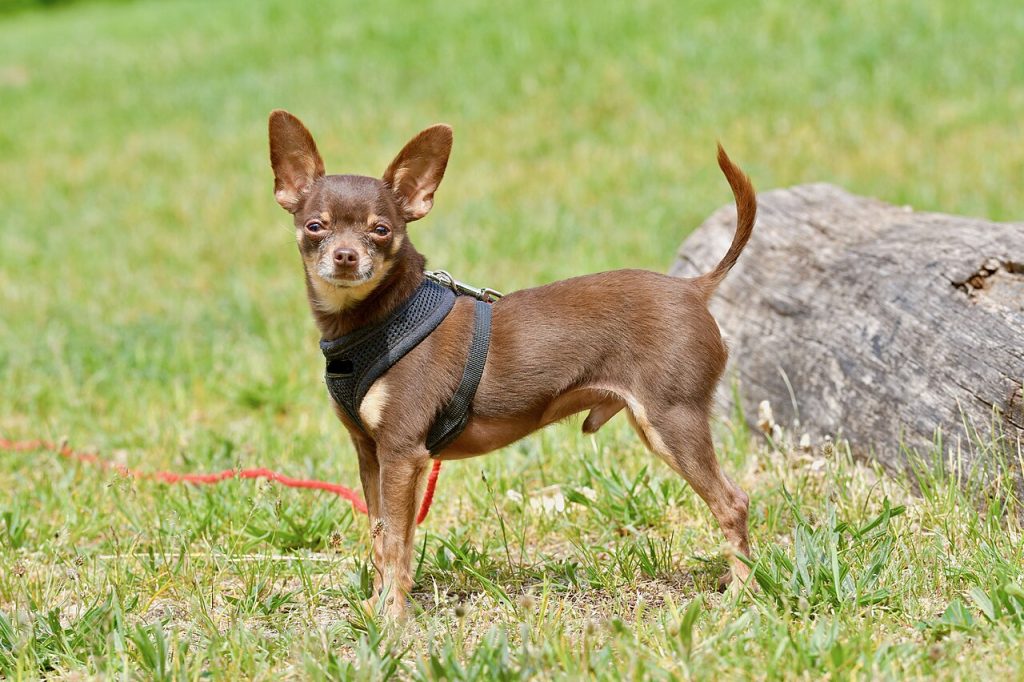
The Little Russian dog(known internationally as Russkiy Toy or Russian Toy) is one of the smallest companion breeds in the world: A dog with a huge pocket with a huge eye and a huge heart, born in Tsarist Russia as a puppy of the aristocracy and today a faithful shield of his host. Behind his apparent fragility lies the temper of a terrier: Mousetrap, warning barker and miniature guardian, so attached to his family he can barely stand to be left alone. If you’re looking for a small, stylish, devoted flatmate, the Little Russian Dog deserves to be thoroughly acquainted with before you decide.
Is Little Russian Dog for you?

The Little Russian is a pure companion dog: it wants to be with you, enjoys indoor life, and adapts to a flat like few others. But its extreme size and vocal temperament make it less suitable for homes with very young children or for those who spend the day outside. These two boxes summarize who fits in and who doesn’t.
In favour .
- Ideal for flats and small spaces; takes up very little space.
- Very attached and affectionate to his family; perfect lap dog.
- He needs little formal exercise: home play and short walks are all he needs.
- Short hair hardly requires maintenance.
- He is alert, cheerful, and alert.
- It’s easily transported wherever you go.
To be taken into account
- Very fragile: thin bones are fractured by falls or stomping.
- He tends to bark; you have to work the warning from a puppy.
- Reserved and suspicious of strangers if he doesn’t socialize.
- He has trouble coping with loneliness; he may suffer from separation anxiety.
- Sensitive to cold because of his size and low body fat.
- He usually needs to have his teeth cleaned and his baby teeth extracted.
Character and temperament
Active, cheerful, and alert, the Little Russian Dog belies the notion that a tiny dog is merely an ornament. He was raised both as a rat hunter and as a warning dog, and that second facet is still very much alive: is capable of becoming a little lookout who announces with barking any noise or visit. That is why he has a reputation for being vocal, a trait that should be cultivated as a puppy so that he does not become a compulsive barker.
With his family, it’s another thing entirely: he gives of himself. He binds himself tightly to the people in the household, regardless of their age, and enjoys spending hours near them, often climbing into their lap or seeking the warmth of a blanket. He is loyal to the point of being wary of what he perceives as a threat to his own, something striking in an animal that rarely exceeds 10 pounds.
In front of strangers it is usually reserved and cautious. It is not a dog that jumps to greet anyone; it observes, evaluates and decides. This natural prudence, well managed with socialization, translates into a balanced companion; poorly managed, it can lead to shyness or defensive barking. The key is to expose it early to people, sounds and various situations.
Coexistence: children, other pets, flat and loneliness

Niños. The Little Russian Dog can be a lovely companion for older, responsible children, but its fragility makes it unsuitable in homes with very young children. A jump from the couch, a stomp or an overly enthusiastic squeeze can cause it to fracture.
Other pets. usually gets along well with other dogs and can live with cats if raised with them. It is advisable to watch the game with much larger dogs, not because of bad intentions of these, but because of the physical risk that the difference in size entails.
Piso. is an almost ideal breed to live in an apartment. It does not need a garden, occupies very little and its activity level is well satisfied inside the house. The only point of attention is the bark: in neighborhood communities it is advisable to work on warning control to avoid conflicts.
Soledad. Here is its greatest weakness. It is a dog that lives for and for its family, and long absences weigh on it. Left alone for many hours it can develop separation anxiety, with barking, crying or destructive behavior. It is not the right breed for someone who spends full days outside without being able to take it with him.
Education and training
The Little Russian Dog is intelligent and highly motivated to please his family, which makes learning easier. It responds wonderfully to positive reinforcement – rewards, caresses, a gentle voice – and shuts down with harsh methods, which are also meaningless for such a delicate and sensitive animal. Short, fun and frequent sessions yield much more than long training.
Two fronts deserve priority attention. The first is the control of barking: As a good whistleblower, he will tend to alert you to anything, so it is good to teach him early on to be quiet on a signal and not to overreact. The second is early socialization, which is essential to counteract your natural tendency to distrust strangers; the more variety of people, environments, and noises you experience as a puppy, the safer and more balanced you will be as an adult.
A common mistake with very small dogs is the so-called “small dog syndrome”: allowing them behaviors we would never tolerate in a large one because “they are monkeys”. Treating them like a real dog, with clear and consistent rules, prevents them from becoming bossy, grumpy or insecure. Consistency is their best ally.
Exercise and activity
Despite its energy and alert nature, the Little Russian Dog has modest and perfectly acceptable exercise needs. A couple of short walks a day and playing time at home cover its physical expense. It loves toys, chasing small balls and games that involve interaction with its people.
Mental stimulation is as important as physical stimulation: smelling games, food dispensing toys, and little tricks keep your mind active and prevent boredom.
It is not advisable to confuse its vitality with endurance: it is a dog with thin legs and a light body, and days of intense exercise or jumps from heights are not for it.
Care: fur and hygiene

There are two varieties of fur and the maintenance varies depending on which one you choose. short hair‘s has a smooth, shiny, body-tight coat that barely requires care: a weekly gentle brushing and a run. The long hair has more hair with characteristic fringes on the ears, legs and tail; these fringes of the ears, between 3 and 5 centimeters, take up to three years to fully develop and require somewhat more frequent brushing to avoid tangles.
The most important in this breed is the dental hygiene: miniature dogs are prone to accumulating tartar and suffering gum problems, so regular tooth brushing is almost mandatory.
Because of its low body mass, it feels the cold a lot. In winter it appreciates a coat for walks and a warm and sheltered place to rest at home.
Foodstuffs
A dog this small needs a high-quality food, very digestible and with the energy density appropriate to its rapid metabolism.The usual way is to divide the daily ration into two or three servings and adjust the amount to its actual weight, age and activity level, always with the guidance of the veterinarian.
In puppies and very small animals, the risk of hypoglycaemia(low blood sugar), which is common in toy breeds, should be monitored: they should not go too many hours without eating.
The size of the croquette matters: it must fit your small jaw, and given your history of dental problems, products and habits that help keep your mouth clean are a good addition to your diet.
Health and life expectancy
Since the breed remained virtually unknown outside Russia until the 1990s, there is less information available about its health problems than in more studied breeds.
The most characteristic is retention of baby teeth: puppy teeth often do not fall out in time and the veterinarian must remove them, usually under anesthesia, so that they do not share alveoli with the definitive ones.
Like many small breeds, it may suffer from dislocation of the kneecap, an almost always hereditary defect in which the kneecap flexes out of place. And because of its delicate nature, it’s vulnerable to fractures of the bones derived from falls, jumps or bumps that an older dog wouldn’t even notice. Extreme physical care and avoiding heights is an essential part of their well-being. With proper care, it is a long-lived dog that usually accompanies its family for many years.
Physical appearance
The Little Russian Dog is one of the smallest dogs in the world. It measures between 20 and 28 centimeters at the withers and weighs 1.5 to 3 kilograms, with specimens that can approach 4. Its silhouette is elegant, with fine lines and long legs in proportion, which gives it a stylized and hopping look.
The head is small and very distinctive, with large, round, expressive eyes, and large, erect triangular ears s that give it an attentive, alert expression.
There are two varieties depending on the coat. The short-haired one has it smooth, shiny and attached to the body. The long-haired adds a longer coat with fringes on the ears, legs, and tail. The main colours are four: black and fire, blue and fire, brown and fire, and solid red in various shades, including sword variants. Interestingly, the short-haired variety closely resembles the Czech Prague mouse (Pražský Krysařík), although the latter is usually somewhat shorter and heavier.
Origin and history
The origin of the Little Russian Dog can be traced back to English-style terriers that arrived in Russia in the 18th century. The St. Petersburg Museum of Zoology preserves a dissected terrier dated between 1716 and 1726, with a sign identifying it as “Lizetta”, a dog that personally belonged to Emperor Peter the Great. The breed was developed as a companion dog of the Russian nobility, and there are records of specimens competing in exhibitions in St. Petersburg as early as the 19th century; the first widely accepted reference dates from May 1907, when eleven dogs were shown in the city.
The history of the breed was marked by two moments when it almost disappeared. The first came in the 1920s with the October Revolution: Associated with the aristocracy, these puppies fell out of favor and their numbers plummeted. Isolated from the outside world and with very few pedigree breeds, the Russian terrier developed into a different breed from the old English toy terrier, with a higher head, flat cheeks, and round eyes. By 1966 the first standard for the two varieties was drawn up, authorised by the Ministry of Agriculture.
The long hair variety was born from a dog named Chikki, born on October 12, 1958 to two parents with shorter hair somewhat longer than usual. Instead of discarding it, breeder Evgeniya Zharova registered it and crossed it, giving rise in Moscow to what became known as the Moscow Toy Terrier. The second critical moment came after the fall of the Iron Curtain in 1989: The avalanche of fashionable foreign breeds was on the verge of driving the Little Russian Dog to extinction, until a new generation of breeders recovered it. In 1988 the Russian Kennel Federation unified both varieties under the name “Russkiy Toy Terrier”.
International recognition came late but firm: The FCI accepted it provisionally in 2006 and definitively in 2017, classifying it in Group 9 (pet dogs). The United Kennel Club and the Foundation Stock Service of the American Kennel Club admitted it in 2008. Today it has established breeding operations outside Russia, with particular strength in Finland, Estonia, the Czech Republic and Ukraine, and growing interest in the United States and Japan.
Curiosities
- It is one of the smallest dog breeds in the world, comparable in size to the Chihuahua, although they are not closely related.
- The name “Terrier” disappeared from its official designation in 2006, being recognized by the FCI simply as Russkiy Toy.
- The ears of the long-haired variety can take up to three years to grow fully.
- From two short-haired individuals a long-haired offspring may be born if the gene is present; but the opposite has never been recorded.
- An English-style terrier belonged to Peter the Great and today is exhibited dissected in St. Petersburg, testimony to the breed’s origin.
- Despite its size, it retains its warning dog instinct: it was bred as a miniature mousetrap and guard dog.
If you are attracted to this tiny, devoted dog, you may also be interested in other small companion breeds with a distinctive character. You can compare the Little Russian Dog to the Chihuahua, with which it is often equated for its size; to the Yorkshire Terrier, another terrier toy; to the Teckel, brave and determined despite its size; or to the Bulldog Francés, another great floor companion.
Frequently Asked Questions About the Little Russian Dog
Does the Little Russian Dog bark a lot?
It has a tendency to bark because it was raised as a warning dog and retains that instinct. It is not an uncontrollable barking by nature, but it is advisable to teach it from puppyhood to warn without exaggeration and to be quiet on signal, especially if you live in an apartment with neighbors.
Is he a good dog to live on?
Yes, it’s almost ideal for an apartment. It takes up very little space, it doesn’t need a garden and its exercise needs are covered by short walks and play at home.
How tall and how much does a Little Russian Dog weigh?
It measures 20 to 28 centimeters at the withers and weighs 1.5 to 3 kilograms, although some specimens can approach 4. It is one of the smallest breeds in the world.
Is it the same as the Chihuahua?
They are similar in their diminutive size and so are often compared, but they are not closely related.
What medical care do you need?
The most characteristic is the retention of baby teeth, which usually require extraction by the veterinarian. You also need to monitor the dislocation of the kneecap, take great care of your dental hygiene and protect it from falls and bumps, since its thin bones break easily.
Do you get along with children and other pets?
It can coexist with older and responsible children and with other dogs or cats, especially if it is raised with them.
Can you stay alone for many hours?
It’s not ideal. It’s a very close family dog and long absences affect it; it can develop separation anxiety with barking, crying or destructive behavior. It fits better with people who spend a lot of time at home or who can take it with them.
What’s the difference between short hair and long hair?
The short-haired has a smooth, shiny coat that is attached to the body, with minimal maintenance. The long-haired has characteristic fringes on the ears, legs and tail, which take up to three years to develop and require somewhat more frequent brushing to avoid tangles.