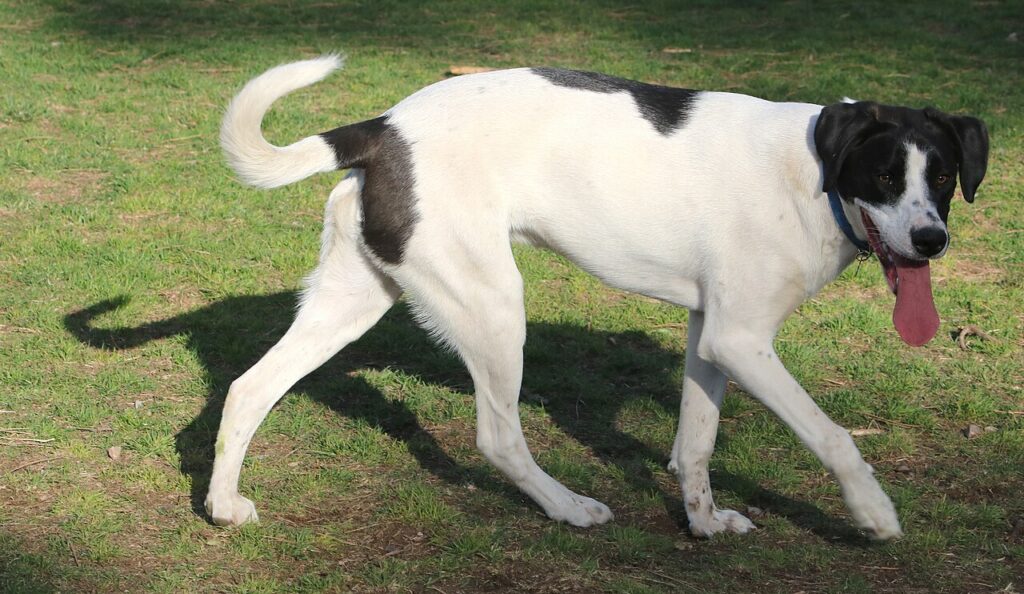
The Pointer Inglés is the show dog par excellence: an elegant athlete, with a very fine sense of smell and a tireless gallop, bred in England to locate the prey and signal it with his famous immobile “pose”. Beneath that pure hunter’s guise lives a noble, balanced and surprisingly affectionate companion at home. Of course, he’s a high-energy dog who needs real exercise. In this comprehensive guide we tell you about his character, what care he requires, his health, his history and everything you should know before sharing your life with an English Pointer.
Is the English Pointer for you?
The English Pointer shines with active people who enjoy the outdoors and want a sporty, healthy, easy-to-maintain dog. It’s not the ideal breed for a sedentary life: as much as it’s a quiet gentleman on the couch, its engine is built to run for hours. Before you decide, weigh these pros and cons.
In favour .
- Sturdy and elegant athlete, perfect for sports and outdoor life.
- Very short hair: barely needs brushing and minimal care.
- Noble, balanced and affectionate with his family.
- Generally healthy and long-lived (13-14 years on average).
- Little barking and nothing aggressive; poor candidate for guard dog, great candidate for companion.
To be taken into account
- He needs plenty of daily exercise; without it, he gets bored and frustrated.
- Its fine hair makes it susceptible to cold, rain and humidity.
- Very strong sense of taste and smell: it can “disconnect” after a trail.
- A somewhat independent character; it requires consistency and motivation in education.
- It doesn’t fit well in small apartments or with owners who spend many hours outdoors.
Character and temperament
To speak of the English Pointer is to speak of a two-faced dog, and both equally agreeable. In the countryside it is a passionate hunter, fast and tireless, with a very fine sense of smell capable of detecting the slightest odor even in dry, warm terrain. He works with an unmistakable style: At full gallop, he raises his head to “read” the wind and, as soon as he catches the piece, he gets stuck in his famous, firm, upright and expressive sample. It’s that instinct, refined over centuries, that defines much of their behavior.
At home, the landscape changes. The Pointer is a dog of stable temperament and adaptability, obedient and non-conflicting. He is described as faithful, noble and very affectionate to his people. Compared to other hunting dogs, it is somewhat more reserved and independent, with a slightly lower need for human contact: A probable heritage of the Greyhound running through his veins. This does not mean that he is distant; he is simply a dog who knows how to be alone for a while without being dramatic, provided he has spent energy before. Lines of work are usually much more active and nervous than exposed ones, something to be valued according to the lifestyle of each family.
Coexistence: children, other pets, flat and loneliness
Well socialized and with their exercise needs covered, the English Pointer is a comfortable and pleasant companion.
- With children: is tolerant, playful and good-natured.
- With other dogs: usually gets along well and enjoys canine company, especially if it has been raised in packs or with other dogs since puppyhood.
- With other pets:‘s strong hunting impulse may cause it to chase cats, rabbits, or birds; coexistence is possible with early socialization, but caution is advised.
- On the floor: is not your ideal environment. It can adapt if you receive several long and demanding outings a day, but a home with a garden or easy access to the countryside feels much better to you.
- Soledad: tolerates solitary mice better than other hunting breeds, but does not tolerate abandonment or lack of activity.
Education and training
The Pointer is intelligent and willing to collaborate, but its somewhat independent nature and ubiquitous sense of smell make education demand method and patience. The key is to start early, with short, fun and always positive sessions: reinforcement with rewards and play works infinitely better than harshness, which only manages to block such a sensitive dog.
Early socialization is essential for learning to manage stimuli, other animals and new environments. The call (the “here”) deserves special and constant work, because when a Pointer catches an interesting trail it can mentally “go away” and stop answering. It is wise to reinforce basic obedience in places with increasing distractions and, if possible, channel your natural instinct with scent games, searches or sample activities. A Pointer that understands its “job” is a much happier, more balanced dog.
Exercise and activity
This is undoubtedly the most important part of the breed. The English Pointer was designed to gallop for hours combing the terrain, and that need is still intact even though it lives in a city. It is not satisfied with a couple of short walks: it needs to run, explore and smell. We are talking about several daily outings and, ideally, loose moments in safe areas where it can deploy its stride.
Running, cycling (canycross and bikejoring), long walks in the countryside, mantrailing or scent-searching are activities he loves and that fill his double need, physical and mental. A Pointer that spends its energy is quiet, sociable, and obedient at home; one that doesn’t develops anxiety, destructive behavior, and nervousness. If you can’t guarantee a good level of daily exercise, this is not your breed.
Care: fur and hygiene
In terms of grooming, the Pointer is one of the most grateful dogs that exist. Its hair is short, thin, hard, smooth and shiny, without woolly undercoat, so maintenance is minimal: a weekly brushing with a glove or soft pig brush is enough to remove the dead hair and keep the coat shiny. It loosens hair moderately and only needs occasional baths, when it gets really dirty.
The big “but” of that short hair is thermoregulation: The Pointer passes cold easily and is sensitive to rain and humid climates. In winter, it is advisable to protect it with a waterproof coat for outings and avoid leaving it outdoors. As with any dog, he completes the routine by checking and cleaning his ears (falling and sticking to his face), cutting his nails when necessary, and maintaining dental hygiene with regular brushing.
Foodstuffs
As an athletic and high-energy dog, the English Pointer needs a complete and high-quality diet, adjusted to its actual activity level, age and weight. A sporting or working dog will burn many more calories than one with a quieter life, and the ration must reflect this to keep it at its optimal weight, muscular and without overweight.
Since it is a deep-chested dog, it is advisable to take precautions against gastric torsion: divide your food into two servings a day, prevent anxious eating, and avoid vigorous exercise just before or after eating. Always have fresh water available, especially on active days, and consult your veterinarian about the amount and type of feed that is most appropriate for each stage of your life.
Health and life expectancy
The English Pointer is considered a generally healthy and robust breed, with a life expectancy of around 13 to 14 years, a remarkable figure for a dog of its size.
Conditions that have been described in the breed include hip and elbow dysplasia, knee dislocation, hereditary sensory neuropathy, spinal muscular atrophy, X-linked cerebellar ataxia, and deafness. More specifically, it may show minor predispositions to hypothyroidism, demodicosis, cataracts, retinal dysplasia and corneal dystrophy. The best prevention is to go to responsible breeders who test the breeders, and to keep veterinary checks, vaccination and deworming up to date throughout their lives.
Physical appearance
The Pointer is a medium to large sized dog, athletic and harmonious, built in equal parts for endurance and speed. According to the standard, males measure between 63 and 69 cm at the withers and females between 61 and 66 cm, with a weight of around 25-30 kg in males and 20-25 kg in females. Its silhouette, with its clean lines and recollected belly, is partly reminiscent of that of the Greyhound, the result of the crosses that refined the breed.
It has a very characteristic head, with a slightly concave snout, elevated truffle and broad nasal openings; the ears are sloping, high-inserted and glued to the face. The neck is long and muscular, the breast broad, the limbs straight and well aplomated, the feet oval and the tail of medium length, thick at the base and tapering towards the tip, which leads to the height of the body. The mantle, short and thin, is usually bicolored: white with spots lemon, orange, liver (brown) or black, although there are also tricolor or one-color specimens, much rarer.
Origin and history
The origins of the English Pointer go back to England in the 17th and 18th centuries, when shotgun hunting became popular and dogs were sought that could locate the piece and “mark” it so that the hunter could shoot. The most widespread theory holds that the breed descends from the Old Spanish Pointer, brought to England in the early 18th century – usually cited as 1713, after the Peace of Utrecht – by soldiers returning from the peninsula. Other sources also point to Portuguese, Italian or French show dogs as part of their family tree.
Once on English soil, these dogs were crossed with local breeds to improve their skills: Setters, bloodhounds and foxhounds, and even bull terriers and bulldogs according to some chronicles. The earliest Pointers were heavy, restrained animals, able to hold a firm sample while the hunter prepared the weapon. With the improvement of firearms during the 18th and 19th centuries, faster and more agile dogs were sought, and Greyhound blood was introduced, which brought speed and that stylized air that distinguishes the modern Pointer. The breed standard was officially set in 1936 and has hardly changed since then. Today it is the most widely used and awarded show dog in UK and US field trials.
Curiosities
- His name says it all.“Pointer” comes from the English to point(“pointing”): the breed takes its name from the immobile pose it adopts to indicate where the hidden piece is.
- Point, but don’t charge. Unlike the continental show dogs (the so-called “hunt-point-retrieve”), the classic Pointer specializes in locating and signaling; collection is usually handled by recovery dogs.
- In the United States, especially in the South, the term bird dog is used to refer specifically to the Pointer.
- It’s grey blood. If you compare engravings of the 19th-century Pointer with one today, you’ll see a much finer and more stylized dog – the result of crosses with Greyhound.
- Judy, a Pointer dog, was the only animal officially recognized as a prisoner of war and received the Dickin Medal for bravery during World War II.
- Also in falconry. Its ability to locate and lift the piece makes it an ally of falconers and hunters with birds of prey.
If you are drawn to the world of show dogs and hunting sports, you may be interested in comparing the English Pointer to breeds in the same family. Check out the Short-haired German Bracho, a versatile all-terrain hunter; the sleek Weimaraner, with its signature silver coat; the energetic and affectionate Hungarian Vizsla; and the spectacular Setter Inglés, another British classic of field days. They’re dogs with similar exercise needs and a charm hard to resist.
Frequently asked questions about the English Pointer
Is the English Pointer a good family dog?
Yes. It is noble, balanced, affectionate and non-confrontational, which makes it an excellent companion for active families. Its only non-negotiable requirement is exercise: if it receives the activity it needs, home is quiet and pleasant.
How much exercise does an English Pointer need?
Many. He needs several daily outings and, if possible, leisure time in safe areas where he can run and smell. Activities such as running, canicross, hiking or olfactory games are ideal to meet his great physical and mental demand.
Does the English Pointer adapt to living in a flat?
A home with a garden or easy access to the countryside feels much better than a small flat.
Does the English Pointer lose a lot of hair?
Its hair is short and fine, and its moustache is moderate. A weekly brushing is enough to keep it clean and shiny.
Is it easy to train the English Pointer?
It is intelligent and collaborative, but somewhat independent and very sensitive to odors, so it requires constancy and positive reinforcement.
How long does an English Pointer live?
Their life expectancy is about 13 to 14 years, and they are generally a healthy breed; maintaining veterinary checkups, good nutrition, and proper exercise help them to grow up fit and healthy.
Can the English Pointer live with children and other pets?
With children it is usually tolerant and playful, although it is advisable to supervise the game because of its size and energy. With other dogs it gets along well; with cats or small animals you have to be careful, because its hunting instinct can lead it to chase them.