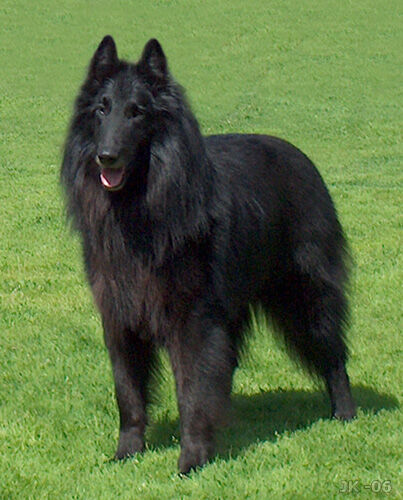
The Pastor Belga Groenendael is the long-haired, black azache variety of the Belgian Shepherd, an elegant, athletic and outstandingly intelligent herding dog. vigilant, sensitive and deeply attached to his family, he needs an active owner who gives him mental and physical work daily.
Is Belgian Shepherd Groenendael for you?
Before you fall in love with that black, furry silhouette, you should be honest: the Belgian Shepherd Groenendael is a demanding dog. He shines with whoever spends time with him and challenges him, and gets frustrated (with consequences) with whoever leaves him alone and bored.
In favour .
- High intelligence: learn quickly and enjoy your work.
- Huge loyalty and attachment to his family.
- Versatile: shepherding, obedience, agility, tracking, search and rescue.
- Natural instinct to guard and watch.
- Athletic and tough physique, ideal for dog sports.
- Spectacular coat and fairly easy to maintain despite its length.
Against
- He needs a lot of exercise and mental stimulation.
- Sensitive and reactive: requires early and constant socialization.
- Prolonged loneliness is bad for him; he may develop anxiety.
- It’s not a dog for beginners or sedentary homes.
- Abundant seasonal molds.
- He can be suspicious of strangers and reactive if bored.
Character and temperament

If we had to describe the Groenendael in three words it would be intelligent, alert and sensitive. It is a dog that observes everything, that seems to be always thinking and that connects with its reference person to the point of reading its body language. That sensitivity is its greatest virtue and, at the same time, what forces you to treat it with head: it responds phenomenally to positive reinforcement and closes in band with hardness.
It has a strong guarding instinct and a marked attachment to territory and family, which makes it an excellent alert dog. It is not aggressive by nature, but it is suspicious of strangers until it validates that there is no threat.
The Groenendael is also a tremendously active mentally dog. It’s not enough for him to get physically tired: You need to solve problems, learn new commands and feel useful. A Groenendael without a job is a Groenendael who invents his own, and you will rarely like the result (barking, chasing shadows, obsessively watching the window, nibbling). Well-managed, however, it is one of the most devoted and communicative companions there is.
Coexistence: children, other pets, flat and loneliness
- With children: is protective and affectionate with the children in its family, but its sensitivity and herding instinct can lead it to chase or “group” those who run and scream.
- With other pets: has been well socialized since puppyhood and is able to live comfortably with other dogs and cats in the house.
- On the floor: can adapt to living indoors as long as it is covered in daily exercise. It is not a garden dog that entertains itself: what it needs is to go out, move and work with you, live where you live.
- Soledad: is its weak point. The Groenendael is an intense bonding dog and is frankly bad at long days in solitude. Lack of companionship and stimulation easily leads to anxiety, barking and destructive behavior.
Education and training
This is where the Groenendael unleashes its full potential. It’s considered one of the smartest dogs in the world and learns at an astonishing speed: it picks up a new command in a few repetitions and retains it. That ability is a double-edged sword, because it also learns quickly what you don’t want it to learn.
The keys to his education are three: start early, be consistent and always work on the positive.. Early socialization – exposure as a puppy to people, noises, surfaces, other dogs, and various situations – is non-negotiable in such a sensitive breed; without it, an adult Groenendael may become nervous, suspicious, or unruly. Positive reinforcement (rewards, play, voice) brings out the best in him; coercive methods block it and damage trust.
Because of its restless mind, it loves short but challenging sessions: obedience, tricks, olfactory games, impulse control exercises. Channeling that mental energy is as important as physical wear and tear.
Exercise and activity

The Groenendael is a natural athlete, bred for centuries to jog alongside herds for hours at a time. Its body is built for endurance, and its energy level is high. A quiet walk around the block doesn’t do it any good: it needs real activity, every day.
As a guideline, he appreciates a minimum of one to two hours daily of distributed exercise, combining physical wear and tear (running, long walks, seek and bring game) with mental work.
An important detail: exercise does not replace mental stimulation, nor vice versa. A physically exhausted but mentally bored Groenendael will remain restless. The winning formula is to tire him inside and out, and do it with activities that strengthen your bond.
Care: fur and hygiene
Despite its spectacular mane, the Groenendael’s upkeep is more bearable than it seems. Its coat is double and long, with straight and abundant hair around the neck, chest (forming a mane or “collar”) and back of thighs, freckles on the legs and a plumed tail.
In everyday life, a brushed two to three times a week is enough to avoid knots and remove dead hair, paying attention to the areas of friction (behind the ears, armpits, freckles).
It does not need frequent baths: its hair tends to stay clean and excessive bathing dries the skin. Complements hygiene with regular checking and cleaning of ears, cutting nails when necessary and a good dental hygiene routine. Important: a Groenendael should never be shaved, because its double coat protects it from both cold and heat.
Foodstuffs
The Groenendael is a medium, muscular and very active dog, so it needs a complete, balanced and adjusted to its energy expenditure feeding.
The general guidelines are the usual ones for a breed of your size: It is important to ensure that the diet is adequate for your age, weight and activity level; high-quality food with a good protein intake to support your muscle mass; and divided into two daily servings in the adult. In the puppy, a specific growth food helps proper bone and joint development, something relevant in a breed with some predisposition to dysplasia.
Weight should be monitored – a Groenendael should look stylish, never stuffed – prizes should not be abused during training (discounted from the ration) and allowed to rest before and after intense exercise.
Health and life expectancy
Overall, the Belgian Shepherd is a robust and long-lived breed for its size. A British study placed the average life expectancy of the Belgian Shepherd (in its different varieties) around 12,5 years, a high figure both compared to other breed dogs and compared to half-breeds of similar size; in that same study, the longest-lived specimen reached 18 years. As a reasonable reference, a well-kept Groenendael usually lives between 12 and 14 years.
The pathologies to be monitored are those of the breed and dogs of its size:
- Hip and elbow dysplasia: the authorities recommend testing the breeders to reduce their incidence.
- Epilepsy and seizures: have a somewhat higher than average incidence in the Belgian Shepherd (around 9% in some surveys), so it is a point to monitor.
- Skin, reproductive and musculoskeletal problems: common in the species.
The main causes of death recorded were cancer, old age and failure of internal organs, a common pattern in dogs reaching advanced ages.Buying a responsible breeder who performs health tests, keeping veterinary visits and vaccination up to date, and taking care of weight and exercise are the best guarantee of a long and healthy life.
Physical appearance

The Groenendael is the elegant image of the Belgian Shepherd: a medium-sized, athletic and harmonious dog, with a body built for endurance rather than brute strength.
Its most distinctive feature is the long coat, uniform black and silky in appearance, which only supports a small white patch on the chest and fingers. The neck hair and the fringes of the legs and tail give it that unmistakable silhouette. The head is elongated and well-chinned, with a long snout and triangular, erect, high-inserted ears. The ensemble conveys nobility, attention and an almost savage distinction: Not in vain has he been compared by his demeanor to the wild canids.
It is worth remembering that the Groenendael is only one of four varieties of the Belgian Shepherd, which are distinguished by hair type and color: the Groenendael (long black hair), the Tervueren (long lion hair), the Malinois (short lion hair) and the Laekenois (hard lion hair).
Origin and history
The Belgian Shepherd Groenendael was born in Bélgica in the late 19th century. At that time, the country had an enormous variety of herding dogs, which differed greatly in appearance. To put an end to the chaos, the Belgian Shepherd Dog Club was founded in Brussels in 1891, and a team led by Professor Adolphe Reul of the Cureghem Veterinary School gathered more than a hundred dogs to lay the foundations for a unified breed. The first standard was drafted in 1892, and in time it was agreed to classify the Belgian Shepherd as a single breed with several varieties depending on the coat.
The Groenendael variety takes its name from the village of Groenendael, where Nicolas Rose, owner of the castle in the area, established the line of long-haired black dogs from his dog “Petite” and the male “Picard d’Uccle”, considered the founders of the variety. Their best offspring were widely crossbred while retaining the black color, and so the type we know today was established.
His story is tied to work and service. During World War I, the Groenendaels were used by the Belgian army to locate wounded soldiers and carry messages, a feat that was recognized by American soldiers, prompting their importation to the United States. That’s where a curious detail comes in: in the United States. The United States the name ‘Belgian Sheepdog’ is reserved precisely for the Groenendael, while the FCI recognises it as one of the four varieties of the same Belgian Sheepdog.
Curiosities
- In the United States, “Belgian Sheepdog” is the official name of the Groenendael; the American Kennel Club considers the four varieties as separate breeds, while the FCI groups them into one breed.
- The Belgian Shepherd is one of the most intelligent dogs in the world, ranking highly in both obedience and learning ability.
- It is possible for two individuals of the same variety to be crossed to produce puppies of a different variety – they are thus genetically related.
- The Groenendael owes its black color to its creator’s desire to fix a uniform type; Rose wanted to name the variety “Rose”, but it was discarded to avoid confusion with its dark coat.
- Today the Groenendael is still the most numerous long-haired variety of the Belgian Shepherd, highly valued both as a companion dog and in sports and services.
If you are attracted to the hardworking and intelligent character of the Groenendael, you will be interested in comparing its profile with that of its closest relative, the Pastor Belga Malinois, and with other large herding and working dogs such as the Pastor Alemán, the tireless Border Collie or the versatile Pastor Australiano.
Frequently Asked Questions about the Belgian Shepherd Groenendael
Is the Belgian Shepherd Groenendael a good family dog?
Yes, it is very loyal and protective of its family, but it is not an easy dog for any household. It needs active people who give it exercise, mental work and companionship. With children it behaves well if it is well socialized, although supervision is warranted because of its sensitivity and herding instinct.
How much exercise do you need a day?
As an orientation, between one and two hours a day combining physical wear and tear (running, long walks, play) and mental stimulation.
Is it hard to educate?
It’s one of the fastest learning dogs, so education is rewarding with the right technique. The key is to start early, be consistent and always use positive reinforcement. Hard methods block it. It’s not the best option for first-time owners.
Can you have it on one floor?
The Belgian Shepherd adapts to living indoors, but what he really needs is not space at home, but to get out, move and work with you every day.
Does it lose a lot of hair?
Its long and double coat is more bearable than it seems: it is enough to brush it two or three times a week. The exception is the seasonal moult, in spring and autumn, when it releases the undercoat intensely and it is convenient to brush it daily.
How long does a Belgian Shepherd Groenendael live?
Between 12 and 14 years on average, a high longevity for its size. A British study placed the average Belgian Shepherd at around 12.5 years, with specimens over 18.
Is it the same as the Belgian Shepherd Malinois?
Both are varieties of the same Belgian Shepherd, but differ in coat: the Groenendael is long-haired and black, while the Malinois is short-haired and lion-like.
Do you get along with children and other pets?
Well socialized since puppyhood, it coexists without problems with children, dogs and cats in the house.