The Rhodesian Ridgeback is a large, athletic dog of African origin, famous for the hair crest that runs along its back in the opposite direction to the rest of the coat. Raised in southern Africa to stalk lions and guard the farm, today he is a loyal, serene companion and deeply attached to his family. He’s a magnificent dog, but with very specific character and needs: Here’s the complete guide to whether the Rhodesian Ridgeback is a good fit for you.
Is the Rhodesian Ridgeback for you?
Before you fall in love with his image, you should be honest. The Rhodesian Ridgeback is a large hunting dog turned into a family dog: strong, independent and with a lot of energy. It is not a large stuffed animal or a dog to wear as an ornament. These are its lights and shadows for you to decide with your head.
In favour .
- Loyal and very attached to his family; a natural guardian and deterrent.
- Low-maintenance short hair: little brushing and very little smell.
- Clean, quiet in the house and not a lot of barking.
- Athletic and resistant: ideal companion for running, walking or hiking.
- Smart and sensitive; learns fast when he trusts you.
- Healthy and rustic compared to many large breeds.
Against
- Strong and independent: not recommended for first-time owners.
- It needs plenty of daily exercise; bored, it becomes destructive.
- Reserved with strangers and with a hunter’s instinct for small animals.
- It requires constant socialization and training from puppyhood.
- Its size and thrust can knock a small child down unintentionally.
- Risk of gastric torsion from his deep chest.
Character and temperament

The Rhodesian Ridgeback combines two seemingly opposite things: the toughness of a large hunting dog and a surprising sensitivity. It is loyal, intelligent and quiet at home, but also self-confident and with its own criteria. It is not a servile dog that obeys for obedience’s sake; it cooperates with you when you have earned its respect.
With its own kind it is affectionate and very attached, to the point of wanting to be always close. With strangers, on the other hand, it is reserved and distant. This caution should not be confused with aggressiveness: a balanced Ridgeback does not attack without reason, it simply observes and keeps on guard.
A nuance that many overlook: Despite its imposing physique, it is an emotionally sensitive dog. As early as 1922, the draftsman of its first standard warned that harsh treatment should never be applied to these dogs, especially young ones, because they “crumble” under such handling. The Ridgeback accepts a correction as long as it’s fair, consistent and comes from someone he trusts. Being hard on him is counterproductive.
Coexistence: children, other pets, flat and loneliness
- With children: is patient and protective of the children in the family with whom it has grown up, but its size and thrust can knock down a small child in the middle of play.
- Well-socialized With other dogs: coexists with other dogs, although males can be dominant.
- With cats and small animals: retains a strong hunting instinct. He can learn to respect house cats if he grows up with them, but he will chase other people’s cats, rabbits or birds.
- On the floor: can live on the floor if given plenty of daily exercise, because indoors it is quiet.
- Soledad: is very attached and doesn’t do well with prolonged loneliness. Spending too many hours only results in boredom, anxiety and destruction.
Education and training
The Ridgeback is intelligent and quick to learn, but it has a will of its own and is bored with repetition. This makes it a dog that challenges the trainer: not because it is “clumsy”, but because it questions the meaning of what you ask.
The key is to start early, with short, varied and motivating sessions, and lots of positive reinforcement. Early socialization – people, noises, other animals, environments – is non-negotiable so that as an adult he is stable and not overly suspicious. Set clear and consistent rules from day one: this dog instantly detects inconsistencies and a lack of serene leadership.
Forget the harsh or coercive methods: with a Ridgeback they only get you in a band or lose confidence. Calm firmness, patience and justice are your best tools. Consistency matters more than intensity.
Exercise and activity

There are no shortcuts here: the Rhodesian Ridgeback is a long-distance athlete whose ancestors accompanied hunters over vast distances across the African savannah, enduring the heat of the day and the cold of the night.
An adult requires at least one or two long hours of daily exercise: vigorous walks, running, play and, above all, opportunities to run at full speed in a safe environment.
In addition to muscle, the head must be tired: olfactory games, interactive toys, obedience and dog sports prevent boredom. A Ridgeback without expending physical and mental energy is a frustrated dog that will chew your couch. It is not a breed for a sedentary life.
Care: fur and hygiene

In this the Ridgeback is grateful. Its hair is short, dense, smooth and shiny, without woolly undercoat, so maintenance is among the easiest among large dogs. A weekly brushing with a glove or bristle brush removes the dead hair, distributes the natural fat and keeps the coat shiny.
Bathing is only necessary once in a while or when they get really dirty; their skin and hair stay clean easily and hardly give off a doggy smell. The rest is basic hygiene for any dog: checking and cleaning the ears, cutting the nails when they ring when walking, and taking care of dental hygiene with proper brushing or biters.
Because of its short hair, it tolerates heat well but not extreme cold: in harsh climates, it appreciates a coat for winter walks and a warm place to sleep.
Foodstuffs
The Rhodesian Ridgeback is a large, muscular and active dog, so it needs a quality diet, balanced and adjusted to its age, weight and activity level.
Watch the weight: the race has a certain tendency to thyroid problems that favor overweight, and the extra kilos punish joints and heart. You should look athletic, with the waist marked. Adjust the ration to your actual expenditure and limit the prizes.
A critical point for your deep chest is preventing gastric torsion: divide food into two servings instead of one, prevent her from drinking or eating anxiously, use anti-voral feeding trays if she swallows, and avoid giving her strenuous exercise just before or after eating.
Health and life expectancy
As a whole, it is a rustic and healthy breed, with a life expectancy of around 10-12 years (a study in the United Kingdom places the average around 12).
- Skin and subcutaneous tissue: is a birth defect of the breed’s own neural tube, a kind of “thread” under the skin along the back. The breeder must feel the puppies at birth to detect it; it has surgical solution.
- Hip and elbow dysplasia: as in other large breeds, it is advisable for breeders to have X-rays evaluated.
- Hipotiroidismo: is an increasing problem in the breed (among the most affected in thyroid records); it causes weight gain and hair loss, and is controlled with inexpensive daily medication.
- Degenerative myelopathy: late-onset neurological disease associated with a recessive mutation of the SOD1 gene, with genetic testing available.
- Gastric torsion (dilatation-volvulus) is defined as: common risk in deep-breasted breeds; it is a vital emergency requiring immediate veterinary attention.
Breed clubs recommend at least four breeder screenings: hips, elbows, thyroid, and eyes, with heart and hearing tests optional.
Physical appearance
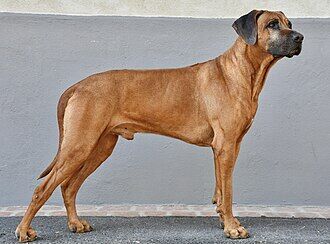
The Rhodesian Ridgeback is a large, strong and elegant dog, with athletic lines and a balanced build, capable of covering long distances with ease.
Its distinctive mark is the crest(the “ridge” that gives the breed its name): a strip of hair on the spine that grows in the opposite direction to the rest of the mantle.
The hair is short, dense, smooth and shiny, neither woolly nor silky. The colors range from pale wheat to reddish. A small white spot is admitted on the chest and fingers, and may present a black mask. The truffle can be black or brown (“liver nose”); in the specimens of black truffle the eyes are dark, and in the brown truffle, amber in tone, in harmony with the color of the dog.
Origin and history
The Rhodesian Ridgeback is the only recognized indigenous breed in South Africa today. Its roots go back to the semi-domesticated dogs of the Khoikhoi, a people of South Africa whose dogs already had that curious ridge of hair inverted on the back.
Starting in the 17th century and especially in the 19th, European settlers in the Cape crossed those native dogs with breeds they had brought with them – greyhounds, mastiffs, Great Danes and hounds, among others – in search of a dog capable of hunting and keeping in an extreme environment. Genetic analysis confirms, for example, a close relationship with the Great Dane. From these mixtures came the Boer farm dogs, direct ancestors of the modern Ridgeback.
Hunters discovered that by working in packs, these dogs were very effective against lions: They didn’t attack the prey, but they harassed it and distracted it by going in and out with quick teeth until the hunter arrived. Hence his famous nickname “African lion hunter”. In 1922, F. R. – What ? Barnes drafted the first standard in Bulawayo, in what was then Southern Rhodesia (now Zimbabwe), taking the Dalmatian as a reference; in 1927 it was approved by the South African canine union. The breed later came to the United Kingdom and the United States, where the American Kennel Club recognized it in 1955 within the group of hounds.
Curiosities
- Its most famous nickname is “African Lion Hound”, although its job was not to kill the lion, but to corner it for the hunter.
- The first breed standard was based on that of the Dálmata.
- The genetics of the crest was deciphered in 2007: it is due to a dominantly inherited gene duplication (FGF).
- Ancient genomes show that the Ridgeback retains about 4% of pre-colonial ancestry from southern Africa.
- Among its famous owners are Princess Charlene of Monaco, who had a Ridgeback named Khan, and actor Patrick Swayze, a great lover of the breed.
- It is so rustic that, in its original environment, it could withstand extreme temperatures and go more than 24 hours without water or food.
If you are attracted to the Rhodesian Ridgeback, you may also be interested in other large, athletic, or historically related breeds. Check out the Dálmata, whose standard inspired the Ridgeback’s; the towering Gran Danés, with which it shares a genetic affinity; the sleek and sporty Weimaraner; or the Bloodhound, one of the hounds that participated in its training.
Frequently Asked Questions about the Rhodesian Ridgeback
Is the Rhodesian Ridgeback an aggressive or dangerous dog?
It is not aggressive by nature. It is reserved and vigilant with strangers, but a balanced specimen does not attack without reason. Well socialized and educated, it is a dissuasive, loyal and reliable guard; problems usually come from lack of socialization or improper management.
Is this a good breed for someone who’s got their first dog?
It is not usually recommended for first-time owners. It is strong, independent, and needs calm leadership, early socialization, and plenty of exercise. It works best with people who already have experience with large, character dogs.
How much exercise do you need a day?
Enough: at least one or two long hours a day between walks, running and play, plus mental stimulation.
Do you lose a lot of hair and are you expensive to care for?
No, their hair is short and moderately loose, with a weekly brushing and occasional bathing, they barely smell, and they are one of the most comfortable breeds in terms of hairdressing.
Do you get along with children and other animals?
It is patient and protective with the children of its family, although due to its size it is advisable to supervise the game with the smaller ones.
How long does a Rhodesian Ridgeback live?
Their life expectancy is around 10-12 years; a British study puts the average at around 12.
What exactly is the “crest” of the back?
It is a strip of hair that grows in the opposite direction to the rest of the coat, forming two swirls or crowns that narrow towards the hips.
Can he live in a flat?
Yes, as long as he gets plenty of daily exercise, because the house is quiet and clean inside, but he appreciates space and a fenced-in garden, and he does not tolerate being alone for long hours.