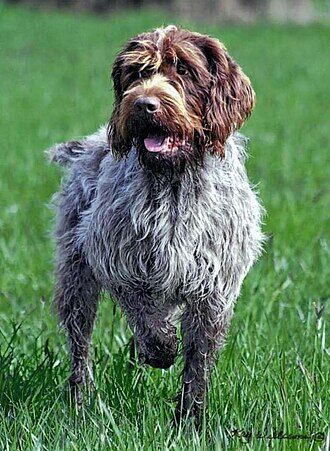
The Hard-haired sample griffin(Wirehaired Pointing Griffon or Gryphon Korthals) is one of the most versatile and endearing show dogs in existence. Under his unmistakably rough coat, beard and crowded eyebrows lurks a tireless hunter and, at the same time, a tender family companion deeply attached to his people. If you’re looking for a hardworking, intelligent, loving dog, the Hard-Haired Sample Griffin deserves a thorough introduction.
Is the Hard Hair Sample Gryphon for you?
Before you fall in love with its unkempt, sympathetic appearance, be honest about what it’s like to live with a Hard-haired Sample Griffin. It’s a wonderful dog for a proper home, but demanding of those who don’t fit in with its energy.
In favour .
- Extraordinarily attached and affectionate to his family.
- Very intelligent and eager to please: he learns fast.
- Versatile: shows, charges and works in water and weeds.
- It sheds less hair than most breeds.
- Balanced and sociable, rarely aggressive.
To be taken into account
- It needs plenty of daily exercise; it is not a sedentary dog.
- He suffers if he spends many hours alone or lives isolated in a yard.
- The hard coat requires stripping and regular care.
- His sensitive temperament does not tolerate harsh methods.
- Rare breed: finding a breeder can be expensive.
Character and temperament
If there’s one thing that defines the Hard Haired Sample Gryphon, it’s his balanced character and his devotion to people. It is an intelligent, attentive dog with a genuine desire to please its owner, a combination that makes it an easy companion to deal with inside the house. Unlike other more independent hunting dogs, the Gryphon wants to be close to its people; it likes to work for its owner, not on its own.
On the one hand, it is a gentle, patient, and rarely aggressive dog. On the other hand, it is much more affected by abrupt methods or yelling than a harsh-tempered dog: it shuts down, withdraws, and loses confidence. It is a dog that gives its best when it feels part of a group and is treated with respect.
On the field, he displays another facet: concentration, endurance, and a strong instinct for display. On the couch, on the other hand, he is usually calm and clingy, happy to rest at your feet after a good day of activity.
Coexistence: children, other pets, flat and loneliness
- With children: is excellent. It is patient, playful and tolerant, a good companion for active families. As always, it is good to teach children to respect their rest times.
- With other dogs: is generally sociable and has no problems, especially if it has been socialized as a puppy.
- With other pets: being a hunting dog with prey instinct, supervision with small animals is appropriate; many, however, get along well with cats if bred together.
- On the floor: possible, but not ideal. indoors it is quiet, although it needs long and intense exits to compensate for the lack of space.
- Soledad: is so attached to his family that he has trouble with prolonged loneliness and may develop anxiety or destructive behaviors if left alone for too many hours.
Education and training
The Hard-haired Show Gryphon is possibly one of the easiest show dogs to train, precisely because of that combination of intelligence and a willingness to please.
The key is in the tone. This dog responds wonderfully to positive reinforcement: rewards, play, gentle voice and consistency. It does not tolerate harshness; training based on harsh punishments or corrections achieves just the opposite, blocking it. It starts early, with short, fun sessions, and socializes the puppy with people, dogs, noises and a variety of environments.
By its origin, it shines in disciplines of hunting, show trials and collecting, but it also performs well in obedience, agility or tracking.
Exercise and activity
There are no shortcuts here: The Hard-haired Gryphon is a versatile hunting dog, bred to work full days in rough terrain, and that energy needs to be channeled. It needs at least one or two sessions of intense exercise a day – long walks, running, swimming, or active play.
He loves water and thick grass, terrains for which he was designed, so he greatly enjoys outings to the countryside, mountains or rivers. In addition to physical wear and tear, he needs mental stimulation: olfactory games, searches, and obedience exercises keep his mind occupied.
Care: fur and hygiene
Its hallmark is that double cloak, with a hard and rough outer hair (hence the “hard hair” of its name) and a softer and insulating inner layer.
- Cepillado: once or twice a week to prevent tangles and remove dead hair, especially on the beard, eyebrows and legs.
- Stripping: the hard coat is kept better with trimming or manual hair pulling (stripping) a couple of times a year, rather than a machine cut, which softens the texture.
- Muda: sheds considerably less hair than other breeds, although it is not a “mute-free” dog.
- Basic hygiene: check and clean the ears, watch the eyes under the eyebrows, cut the nails and take care of the beard, which tends to get dirty when eating and drinking.
Foodstuffs
As a good sporting dog, the Hardhaired Gryphon needs a quality diet, balanced and adapted to its actual level of activity. A specimen that hunts or exercises a lot burns a lot of energy and requires a greater caloric input than one with a quieter life; adjusting the ration to each stage and to each dog is the best rule.
Split food into two daily servings, avoid intense exercise right after eating (deep-breasted dogs have a certain risk of gastric torsion) and control weight regularly. Water always fresh and available, especially after days of activity.
Health and life expectancy
The Hard-Haired Sample Griffin is generally a rustic and healthy dog, with a life expectancy of about 12 to 15 years. Like any breed, it is advisable to acquire it from responsible breeders who perform health tests on breeders and offer written guarantees.
Since it is a medium-sized dog with droopy ears, it is worth monitoring the health of the ears (cleaning to prevent otitis) and, as in many breeds, paying attention to hip dysplasia and eye health.
Physical appearance
The Hard-Haired Sample Griffin is a medium-sized, robust and well-proportioned dog, with an unmistakable expression thanks to its beard and crowded eyebrows.
- Altura: males measure approximately 56 to 60 cm at the withers; females, between 50 and 56 cm.
- Peso: males weigh around 23-32 kg and females 16-23 kg.
- Pelaje: double, with hard and rough outer hair and soft undercoat. The preferred color is steel gray with brown spots, although brownish-brown, white and brown, ruano and white and orange are also accepted.
- Cabeza: large and elongated, with large round eyes covered by eyebrows and topped by a characteristic beard.
- Cuerpo: long neck, muscular trunk and well proportioned.
In the FCI nomenclature, the Hard Hair Sample Griffin is classified in the Group 7 (sample dogs), within the section of hard hair griffins.
Origin and history
Its creator was Eduard Karel Korthals, a dog enthusiast of Dutch origin who, around 1873, set himself an ambitious dream: to create the perfect versatile hunting dog, resistant, tireless, willing to work close to its owner and easy to train.
Korthals began their breeding line in 1874 with a founding female named Mouche and other specimens described as “griffins” (Janus, Satan, Bank, Hector and Junon). After carefully crossing her dogs for years, she obtained offspring that embodied her ideal: the so-called “Patriarchs Korthals” (Moustache I, Lina and Querida), direct ancestors of the breed. Much of this work was developed in his breeding farm Ipenwoud, in Biebesheim am Rhein (Germany), for more than twenty years; for this reason some consider the German breed and others, due to Korthals’ nationality, Dutch. Finally it was Francia who sponsored it and where today it is officially recognized.
The first griffin club was born in 1888 as an international organization, followed by clubs in Germany (1895), Belgium (1895) and France (1901). In the United States, the first specimen registered by the American Kennel Club was “Zolette” in 1887 – curiously listed as “Russian Setter (Griffin) ” for its supposed Russian origin – and it was not until 1916 that the breed was officially recognized as the Wirehaired Pointing Griffon. That same year, sixteen griffins paraded at the prestigious Westminster Kennel Club show.
Curiosities
- Its name varies by country: Wirehaired Pointing Griffon in the United States, Grifón Korthals or Griffon d’arrêt à poil dur Korthals in France, in honor of its creator.
- It was conceived as an “all-in-one” dog: it shows, crawls and works both on land and in water, something unusual in a single breed.
- Its rough coat is not only aesthetic: it acts as a natural armor against brambles and as an insulator in cold water.
- Despite its long history, it is still a relatively rare breed outside of continental Europe, including in the United States, Canada and the United Kingdom.
- Recent research has detected the introduction of another breed into the griffin population worldwide, which has sparked a debate between those who advocate keeping the Korthals Griffin “pure” and those who accept crosses.
If you’re interested in show dogs and versatile hunters, you may also want to meet the German Shorthaired Pointer, the rustic Italian spinone, the sleek Weimaraner or the energetic Vizsla, all hunting dogs with fascinating personalities and close ties to their owners.
Frequently Asked Questions about the Hard Hair Sample Griffon
Is the Hard Haired Sample Gryphon a good family dog?
Yes. It is an extraordinarily attached dog to its people, sweet and sociable, which enjoys participating in home life. It is worth remembering that it needs a lot of daily exercise and company; it is not a dog to be left alone or relegated to a yard.
Does the Hard Hair Sample Gryphon shed a lot of hair?
It sheds considerably less than most breeds due to its hard and rough coat, but it is not a dog that does not shed: all dogs shed hair.
How much exercise does a Hard Hair Sample Griffin need?
It’s a versatile hunting dog bred to work all day in the field, so it needs at least one or two long hours of intense activity a day, in addition to mental stimulation.
Is it easy to train the Hard Hair Sample Gryphon?
It is intelligent and eager to please, which makes it very easy to train, but it has a sensitive temperament and does not tolerate harsh methods: it responds to positive reinforcement, patience and coherence.
Where does the Hard Haired Sample Griffon originate from?
Its origins are a European story: its creator, Eduard Karel Korthals, was Dutch, he developed the breed for more than twenty years in Germany (in his breeding farm Ipenwoud, in Biebesheim am Rhein) and finally it was France who sponsored it and where today it is recognized as a French breed.
Is the Hard Hair Sample Gryphon adapted to living in a flat?
It can live on the floor if it gets plenty of exercise and doesn’t stay alone for too many hours, because indoors it’s usually quiet and sticky.
How long does a hard-haired sample griffin live?
Its life expectancy is about 12 to 15 years, a good longevity for a medium-sized dog.
Does the Hard Haired Sample Gryphon get along with other dogs and pets?
As a hunting dog with a show instinct, it is advisable to socialize it well and to have some caution with small animals, although many coexist without problems with cats if they grow up together.