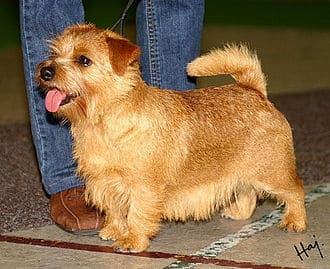
The Norfolk Terrier is one of the smallest working terriers in existence: a compact, brave and surprisingly affectionate British puppy with droopy ears and a hard reddish coat that gives it an eternally uncombed look. Born in the barns of East Anglia to hunt deer, today he is above all an alert and manageable family companion. If you’re looking for a small dog with a terrier soul but a good temper, the Norfolk Terrier deserves your attention.
Is the Norfolk Terrier for you?
The Norfolk Terrier is suitable for those who want a small, robust, low-maintenance dog, but with terrier energy and a willingness to participate in everything. It is not an ornamental dog: it enjoys walks, games and the constant company of its people. Before deciding, weigh its lights and shadows.
In favour .
- Small and manageable, ideal for a flat or a house with a garden.
- Of the terriers with the most gentle and sociable character.
- Very attached to people and good with children.
- It usually gets along well with other dogs (it is a pack dog).
- It sheds sparingly and is considered largely hypoallergenic.
- Healthy and long-lived, with a good life expectancy.
To be taken into account
- Strong prey instinct: watch out for other rodents, rabbits or cats.
- Hard hair needs stripping, it doesn’t rip.
- He has his typical terrier stubborn point of independence.
- If he gets bored or spends too much time alone, he may dig or bark.
- He’s not a dog to live outside: he needs to be inside, with his family.
- Demand outstrips supply: finding a puppy from a serious breeder is expensive.
Character and temperament

The Norfolk Terrier has a temperament that demolishes the stereotype of the nervous and quarrelsome terrier. It is courageous and resolute – not for nothing it was bred to crawl into burrows and face predators – but along with the Norwich Terrier and the Border Terrier it is considered one of the sweetest and most balanced temperament terriers.
It is a cheerful, curious and very attached to people dog. It adapts its activity level to the rhythm of the house: as soon as it accompanies you on a walk as it curls up with you on the couch. Of course, it retains its independence: it thinks for itself and sometimes decides that its plan is better than yours. It is not malicious stubbornness, but the cunning of a hunter accustomed to solving alone.
It is not a particularly barking dog or the kind that protests about everything, but it does have a watchdog instinct and will warn when something deserves it. Beneath its hairless plush appearance beats a born hunter with a strong prey instinct for small animals, something not to be forgotten.
Coexistence: children, other pets, flat and loneliness
- With children: is excellent. It is sociable, patient and playful, and enjoys family life. As with any small dog, it is good to teach the younger ones to handle it with respect.
- The Norfolk was bred to work in packs, so coexistence with other dogs usually comes naturally.
- If it grows up with a cat it will accept it as part of the family, but its prey instinct towards rodents, rabbits or birds is strong; it is not a good combination with hamsters or guinea pigs.
- On the floor: is perfectly adaptable, its small size and sparse moustache make it comfortable indoors, as long as it receives your daily walks and stimulation.
- In the face of loneliness: is its weak point. It needs company and human contact; if it spends too many hours it can only get bored and develop behaviors such as digging or barking. It is not a dog to leave in the garden or for empty homes all day.
Education and training
The Norfolk Terrier is intelligent and quick to learn, but its independent side demands a skillful approach. It responds much better to positive reinforcement – rewards, play, cheerful voice – than to imposition. Short, varied, and fun sessions work better than long, repetitive routines, which bore it quickly.
Early socialization is key: the sooner you get to know people, dogs, noises and different environments, the more balanced you will be as an adult. You should also work on calling and self-control, because your prey instinct can lead you to run after a cat or a squirrel ignoring your orders.
It is a sensitive dog that does not fit into harsh methods: firm but gentle treatment, constancy and patience give the best results.
Exercise and activity

Despite its size, the Norfolk Terrier is an active and athletic dog that needs to expend energy daily. It is not satisfied with a couple of hygienic outings: it appreciates walks of a certain duration, playing moments and, above all, mental stimulation. A Norfolk who is bored is a Norfolk who seeks fun on his own, usually digging or entertaining with mischief.
With a couple of decent daily walks plus some game of searching, throwing, or tracking scents, he has plenty to keep himself happy and in shape. He loves activities that awaken his hunting instinct, such as olfactory games or earthdogs, and his agility makes him stand out in small-scale agility.
Its energy level is flexible – it fits well into your family’s lifestyle – making it a good companion for both active people and quieter homes, as long as you don’t neglect your daily dose of exercise and attention.
Care: fur and hygiene
The Norfolk Terrier’s coat is twofold: a hard, rough, wire-like outer coat, and a soft, warm inner coat.
Brushing is simple: A metal comb once a week is enough to remove dead hair and avoid tangles; ideally it would be daily, but it is not essential in a companion dog. The key is in the stripping or manual hair start, which is done at least twice a year (typically in the fall and spring). It is important not to shave or cut the coat with scissors or a machine, because that ruins its characteristic rough color and texture, leaving it soft and dull.
Otherwise it is a very clean dog. It bathes only when it is dirty, with a shampoo suitable for dogs. It sheds very little hair during the year and is considered to be highly hypoallergenic, which makes it attractive to many households. It completes the routine with the usual: checking ears and eyes, cutting nails and taking care of dental hygiene.
Foodstuffs
As a small but active dog, the Norfolk Terrier needs a complete and balanced diet, tailored to its size, age and activity level. A quality feed for small breeds or a well-formulated diet perfectly meets its needs; the important thing is the right quality and quantity, not the specific brand.
It is advisable to monitor the rations and divide the food into two portions per day. As a good gluttonous terrier, the Norfolk can gain weight easily if it is overfed or overrewarded, and overweight punishes its joints and heart. Maintaining your ideal weight is one of the best things you can do for your long-term health. Always have fresh water at your disposal and adapt your diet to each stage of your life, from puppy to senior dog.
Health and life expectancy

The Norfolk Terrier is a robust and remarkably long-lived breed. A 2024 British study estimated its life expectancy at around 13.5 years, above the average of purebred dogs, confirming its reputation as a healthy and hardy dog.
Still, like all races, there are predispositions to be known. Among the most well-documented are mitral valve disease (a heart problem), kneecap dislocation, and malocclusions or bite defects (teeth that do not fit according to the standard). Shallow hips and hip dysplasia have also been described in several bloodlines, so responsible breeders X-ray and evaluate the hips of their breeders.
The best guarantee of a healthy puppy is to go to a serious breeder who performs the relevant health tests, raises only healthy and good-tempered specimens, and raises in a suitable environment, since the first weeks mark the character of the dog for life. Coupled with good nutrition, regular exercise, weight control, and regular veterinary checkups, the Norfolk has all the cards to go with you for years to come.
Physical appearance
The Norfolk Terrier is, along with its relative the Norwich, the smallest of the working terriers. It is a compact, short and well-proportioned dog, with good boning and resistant appearance: neither too heavy (it would lose agility) nor too thin (it would look like a toy dog).
The ideal height is around 23 to 25 cm at the withers, with an approximate weight of 5 to 5.4 kg. Its most distinctive feature compared to the Norwich is the drooping ears(bent forward), while the Norwich carries them upright; in fact, it was this difference that separated the two breeds.
According to the standard, all shades of red, wheaten, black and tan, and grizzly are accepted. The expression is lively and wary, with dark eyes and an alert look that betrays his alert and good-natured character.
Origin and history
The Norfolk Terrier is a British dog that originated in East Anglia, in eastern England, and owes its name to the county of Norfolk. Its origins date back to the 1880s, when English sportsmen and amateurs looked for a small and effective working terrier to rid barns of rats and other vermin. To do this, they crossed local short-legged terriers with small Irish-type terriers and with the small red terriers used by the local Roma mouse hunters.
Those dogs had funny names before they settled on the current one. They were first called Cantab Terrier, when they became fashionable among students at Cambridge University, who had them in their bedrooms. They were later renamed Trumpington Terrier, after Trumpington Street where the breed continued to be developed in stables. And shortly before World War I, Irish horseman Frank Jones sold many of these short-legged terriers to the United States, where they became known as Jones Terriers.
In 1932, the British Kennel Club recognized the Norwich Terrier and drafted its first standard; the erect-eared variety and the slender-eared variety then coexisted under the same name. Separation came in 1964, when the Kennel Club reclassified the dropped-eared variety as a separate breed, the Norfolk Terrier, leaving the Norwich name for the upright-eared. The American Kennel Club and the Canadian Kennel Club recognized the division in 1979, the same year the United Kennel Club did. Today the breed is in Group 3 (Terriers), Section 2 of small size terriers, of the FCI.
Curiosities
- Separated brothers: Norfolk and Norwich Terrier were the same breed until 1964; the only thing that distinguishes them is the shape of the ears (fallen in the Norfolk, erect in the Norwich).
- The smallest in the business: both share the title of smallest working terriers in existence.
- From Cambridge to America: went by the names Cantab, Trumpington and Jones Terrier before settling on their final name.
- Character of gold: is considered, along with the Norwich and Border Terrier, one of the mildest temperament terriers.
- Dogs in packs: unlike many terriers, was bred to work in a group, which explains its good sociability with other dogs.
- Coat that does not cut: shaving a Norfolk ruins the color and texture of his hair; the correct thing is manual start.
If you are attracted to the Norfolk Terrier, you will surely enjoy meeting other related breeds. Its most direct relative is the Norwich Terrier, practically identical except for the ears. It also shares that friendly terrier character with the Border Terrier, another of the small, sweet-tempered workers. Cairn Terrier Yorkshire Terrier
Frequently Asked Questions about the Norfolk Terrier
Is the Norfolk Terrier a good dog for families with children?
Yes, it is sociable, affectionate, and playful, and it is considered one of the most mild-tempered terriers. It enjoys family life and gets along well with children, provided they are taught to treat it with respect.
How tall and how much does a Norfolk Terrier weigh?
It is one of the smallest terriers: it measures about 23 to 25 cm at the withers and weighs approximately between 5 and 5,4 kg. It is compact and robust, without becoming a toy dog.
How many years does a Norfolk Terrier live?
It is a long-lived breed. A British study from 2024 put its life expectancy at around 13.5 years, above the average for purebred dogs. With good care it is easy to exceed that figure.
Does the Norfolk Terrier shed a lot of hair?
It sheds very little hair throughout the year and is considered to be largely hypoallergenic.
Do you get along with other dogs and pets?
With other dogs it usually gets along very well, as it was bred to work in packs. With cats it can coexist if it grows up with them, but its strong prey instinct makes it unsuitable for rodents or other small animals.
Do you need a lot of exercise?
He is active and needs to expend energy daily – a couple of walks, playtime, and mental stimulation – yet he adapts his activity level quite well to the rhythm of the house, so he fits into both dynamic and quiet homes.
What’s the difference between the Norfolk Terrier and the Norwich Terrier?
They are almost identical breeds that shared a name until 1964. The key difference is in the ears: the Norfolk carries them down (bent forward) and the Norwich carries them upright.
Does the Norfolk Terrier bark a lot?
It’s not a particularly barking dog, but it warns when something’s due, by its guarding instinct, but it’s not usually noisy unless it’s bored or spending too much time alone.