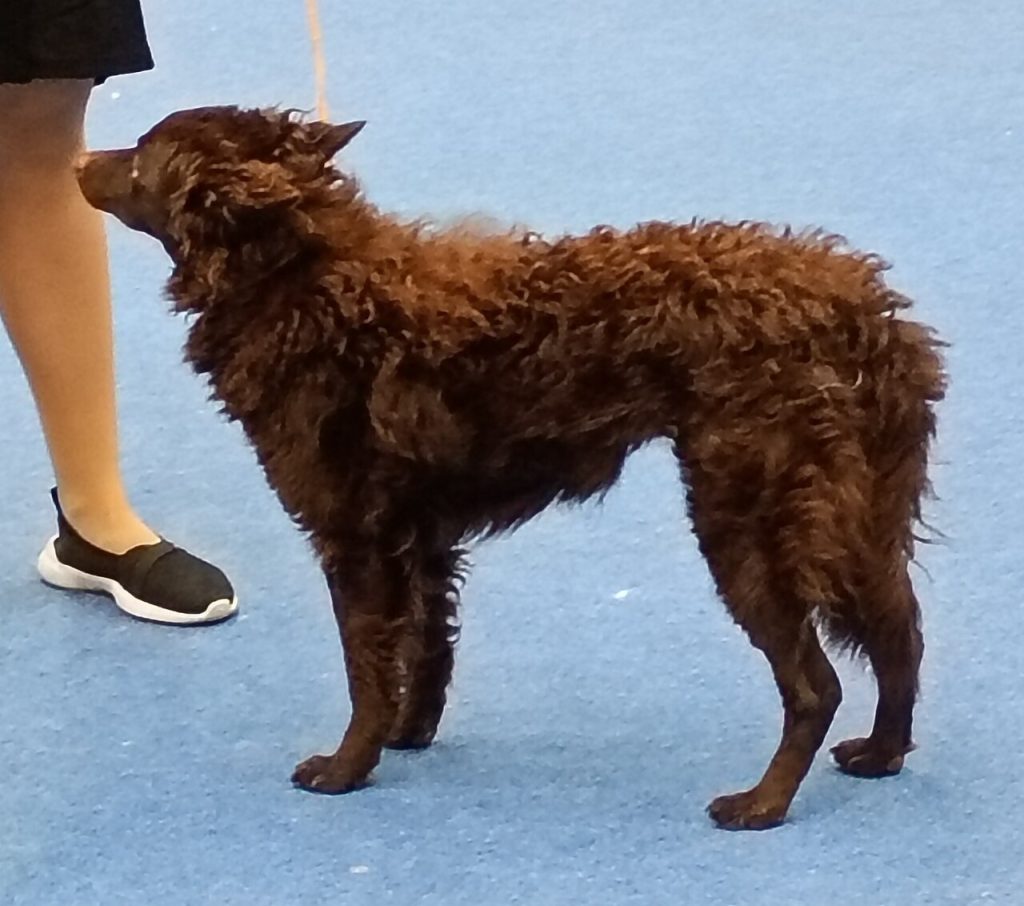
The Mudi is one of those dogs that hardly anyone knows outside of their native Hungary and yet leaves its mark as soon as you see it at work. Versatile, agile and intelligent, the Mudi is a farm dog made to move: He guides herds, warns as a guardian, hunts prey and shines in any canine sport. If you are looking for a companion who is energetic, loyal, and eager to learn – and willing to give him the exercise and mental work he needs – the Mudi may surprise you. In this guide, we go through their character, care, health, and history so that you know if it’s the breed for you.
Is the Mudi for you?
The Mudi is not a dog for any household. It is a working breed with a lot of energy and a head that does not stop: it needs movement, mental stimulation and an owner who gives it a purpose. In the right place, it is an exceptional companion; in the wrong, a frustrated and barking dog. Before you fall in love with its curly hair, look honestly at these two lists.
In favour .
- Very smart and easy to train: he learns almost anything.
- It’s really versatile: shepherding, agility, obedience, flyball, frisbee, the search.
- Medium size manageable, healthy and moderately maintainable.
- Coat that needs little brushing compared to other shepherds.
- Loyal, vigilant and very close to his family.
- Rustic and long-lived breed, with few known hereditary problems.
Against
- It needs a lot of daily exercise: it’s not worth a short walk.
- It tends to bark; without work it can become noisy.
- Bored or alone too many hours, he develops destructive behaviors.
- Shepherding instinct: may try to “catch” children or pets.
- Reserved with strangers; requires constant socialization.
- Rare breed: hard to find and with few serious breeders.

Character and temperament
The Mudi is first and foremost a working dog with an intense personality. Its own Hungarian breeders often say that, although it is much less popular than the Puli or Komondor, they would not trade it for either: They recognize in him a versatility and an ever-kind and hardworking disposition that is hard to match. It is an alert dog, attentive to everything that happens around it and with a very quick reaction capacity.
With his family, he is affectionate and deeply loyal. He is very attached to his people and enjoys being close to them, participating in whatever they do. This loyalty has its counterpart: the Mudi is reserved and vigilant with strangers, which makes him a natural guardian and an excellent alarm dog.
It is a sensitive and perceptive breed, which reads its owner’s mood very well. This makes it wonderful for those who understand how to communicate with it, but it also means that it suffers from harsh methods or incoherence. A well-guided Mudi is balanced, confident and charming; a poorly managed one, nervous and difficult.
Coexistence: children, other pets, flat and loneliness
With children: the Mudi can be a great playmate for active children, always with supervision. Its strong shepherding instinct can lead it to “catch” the little ones by giving small pushes or nibbling on heels when they run; it is a natural behavior that is corrected with early education, but it is worth knowing.
With other pets: is well socialized since puppyhood, cohabits with other dogs without problems. With cats and small animals you have to be patient: its origin as a rodent hunter awakens the instinct of pursuit, so the introductions should be gradual.
On the floor: a Mudi can live in an apartment if – and only if – it is provided with plenty of daily exercise and stimulation. It is not its ideal habitat. It performs much better in a house with terrain to run and play in wide spaces; in fact, it is a breed that can live perfectly outdoors in temperate climates.
In the face of loneliness: here’s his Achilles heel. The Mudi is a companion and working dog that doesn’t like to spend long hours alone. Boredom and lack of stimulation quickly lead to barking, digging and wrecking. It’s not the breed for someone who walks outside all day.
Education and training
If there’s one thing that defines the Mudi, it’s its ease of learning. It’s one of the most intelligent and trainable dogs out there: it picks up commands with very few repetitions and genuinely enjoys training. For an experienced owner, it’s a luxury; for a motivated beginner, it’s a very appreciated challenge as long as you use the right methods.
It responds wonderfully to the positive reinforcement: rewards, play and praise. It is sensitive, so screaming and harshness can only block it or make it suspicious. The key with this breed is consistency, short and varied sessions – it gets bored of mechanical repetition – and always giving it a “job” to do.
The early socialization is non-negotiable. A Mudi who as a puppy knows people, dogs, noises and different environments will be a balanced adult; one raised in isolation will tend to be fearful or excessively barking.

Exercise and activity
This is the point that decides whether the Mudi is your dog or not. We are talking about a very high energy. breed that needs much more than a walk around the neighborhood. The Mudi requires daily long and vigorous walks – at a brisk pace or even jogging – and, in addition, a safe space where he can run freely and thoroughly. Without that physical discharge he is not in good shape either in body or head.
The Mudi is a dog that needs work your mind.. He loves to play and excels in all kinds of canine sports: agility, obedience, rally, frisbee, flyball, tracking, Schutzhund and, of course, the herding tests, where he brings out his natural instinct.
A Mudi that plays sports, learns new tricks and has a clear function is a happy and calm dog at home. One that just walks around the garden is a frustration bomb about to explode. If you like hiking, running or any outdoor activity, this breed will be your perfect shadow.
Care: fur and hygiene
Good news: the Mudi’s coat is surprisingly easy to maintain. It has a medium-length, wavy or curly coat over the body, with short, smooth hair on the face and front of the legs. It does not form ropes or require the complex maintenance of other Hungarian shepherds such as the Puli or Komondor.
With a weekly brushing it is enough to keep the hair healthy and free of knots; in times of moult it is advisable to brush a little more often to remove the dead hair.
The rest of the hygiene is the usual for any healthy dog: checking and cleaning the ears to prevent infection, brushing the teeth regularly, cutting the nails when they don’t wear out on their own, and keeping the deworming up to date.
Foodstuffs
Being a medium and very active dog, the Mudi needs a quality diet, with good protein intake, adapted to its high energy expenditure. The exact amount depends on its weight, its age and – above all – the actual exercise it does every day: a Mudi that competes in agility or works with herds burns many more calories than a companion.
The ideal is to distribute the daily ration in two meals and adjust it by observing its physical condition: the Mudi must remain slender and muscular, without overweight. It is an athletic dog and excess weight punishes its joints and heart. Always have fresh water available, especially after intense exercise.
As with any breed, it is best to avoid feeding just before or after a large effort and to consult your veterinarian about the most appropriate diet for each stage of your dog’s life, from growing puppy to senior dog.

Health and life expectancy
The Mudi is generally a healthy and robust breed, a result of its origin as a rustic farm dog selected for its utility rather than its aesthetics.
As it is a small population and little manipulated by intensive breeding, it does not carry the long list of hereditary problems of other more popular breeds. Still, as with all dogs, common issues such as hip dysplasia, eye problems, and dental care should be monitored. The best prevention is to go to a responsible breeder who checks the health of the breeders.
Regular veterinary checks, daily vaccination and deworming, a balanced diet and – essential in this breed – sufficient exercise are the keys for your Mudi to reach old age healthy and active.
Physical appearance
The Mudi is a rustic-looking and proportionate medium size dog, built for work. The males usually measure between 36 and 47 cm at the withers and weigh around 8 to 13 kg, with the females somewhat lighter.
Its most recognizable feature is the coat: medium-length, dense, wavy or clearly curled over the body, and instead short and smooth on the head and the front face of the limbs.
A curious detail is the tail: the Mudi can be born with a full long tail or with a natural short tail (bobtail); the FCI pedigrees indicate whether the specimen was born with a short tail naturally.
Origin and history
The Mudi is one of the native Hungría herding breeds, closely related to the Puli and Pumi, from which it differentiated as its own breed in the 1930 decade.
The breed was “discovered” and described as such in 1936 by Dr. Dezső Fényes, director of a Hungarian museum, who popularized it with the name “driver dog” or “boyer dog”.
International recognition came from the International Kennel Federation (FCI) in the year 1966. Already in the 21st century, the breed took important steps towards its worldwide spread: the American Kennel Club recognized it as a pure breed on 5 January 2022, and the British The Kennel Club did the same in 2025. Despite these milestones, the Mudi remains a rare breed even in its country of origin.
Curiosities
- The best kept secret of Hungary. Although the Puli and Komondor take all the glory, the breeders of the Mudi maintain that their versatility is unrivalled among Hungarian herders.
- It’s a farm SUV. A single Mudi can herd sheep, drive cattle, hunt rats, guard and warn of intruders.
- The surprise tail. is one of the few breeds in which some puppies are born with a long tail and others with a natural short tail, within the same litter.
- Star of canine sports.‘s intelligence and agility have made him an outstanding competitor in agility and frisbee far beyond what his oddity would lead one to expect.
- Superviviente. was on the brink of extinction after World War II and its current population descends from a handful of recovered specimens.
If you are attracted to the Mudi for its energy, intelligence, and shepherding instinct, you may be interested in other working dog breeds with a similar profile. Check out the Border Collie, the smartest and hardest-working shepherd of all; the versatile Pastor Australiano, another great athlete with a merle coat; the sleek Shetland Shepherd, small and alert; or the versatile Pastor Alemán, the quintessential working dog.
Frequently asked questions about the Mudi
Is the Mudi a good dog to live on?
It can live in an apartment, but it’s not its ideal habitat. It only works if you give it plenty of daily exercise and mental stimulation. Without it, it barks, it gets bored and develops destructive behaviors. It performs much better in a house with land.
How much exercise does a Mudi need a day?
It needs long, vigorous walks every day, plus a safe space to run freely. Physical exercise should be combined with mental stimulation: dog sports, tricks or herding. A short walk around the neighborhood is not enough.
Does the Mudi bark a lot?
It is a vigilant breed and has a tendency to bark, especially if it is bored or has no work to do. It is an excellent alarm dog. With early education, barking control and enough exercise, the problem is well managed.
Is it hard to train the Mudi?
On the contrary, it is one of the most intelligent and easy-to-train dogs in existence. It learns with very few repetitions and enjoys training. It responds to positive reinforcement and hates harsh methods, which block it.
Does the Mudi get along with children and other pets?
Yes, well socialized. With children it is a good playmate, although its herding instinct may lead it to “catch” the smaller ones. With other dogs it coexists without problems; with cats and small animals it is advisable to make gradual introductions.
How long does a Mudi live?
Between 12 and 14 years with proper care. It is a rustic and healthy breed, with few known hereditary problems thanks to the fact that it has not been subjected to intensive breeding. Veterinary reviews and exercise are key to its longevity.
Does it cost a lot to maintain your fur?
No. Its medium coat, wavy or curly, is maintained with a weekly brushing and a little more in the muzzle. It does not form strings like the Puli or require frequent baths. It is one of the easiest Hungarian shepherds to care for in terms of hair.
Where does the Mudi originate from?
Described in 1936 by Dr. Dezső Fényes and recognized by the FCI in 1966, it remains a rare breed even in its country of origin.