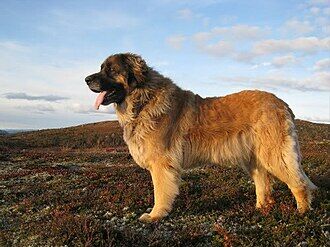
The Leonberger is a German giant leonin-haired dog, black mask and serene character, bred in the mid-19th century in the town of Leonberg. It combines the towering size of its mountain ancestors with an amazing sweetness for the family, making it one of the great gentle giants of the canine world. It is a versatile working dog, a natural swimmer, and a loyal companion, but its size and care demand an informed owner. In this guide, we go over everything you need to know about the Leonberger before you share your life with one.
Is the Leonberger for you?
Before you fall in love with its lion-like appearance, you should be honest: the Leonberger is a giant dog that fills the house, the car and the agenda. It is not a breed for everyone. If you have the space, time and desire to live with a huge and loving companion, few breeds give as much. If you are looking for a discreet, clean and low-maintenance dog, look elsewhere.
In favour .
- Balanced temperament, calm and very affectionate with the family.
- Excellent with children: patient, tolerant and protective without being aggressive.
- Smart and willing to collaborate, which makes education easier.
- Exceptional swimmer and versatile water rescue and work dog.
- Insensible to noise and sociable with people and other dogs.
To be taken into account
- Giant size: eats a lot, takes up a lot and everything costs more (vet included).
- Short life expectancy, common in giant breeds.
- Abundant mucus and long coat requiring constant brushing.
- Poorly adapted to heat by its dense double layer.
- He drools and brings mud and water home eagerly.
Character and temperament

If anything defines the Leonberger above size is its character. It is, above all, a family dog: self-confident, balanced and of a serenity that contrasts with its enormous presence. Well socialized, it is friendly with children, calm with strangers and docile with its own, to the point that it can be taken almost anywhere without surprises.
It is not a nervous or barking dog. It is remarkably insensitive to noise and bustle, a quality that makes it comfortable in lively family environments. It has a protective instinct, but it exercises it with its head: it watches and warns, without the aggressiveness of a reactive guard. That combination of confidence, self-control and gentleness is just what its breeders have been looking for for generations.
It is a sensitive dog that needs to be part of home life. It loves to accompany, participate and be close to its people; a Leonberger relegated to the garden and little cared for becomes an unhappy dog. In exchange for companionship and dedication, it returns an unwavering loyalty and kind treatment that has made the breed famous as a “good-hearted giant”.
Coexistence: children, other pets, flat and loneliness
- With children: is one of its great virtues. Patient and tolerant, it is usually a great playmate. Of course, by sheer size, it is advisable to monitor the contact with the smallest: an enthusiastic movement can knock a child down without malice.
- With other dogs: is well socialized, adapts easily to the presence of other dogs and accepts new additions naturally.
- With other pets:‘s friendly nature and low prey impulse allow him to get along with cats and other animals if he grows up with them and the introductions are made calmly.
- On the floor: is not ideal. It can live indoors because it is quiet and not very barking, but it needs space to move, frequent outings and, above all, a cool environment. A house with a garden suits its needs much better.
- Soledad: does not tolerate prolonged loneliness. It is a dog that lives to accompany; long isolations generate boredom, anxiety and destructive behaviors. It is not the right breed if you are going to spend many hours away from home.
Education and training
The Leonberger is intelligent and collaborative, which makes it relatively easy to train for a steady owner. It learns quickly and responds wonderfully to positive reinforcement, rewards, and gentle treatment.
The key with this breed is starting soon. Because it is a giant dog, socialization and basic obedience must be worked on from puppyhood, when it is still manageable. An educated adult Leonberger walks on a leash without pulling, responds to calls and is controlled in any situation; a 60- or 70-kilogram Leonberger without manners is simply unruly.
It is advisable to prioritize calling, walking with a loose leash and impulse control. Its willingness to work makes it suitable for disciplines such as obedience, dragging of loads, water tests or assisted therapy. It does not need sophisticated training, but rather calm firmness, routine and patience during a childhood that, in giant breeds, is prolonged.
Exercise and activity

The Leonberger needs moderate daily exercise, not strenuous exercise. A couple of long walks, playtime and the ability to move in its air cover its needs. It is surprisingly agile and coordinated for its size, but it is not an endurance athlete or a racing dog: its pace is that of a powerful and rested worker.
With its double waterproof mantle that traps air and gives it buoyancy, and its padded legs, the Leonberger is an exceptional swimmer. Few activities make it as happy as diving, and swimming is also an ideal exercise to care for its joints.
An important warning about the puppy: during growth there is dose the effort. Giant breeds mature slowly and excessive impact exercise, jumps or stairs before the skeleton is complete favors joint problems. Quiet walks and controlled play, yes; marathons and jumps, no, until the dog finishes forming.
Care: fur and hygiene
The coat is the Leonberger’s mark of identity and also its main demand for care. It has a long, dense and water-resistant double coat, with a relatively smooth outer coat and a soft undercoat that becomes abundant in cold climates.
It needs several times a week brushing to avoid knots and tangles, especially behind the ears, on the mane and on the fringes of the legs and tail. During seasonal mowing, which are intense, the ideal is to brush daily: be prepared to find hair all over the house.
Otherwise, the usual care: checking and cleaning hanging ears, checking nails, maintaining good dental hygiene and drying the dog well after bathing in water. A critical point is heat: The Leonberger is poorly adapted to warm climates, so in summer it is advisable to offer shade, fresh water, walks in cooler hours and avoid exercise in the hottest hours.
Foodstuffs
Feeding a giant has its own rules. The Leonberger requires a quality diet, balanced and adjusted to its age, weight and activity level, with careful control of rations to avoid overweight: each extra kilo punishes joints that already support a lot of structure.
In giant breeds, too fast growth or too much energy and calcium can lead to bone and joint problems, so a specific feed for large/giant breeds is usually recommended and the guidelines should be consulted with the veterinarian.
Forced mention of gastric torsion(dilatation-volvulus), a frequent vital urgency in large, deep-chested dogs like this one. To reduce the risk, it is advisable to divide food into two daily servings instead of one, use feeders that slow intake, and avoid strenuous exercise just before and after meals. A swollen abdomen, unproductive attempts to vomit, and restlessness should prompt an immediate visit to the vet.
Health and life expectancy
The great shadow of this breed is longevity. Like most giants, the Leonberger is short-lived: Studies place their life expectancy around 8 to 10 years. A British study from 2024 calculated an average close to 10 years, versus 12-13 years of the average for purebred dogs; other work, such as a French one from 2015, yields even lower figures. The low genetic diversity of the breed, derived from the few specimens that survived the world wars, aggravates several of its hereditary problems.
Among the pathologies to be monitored are:
- Dysplasia of the hip and joint problems, typical of his size.
- If you have been diagnosed with Leonberger polyneuropathy (LPN): a group of hereditary neurological disorders, comparable to human Charcot-Marie-Tooth disease, for which there are genetic tests used by responsible breeders.
- Cataratas and other eye problems.
- Hipotiroidismo and dilated myocardial disease(heart).
- Gastric torsion, the digestive urgency described earlier.
- Tumores: the breed shows predisposition to osteosarcoma and hemangiosarcoma.
The best prevention starts with the choice of puppy: a serious breeder performs hip, eye, heart and polyneuropathy genetic tests on the breeders. From there, regular veterinary checkups, weight control, sensible exercise and good nutrition are the keys to making the most of the years he shares with you.
Physical appearance

The Leonberger is a large, muscular and elegant dog, with a balanced body and rounded presence. Males measure between 71 and 80 cm at the withers (average about 75 cm) and females between 65 and 75 cm (average 70 cm). Weight accompanies size: the males weigh around 54-77 kg and the females 45-61 kg. It is a markedly dimorphic race, in which one look is enough to distinguish the sex: the male is clearly more masculine and the female, thinner.
The head, well proportioned, exhibits the unmistakable black mask framed by dark brown almond-like eyes and an intelligent and friendly expression. The ears are hanging, fleshy and medium-sized.
The coat supports several colours: lion (lion yellow), red, red-brown and sand, always with the black mask and with black nose, lips and pads. A small white spot is allowed on the chest or fingers.
Origin and history
The Leonberger was born in the German town of Leonberg, in Baden-Württemberg, in the mid-19th century. Its creation is attributed to Heinrich Essig, breeder, dog trader and mayor of the city, who by the 1830s claimed to have obtained the breed by crossing a Newfoundland female (Landseer variety) with a Saint Bernard type male from the Great Saint Bernard hospice; later he would have added Pyrenean Mountain Dog blood. The first specimens registered as Leonberger were born in 1846. Legend has it that the breed was conceived as a tribute to the lion in Leonberg’s coat of arms.
The success was immediate. Essig, a skilled promoter, gave copies to royal houses and celebrities, and soon the Leonberger was part of European courts: He is associated with Empress Elizabeth of Austria (Sissi), the Prince of Wales, Otto von Bismarck, Napoleon III or Umberto I of Italy. Traditionally, however, it was a highly prized farm dog as a guard and, above all, as a draught animal, capable of dragging carts through the villages of Bavaria and neighboring counties. In the early 20th century, Canada imported specimens for water rescue duties, a role the breed continues to play today.
The two world wars almost wiped the race off the map. The Leonbergers were used to pull ammunition tanks and their numbers plummeted: Only five survived World War I, and after World War II the entire current population descends from only eight dogs. Breeders such as Karl Stadelmann and Otto Josenhans are remembered as the breed’s saviors. The American Kennel Club did not officially recognize it until January 1, 2010, as the 167th breed.
Curiosities
- Her name and mane are a literal homage to lion of the Leonberg shield, her hometown.
- The entire world population today is descended from the eight dogs that survived World War II.
- He is such a gifted swimmer that he is used in water rescue; at the Italian School of Canine Rescue he works alongside Newfoundlanders, Labradors and Golden Retrievers.
- It was the fashion dog of several European royal houses in the 19th century thanks to the advertising talent of its creator.
- Three Leonbergers (one female and two males) played Buck in the film The Call of the Wild: Dog of the Yukon(1997).
- She appears in the music video for “Deutschland” by the German band Rammstein, where the figure of Germania gives birth to Leonberger puppies, and stars on postage stamps from numerous countries.
If you are attracted to the world of gentle giants, you will be interested to know the relatives and ancestors of the Leonberger. Much of its blood comes from the San Bernardo and the Terranova, two rescue colossuses, while the Gran Pirineo contributed its mountainous bearing. And if you are looking for another tricolor giant of sweet character, do not miss the Boyer of Bern.
Frequently asked questions about the Leonberger
How tall and how much does a Leonberger weigh?
The males measure between 71 and 80 cm at the withers (average about 75 cm) and weigh 54 to 77 kg. The females measure 65 to 75 cm (average 70 cm) and weigh 45 to 61 kg.
How long does a Leonberger live?
Their life expectancy is short, around 8-10 years, which is common in giant breeds. Good genetic selection, weight control and veterinary checkups help to make the most of those years.
Is he a good family dog with kids?
The Leonberger is, above all, a family dog: patient, tolerant and very affectionate with children.
Does it lose a lot of hair?
It has a long double coat and moults abundantly, especially in the changing seasons. It needs brushing several times a week, and daily during moults, to avoid knots and control hair.
Do you need a lot of exercise?
It needs moderate daily exercise – long walks, play and, if possible, swimming, which it loves and takes care of its joints.
Is it easy to educate?
It is intelligent and collaborative, which facilitates its education with positive reinforcement. The essential thing is to start early socialization and obedience, because a dog of this size must learn manners while it is still manageable.
Can you have it on one floor?
It’s not ideal. It’s quiet and not very barking, but its size and poor heat tolerance require space and a cool environment. A house with a garden suits your needs much better.
What health problems does the Leonberger have?
It is necessary to monitor for hip dysplasia, hereditary polyneuropathy (HPL), cataracts, hypothyroidism, dilated cardiomyopathy, gastric torsion and predisposition to tumors such as osteosarcoma.