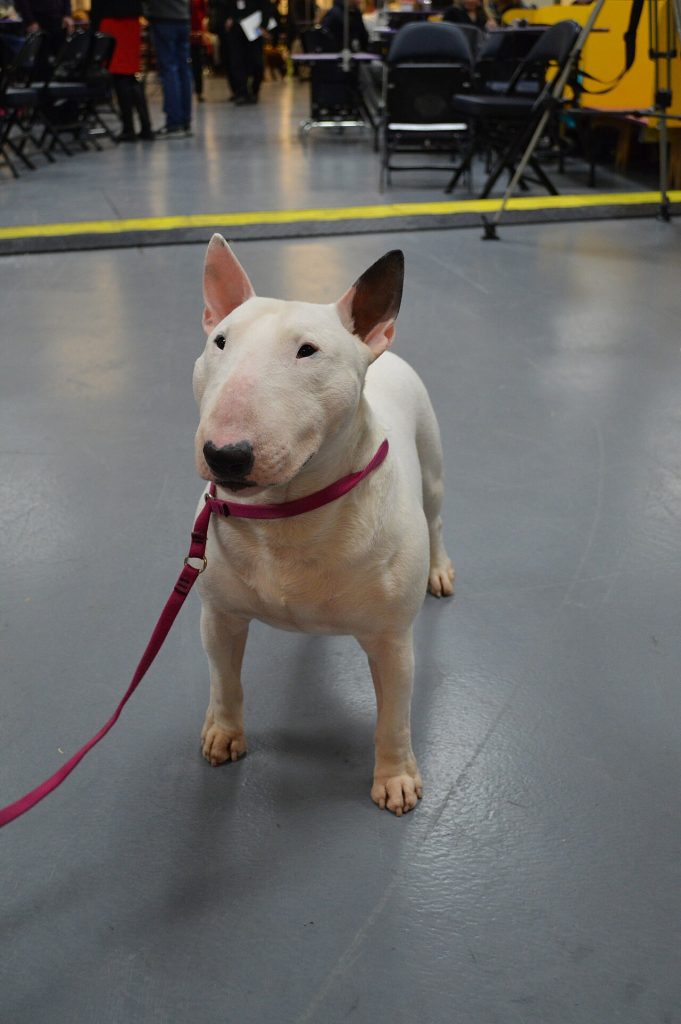
The Bull Terrier Miniatura is a small terrier but of enormous character: a compact muscle block with the Bull Terrier’s unmistakable oval head, condensed into a body that fits comfortably on a floor. Loving, stubborn and courageous to the point of recklessness, he is the ideal dog for anyone who wants the full personality of a miniature Bull Terrier, provided he is willing to give him exercise, clear boundaries and company. In this guide you’ll find everything you need to know before sharing your life with a Miniature Bull Terrier.
Is the Miniature Bull Terrier for you?
The Miniature Bull Terrier is not a dog for everyone. It is fun, loyal and surprisingly manageable in size, but also stubborn, dominant with other dogs and with an energy that must be burned daily. Before you decide, honestly review these pros and cons.

In favour .
- All the personality of the Bull Terrier in one size fits all.
- Loving and devoted to his family, an excellent companion.
- Short coat with minimal maintenance.
- Sturdy, athletic and playful, he can handle children’s jogging.
- Funny and with a sense of humor that hooks.
To be taken into account
- Stubborn: it needs consistent and patient education, not force.
- He can be conflicted with other dogs if he doesn’t socialize well.
- High energy: requires daily exercise and mental stimulation.
- Predisposition to deafness and lens dislocation: requires a serious breeder.
- Light skin sensitive to the sun; in some countries the Bull Terrier is on lists of potentially dangerous breeds.
Character and temperament
The Miniature Bull Terrier is first and foremost a family dog. He is described as fun loving, active, funny and deeply attached to people. Underneath that clown cloak is a pure-bred terrier: stubborn, determined, and disproportionately brave for his size. It is not uncommon for a Miniature Bull Terrier to face a much older dog without hesitation, something the owner must anticipate and manage.
He’s a dog who needs to be with his people. He suffers if he is left alone for too many hours, and bored, he finds creative – and destructive – ways to entertain himself. In return, it offers total loyalty, a willingness to play endlessly, and an expressiveness that makes daily coexistence something very entertaining. Your stubbornness is not bad faith: It is autonomy. With respectful but firm training, such a strong character develops into a balanced, confident companion.
Coexistence: children, other pets, flat and loneliness

With children: usually gets along well with the children of the house, with whom it is tolerant and playful; its massive body withstands the hustle better than that of a delicate dog.
With other pets: is a brave dog and can be dominant or defiant with other dogs, especially of the same sex. Early and quality socialization makes the difference; with cats and other animals the outcome depends a lot on breeding and controlled presentations.
Floor and solitude: is recommended by many breeders for people with limited space precisely because of its small size. It adapts well to a floor as long as its exercise needs are met. What is worse is prolonged loneliness: it is a dog that wants to be with you, not locked up for hours without company.
Education and training
Training a Miniature Bull Terrier is an exercise in perseverance. It is intelligent and quick to learn, but its stubbornness sometimes causes it to “choose” not to obey if it doesn’t see the point. The key is positive reinforcement, short and varied sessions, and absolute consistency: if you once let it up on the couch and another time you don’t, it will interpret it as an invitation to negotiate.
Socialization is the most important part of their education. Exposing it from puppyhood to people, environments, noises and – carefully – other well-balanced dogs greatly reduces the risk of reactivity in adulthood. Basic obedience (called being reliable, walking without pulling, controlling impulses) must be worked on from the beginning. Aversive methods should never be used: With this breed they create distrust and reinforce stubbornness instead of correcting it.
Exercise and activity
Despite its size, the Miniature Bull Terrier is an athlete. It needs to burn energy every day: two good walks, moments of intense play and mental challenges to keep its head occupied. It loves tug-of-war games, chasing balls and activities where it can use its strength and thrust.
A well-trained Miniature Bull Terrier is a quiet dog at home; a boring one is a troubleshooting machine: He nibbles on furniture, digs and barks. Meeting their needs for physical and mental activity is not optional, it is the basis of good coexistence. Of course, be careful with the heat: Its relatively short snout and its intensity make it advisable to avoid vigorous exercise in the sunniest hours.
Care: fur and hygiene
The Miniature Bull Terrier’s coat is one of the simplest to maintain. Its short, thin, shiny, and very skin-tight coat is solved with a weekly brushing – or a quick, almost daily review during moult – with a glove or brush of soft bristles.
The big exception is the fair-skinned areas. In white specimens or with white spots on the face, ears, groove and belly, the skin is sensitive and vulnerable to sunburn and even skin cancer. When you spend time outdoors, apply sunscreen suitable for dogs in these areas. Complement hygiene with ear checks and cleanings, nail trimming, and regular dental care.
Foodstuffs
Being a muscular and active dog, the Miniature Bull Terrier needs a complete and balanced diet, with quality protein that supports its muscle mass.
If you have any doubts about quantities, dietary changes, or supplements, it is wise to consult your veterinarian, who will adjust the guideline for each dog.
Health and life expectancy

The Miniature Bull Terrier is generally a robust dog, with a life expectancy around 12 years(a British study from 2024 placed it at 12.2 years on average, very close to the average of breed dogs).
- Sordera: occurs in both white and colored specimens and can be unilateral or bilateral. It is hereditary, so puppies should pass the BAER test before sale and deaf dogs should not be bred.
- Primary lens dislocation: the Miniature Bull Terrier is one of the most affected breeds. It is caused by a recessive mutation in the ADAMTS17 gene and there is a genetic test to detect it.
- Lethal acrodermatitis: is a rare and serious genetic disease, exclusive to white Bull Terriers (including the miniature variety).
The best prevention is to go to responsible breeders who perform deafness (BAER) and lens dislocation tests, and maintain veterinary checks, proper feeding and sun protection throughout their lives.
Physical appearance
The Miniature Bull Terrier is a reduced – but no less imposing – version of the Bull Terrier. Its most characteristic feature is the head oval, ‘in the shape of an egg’, flat on top and with a Roman nose profile that descends curved to the truffle. The eyes are small, triangular and close together, with an unmistakable mischievous expression; the ears are carried upright and do not cut or alter.
The body is compact, robust and highly muscled, with powerful shoulders and a constitution that transmits strength despite its small size. The tail is carried horizontally, not vertically. In terms of size, the lift to the cross should not exceed the 35,5 cm and the weight should be proportional to the height (usually between 9 and 16 kg). The coat is short, fine and shiny, and white, white with another colour or completely coloured is acceptable; bluish or liver tones are considered undesirable.
Origin and history
The Miniature Bull Terrier completely shares its origin with the Bull Terrier, an English breed born in the 19th century. Their ancestry goes back to the now extinct English White Terrier(white English terrier), the bulldog and the dalmatian, among other crosses. The key figure was the breeder James Hinks, who in the 1850s worked to obtain a dog that would not only be good for fighting, but also have an elegant and harmonious appearance. The first documentary record of miniature type specimens appears in 1872, in the work The Dogs of the British Islands.
Interestingly, when the breed was created, the Bull Terrier was about the size of today’s Miniature. For a time, the difference between the two varieties was established by weight, which led to the breeding of specimens so small and thin that they looked more like a Chihuahua than a Bull Terrier. To correct this, in the 1970s the weight limit was replaced by a height limit (below 14 inches). The American Kennel Club recognized the Miniature Bull Terrier in 1991, with effect from 1 January 1992.
Curiosities
- For the International Kennel Federation, the Bull Terrier and the Miniature Bull Terrier are the same breed in two varieties: they are judged separately and should not be crossed with each other.
- Its characteristic oval head has made it a cultural icon: the breed has starred in comic strips, books, films and advertising campaigns.
- The standard does not set a maximum weight: the dog is asked to be harmonious and proportionate, giving a “good impression of substance” for its size.
- Its small size makes it highly recommended for those living in small spaces, as long as it can give you the exercise you need.
- Colored specimens did not appear until after 1900; the first Bull Terriers, from which he descended, were white.
If you are attracted to the Miniature Bull Terrier but want to compare with other breeds of strong character, manageable size or terrier root, take a look at related breeds such as the Bulldog, Bóxer, Bulldog Francés or Dálmata, the latter present in its own family tree.
Frequently Asked Questions about the Miniature Bull Terrier
Is the Miniature Bull Terrier a dangerous dog?
Not inherently. It shares ancestry with hunting dogs and, in some countries, the Standard Bull Terrier is on lists of potentially dangerous breeds, but the Miniature Bull Terrier is a loving and close family companion. Their character depends above all on early socialization, exercise and consistent education. Their stubbornness and courage require constant ownership, not forced training.
How tall and how much does a Miniature Bull Terrier weigh?
Its height at the withers should not exceed 35.5 cm (about 14 inches) and rarely less than 25 cm. The weight is not fixed by standard: it should be proportional to height, and in practice it moves between about 9 and 16 kg. It should give an impression of substance and musculature despite its small size.
Do you get along with children and other dogs?
With the children of his family he is usually tolerant, playful and robust, although for his energy it is advisable to supervise the game with the smallest.
How much exercise do you need?
It is a very energetic and athletic dog for its size. It needs at least two walks a day plus active play and mental stimulation. It is not enough for it to go out to do its business: if it is bored, it channels energy by nibbling or digging.
What health problems does the Miniature Bull Terrier have?
The most frequently monitored are deafness (unilateral or bilateral, hereditary, detectable with the BAER test in puppies), primary lens dislocation – linked to a mutation in the ADAMTS17 gene – and, in white specimens, rare and severe lethal acrodermatitis.
How long does a Miniature Bull Terrier live?
A British study from 2024 estimated an average life expectancy of about 12.2 years for the breed, in line with the average for purebred dogs. With good nutrition, exercise, veterinary checks and sun protection in light-skinned areas, many specimens reach that age well or exceed it.
Does it need a lot of coat care?
No, its coat is short, thin and sticky to the skin, so a weekly brushing (or a quick check-up almost daily in mud) is enough.
Is that the same as the standard Bull Terrier?
For the FCI they are the same breed in two varieties, judged separately and not to be crossed with each other. The essential difference is the size: the Miniature does not exceed 35.5 cm at the cross.