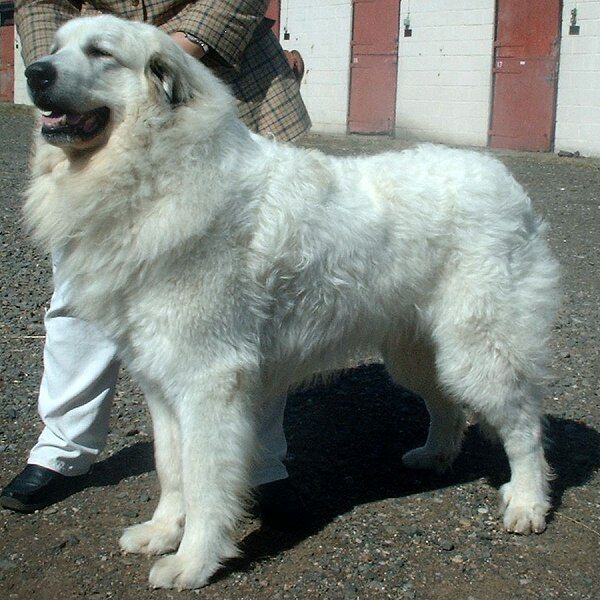
Pyrenees Mountain, known in the United States as Great Pyrenees and in France as Patou, is a white giant raised for centuries to guard herds against wolves and bears. Behind their serene demeanor and snowy fur is an independent, courageous and deeply loyal guardian. Before you fall in love with his image, you should understand that the Pyrenean Mountain is a working dog with its own instincts, not a large stuffed animal. Here’s everything you need to know to decide and live with it.
Is the Pyrenees Mountain for you?
This breed doesn’t fit into any home. It’s a huge, territorial dog with a very autonomous mind, the result of generations of making decisions alone in the mountains. It shines in a house with land and in the hands of someone who values their independence rather than fighting with it. If you’re looking for an obedient city mate, there are better options. If you want a quiet, devoted protector to take care of your own, few races do it like him.
In favour .
- Exceptional guardian: protects his family, his territory and other animals with total dedication.
- Serene and balanced indoors; not a nervous or hyperactive dog.
- Great patience and gentleness with the children and the cattle in your charge.
- Loyal and independent: he doesn’t need to be stuck with you all day.
- Weather-resistant coat and largely self-cleaning.
Against
- Huge size and strength – it needs space, high fences, and an owner who can handle it.
- Very stubborn and independent; “competitive” obedience is not his thing.
- Tendency to escape and patrol: without a good lock, disappear to explore.
- He barks a lot, especially at night, as part of his surveillance work.
- It sheds abundant hair and eats according to its size.
Character and temperament

The Pyrenees Mountain is, first and foremost, a born guardian. He’s loyal and brave to the point of defending his own with his own life, but that intensity coexists with a surprising calmness. Inside the home is usually a quiet, almost phlegmatic dog that spends much of the day quietly observing its surroundings. His protective instinct isn ‘t triggered on a whim . It monitors, evaluates and only reacts when it perceives a real threat.
It is a tremendously independent breed. For centuries it worked alone in the middle of the field, deciding for itself when and how to intervene, and that trait is still very marked. It does not wait for orders to do its job and often prefers its own criteria to yours. This makes it a fascinating dog, but also one that does not seek to please at all costs as other breeds do.
With strangers he is cautious and reserved. Without being basically aggressive, he will not allow a stranger to enter his zone or approach what he considers to be under his protection. His reaction is usually progressive: It warns first with barking, then with increasingly loud growls as the distance is shortened, and only gets further if the intruder completely ignores it. Interestingly, once you accept someone new, you adapt to that person quickly.
Coexistence: children, other pets, flat and loneliness
- With children: is patient, tolerant and protective, usually gets along well with the smallest of the family, whom he tends to treat as part of the herd that he must take care of.
- With other pets:‘s instinct is to protect, not to hunt, so well socialized it gets along great with other dogs, cats, sheep, goats and farm animals.
- On the floor: is not a city dog. It needs space, open air and a territory to patrol. In an apartment it feels out of place and its barking can become a serious problem of coexistence with neighbors.
- Soledad: tolerates loneliness better than many breeds due to its independent nature, especially if it has a space to guard.
Education and training
Raising a mountain in the Pyrenees requires patience and realism. He’s an intelligent dog, but his independence makes it hard for him to take orders and he gets bored with mechanical repetition. Don’t expect an immediate response from a Border Collie: This giant values his own judgment and needs to understand the “why” of what you’re asking. The training is based on consistency, positive reinforcement and many repetitions over time.
Early socialization is absolutely imperative. Puppies grow in size and strength at a tremendous rate, so bad habits – jumping on people, pulling on the leash – should be corrected as soon as possible while they are still manageable. An uneducated adult is simply too big and strong to improvise. Work from puppyhood on basic obedience, contact with people and other animals, and home boundaries.
Forget the obedience contests: it’s not their territory. Their goal was never to obey, but to protect autonomously. If you accept that nature and channel it, you will have a reliable and balanced dog; if you insist on bending its character, you will only get both of you frustrated.
Exercise and activity
The Pyrenean Mountain is a moderate-energy dog with an important point: She likes quiet, but not intense exercise. It does not need strenuous racing or high-impact sports; it is far better off patrolling its territory leisurely and taking long, quiet walks. If you don’t have a lot of ground to cover, you need to walk for at least an hour a day to keep fit and avoid being overweight, which your size tends to make you.
Special care must be taken during growth. Being a large-boned mollusk, excessive exercise in the first year of life can damage its developing joints. So avoid long walks and, most important, limit going up and down stairs while you are young. His ideal activity is the one he himself chose for centuries: Moving slowly, watching and saving energy for when it’s really needed.
Care: fur and hygiene

Its spectacular double coat requires less work than it appears to do. A weekly brushing is enough to keep it clean and free of knots for most of the year, and its hair has a remarkable self-cleaning ability: dirt and mud tend to come off when it dries.
The great time of the year is the rainy season. You usually change your hair thoroughly twice, in the changing seasons, and in those weeks you will need to brush it daily to control the enormous amount of hair that falls out. It is advisable never to shave your coat: this double layer insulates you from both cold and heat and protects your skin.
Pay attention to your nails and especially to the spurs on your hind legs, which grow noticeably and can get caught or stuck if not trimmed regularly. Also check your eyes, as you are prone to conjunctivitis, and take care of your skin in summer to prevent dermatitis. Bathrooms, the fair ones: only when it is really dirty.
Foodstuffs
Feeding a giant of this size has its own logic. It eats considerably more than a medium-sized dog, so it is advisable to choose a quality feed suitable for dogs of large and giant breeds, and adjust the ration to their age, weight and activity level. Since it tends to overweight, it is preferable to be prudent with the quantities and monitor their body condition regularly.
In puppies, feeding is especially delicate. Growing too fast overloads developing joints, so specially formulated giant-breed puppy foods for controlled development are the best choice. Because of their size and deep breasts, it is wise to divide food into two servings a day and avoid exercise right after eating, a common precaution to reduce the risk of gastric torsion in large dogs. Water always fresh and available.
Health and life expectancy
The Pyrenean Mountain is considered a rugged and hardy breed, but, like all giant dogs, it has its weak points. Life expectancy is around 10 to 12 years; a British study in 2024 placed the median at around 10.9 years, somewhat below the canine average, a figure consistent with the typical longevity of large breeds.
The most common and well-known health problem is hip dysplasia, an inherited joint disorder common in moles that worsens with age. Other joint problems may also occur, especially if they have been required to exercise too much while growing up. On the skin, dermatitis is relatively common, especially in the summer, and your eyes are prone to conjunctivitis, so keep them protected from dust.
The best prevention is to acquire the puppy from a responsible breeder who performs hip tests on breeders, controls weight, doses exercise in the first year and keeps veterinary checks up to date.
Physical appearance
It’s one of the most imposing dogs in existence. According to the standard of the Société Centrale Canine, males measure between 70 and 80 cm at the withers and females between 65 and 75 cm. The weight of a healthy adult is usually between 50 and 60 kg for males and slightly less for females, although some large specimens easily exceed this figure. It belongs to the molosoid type, but with more stylized and elegant lines than usual in this group.
Their hallmark is their fur: a long, very dense double layer, with a flat outer mantle – especially abundant in the neck, tail and hind legs – and a thin, compact sublayer that insulates it from the elements. The predominant color is white, sometimes with gray spots, badger color (a mixture of brown, black, gray and white hairs) or cream tones, which are usually concentrated on the head. Only one in four specimens is entirely white.
The head is proportionate, with a long, wide and slightly pointed snout, and small, triangular ears attached to the head. The tail is long, hanging at rest and curving over the back when the dog is alert. And a unique detail: it has double spurs on the hind legs, a feature so characteristic that its absence is considered a disqualifying defect in exposure.
Origin and history

The Pyrenees Mountain takes its name from the mountain range that separates Spain and France, where it was forged as a cattle guard dog. It’s one of the oldest documented breeds: He was a companion of the Basque shepherds for almost a millennium and his role was clear and tough, defending the flocks of sheep from wolves and bears. To accomplish this, they wore a heavy iron collar with spikes to protect their neck from predators.
Her story also has a courtly chapter. In the 17th century it came to the court of Louis XIV, where it became fashionable to the point of being named the royal dog of France, and the nobility employed it to guard their castles in the south of the country. It is considered one of the founding breeds of the Leonberger in the 1830s and is believed to have influenced the ancestor of the Newfoundland when French settlers brought it to Canada.
After the disappearance of the Pyrenean wolves in the 19th century, their numbers plummeted and at the beginning of the 20th century they were close to extinction. The aristocrat and expert cinophile Bernard Senac-Lagrange rescued him: He scoured the mountains in search of the best specimens, founded a breed club in 1923 and drafted the first standard. It was finally recognized by the Fédération Cynologique Internationale in 1955. In the 1930s it came to North America, where it became popular under the name Great Pyrenees, which it still retains in the United States.
Curiosities
- The magic haired dog: its mantle has such remarkable self-cleaning ability that mud and dirt come off on its own as it dries.
- The Fingers too many: has double spurs on its hind legs, a feature traditionally attributed to better traction on snow.
- Louis XIV distinguished him with that title after conquering the court of Versailles.
- Mountain smuggler: was formerly used to move goods between France and Spain by carrying loads over routes impossible for people, evading customs.
- Concentric guard: does not stand still watching a point; it patrols in ever-widening circles to detect danger long before it approaches.
- Unexpected jumper: despite its body size, is very agile and can jump fences over two meters, so its fence must be high and secure.
If you are attracted to this guardian giant, you will be interested to know about other breeds that share its size, its mountain origin or its protective vocation. Take a look at Boyer of Bern, another sweet-tempered mountain colossus; San Bernardo, the legend of the alpine rescue; the imposing Terranova, with which it shares part of its ancestry; and Leonberger, a breed in the creation of which the Pyrenees Mountain directly participated.
Frequently asked questions about the Pyrenees
Is the Pyrenean Mountain a good family dog?
Yes, it is an excellent family dog for homes with space. It is loyal, serene inside the house and very patient and protective with children. Its main limitation is not character, but size and the need for proper terrain and fence.
How long does a Pyrenean Mountain live?
Their life expectancy is around 10 to 12 years. A British study from 2024 placed the median at around 10.9 years, a normal figure for a giant-sized breed.
Is he an aggressive dog?
It is protective and suspicious of strangers, but its reaction is progressive: first it warns with barking and growling. With good socialization it is balanced and reliable; it only acts forcefully if it perceives a real threat to its own.
Can you have it on one floor?
It is not recommended. It is a large, territorial and barking dog that needs outdoor space and a territory to patrol. It lives much better in a house with a garden or in the country, always with a high and safe fence.
How much exercise do you need?
Moderate energy: prefers long, quiet walks to intense exercise. If you don’t have your own terrain, you need at least an hour a day of walking. During the first year you should dose exercise and avoid stairs to protect your joints.
Does it lose a lot of hair?
It loosens a lot, especially in the two annual mows, when it is convenient to brush it daily. The rest of the year is enough with a weekly brushing, since its hair is largely self-cleaning.
Does he bark a lot?
Yes, barking is part of their surveillance work, and it is usually more frequent at night. It is their first tool to warn and deter intruders, something to be very careful of if there are neighbors nearby.
Is it easy to train?
It’s not one of the easiest. It’s intelligent but very independent and stubborn, since it was raised to decide on its own. It responds to positive reinforcement, patience and repetition, but does not excel in competitive obedience. Early socialization is essential.