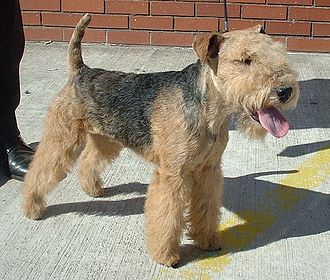
The Lakeland Terrier is a small, courageous, hardworking terrier native to the Lake District in England, where it was bred to chase deer and foxes on foot through mountainous, rocky terrain. Behind his compact and elegant appearance is a dog of enormous energy, very intelligent and independent character who, however, is completely devoted to his family. In this guide you will find everything you need to know about the Lakeland Terrier before sharing your life with one: His actual temperament, his care, his health and origin explains why he is the way he is.
Is the Lakeland Terrier for you?
The Lakeland Terrier is not a dog for everyone. It is an authentic terrier: alert, determined and with a dose of energy that needs a daily outing. Before deciding, it is advisable to be honest about what it offers and what it demands. These two boxes summarize, without makeup, its advantages and the aspects that you should be clear about.
In favour .
- Small and compact in size, it fits well in apartments and houses.
- Hair that barely loosens, considered suitable for sensitive people.
- Very smart and quick to learn.
- Brave, cheerful, and generally robust in health.
- A good alarm dog warns you of what’s going on at home.
- Resilient and tireless for hiking and play.
To be taken into account
- Independent and stubborn: he practices “selective deafness”.
- Strong prey instinct for small animals.
- He likes to dig and he can bark if he’s bored.
- The mantle needs stripping and periodic grooming.
- He needs daily exercise and mental stimulation, without fail.
- It’s not the best option for anyone looking for a passive dog.
Character and temperament
The Lakeland Terrier’s temperament can be summed up in three words: Friendly, bold and self-assured. Shyness is very atypical of the breed, as is gratuitous aggressiveness; a well-balanced Lakeland moves about the world with almost brazen confidence, as befits a dog bred to face a fox in its own den. That bravery is part of its charm and, at the same time, what compels a mindful handling.
He’s an extraordinarily intelligent and independent-minded dog. He learns quickly, but he doesn’t obey because he obeys: You need to understand that winning something. Breeders and growers humorously describe their “selective deafness”, that ability to completely ignore you when something more interesting catches their attention, whether it’s a smell, a cat, or a leaf rolling in the wind. It ‘s not foolishness or bad manners: It’s the trail of centuries of selection to work alone, underground, away from the voice of the hunter.
With his family he is affectionate, playful and surprisingly sensitive. He enjoys company, participates in everything that happens at home and watches his territory with zeal. This combination of affection, liveliness and courage makes him a fun and very present companion, provided that his needs for activity are respected and clear boundaries are set for him from a puppy.
Coexistence: children, other pets, flat and loneliness
- With children: is usually friendly and playful with family children, especially if they grow up together and the little ones learn to respect it.
- With other dogs: sociable but with character; can be challenging with dogs of the same sex.
- With other pets: here you have to be realistic. The Lakeland retains a very vivid prey instinct towards rodents, rabbits and sometimes cats. It can coexist with a cat it has been raised with, but small cage animals are not a recommended combination.
- On the floor: adapts perfectly to apartment life thanks to its large content, provided it receives its daily exercise.
- Soledad: is a dog attached to its people and does not take long absences well. It tolerates loneliness better if it is gradually accustomed to it and is left with a tired mind and body.
Education and training
Training a Lakeland Terrier is both easy and challenging. Easy, because he’s so smart and he picks up the exercises the first time. Defiant, because his independence leads him to constantly ask himself “and this to me that brings me”. The key is positive reinforcement: prizes, games and lots of variety so you don’t get bored. Short, frequent, fun sessions work better than long, repetitive ones, which disconnect you.
Early socialization is nonnegotiable. Exposing him as a puppy to different people, dogs, noises and environments builds the balanced and confident adult that the breed can be. It’s a good idea to work on calling and self-control early on, because your chase instinct can take you behind anything that moves. Therefore, in open and unfenced areas, caution with the leash is the wisest thing to do.
The Lakeland responds very well to crate training, which helps with loneliness management and rest.Consistency is key: this terrier instantly detects cracks in rules and takes advantage of them.Kind firmness, patience and a sense of humor are your best allies.
Exercise and activity
Despite its size, the Lakeland Terrier is a thoroughbred dog. Its resilience is legendary: it is said to have inherited running all day alongside herds through the mountains of the Lake District, rather than being carried in a saddlebag like its cousin the fox terrier.
Daily exercise and playtime are essential; if he does not find a suitable outlet for his energy, he will seek it out on his own, and the result is rarely pleasing to the patient: Holes in the garden, bitten furniture or barking. It marvels at long walks, hiking, search games, food puzzles, and dog sports such as agility or earthdog, where it can unleash its burrowing instinct in a controlled environment. A physically and mentally satiated Lakeland is a quiet, educated companion at home.
Care: fur and hygiene
The coat of the Lakeland Terrier is twofold: a hard, dense and rough outer coat (the terrier’s typical “wire” texture) and a soft inner coat that insulates it from cold and moisture.
The traditional and recommended method is stripping (manual pulling of dead hair), which maintains the rough texture and bright colors of the mantle. If machine-cutting is chosen instead of stripping, the hair tends to soften and fade in color over time. For a companion dog, stripping or grooming every few months and regular brushing are sufficient to avoid entanglement; in exhibition dogs the work is more demanding. The rest of the hygiene is the usual: Check and clean the ears, take care of dental hygiene, cut the nails and brush only when necessary so as not to spoil the hair texture.
Foodstuffs
The Lakeland Terrier does not have exotic dietary needs, but if it is convenient to adjust the ration to a small, active and muscular dog, a complete and balanced diet, appropriate to its age, weight and activity level, is the basis.
Overweight is the enemy of any terrier: It burdens your joints and reduces your quality of life. Split your food into one or two servings a day, monitor your prize intake (especially if you use them a lot in training), and always have fresh water available. If you have any questions about the diet, the exact amounts, or a change in food, it is wise to consult your veterinarian, who will tailor the recommendations to your particular dog.
Health and life expectancy
Taken together, the Lakeland Terrier is a robust and healthy breed. A health survey conducted by the Midland Lakeland Terrier Club in 2005 concluded that it is a solid breed, with no widespread serious health problems. His longevity accompanies that impression: A 2024 British study estimated a life expectancy of 14.2 years for the breed, above the 12.7 year average for purebred dogs. In practice, it is usual to talk about 12 to 15 years of life with proper care.
That doesn’t mean I’m free of predispositions. The breed shows some tendency to various eye conditions, such as cataracts, lens dislocation, microphthalmia (abnormally small eyes) and persistent pupillary membrane. Predisposition to Legg-Calve-Perthes disease, a degeneration of the femoral head that causes pain and lameness, and to ventricular septal defect, a congenital alteration in the wall separating the ventricles from the heart, has also been described. Recourse to responsible breeders who carry out health checks and maintain regular veterinary checks is the best way to prevent and detect these problems in time.
Physical appearance
The Lakeland Terrier is the smallest of the long-legged, black coat and fire, thin-boned and elegant-looking terrier groups. It resembles a reduced, more stylized version of the Welsh Terrier, and shares family air with the Airedale, the largest of the trio. It is a robust and compact, free-moving and agile dog, capable of covering ground with little effort and very quickly.
It has a flat, well-developed skull, a long, slightly arched neck, a short back, and strong, muscular limbs. The chest is relatively narrow and the nose wide. The ears are small, V-shaped and fall forward; the eyes, small, dark and oval in shape, have a lively and cheerful expression. The truffle and the pads are black, except in liver-colored specimens, where they acquire that hue. The tail is held upright and traditionally amputated in some countries, a practice now banned in much of Europe.
In terms of size, most specimens measure between 34 and 38 cm at the withers and weigh around 6.5 to 8 kg. The mantle supports a varied range of colors: black and fire, blue and fire, red, wheat, grizzle red, liver, blue or black, with white spots tolerated on the chest and legs.
Origin and history
The Lakeland Terrier takes its name from the Lake District, in northwest England, and is one of the oldest terriers: Its origins go back to the 18th century. It is descended from the old English Black and Tan Terrier and the Fell Terrier, the ground dogs (from Latin terra) used by farms to chase deer. In that mountainous and rocky terrain, where it was impossible to hunt foxes on horseback, the foxes were chased on foot, and the terrier had to accompany the pack for hours and, when the time came, go underground to face the prey in its den.
This requirement explains a detail that distinguishes it from other terriers: While most only corner or signal prey by barking, the Lakeland had to be able to kill the fox in its burrow. Its working version is often known as the Patterdale Terrier or Fell Terrier. The modern Lakeland is the result of crossing several breeds: The Bedlington may have inherited its agile constitution; the Border, features of its fur; the Fox, its characteristic tail; and the Airedale, part of its appearance.
The breed was organized in the early 20th century. The Lakeland Terrier Association was founded in 1921, the same year that the British Kennel Club claims to have recognized it (the breed club places the recognition more towards 1928). In 1925, after crossing with the Fox Terrier and the Airedale, the breed achieved homogeneity, and in 1932 the Lakeland Terrier Club was born, which promoted it nationally. The American Kennel Club recognized it in 1934. Today, in its native United Kingdom, the Lakeland is listed as a vulnerable native breed, at risk due to its low breeding numbers.
Curiosities
- The Lakeland Terrier has twice won Best in Show at both Crufts and the Westminster Kennel Club Dog Show, the two most prestigious dog shows in the United Kingdom and the United States.
- The Stingray of Derryabah was the first dog to win the top prize on both occasions: Crufts in 1967 and Westminster in 1968.
- His famous “selective deafness” is not a hearing impairment, but the legacy of a dog designed to work alone and make decisions underground.
- Comedian and actor Bill Cosby was a co-owner of a prominent Lakeland exhibit, Awesome Blossom.
- Neil Tennant, lead singer of the Pet Shop Boys, had a Lakeland named Kevin.
- Despite its show dog elegance, it is still a born hunter: the breed is among those eligible for official earthdog testing.
If you’re attracted to the Lakeland terrier’s character, you might be interested in meeting its closest relatives, with whom it shares history and blood. The Airedale Terrier is the giant of the family and participates in the fixation of the breed; the Border Terrier contributes features to its coat; the Bedlington Terrier influences its agile constitution; and the Wire Fox Terrier shares with it the characteristic tail. It also bears a striking resemblance to the Welsh Terrier, its larger relative. They’re all great working terriers with personality to spare.
Frequently Asked Questions About the Lakeland Terrier
Is the Lakeland Terrier a good family dog?
Yes. It is affectionate, cheerful and playful with its family, and usually gets along well with the children in the house, especially if they grow up together. It needs daily exercise, clear boundaries and supervision with small children, but as an active family companion it functions very well.
Does the Lakeland Terrier shed a lot of hair?
No dog is 100% hypoallergenic, but its double coat, removed by stripping rather than falling off on its own, produces little dandruff and little loose hair at home.
How much exercise does a Lakeland Terrier need?
It needs daily exercise and playtime: long walks, runs, sniffing games and, ideally, some dog sports. It is a hardy and tireless dog; without enough activity it tends to bark, dig or become destructive.
Is it easy to train?
It is very intelligent and learns quickly, but it is also independent and stubborn, with its famous “selective deafness”. With positive reinforcement, short and fun sessions, consistency and early socialization, it gives excellent results. Patience and a sense of humor help a lot.
How long does a Lakeland Terrier live?
It is a long-lived and robust breed. A British study from 2024 estimated an average life expectancy of 14.2 years, above the average for purebred dogs.
Does he adapt to living in a flat?
Yes, its small and compact size makes it suitable for apartment living, as long as it covers its need for daily exercise.
Do you get along with other dogs and pets?
With dogs it is usually sociable, although it can be challenging with specimens of its own sex; early socialization is key.
How tall and how much does a Lakeland Terrier weigh?
It is a small terrier: most measure between 34 and 38 cm at the withers and weigh about 6.5 to 8 kg. It is the smallest of the long-legged and black-and-fire terriers, with a fine but solid constitution.