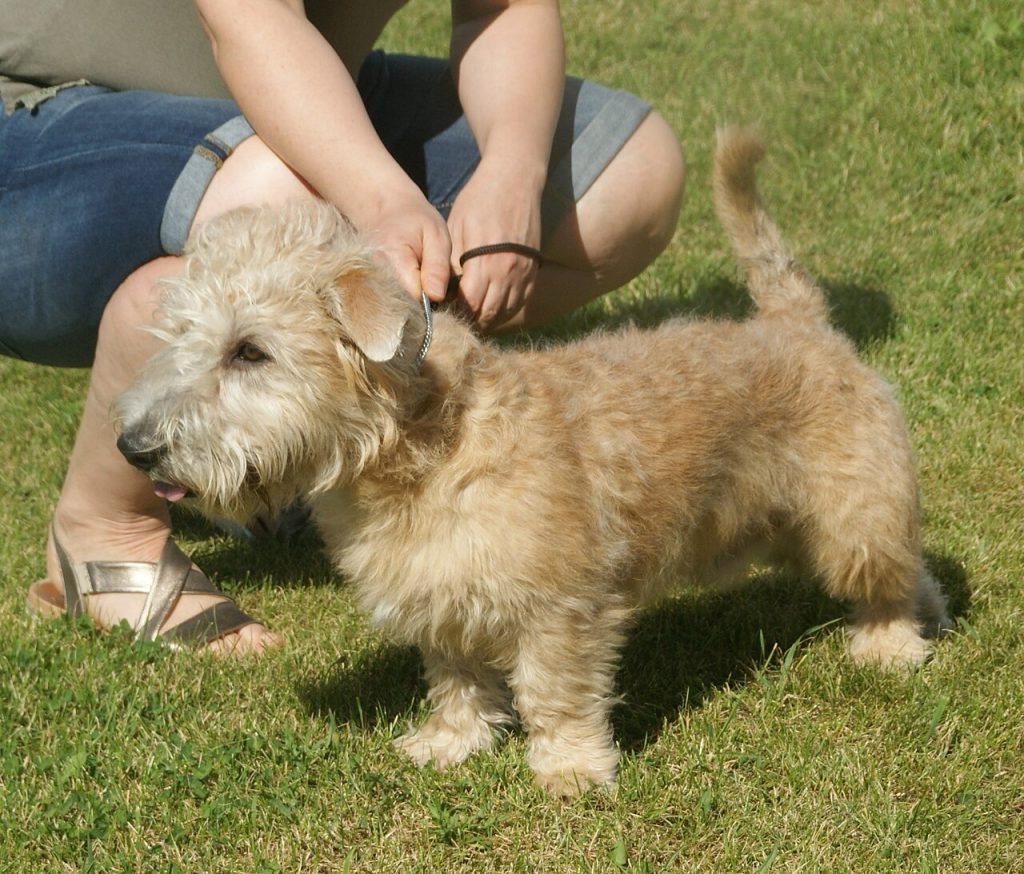
The Glen of Imaal Terrier is a big little dog: an Irish terrier with short legs, compact body and amazing musculature, bred in the remote Glen of Imaal valley, in County Wicklow, to work the land and hunt game. It is one of the four terrier breeds native to Ireland and by far the least known and one of the rarest in the world. What makes him special is his character: Brave and tenacious like any terrier, but much calmer, quieter and quieter than their cousins. If you’re looking for a robust, loyal, low-barking companion with a rustic dog’s soul, the Glen of Imaal Terrier deserves to meet you.

Is the Glen of Imaal Terrier for you?
The Glen of Imaal Terrier is not a dog for everyone, and that is precisely why it is so special for those who fit in with it. It is a working terrier tucked into a short and strong body: affectionate and calm at home, but determined and with hunting instinct as soon as it steps on the field.
Points in favour
- Calmer and less barking than most terriers.
- Loyal, brave and excellent with people, including children.
- Robust and generally healthy, with few serious hereditary problems.
- It sheds very little hair and doesn’t give off much odor.
- Manageable size: fits well on a floor if exercised.
- Good warning dog, with an imposing bass voice.
Points to Consider
- Tozudo: He needs patient and consistent education.
- Strong prey instinct for cats, rodents and rabbits.
- He can be dominant with other dogs if provoked.
- Requires periodic stripping of the mantle, not shaving.
- Very rare breed: finding a serious breeder is hard and there’s a waiting list.
- As a puppy, its front legs are fragile: beware of jumping.
Character and temperament
The great surprise of the Glen of Imaal Terrier is its temperament. He was selected for generations to work quietly underground, and that work shaped an atypical terrier: energetic and tenacious when playing, but usually more balanced, calm and less vocal than its Irish relatives. He loves activity, but he is neither demanding nor heavy; he is just as happy relaxing with his owner on the couch as he is crawling in the field.
He is a courageous dog, loyal and very attached to his family. It has a reputation for being splendid with people, and its serious and authoritative barking, more like a large dog, makes it a good watchdog that warns without becoming a compulsive barker. Of course, it retains the terrier’s stubborn streak: He’s smart and he learns fast, but he decides for himself when to collaborate. As it matures, it develops a remarkable instinct for prey and will not hesitate to run after a rat or any moving insect.
A curious feature of its character is the famous “Glen sit”: the dog sits on its hindquarters and keeps its entire body upright, an unusual posture in other breeds that reflects both its structure and its self-confidence.

Coexistence: children, other pets, flat and loneliness
In the home, the Glen of Imaal Terrier is a balanced companion. With the children it usually behaves wonderfully: it is patient, robust and protective, although as with any dog it is advisable to supervise the game and teach the little ones to respect it.
The delicate point is the other pets. He can get along well with other dogs, but some dogs are prone to canine aggression, especially if challenged; good early socialization is essential. With small animals (cats, rabbits, ferrets, rodents) you have to be careful: Their prey instinct is high and can confuse them with hunting. If you live with them as a puppy, most learn to respect them, but never let your guard down completely.
It is well adapted to life in floor thanks to its moderate size and its calm character indoors, provided it is provided with daily exercise. It tolerates the loneliness better than many nervous terriers, but is a sociable dog that enjoys company; long days alone and without stimuli can lead to boredom and the appearance of undesirable behaviors.
Education and training
Training a Glen of Imaal Terrier is an exercise in patience with reward. He’s smart and quick on his feet, but he’s got a clear streak of stubbornness: If something doesn’t interest you, just “don’t hear it”. The key is in the positive reinforcement, the short fun sessions and variety, so you don’t get bored. Harsh or coercive methods are counterproductive and only get you to close in on each other.
The early socialization is the most important point of your education: The sooner he gets to know people, environments, noises and other animals, the more balanced he will be as an adult. It’s a good idea to work on calling and impulse control early on, because your prey instinct can lead you to jump on a trail. He responds well to activities that stimulate his mind and work origin, such as earthdog, barn hunt or agility adapted to his physique.
Exercise and activity
The Glen of Imaal Terrier needs daily exercise, but it is not an endurance athlete or a hyperactive dog. A couple of good walks a day, some play and moments of exploration and sniffing cover its needs. It loves activities that awaken its terrier instinct: tracking, digging in a controlled manner, searching and chasing.
Because of its short legs and dense body, it is not usually a good swimmer, although some specimens work well in water; others have even been trained to drive sheep and cattle. An important warning: Due to their chondrodysplasia(dwarfism), puppies are especially prone to injury to the growth plates of the front legs. Until at least one year of age, avoid jumping from sofas, beds, or chairs and limit high-impact exercise.
Care: fur and hygiene
The Glen of Imaal Terrier’s coat is double: a hard, rough outer coat of medium length and a soft inner coat.
Just brush or comb it every week or two to keep the coat smooth without knots. The peculiarity lies in the hard layer: Between two and four times a year you have to do stripping, that is, pulling out the dead hair by hand (with the right tool), which comes out easily and without pain. It should not be shaved or cut with a machine, because it spoils the texture of the hair and deprives it of the rustic and “natural” appearance characteristic of the breed. In short: bathrooms only when necessary, regular checkups of ears, nails and teeth, and seasonal stripping instead of scissors.

Foodstuffs
The Glen of Imaal Terrier is a compact and muscular dog, so its diet must meet its needs without becoming overweight, which would overload its spine and short legs.
There’s one thing about the breed: From 12 months onwards, Glens usually perform better with a slightly lower protein diet than other breeds. Food allergies should also be monitored, as some specimens have skin sensitivity that may be aggravated by grain-rich feed such as soy or corn. Divide the ration into two meals a day, monitor the contribution of prizes during training and always consult with your veterinarian on the most appropriate regimen for your dog.
Health and life expectancy
Overall, the Glen of Imaal Terrier is a strong and healthy breed. Its average life expectancy is around 11-12 years old according to the British Kennel Club health survey, in which the main causes of death were cancer, organ failure and heart problems, many linked to advanced age.
The most significant hereditary problem is progressive atrophy of the retina(crd3 type PRA), a disorder that causes gradual blindness from about five years of age. There’s a genetic test that allows breeders to plan disease-free litters, so today it’s a controllable problem. Other points to watch for are allergies and itching of the skin (especially on the legs and in wet weather), hip dysplasia (which is usually mild and rarely causes lameness due to its strong musculature) and, in puppies, the fragility of the growth plates of the front legs derived from its dwarfism. On the other hand, the back problems typical of other long-bodied breeds hardly affect it, and heart conditions are virtually non-existent. Buying from a responsible breeder who does PRA and hip testing is the best guarantee of a healthy puppy.
Physical appearance
The Glen of Imaal Terrier is described with a perfect phrase: “a big dog on short legs”. It’s an achondroplastic dwarf, more massive and muscular than it appears in the photos. A typical adult is about 35 cm at the withers and weighs about 16 kg (35 lb), with females somewhat less; the AKC standard fixes 30 to 35 cm in height, although quite a few champions loosely exceed that weight. Its long-to-high ratio is 5:3, which gives it that low, elongated silhouette so recognizable.
It has a large head, pink or semirangular ears, short, slightly arched legs with the front feet turned outward, and a straight dorsal line that ascends gently towards the tail. Shoulders, chest, and hips are robust, seeking “maximum substance for their size”. The coat can be wheaten or blue, in a range of tones; occasionally other variants such as “grizzle” appear. Wheat pups usually show black reflexes and a darker dorsal stripe that fades as they grow. He ‘s a slow-growing dog: It goes through three stages of growth and can take up to four years to reach full development. Traditionally its tail was amputated leaving just the right length to serve as a handle and pull the dog out of a badger’s burrow; today tail cutting is prohibited for display in many countries.
Origin and history
The Glen of Imaal Terrier takes its name from the Glen of Imaal valley, in County Wicklow (Ireland), and is one of the four indigenous terrier breeds on the island. Tradition has it that their origin dates back to the reign of Elizabeth I, when the queen hired French and Hessian mercenaries to quell unrest in Ireland; many of those soldiers settled in the Wicklow area with their low-height dogs, which were crossed with local terriers and ended up giving rise to a separate and isolated breed from the valley.
He was developed as a versatile farm dog: control of pests (foxes, badgers, otters, rats) and general work, always in silence so as not to be exposed underground. The breed was on the verge of extinction, until it recovered in the 20th century. It was recognized by the Irish Kennel Club in 1934 and, much later, by the American Kennel Club in 2004. It’s still very rare: The British Kennel Club lists it among its vulnerable native breeds and in 2003 only 26 puppies were registered in the UK. As a bitter curiosity, much of the Glen of Imaal valley itself is now an Irish Army firing range, so there are no longer any Glens left in the valley that gave them their name. Interestingly, some DNA analyses place this breed genetically closer to Mastiffs than to terriers themselves.
Curiosities
- The silent terrier. He was selected to work without barking; in hunting tests, making noise was grounds for disqualification.
- The Glen sitting. Their position of sitting with their body fully upright is almost a sign of race identity.
- The dog on the wheel. Tradition states that it was used as turnspit dog, running inside a wheel to turn the meat grinder over the fire, although historical evidence is sparse.
- A distant relative of the Mastiff. Genetic studies place it more closely with mastiffs than with terriers, a case where genetics contradicts functional classification.
- Minimum population. With a worldwide population estimated at around 3,100, it is one of the rarest dogs in existence.
- It matures slowly. may take up to four years to reach full physical and mental fitness.
If you are attracted to the Glen of Imaal Terrier’s rustic, well-balanced character, you may also be interested in other terrier breeds and working dogs with strong personalities. You can check out the Yorkshire Terrier, another terrier of British origin; the versatile Border Collie for its intelligence and ability to herd; the faithful Beagle, another hunting dog with a great sense of smell; or the rugged Bulldog, a compact and quiet companion inside the house.
Frequently Asked Questions about the Glen of Imaal Terrier
Does the Glen of Imaal Terrier bark a lot?
No. It’s one of the quietest terriers in existence. It was bred to work underground without making noise, to the point that in Ireland it was disqualified for individuals to bark during hunting. It barks little, but when it does, its voice is deep and powerful, like that of a much larger dog, making it a good warning guard dog.
Is he a dog fit to live on the floor?
Yes, it adapts well to a flat whenever it receives its daily walk and activity. It is quiet indoors, does not bark and likes to relax next to its owner. Its short legs do not prevent it from being a good flatmate, but it needs to go out daily to expend energy and stimulate its terrier instinct.
Do you get along with children and other pets?
With children it is usually excellent: it is courageous, loyal and patient. With other dogs it can be dominant or seek a fight if provoked, and with small pets (cats, rabbits, rodents) it has a strong prey instinct.
How much hair does she let loose and how does she take care of her coat?
It has a double coat of rough texture on the outside and soft on the inside that hardly changes. It needs brushing every one to two weeks to avoid knots and, two to four times a year, a stripping (manual pulling of dead hair) instead of scissors or machine to preserve the correct texture.
What health problems does the Glen of Imaal Terrier have?
It’s a generally robust breed. The main focus is on progressive retinal atrophy (PRA type crd3), for which there is a genetic test that allows disease-free layers to be planned. Skin allergies may also occur and, because of their chondrodysplasia, puppies are susceptible to lesions in the growth plates of the front legs. Heart problems are virtually non-existent.
How long does a Glen of Imaal Terrier live?
According to the British Kennel Club’s health survey, their average life expectancy is around 11-12 years, in line with other similarly sized terriers.
Is it easy to educate?
It is intelligent and quick learner, but has the typical terrier stubbornness. It responds very well to positive reinforcement and to short and varied sessions; instead, it closes in to harsh or repetitive methods. With patience, constancy and socialization from puppy it becomes a balanced companion.
Why is it such a strange breed?
The Glen was on the brink of extinction and today remains one of the rarest dogs in the world, with a global population estimated at around 3,100. The Kennel Club lists it as a vulnerable native breed (less than 300 puppies registered per year). In addition, much of the Glen of Imaal valley itself is now an Irish Army firing range, so there are no longer any Glens left in their valley of origin.