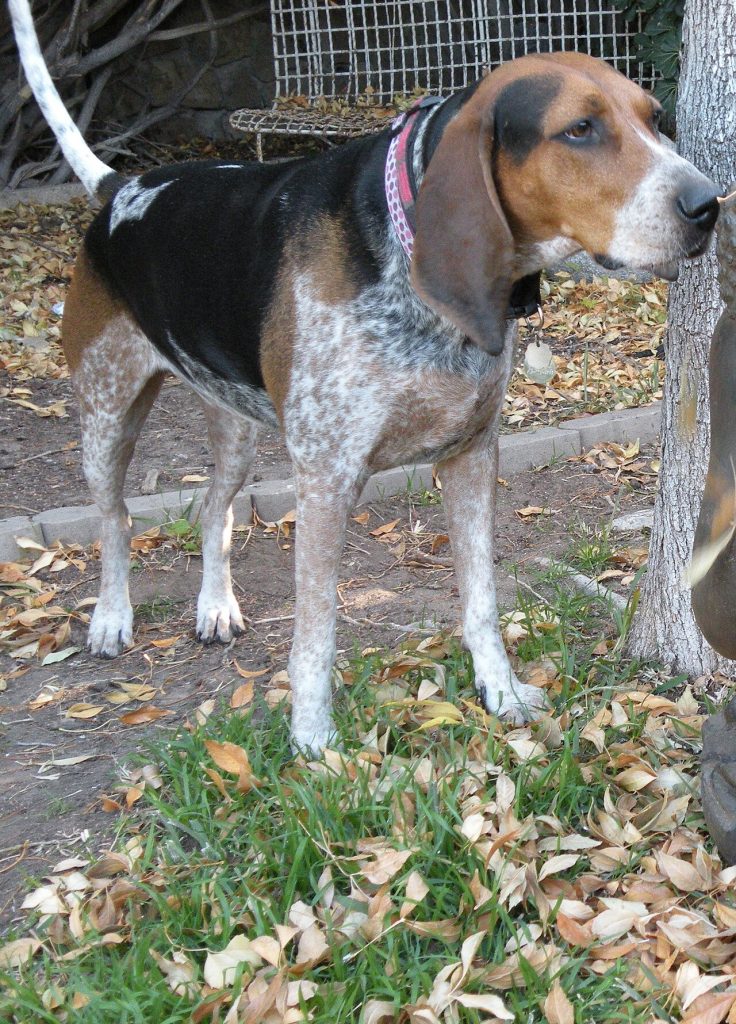
The Bluetick Coonhound is an American-born hunting dog, famous for its bluish-looking mottled coat, prodigious smell, and unmistakable howl. It’s an athletic, tough, down-to-earth dog, bred for generations to track and corner raccoons in the forests of South America. Affectionate and sociable at home but stubborn and very vocal, the Bluetick Coonhound is not for everyone: He who gives work, space and patience is richly rewarded.
Is the Bluetick Coonhound for you?
Before you fall in love with her melancholy gaze and her endless ears, be honest: The Bluetick Coonhound is a working dog with very specific needs. It shines in the hands of active people, with experience or a desire to learn, who enjoy the outdoors and who are not frightened by a stubborn and noisy dog. For a sedentary home or an apartment with noise-sensitive neighbors, it can be a constant source of frustration.
In favour .
- Loving, loyal and sociable with his family.
- He usually gets along well with children and other dogs.
- Extraordinary sense of smell – an ideal companion for tracking and hunting.
- Rustic, tough and generally robust in health.
- Short coat and easy to maintain.
To be taken into account
- Very vocal: howls and “sings” loudly.
- He needs plenty of daily exercise; he gets bored easily.
- Independent and stubborn: training is expensive.
- His sense of smell drives him to run after a trail.
- Not recommended for small apartments or idle urban life.
Character and temperament

The Bluetick Coonhound combines two souls. Inside it is a calm, affectionate dog and very attached to its people: it seeks company, lies beside you and enjoys contact. Outside, as soon as its nose catches an interesting smell, it transforms into a focused and determined hunter who seems to forget the world. This duality defines coexistence with the breed.
It’s a remarkably intelligent dog, with an almost unsettling talent for solving problems: opening locks, finding a way out of a fence, or getting to food you thought was safe. That intelligence, coupled with a good dose of independence, makes the Bluetick do things his way. It’s not a submissive or servile dog; it’s a collaborator with its own criteria.
The characteristic that most surprises those who do not know the breed is its voice. The Bluetick Coonhound was bred to warn the hunter with a deep, prolonged howl, and he uses it generously: to greet, to protest, to announce visitors or, simply, because yes. It is often mistaken for an aggressive dog because it greets strangers with its characteristic howl and sniffs until it is satisfied, but it is actually its way of getting to know its surroundings. He’s not a bad-tempered dog, but a talking dog.
Coexistence: children, other pets, flat and loneliness
With children: in normal conditions the Bluetick Coonhound gets along very well with children. It is attentive, friendly and tolerant, a good playmate for an active family. As with any large dog, it is advisable to supervise the smaller ones and teach mutual respect.
With other animals:, being a pack dog, usually gets along well with other dogs. With cats and small pets, on the other hand, you have to be careful: his tracking and hunting instinct is intense, and although he can learn to respect house cats if he grows up with them, his urge to chase anything that moves never completely disappears.
On the floor and alone: here is its big limitation. The Bluetick needs space, exercise and stimulation. Spending long hours alone and locked up is the perfect recipe for him to howl incessantly and develop destructive behaviors. You can live in a flat if your family guarantees you plenty of activity, but a house with a well-fenced garden fits in much better with your nature. And watch the fences: A motivated Bluetick jumps, digs and climbs more than you can imagine.
Education and training
Training a Bluetick Coonhound is an exercise in patience. It is intelligent, so it learns quickly what interests it, but its independence and its sense of smell play against it: when it catches a trail, it stops listening to you completely. It is not rebellious disobedience, but pure instinct.
The keys that work best are consistency, short, fun sessions, and positive reinforcement with appetizing rewards. Hard methods don’t work with this breed; they just create distrust. Early socialization – people, noises, other animals, varied environments – is critical to having a balanced adult.
The biggest challenge is the call. Releasing a Bluetick into an open space without a fence is risky: As soon as it finds a scent that’s worth chasing, it’ll follow you for miles without looking back. It is good to work the call from a puppy and, even so, assume that in unfenced areas the long leash or harness is the most sensible. Channeling your smell with tracking games or sports like the mantrailing is one of the best ways to keep your mind occupied and strengthen the bond.
Exercise and activity
The Bluetick Coonhound is an endurance athlete. It was bred to follow tracks for hours on end on rough terrain, and that physical strength is still intact. It needs much more than a lap around the block: we’re talking about one or two long walks a day, runs and, above all, activity that puts its nose to work.
He loves dog sports: tracking, mantrailing, agility or, of course, hunting for those who practice it. A Bluetick that spends its energy is a calm and happy dog at home; one that doesn’t is a howling and mischief-seeking machine. If you’re not an active person, this isn’t your breed.
Care: fur and hygiene

The good news is that maintenance is simple. The Bluetick Coonhound’s coat is short, dense, and shiny, and it only needs a weekly brushing to remove the dead hair and keep it shiny. It requires no hairdressing or complicated care, and baths can be spaced unless the dog, faithful to its fondness for wallowing in anything, decides otherwise.
The critical point of your hygiene is your ears. These long, sloping, well-flanked ears have poor ventilation and retain moisture, which favors infections. They should be checked and cleaned regularly, and dried thoroughly after each bath or wet field day. It complements the routine with nail trimming, dental hygiene, and parasite monitoring, especially important in a dog that spends so much time among weeds.
Foodstuffs
The Bluetick Coonhound needs a quality diet adjusted to its large size and high level of activity. A working dog that hunts or trains daily burns a lot of energy and requires an adequate intake; a more sedentary Bluetick, on the other hand, easily gains weight if overfed.
The ideal is to divide the ration into two meals a day and monitor your body condition to maintain a healthy weight, since overweight punishes your joints. And a very specific race warning: His sense of smell and his appetite get him in trouble all the time. Never leave food or garbage within reach, because he’ll find a way to get to it. As with any large, deep-chested dog, it is best to avoid strenuous exercise right after eating.
Health and life expectancy
The Bluetick Coonhound is a rustic breed, selected for its functionality rather than its aesthetics, and that shows in a generally robust health.
The points to watch are the usual ones for a large hound with drooping ears. Otitis or ear infections are the most common problem and can be prevented with a good cleaning and drying routine. In large dogs, hip dysplasia should be kept in mind, so it is advisable to acquire the puppy from a responsible breeder who monitors its breeders. Maintaining an adequate weight, regular vaccination and deworming, and regular veterinary checkups are the best guarantees of a long and healthy life.
Physical appearance
The Bluetick Coonhound is a large-sized, muscular, fast-moving dog that moves with its head held high and tail draped over its back, with no signs of fear or nervousness. Males measure between 22 and 27 inches at the withers (about 56 to 69 cm) and weigh approximately 25 to 36 kg; females are noticeably smaller, with an average weight of 20 to 29 kg. Their rounded, arched toes are strikingly large, almost larger than those of any other breed.
Its most characteristic feature is its fur. The colour “blue” arises from a mottling (ticking) of black dots on a white background so thick that, at a certain distance, it gives the impression of a slate or navy blue. This mottling covers the body and can intermingle with black spots of various shapes on the back, ears and sides; black predominates on the head and ears. Many specimens have brown markings (“that ‘s so“) on the eyes, sides of the snout, chest and legs, and usually have a mottled streak running up the face. The set, topped by long, low-inserted ears, gives the breed its unmistakable classic hound air.
Origin and history
The Bluetick Coonhound is a genuinely American breed, originally from Louisiana. It developed from a mixture of hounds: the Grand Bleu de Gascogne of south-west France – responsible for its type and its mottled coat – together with the English Foxhound, the American Foxhound, the former Black and Tan Virginia Foxhound and the cur type dog. The result was a dog with a cold nose and tenacious tracking, perfect for night raccoon hunting (hence the name coonhound, raccoon hound).
At first, these dogs were registered with the United Kennel Club alongside the English Foxhound and Coonhound, but in 1946 the club recognized them as an independent breed. Later recognition came from the Australian National Kennel Council and the New Zealand Kennel Club. The American Kennel Club admitted it in April 2009 and, since December of that same year, the Bluetick can compete in its coonhound events, within the hound group. You should know that the FCI does not recognize the breed.
There is also a subgroup, the American Blue Gascon, made up of larger, heavier, and more “savage” looking Blueticks. These specimens are often called “old-fashioned” Blueticks (old fashioned), for their appearance and cooler nose, i.e. a slower and more thorough tracking style than the standard Bluetick.
Curiosities

- A very famous college mascot: Smokey, the living mascot of the University of Tennessee, is a Bluetick Coonhound.
- A dog-headed mayor: in the small town of Rabbit Hash (Kentucky), known for electing dogs as mayors, the position fell in 2024 to Boone, a Bluetick.
- Cartoon star: the classic Huckleberry Hound (“Don Cat” is known to some), from Hanna-Barbera, is a blue Bluetick.
- Icon of country culture: The breed is cited in a multitude of American country songs, from “Ol’ Red” to songs by Charlie Daniels or Carrie Underwood, as an emblem of rural southern life.
- Cat’s feet:‘s rounded legs and strikingly large arched toes give it traction and endurance over rough terrain during long days of tracking.
If you are attracted to the Bluetick Coonhound’s dog-like character, its portentous scent, and its independent personality, you may also be interested in other breeds in the same family. Check out the Bloodhound, the absolute king of the trail; the unmistakable Basset Hound, another hound with endless ears; the intelligent and popular Beagle, perfect for those looking for a smaller hound; or the curious Dachshund or Teckel, a tenacious small-format hunter.
Frequently Asked Questions about the Bluetick Coonhound
Does the Bluetick Coonhound bark or howl a lot?
Yes, and you should know that before you adopt. The Bluetick Coonhound was bred to warn the hunter with a deep, prolonged howl (the famous bawl or bay) when following a trail or cornering its prey in a tree. It’s one of the most vocal breeds in existence: It barks, howls and “sings”. In a house with close neighbors it can be a serious problem if you get bored or spend many hours alone, so it is not the best choice for a small block apartment.
Is he a good dog for families with children?
In general, yes. The Bluetick Coonhound is usually affectionate, patient and sociable with children if it has been well socialized since puppyhood. It is an attentive and friendly dog, not aggressive.
Can you have a Bluetick Coonhound on a floor?
It’s possible, but it requires commitment. It’s not a couch dog: it needs lots of daily exercise and gets bored easily, and a bored Bluetick howls and can become destructive. If you live on the floor, you’ll have to guarantee it long walks, olfactory activity and, if possible, safe running space. A house with a well-fenced garden does it much better.
Does the Bluetick Coonhound get along with cats and other animals?
With dogs it usually coexists well, as it is a breed accustomed to working in packs. With cats and small animals you have to be careful: its hunting and tracking instinct is very strong, so coexistence should be monitored and, ideally, raised with them from puppyhood.
Is it hard to train?
He has a reputation for being stubborn. He’s very intelligent and solves problems with amazing skill, but he’s also independent, and when he catches an interesting smell, he stops listening to you. Training works best in short sessions, with positive reinforcement, lots of patience, and food as motivation. Calling (returning when asked) is the most complicated point because of his tracking instinct.
How long do you live and what health problems do you have?
It is a rustic and fairly healthy breed, with a life expectancy of around 11-12 years. Like other large dogs with long and dropped ears, it is advisable to monitor otitis (ear infections) and, in concrete lines, hip dysplasia.
How much exercise do you need a day?
It’s a long distance athlete bred to hunt for hours. It needs at least one or two long walks a day plus moments of intense activity: running, tracking or dog sports. Without that physical and mental expense, it channels energy by howling, scratching or escaping. It calculates at least one or two hours a day of actual activity.
Why is it called “bluetick” if it’s not blue?
The name describes its coat. The Bluetick Coonhound has a speckled (ticking) black spots on a white background so dense that, at a distance, it gives an impression of slate blue or navy blue.