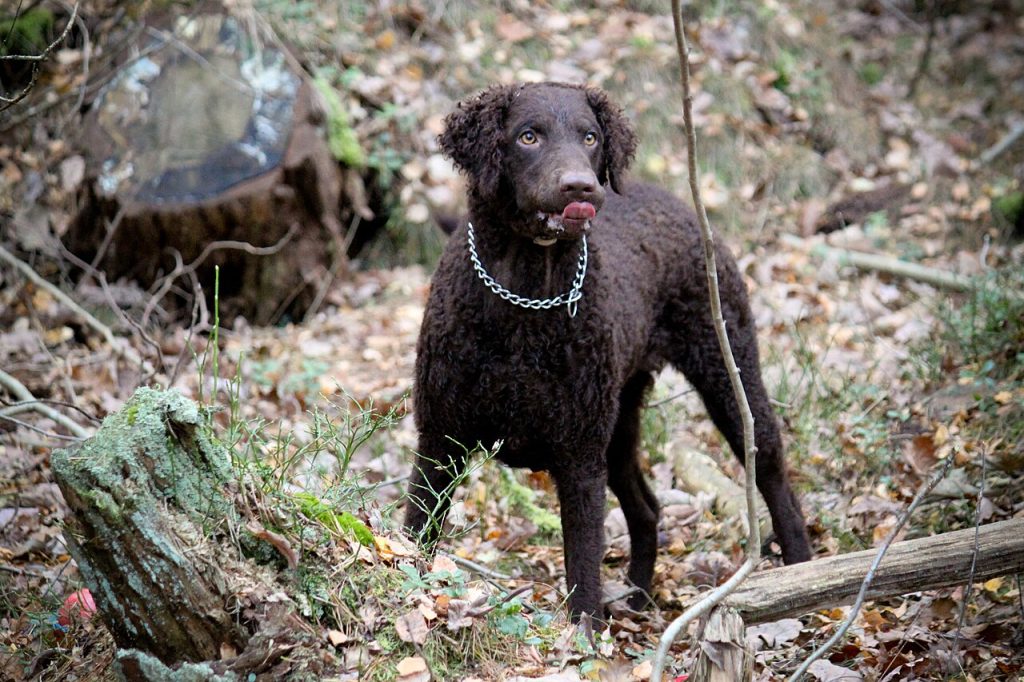
The Curly haired retriever– in English Curly Coated Retriever, or simply “Curly” – is one of the oldest and least known collector dogs in the world. Born in England to gather birds on land and in the water, he stands out for two unmistakable traits: It’s the tallest of all the retrievers and it’s covered in little tight curls that look like an astrakhan. Hiding behind that elegant and somewhat stately countenance is a complete, tough, intelligent and surprisingly quiet hunting dog at home, but also independent and reserved, very different from the Labrador or Golden most people have in mind.
Is the curly-haired retriever for you?
Before you fall in love with her curly hair, you should know what you’re getting into. The Curly Retriever is a true hunting dog, with energy, a head of its own and a need for activity. Suitable for active people who enjoy the countryside, water, and teamwork with their dog; not the best choice for someone looking for a lazy couch mate or a beginner who wants a dog that “trains itself”.
In favour .
- Quiet and balanced at home if you get enough exercise.
- Simple maintenance coat: two brushes a week are enough.
- Smart, versatile and an excellent swimmer and collector.
- Soft mouth: handle prey (and objects) carefully.
- Loyal and loving to his family, good playmate.
- More discreet and less “sticky” than other retrievers.
To be taken into account
- He needs plenty of daily exercise and mental stimulation.
- Independent: He is bored with repetitive training.
- Reserved with strangers; demands early socialization.
- Rare breed: finding a serious breeder can be expensive and there’s a waiting list.
- Notable seasonal change despite its unique coat.
- It is not a dog to live isolated in the garden or to spend long hours alone.
Character and temperament

The curly-haired retriever evolved as a ranger’s dog, and that origin explains almost everything. It’s a cheerful, fun-loving dog, but with a maturity and independence that sets it apart from other collectors. While a Labrador tends to overflow with enthusiasm for everyone, the Curly tends to be more serene, observant and, at times, distinctly reserved with strangers. It’s not aggressive distrust, but a somewhat distant courtesy: She needs her time to decide that she likes someone.
With his family, however, he is loyal, affectionate, and an excellent companion. Inside the house, as long as it has covered its exercise quota, it transforms into a quiet, discreet dog, able to spend the afternoon lying down while you work. That double face – exuberant in the countryside, placid in the living room – is one of its great charms. She’s smart and very capable, but you shouldn’t confuse intelligence with submission: This dog thinks for himself and values that things make sense to him.
Coexistence: children, other pets, flat and loneliness
Well socialized, the Curly Retriever is a good family dog and usually gets along well with children, with whom he shares that playful point and that soft mouth that makes him careful.
With other dogs and pets the coexistence is generally good if he grows up with them and socializes early. His collecting instinct towards birds is very marked, so with domestic birds or small animals you have to be careful. Reservation from strangers makes him an attentive dog that warns, although he is not an aggressive guard.
Can it live in a flat? Yes, provided it is given the exercise it needs. It is not a permanent outdoor or garden dog: it wants to be with its people. It tolerates better than many breeds the moments alone if it is well tired and polite, but the long days alone, day after day, are not for it: boredom and lack of activity bring out undesirable behaviors.
Education and training
Here’s the key to understanding this race. The curly-haired retriever is intelligent – in the well-known Stanley Coren classification it ranks 41st out of 131 breeds, within the “medium” category of obedience and work capacity – but its intelligence is accompanied by independence and a low threshold of boredom. The mechanical repetition drains his patience: repeat the same exercise five times and you’ll stop cooperating, not because you don’t understand, but because you’re no longer interested.
The formula that works is positive reinforcement, short, varied, fun sessions, and tapping into your natural drive to get paid. Start early, be consistent and make the training a meaningful game. Early socialization – people, noises, environments and other dogs – is especially important to soften their tendency to reserve. With a patient and creative guide, the Curly shines; with harsh or monotonous methods, it closes.
Exercise and activity

Raised for its agility and endurance in the field, this dog needs real movement. A short walk around the block is not enough for it: it requires plenty of daily exercise, play and mental stimulation. When it meets this need, it is a happy and calm companion; when it does not, it becomes frustrated.
His great passion is water. Dog encyclopedias describe swimming as “the delight of this dog”, and they do not exaggerate: Few breeds enjoy a river, lake or sea as much, where their waterproof fur and tough physique make them a tireless swimmer. He also excels in canine sports such as hunting trials, the agility and the flyball. If you offer him work, challenges and the outdoors, you’ll have a balanced dog inside the house.
Care: fur and hygiene
Although its curly coat seems demanding, it is one of the easiest to maintain among hunting dogs. The Curly-haired Retriever has a unique layer of tight curls, with no undercoat, and that greatly simplifies the routine: two brushes a week are enough to keep it clean and free of knots.
It is mute. All Curlies fight, though not to the extent of double-coated dogs; females usually shed more hair during their cycle, and both males and females can move in the spring, especially in climates with abrupt seasonal changes. Bathing should not be frequent and it is advisable to use a specific shampoo for dogs so as not to spoil the texture of the curl. In the world of exhibitions, tail, ear, abdomen, legs, and feet are slightly trimmed, but shaving the body is considered undesirable.
Foodstuffs
As a good active and resilient dog, the Curly Retriever needs a quality diet that supports its musculature and energy level.There is no single valid recipe: many owners choose a good complete and balanced commercial feed, while some breeders opt for natural feeding or BARF diet, based on raw meat and vegetables.
Whatever the option, the important thing is to adjust the rations to their age, weight and actual activity, and watch the scale: Overweight is one of the most common problems affecting the race and aggravates conditions such as hip dysplasia. He divides his food into two servings a day, avoids strenuous exercise right after eating – he is a large, deep-chested dog – and always leaves fresh water available, especially after baths and days of activity.
Health and life expectancy

The curly-haired retriever is, in general, a robust dog. Its life expectancy is around 10 to 12 years: a 2004 British Kennel Club survey placed the average at around 10.9 years, while a UK study from 2024 raised the figure to about 12.2 years, in line with the average of purebred dogs.
Like all races, it has predispositions that are worth knowing. Problems described include hip dysplasia, various eye conditions (cataracts, corneal dystrophy, distichiasis, entropy, ectropion, or retinal dysplasia), heart problems, epilepsy, glycogenosis (a disease of glycogen storage), and exercise-induced collapse. Overweight, as already mentioned, is another avoidable risk factor. In British data on causes of death, cancer (about 30%) was highlighted, as were old age, gastric ailments and heart problems. The best prevention is to go to breeders who perform health tests (hip, eye and heart), keep the dog in its weight and follow veterinary checks.
Physical appearance
The Curly Retriever is an active, well-muscled, athletic-looking dog with an elegance reminiscent of a “dress-up” collector. He ‘s the tallest of the retrievers: Males usually measure between 64 and 69 cm at the withers and females between 58 and 64 cm (the American standard is 62 cm for males). The weight should be proportional to the height; the specimens usually move orientally around 30-40 kg. Structurally, it looks somewhat “long-legged”, although in reality it is slightly longer than tall, balanced and agile, with an obvious air of resistance.
Its hallmark, of course, is the coat of small, tight, crisp curls that covers its entire body. This coat repels water and runoff and protects the skin from damage that would be sustained by finer, softer-coated dogs. Only two colors are allowed: solid black and liver (a deep brown). Occasional white hairs are tolerated, but large white spots are a serious fault. The head and snout are long, the bite on scissors, the ears medium and dropped, and the eyes black or brown in the black and brown specimens or amber in the liver colored; the nose is completely pigmented, to match the mantle.
Origin and history
The Curly Retriever originated in England and is considered the oldest type of retriever, closest to old water dogs. Its history dates back to the early 19th century and, according to sources, to an even earlier past. In their formation, breeds such as the extinct English Water Spaniel, the Irish Water Dog, various poodles and, later, the St. John’s or small Newfoundland dogs, common ancestors of all modern retrievers, were crossed.
In the early 19th century there were three varieties – curly, wavy, and smooth – until the early 20th century it was the texture of the hair, rather than the lineage, that determined how a British retriever was classified in exhibitions. The Curly made its debut at a canine exhibition in Birmingham in 1860, was registered by the British Kennel Club in 1873 and, in 1890, its breed club was founded and the standard was drafted. Along with the wavy-haired (today’s smooth-haired Retriever), it was one of the first two recognized collector breeds, already around 1860.
Common throughout the 19th century, it is now a rare breed: it is estimated that there are about 4,000 specimens worldwide, most in northern Europe. In 2006 the Kennel Club included it in its list of vulnerable native breeds of the British Isles – those with fewer than 300 registered puppies a year – and in 2011 it reached a low with just 62 annual registrations.
Curiosities
- The tallest of the retrievers. Among Labrador, Golden, Chesapeake and company, the Curly is the tallest.
- Pioneer with etiquette. was, along with the wavy-haired one, one of the first two officially recognized retriever breeds, around 1860.
- Rarity protected. is on the UK vulnerable native breed list; in 2011 only 62 puppies were recorded.
- Curls with function. Its mantle is not only aesthetic: the tight curl acts as waterproof armor against water and weeds.
- Swimmer by profession. Dog encyclopedias describe swimming as their greatest “delight”.
- Two colors and that’s it. only supports black and liver; any other layer is out of the standard.
If you are attracted to this curly collector, you may be interested in other breeds with which it shares work, water, or even part of its family tree. Check out Labrador Retriever and Golden Retriever, the most popular collectors; Caniche (Poodle), which is among its ancestors; and the towering Terranova, another water dog related to the common trunk of retrievers.
Frequently Asked Questions About the Curly Retriever
Is the Curly Retriever a good family dog?
Yes. Well socialized, it is loyal, affectionate, and playful with its family, and usually gets along very well with children thanks to its balanced character and soft mouth. It is somewhat more reserved and independent than the Labrador or Golden, but an excellent companion for active homes.
How much exercise do you need a day?
He was raised for his agility and endurance, so he needs plenty of daily exercise, play and mental stimulation: long walks, running, swimming or dog sports.
Does it shed a lot of hair?
It has a unique coat of curls without undercoat, easy to care for with two weekly brushes, but it is not hypoallergenic: it sheds less than the double-coated breeds, although it is not hairless.
Is it hard to train?
It is intelligent, but independent and bored with repetition. It is not the ideal breed for an absolute beginner. It responds very well to positive reinforcement, to short and varied sessions and to harnessing its collecting instinct. Patience and creativity are key.
Do you get along with children and other pets?
In general, yes, especially if it grows up with them and socializes early. It is careful with children and usually gets along well with other dogs.
Can he live in a flat?
It can, as long as it gets the exercise it needs and doesn’t spend long days alone. Indoors it’s quiet if it’s very tired, but it wants to be with its family: it’s not a dog to live isolated in the garden.
How long do you live and what health problems do you have?
Their life expectancy is around 10-12 years. Among their predispositions are hip dysplasia, various eye conditions, heart problems, epilepsy, glucogenosis, exercise-induced collapse and overweight.
What color is the curly-haired retriever?
Occasional white hairs are tolerated, but large white spots are a serious fault by the standard.