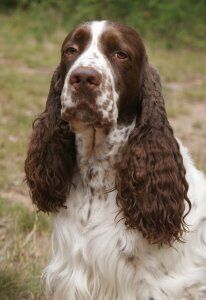
The English Springer Spaniel is a medium-sized English hunting dog, cheerful, tireless and deeply attached to his family. Raised for centuries to “spring” and collect birds, today it shines equally as a sporting companion, detector dog, and affectionate pet. If you are looking for an active, sociable, and very easy-to-train dog, the English Springer Spaniel deserves your attention, provided you can give him the exercise and companionship he needs.
Is the English Springer Spaniel for you?
Before you fall in love with their sweet look, you should be honest: the English Springer Spaniel is a working dog of pure breed. It is not a couch dog. It greatly enjoys family life, but needs to expend body and head daily. These boxes summarize the good and what you should value before taking the step.
In favour .
- Affectionate, sociable and very close to his people.
- Of the easiest dogs to train: ready and eager to please.
- Excellent with children and well socialized with other pets.
- Resilient and versatile: hunting, agility, obedience, tracking or hiking.
- Medium in size and manageable, comfortable in almost any active home.
To be taken into account
- Medium-high energy: You need real daily exercise, not a short walk.
- Very dependent; it hurts to be alone for long hours.
- Fur with fringes requires regular brushing and ear care.
- Their hunting instinct doesn’t go well with birds or other small pets.
- Without enough stimulation, he gets bored and can become restless or destructive.
Character and temperament

If you had to describe the English Springer Spaniel in one word, it would be “enthusiastic”. It is a cheerful, lively, and ever-willing dog, who faces every day with a tail in motion and a contagious desire to participate in everything his family does. Few breeds convey so much joy in life.
It’s, first and foremost, a people dog. He bonds intensely with his people and prefers to be by their side before anything else. This closeness makes him a wonderful companion and very communicative, but it also explains why he suffers when he is left out of family life. It is sensitive, can read its owner’s mood, and responds better to affection and encouragement than to harshness.
His intelligence is remarkable and goes hand in hand with a great capacity for work. He was bred to work side by side with the hunter for hours, so he has focus, consistency and a genuine desire to please. On a day-to-day basis, this results in an attentive, docile, responsive dog that learns quickly and enjoys having “a job” to do, whether it’s playing catch or learning new tricks.
As a good spaniel, its energy level is medium to high. It is not a nervous or difficult dog, but it does need a channel to channel its vitality. A Springer that gets enough exercise and feels part of the group is balanced, calm at home and a pleasure to be around.
Coexistence: children, other pets, flat and loneliness
- With children: is one of its great virtues: patient, playful and tolerant, it fits wonderfully in families with children.
- With other dogs: is usually sociable and friendly. Some specimens, especially among males, may not tolerate dogs of the same sex well, so good early socialization makes a difference.
- With cats and other pets: lives well with cats or other animals if it grows up with them. However, it is not a good idea to have it with birds or other small pets: its instinct to lift birds is very alive and can shoot itself.
- On the floor:‘s medium size makes it viable in an apartment, but only if it gets plenty of exercise outside.
- In the face of loneliness: is his weak spot. As attached as he is, he has trouble staying alone for long hours and may develop separation anxiety, barking or destructive behaviors. He needs a home where he doesn’t spend most of the day alone.
Education and training
The English Springer Spaniel is one of the most grateful dogs to train. Its combination of intelligence, sensitivity and desire to please makes it learn quickly and enjoy the process. It is common to see them excel in obedience, agility, tracking and, of course, in the hunting tests for which they were conceived.
The key is positive reinforcement. It responds excellently to rewards, play and praise, and very poorly to harsh methods: a harsh correction quenches its enthusiasm and undermines its trust in its guide. Short, varied and fun sessions yield better results than long, repetitive ones.
It is good to start early with basic socialization and manners. Since it is a dog that is easily aroused by stimuli, it is worth working from puppy calmness, impulse control and recall, which in dogs with so much smell and so much searching instinct is fundamental. Giving him “mental work” on a daily basis – smelling games, finding objects, retrieving – is the best way to keep a Springer satisfied and obedient.
Exercise and activity
There are no shortcuts here: the English Springer Spaniel needs daily and abundant exercise. We are talking about a minimum of one to two hours of physical activity a day, and ideally more for working line specimens, which have remarkable endurance. It is not enough to go around the apple.
He loves to run, explore, swim and, above all, use his sense of smell. He is a dog made for the countryside: tracking, searching and collecting objects fill him both physically and mentally. Water is another of his passions, a direct inheritance of his work collecting birds in wetlands. Activities such as agility, flyball, canicross, search games or mantrailing are perfect for him.
Just as important as physical exercise is mental stimulation. A Springer who just runs but doesn’t think remains dissatisfied. Combining long walks with olfactory games, food puzzles and training is the formula for avoiding boredom, which in this breed is the number one cause of behavior problems.
Care: fur and hygiene

The Springer’s coat is medium-length, smooth and weather-resistant, with longer fringes on the ears, legs, chest and lower body. It’s not a complicated coat, but it does require regular maintenance: The ideal is to brush it two or three times a week to avoid knots and tangles, especially in the fringed areas. Exhibition specimens, with more hair, need a little more dedication than working ones.
A more frequent brushing at these times keeps the house under control. Many homeowners opt for a periodic arrangement (cutting off legs, feet and ears) to facilitate hygiene.
The point that should never be neglected are the ears. Their long and dropped ears reduce the ventilation of the ear canal and favor otitis, one of the most typical ailments of the breed. It is advisable to check and clean them regularly, and dry them well after each bath or dip.
Foodstuffs
The English Springer Spaniel needs a complete and balanced diet, adjusted to its medium size and, very especially, to its activity level. A working specimen or a sports dog burns much more energy than a quieter-living one, and its diet should reflect this.
Since it is a gourmet dog with a good appetite, it is necessary to monitor its weight: overweight is a silent enemy that aggravates joint problems such as hip dysplasia. Measure rations, control rewards (especially if you use them a lot in training) and keep in touch with your veterinarian to adjust the diet to each stage of life: puppy, adult and senior.
If your dog is prone to skin problems or allergies – something that occurs in the breed – your veterinarian may recommend a specific diet.
Health and life expectancy
The English Springer Spaniel is, in general, a robust and long-lived dog, with a life expectancy that is usually between 12 and 14 years. Recent British studies have estimated its average longevity above that of all dogs, which confirms that it is a healthy breed when it comes from responsible breeding.
Still, like all races, it has a predisposition to certain conditions that you should know about:
- Dysplasia of the hip: hereditary joint malformation; serious breeding selects breeders with evaluated hips.
- Patients who have been diagnosed with progressive retinal atrophy degenerative eye disease for which genetic tests exist.
- Fucosidosis: is a rare hereditary metabolic disorder; there is a DNA test that allows carriers to be removed from reproduction.
- Otitis (infections of the ear): very common because of the shape of their ears; prevention is in regular hygiene.
- Hepatitis is chronic the breed shows some predisposition to this liver disease.
- Skin problems and allergies: dermatitis and autoimmune processes occur with some frequency.
The best guarantee of health is to go to a responsible breeder who performs the appropriate genetic and hip tests, keeps veterinary checks and prevention up to date, and takes care of weight and ears.
Physical appearance
The English Springer Spaniel is a medium-sized, compact and well-proportioned dog, with an elegant and athletic air at once. Males measure around 48-53 cm at the withers and females about 46-51 cm; the British standard fixes a reference height of about 51 cm. The weight ranges from approximately 18 to 27 kg in males and 16 to 25 kg in females, with the working line specimens being somewhat lighter and finer-boned.
Its most recognizable feature are the ears: long, lobular, inserted at eye level and covered with feather-like hair, framing a friendly expression head, with dark hazel-colored almond eyes and lively and kindly gaze.
The mantle is medium-length, smooth and weather-resistant, with fringes on the ears, extremities and body. As for color, the most common are liver and white and black and white, sometimes with fire marks (tricolor). The ruana varieties (blue or liver) also appear and the mottling or “ticking” over the white areas is very typical. It should be noted that there are two quite distinct types – the bench type, heavier, with plump hair and long ears, and the field type, lighter, with shorter hair and a rustic appearance – the result of decades of breeding for different purposes.
Origin and history

The history of the English Springer Spaniel is that of one of the oldest land spaniels. The term “spaniel” derives from the Old French spanish(“Spanish”), alluding to the supposed Iberian origin of their most distant ancestors, but it was in the British Isles that the breed as we know it was forged. As early as 1576, English physician John Caius described spaniels in his treatise on British dogs.
For centuries, spaniels were divided according to their function. Around 1800, the smallest of the same litter were used for hunting and received the name “cockers”, while their larger siblings were used for get up .– in English, spring– the birds and make them jump to the reach of the hunter or falcon: Hence the name “springer”. Cocker and springer came to be born literally in the same litter until just over a century ago.
The direct ancestors of the breed were the spaniels of the counties of Norfolk and Shropshire, known in the mid-19th century as “Norfolk Spaniel”. The British Kennel Club officially recognized the English Springer Spaniel as a differentiated breed in 1902, and the American Kennel Club did the same in 1910. In 1914 the first field champion was crowned, which consolidated the two lines that endure today: The work and the exhibition have been separated for more than 70 years. From a hunting dog, the Springer has also become one of the world’s most beloved detection and rescue dogs.
Curiosities
- Its name says it all: “springer” comes from spring, “jump”, for its task of lifting the flight of birds.
- It’s a first-rate detector dog used to locate explosives and drugs at customs and security agencies halfway around the world, and also in mountain search and rescue.
- Its sense of smell is so subtle that it has been used for unusual tasks, from detecting bee nests to tracking the dangerous hospital bacterium Clostridium difficile, whether or not inhaled.
- She has lived in the White House: Millie, the dog of President George H. W. Bush, and Spot Fetcher, of George W. Bush, were English Springer Spaniels.
- Several have been awarded medals for bravery, including the Dickin Medal – the animal equivalent of a military medal – for their work detecting weapons and explosives.
- The Springer and the English Cocker Spaniel share such recent ancestors that for a long time they were distinguished only by weight.
If you are attracted to the English Springer Spaniel because of its sociable nature and passion for work, you may want to learn about other breeds in its family and their abilities. Its closest relative is the English Cocker Spaniel, with which it shared litters for decades; it is also worth discovering the Cocker Spaniel, the sleek Field Spaniel, and, within show and collection dogs, the versatile Brittany. They all share that unmistakable spirit of a cheerful, dedicated hunting dog.
Frequently Asked Questions about the English Springer Spaniel
How long does an English Springer Spaniel live?
Their life expectancy is around 12 to 14 years.Recent studies in the UK place their average longevity above that of all dogs, especially with good breeding, exercise and veterinary care.
Is he a good dog for families with children?
He is patient, playful and affectionate with children, but it is only good to supervise the play with the little ones for their energy and teach them to respect their moments of rest.
How much exercise do you need?
He needs at least one or two hours of physical activity a day, and ideally combine it with mental stimulation: olfactory games, hunting, swimming or dog sports.
Can he live in a flat?
You can, thanks to its medium size, but only if you get plenty of exercise outdoors and don’t spend too many hours alone.
Does it shed a lot of hair and cost a lot to care for?
Its coat is moderate, especially in spring and autumn. Brushing it two or three times a week keeps it in good condition.
Do you get along with other dogs and cats?
It is generally sociable. It coexists well with cats if it grows up with them and is usually friendly with other dogs, although some males may not tolerate others of the same sex.
Is it easy to train?
Very. He’s intelligent, sensitive and eager to please, which makes him very receptive to positive reinforcement. He learns quickly and excels in obedience, agility and tracking. He avoids hard methods, which quench his enthusiasm.
What’s the difference between the working Springer and the exposure Springer?
They are two lines bred for different purposes for decades. the field is lighter, with shorter hair and shorter ears, selected for its smell and strength. the bench is heavier, with more abundant hair and longer ears.