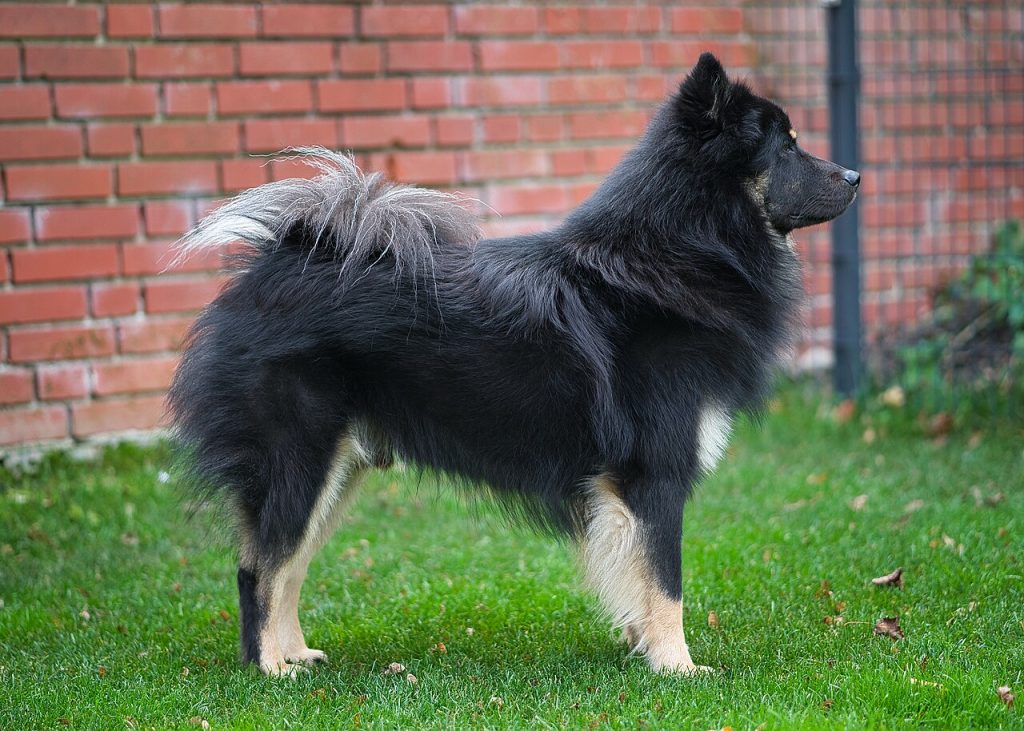
The Eurasier is a medium-sized Spitz dog born in Germany in the mid-20th century with a very clear goal: be the perfect family companion. It brings together the best of the chow chow, the wolf spitz (wolfsspitz or keeshond) and the Samoyed in a quiet, discreet, deeply loyal dog with little hunting instinct. If you’re looking for a dog that’s balanced, barks little and lives close to his own, the Eurasier deserves your full attention.
Is the Eurasier for you?
The Eurasier is not a dog for everyone, and that’s precisely why he fits in so well with those who understand him. He was selected over decades by prioritizing character and health over beauty, so what you get is a stable companion, affectionate with his people and reserved with strangers. In return, he demands something non-negotiable: to be part of the family. A Eurasier doomed to a backyard or solitude goes out.
In favour .
- Balanced temperament, calm and very loyal.
- Little barking and clean, with little body odor.
- Excellent with the family and the kids.
- Low prey pulse: good coexistence with other pets.
- Moderate exercise needs.
- Good warning dog without being aggressive.
To be taken into account
- He can’t stand prolonged loneliness or living in isolation.
- Double dense coat: loosens hair and sheds strongly twice a year.
- Sensitive: harshness in education blocks it.
- Reserved with strangers; needs early socialization.
- Independent and hierarchical: it requires consistency.
- Rare breed: there may be a waiting list with serious breeders.
Character and temperament

Character is literally the raison d’être of this breed. Its creators listened to ethologists such as Konrad Lorenz and Eberhard Trumler, who insisted on prioritizing a pleasant temperament over aesthetic uniformity. The result is a noble, calm and emotionally well-balanced dog, which becomes an exceptional companion when educated with judgment.
The Eurasier is very attached to its owners and develops an intense bond with the family. It is vigilant and attentive: it notices everything that happens around it and warns of the abnormal, but it is not a nervous or noisy dog. With strangers it is reserved and suspicious, without falling into shyness or aggressiveness.
As a puppy it is playful and somewhat mischievous, though without the destructive behavior typical of other breeds, in large part because its prey drive is low. As it matures, it becomes more serene and reflective. It’s an independent dog, capable of making its own decisions, and with a marked hierarchical structure: Respect the one who guides you firmly and fairly, without needing excessive flattery or harsh hand.
Coexistence: children, other pets, flat and loneliness

With children: is one of its greatest strengths. Patient, tolerant and protective without exaggeration, the Eurasier lives wonderfully with the smallest of the house, which he usually considers part of his group.
With other pets:‘s poor hunting instinct makes things a lot easier. Well socialized, tolerates other dogs perfectly and can get along with cats, especially if he grows up with them.
On the floor: indoors is quiet and quiet, which makes it suitable for living on the floor whenever you go out daily.
Soledad: here is its limit. The Eurasier needs constant contact with its family and is not made to spend long hours alone, locked in a yard or tied up. In such conditions it becomes sad and may even become depressed. It is the essential requirement for the breed to give its best.
Education and training
The Eurasier is intelligent and easy to learn, but its independent and sensitive nature dictates how it should be taught. It responds extremely poorly to harsh words and punishment: abruptness blocks it and damages the bond. Instead, with positive reinforcement, patience and consistency, education flows.
The key is consistency and a relationship of trust. Being a hierarchical dog, it appreciates a calm and fair leadership, without authoritarianism. It is advisable to start socialization early, exposing it in a positive way to people, noises, other dogs and new situations, to soften its natural reserve towards the unknown and prevent it from leading to shyness.
It is not a dog designed for strict obedience work or to live in training kennels; its motivation is the bond with the family, so it shines in shared activities and can perform very well as a therapy dog, where its balance and sensitivity are an advantage.
Exercise and activity

The Eurasier is not a high-performance athletic dog or a tireless runner, but neither is it a sedentary dog who settles on the couch. One or two good walks a day plus some play or activity is all it takes to be balanced and fit.
What he really enjoys is doing things with his family: excursions, hiking, outings to the countryside or the mountains. Inside the house it is quiet; outdoors it is animated and lively. It tolerates the cold well thanks to its double coat, so winter activities it loves, while with heat it is advisable to moderate the effort and seek the cool hours of the day.
Care: fur and hygiene
The Eurasier’s mantle is double: a dense, woolly undercoat under a medium-length covering hair that rests loosely on the body. The snout, face, ears and front of the legs are shorter, while the tail, the back of the legs (flecks and culotte) looks long.
Maintenance is more bearable than its appearance suggests. A weekly brushing is enough for most of the year to remove dead hair and prevent tangles. The exception is the two annual moults, in spring and autumn, when the undercoat is released abundantly: Then it’s best to brush it daily. It is a naturally clean dog with little body odor, typical of the spitz, so it does not need frequent baths; washing it only when it is really dirty is enough. Complete the routine with nail, ear and tooth care.
Foodstuffs
As a medium-sized dog of moderate energy, the Eurasier needs a complete and balanced diet, adjusted to its age, weight and activity level. It is not a breed with exotic requirements: the important thing is a quality food with good protein intake and control the rations to maintain a healthy weight, since excess kilos punish their joints.
It is advisable to divide the food into two daily intakes in the adult and respect the guidelines of the puppy to accompany a healthy growth of medium breeds. Fresh water always available and moderation with prizes complete the picture.
Health and life expectancy
The Eurasier is, in general, a healthy and robust dog, with a life expectancy of around 12 to 14 years. Its main Achilles heel is historical: the small number of founding specimens resulted in a narrow genetic pool in the early years, which causes some hereditary diseases to appear occasionally.
Problems described include hip dysplasia, knee dislocation, and hypothyroidism, as well as eyelid and eyelash disorders such as distichiasis, entropy, and ectropion. That’s why it’s so important to go to responsible breeders who do health checks on breeders: evaluation of hips, elbows, kneecaps, eyes, dentition and thyroid function, among others. A dog diagnosed with hypothyroidism can be controlled with medication, but should not be bred.
Physical appearance
The Eurasier is a medium-sized, well-built, harmonious spitz with erect, triangular ears. Its silhouette conveys balance and solidity without heaviness. The males measure 52 to 60 cm at the withers and weigh 23 to 32 kg; the slightly lighter females measure 48 to 56 cm and weigh 18 to 26 kg.
It supports a wide range of colours: Lion, red, wolf gray, solid black and black and fire. All combinations are permitted except pure white, white spots and liver colour. A curious detail is the tongue, which can be pink, blue-black, or mottled, inherited from its chow chow ancestry. His attentive, friendly expression, along with the smooth “smile” he inherited from the Samoyed, are part of his charm.
Origin and history
The history of the Eurasier is one of the best documented in the canine world, because it can be traced back to its first generation. It all started with a man named Julius Wipfel, who was born in Mannheim, Germany, and had a passion for sled dogs. After World War II, he and his wife, Elfriede, took in a dog abandoned by Canadian troops, whom they called “the Canadian”, a wolflike animal that left an indelible mark on them.
When the Canadian died, the couple wanted to recreate that dog. In 1960, in Weinheim, Wipfel launched a breeding plan together with Charlotte Baldamus and a small group of enthusiasts. Inspired by the readings of Konrad Lorenz, he crossed his female wolf spitz (wolfsspitz) with male chow chows in search of a polar dog of attractive colors and good temperament. That initial result he called “Wolf-Chow”.
Twelve years later, in 1972, to refresh the blood and refine the type, they introduced a male Samoyed named “Cito von Pol”. Lorenz himself supported the idea and even kept a puppy of that line, whose character he described as the best he had ever known in a dog. As the FCI did not accept the name “Wolf-Chow”, Wipfel renamed the breed as Eurasier, a nod to its dual European and Asian origin. The FCI officially recognized the breed in 1973.
Curiosities
- It is one of the very few breeds whose genealogy is known from the very first litter, documented on June 22, 1960.
- The name “Eurasier” sums up their mixture of European (wolf spitz) and Asian (chow chow and Samoyed) blood.
- Nobel laureate Konrad Lorenz had a Eurasier and considered him a dog of unsurpassed character.
- Their tongue can be bluish or mottled, a trait inherited from the chow chow.
- Their breeders decided from the outset to put health and temperament ahead of appearance, something unusual in cynophilia.
- It emits very little body odor and barks rarely, two traits that make it especially comfortable at home.
If you are attracted to the Eurasier’s calm nature and family bond, you may be interested in other related breeds of spitz origin or strong attachment to their people. Chow Chow Samoyedo Husky Siberiano Akita
Frequently asked questions about the Eurasier
Is the Eurasier a good family dog?
Yes, that’s exactly what it was created for. The Eurasier was designed from scratch as a family companion dog, with no sharp hunting instinct and a balanced temperament. It is intensely attached to its owners, is patient with children and enjoys participating in home life. Its only condition is not to live in isolation: it needs to be inside, with its people.
Does the Eurasier bark a lot?
No. It is one of the least barking breeds. It warns when something is out of the ordinary, but it does not bark easily or repeatedly. This discretion, coupled with its quiet character indoors, makes it very bearable even in neighborhood communities.
How long does a Eurasier live?
Its life expectancy is around 12 to 14 years. It is a generally healthy dog; the main historical challenge has been a reduced genetic stock in its beginnings, so it is advisable to choose breeders who test the breeders for health.
Do you lose a lot of hair?
It has a double dense coat and does shed hair, with two strong mouldings a year (spring and autumn) in which the loss is shot.
Is the Eurasier adapted to living in a flat?
Yes, as long as it gets its daily walk and exercise. It is quiet and quiet indoors, which makes it suitable for floors. What it does not tolerate is prolonged solitude or living relegated to a yard or kennel: its balance depends on contact with the family.
Is it easy to train the Eurasier?
It is intelligent and easy to learn, but also independent and sensitive. It responds very poorly to harshness and very well to positive reinforcement, coherence and bonding. It is not a dog for authoritarian methods: it is educated from trust.
Does the Eurasier get along with other dogs and pets?
It usually does, especially if it socializes well as a puppy. Its low prey drive makes it easier to get along with other pets, including cats it grows up with.
Does the Eurasier need a lot of exercise?
It has a moderate energy. It suffices with one or two good walks daily and some activity or play; it especially enjoys outdoor activities in the company of its family. It is not a hyperactive dog or extreme sportsman, but neither is it a sedentary.