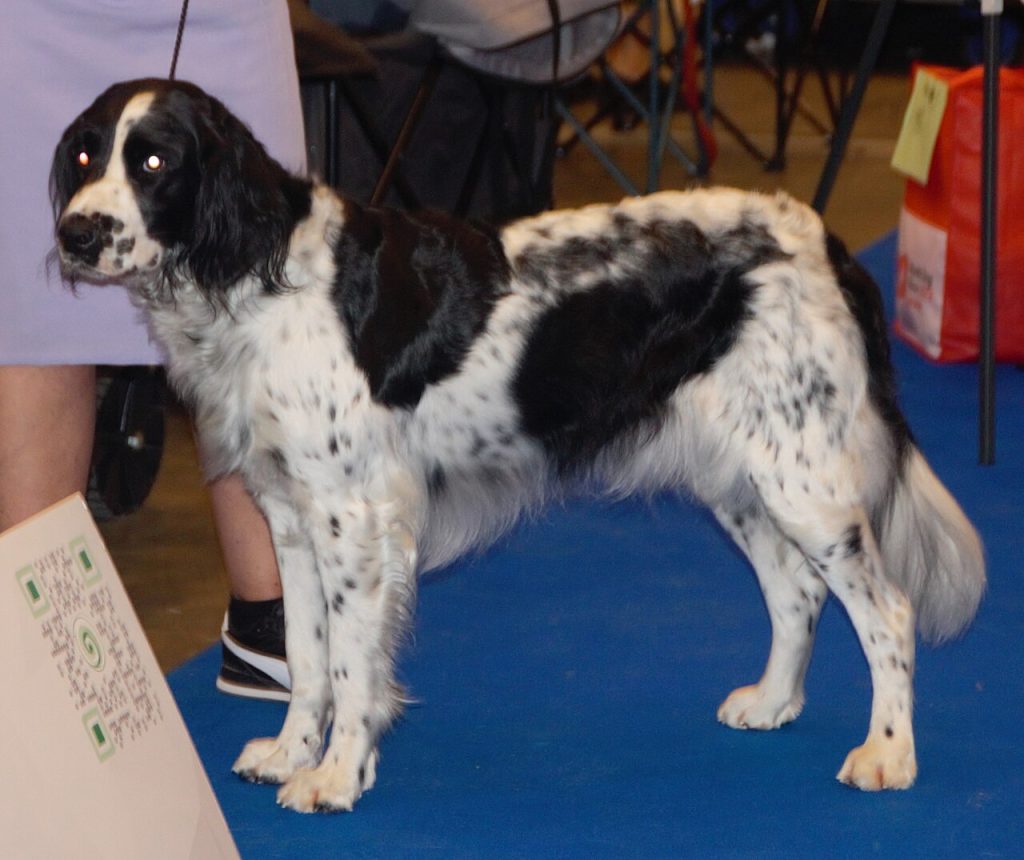
The Large Münsterländer(German: Großer Münsterländer) is a continental breed of dog of the spaniel type, born in the German regions of Westphalia and Lower Saxony and named after the county of Münsterland. With long hair, unmistakable black and white coat and an exceptional sense of smell, it is one of the most versatile hunting dogs in existence: traces, samples and collects parts both on land and in water. Outside the field, he reveals himself to be a balanced, caring and family-friendly partner. In this article you will find everything you need to know about the great Münsterländer before sharing your life with one.
Is the Münsterländer too big for you?
The large Münsterländer is a working dog with a hunting engine. It fits wonderfully with active families, hunters, or canine sportsmen who can offer it intense daily exercise and a task to do. It’s not a couch dog: If you condemn him to inactivity, his energy and intelligence will turn against you in the form of boredom and mischief. Before you decide, honestly weigh these two faces.
In favour .
- Balanced temperament, sweet and very sociable with the family.
- Excellent with children; patient and tolerant.
- Intelligent and cooperative: learns fast and enjoys working with you.
- Really versatile: hunting, tracking, water, obedience, canine sports.
- Resilient coat that protects it from cold and water.
- Generally healthy dog, with few serious hereditary problems.
Against
- He needs a lot of exercise; not fit for a sedentary life.
- Strong hunting instinct: can go after birds and tracks.
- It’s hardly adapted to small apartments and long hours of solitude.
- The long hair curls up and picks up curls and dirt from the field.
- Very attached: suffers if left alone for too long.
- Relatively rare breed outside of canine circles; breeders scarce.

Character and temperament
If we had to describe the large Münsterländer in one word, it would be the balance. It is a calm and affable country dog, which combines passion for work with remarkable serenity at home. In full action it displays concentration, endurance and a tireless hunting thrust; once the engine is turned off, it transforms into a peaceful and affectionate companion who seeks the closeness of his people.
It is a deeply sociable and people-oriented dog. Field studies describe it as one of the most cooperative sample dogs: it tends to work closer to the guide and respond better to his directions than other versatile breeds.
It is not aggressive or nervous by nature. Its nobility and intelligence translate into a stable, sensitive and attentive character. However, this sensitivity demands fair treatment: it responds fatally to harsh methods and thrives with positive reinforcement and coherence.
Coexistence: children, other pets, flat and loneliness
With children: The large Münsterländer is famous for its patience and gentleness with the little ones. It is well socialized, tolerates childish behaviour and enjoys play.
With other pets: usually gets along well with other dogs and lives comfortably with pets he grows up with. However, his strong instinct to collect on birds allows chickens, birds or small rodents to awaken his hunting side; gradual introductions and caution are warranted.
On the floor: is not its ideal habitat. It is a large, active dog made for the outdoors. It can live in a flat alone if it is compensated for by lots of daily exercise and stimulation, but thrives much better in a house with access to a garden and frequent outings.
Soledad: is one of its weak points. Being so attached, it is bad to be alone for long days. Prolonged loneliness generates anxiety and destructive behaviors. It is not the right dog for someone who is out of the house all day.

Education and training
Training a large Münsterländer is a rewarding experience: it is intelligent, cooperative and eager to please. It learns quickly and retains what it has learned well. The downside is that its hunting instinct matures somewhat later than in other breeds, so it is advisable to be patient and not get frustrated if in the first months the “hunting chip” has not yet finished fitting in.
The key with this breed is the positive reinforcement. It is a sensitive dog that shuts down or stresses with harshness and severe correction. Rewards, play, friendly tone and short and varied sessions give much better results. Early socialization – people, other dogs, noises, diverse environments – is critical for its natural balance to be expressed to the fullest.
Control of call and impulses is a priority for their hunting instinct: without a good basis for obedience, a trail or a raised bird can make them forget the world.
Exercise and activity
There are no half-measures here: the large Münsterländer needs lots of physical and mental exercise, every day. It was bred to spend whole days working in the field, and that resistance is still intact. A short walk around the block is not enough for it even from far away.
The ideal activities are daily long walks or runs, exploration in natural environments, swimming (he loves water) and activities that combine body and mind. It is an outstanding candidate for canine sports such as mantrailing, tracking, obedience, agility or, of course, hunting for those who practice it. Giving him a “task” with which to exercise his sense of smell and his cooperation keeps him happy and balanced.
A well-exercised large Münsterländer is a calm and pleasant dog at home. A boring one with no outlet for his energy is an inexhaustible source of problems. If you can’t guarantee him an active lifestyle, this is not your breed.
Care: fur and hygiene
The coat of the large Münsterländer is long, dense, firm and smooth, with longer fringes on the ears, legs and tail. It is not a coat that requires hairdressing, but a regular brushing– two or three times a week – to avoid tangles and knots, especially in fringed areas.
Its long coat has a very specific practical disadvantage: in the field it easily collects brambles, thorns, mud and seeds. After each trip to the mountain it is advisable to check legs, ears and belly and remove what has been caught. Fallen and hairy ears deserve regular attention to prevent infections, especially if the dog swims often.
Other than that, the care is standard: bathing only when necessary, checking and cutting nails, dental cleaning and eye hygiene.
Foodstuffs
As a large and very active dog, the large Münsterländer needs a complete and balanced diet, adapted to its high energy expenditure. Specimens that hunt or play sport intensively demand more calorie and protein intake than a calmer dog; it adjusts the rations to its actual level of activity, age and physical condition.
Divide the food into two servings a day instead of one. In large, deep-chested breeds, heavy meals followed by exercise are associated with an increased risk of gastric dilation-torsion, so vigorous exercise just before and after eating should be avoided. Watch the weight: Keeping it just right protects your joints. Always check with your veterinarian for specific guidelines and have fresh water available at all times, especially after activity.
Health and life expectancy
The large Münsterländer is, in general, a robust and healthy breed, with a lower incidence of serious hereditary diseases than many popular breeds, partly thanks to a genetic base cared for by breeders.
Hip dysplasia is the condition to watch out for par excellence in breeds of this size; choosing puppies from parents with evaluated hip X-rays reduces the risk. Their long, droopy ears are prone to otitis, especially because of their fondness for water, so eye hygiene is important. As with any deep-chested dog, the risk of gastric torsion should be kept in mind and the mentioned dietary precautions applied.
With proper care, proper feeding and regular veterinary checks, the large Münsterländer enjoys a long and active life for its breeding.

Physical appearance
The large Münsterländer is an athletic, elegant and noble dog, of muscular constitution but never heavy. Its body has a length similar to its height at the cross, which gives it a harmonious and square silhouette.
In terms of size, males measure about 60 to 67 cm to the cross and females about 2 cm less.
Its most characteristic feature is the coat: Medium-length, dense, and black and white colored hair. Due to the genetics of the – What ?(spotted) gene, the proportion of black varies greatly from one specimen to another, from almost white dogs to predominantly black dogs. Solid black spots, mottling and ruana layer appear in varying degrees. As a rule, the head is usually mostly black and the tip of the tail white, regardless of the color distribution in the rest of the body.
Origin and history
The large Münsterländer shares roots with the rest of the European continental show dogs, all of them descendants of the ancient and now extinct Spanish show dog, which spread through France and the Netherlands until reaching the courts of the Germanic world, where it was first used in the hunting of birds with nets and hawks and later with shotgun.
When the Langhaar standard was set in 1879, the black-and-white specimens were first excluded and finally removed from the standard by 1908-1909, as their color was considered a sign of crossing with the English setter.
In 1919, a group of breeders founded in Haltern, in the heart of Münsterland, a society for the purebred breeding of these long-haired white and black show dogs, and chose the name Großer Münsterländer Vorstehhund. A list of 83 founding animals was drawn up and in 1922 the first book on the origins of the breed was published, officially recognized that same year. The Federación Cinológica Internacional (FCI) finally accepted it in 1954. The British Kennel Club recognized it in 1971 and the American Kennel Club, very recently in 2023.
Curiosities
- The most versatile of all. A NAVHDA study that compared 82 large Münsterländer with over a hundred dogs of other versatile breeds concluded that this was by far the most versatile breed of all.
- A forbidden color that created a race. The large Münsterländer exists precisely because its black and white coat was expelled from the standard of the long-haired German specimen dog.
- Despite its century of history, Just arrived in the States. was not recognized by the American Kennel Club until 2023, making it one of the most recent additions to the club.
- Genetics of the mottled one. In a genetic study, all large Münsterländer tested were homozygous for the sp allele of the MITF gene, which is responsible for the characteristic mottled pattern (– What ?).
- He works close to you. Unlike other show dogs that go a long way, it tends to hit the ground at a relatively short distance from the guide, usually covering between 40 and 140 meters depending on the type of soil.
If you are attracted to the Large Münsterländer for its versatility and energy, you may be interested in other working and sample breeds with a similar profile. Check out the Vizsla, Weimaraner, Pointer and the versatile Golden Retriever, all intelligent, active and very work-oriented with their guide.
Frequently asked questions about the large Münsterländer
Is the large Münsterländer a good family dog?
Yes, it is an excellent family dog as long as its high exercise needs are met. It is balanced, affectionate, very sociable and especially patient with children. Its weak point is that it needs a lot of activity and does not take well prolonged solitude.
How much exercise do you need a day?
It is a highly resistant hunting dog that requires intense daily exercise: long walks or runs, swimming, exploration and mental stimulation. A short walk is not enough for it. Without enough activity it can develop boredom and destructive behaviors.
How tall and how much does a large Münsterländer weigh?
The males measure between 60 and 67 cm at the withers and the females about 2 cm less.
Can you have a big Münsterländer in a flat?
It’s not ideal. It’s a big, very active dog, built for the countryside. It can live on the floor alone if it’s compensated for by lots of daily exercise, but it thrives much better in a house with a garden and frequent outings.
Is it hard to train?
No, on the contrary: it is intelligent, cooperative and wants to please, so it learns quickly. However, it is sensitive and responds poorly to harshness, so it must be educated with positive reinforcement.
Does it shed a lot of hair and how much maintenance does it require?
It has long and dense hair that should be brushed two or three times a week to avoid tangles, especially in the ears, legs and tail.
Is it a healthy breed?
In general, yes, it is a robust breed with few serious hereditary problems. The aspects to watch out for are hip dysplasia (proper for large dogs), otitis due to its long ears and its fondness for water, and the risk of gastric torsion common to deep-chested dogs.
Is he a rare dog or easy to find?
It is a relatively uncommon breed outside of kennel circles. In Germany, just over 300 puppies are registered per year on average. Finding a responsible breeder may require search and waiting list, but it is worth it for the guarantees of health and temperament.