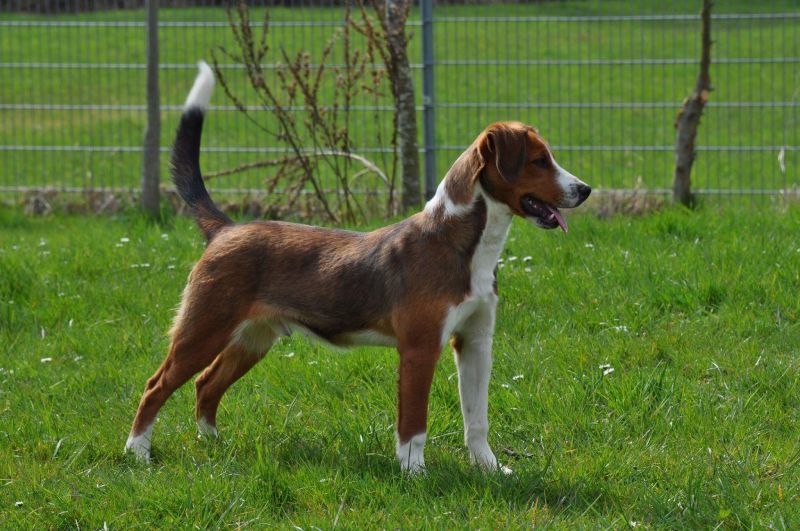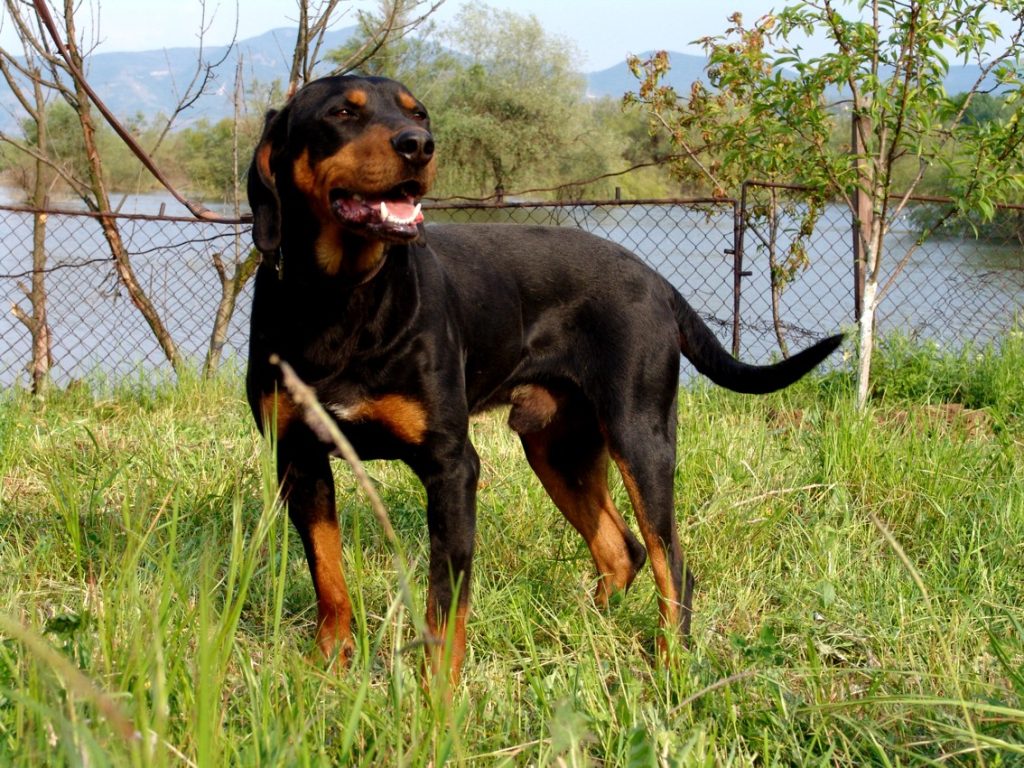
The Sabueso Búlgaro(in Bulgarian Българско гонче, balgarsko gonche) is the most widespread shorthaired hunting dog in Bulgaria and probably one of the great unknowns of European canine science. Born in the Ludogorie region in the northeast of the country, he is a tracker specializing in wild boar: prodigious nose, underlying strength and a balanced character that makes it as effective on the mountain as attached to its owner at home. Here we tell you, without invention, what we really know about the Bulgarian Hound.
Is that the Bulgarian Hound for you?
The Bulgarian Hound is a purebred working dog, not a sofa pet. Before looking for one – something, at first, very complicated outside of Bulgaria – it is advisable to be honest about what you ask and what you offer.
In favour .
- Exceptional olfaction and resistance: a tireless tracker, ideal for hunting and nose sports.
- A balanced and intelligent character, very close to his family and naturally playful.
- Easy maintenance: short and rustic hair, without great hairdressing demands.
- Healthy and functional dog, shaped by job selection rather than aesthetics.
To be taken into account
- He needs a lot of exercise. and daily olfactory work; boring becomes frustrating.
- Strong hunting instinct: recall costs and releases in wildlife areas are risky.
- It tends to give voice when tracking; not the ideal neighbor in a small apartment.
- Extreme rarity: hardly any information, breeding or international standard outside Bulgaria.
Character and temperament
The official Bulgarian description sums up the Bulgarian Hound in a few very revealing words: it possesses a balanced nervous system, is attached to its owner, is playful and clever.
Such stability should not be confused with blind docility. Like any gonche specialized in wild boar, it’s a dog with its own criteria: When you hit a trail, your brain goes into nose mode and the rest of the world goes into the background. He’s brave, determined and persistent. At home, however, he tends to be quiet and coarse with his own, provided he has spent energy. The key to his good character is precisely this: A tired Bulgar Hound is a pleasant dog; one locked up and unstimulated, a bunch of frustration.
Coexistence: children, other pets, flat and loneliness
With the family, its attachment and playful temperament make it, in principle, a good companion for homes with children, always with the usual norms of respect between dog and child.
other dogs is usually well understood: it is a hound bred to hunt in groups, accustomed to sharing terrain.
About the floor, let ‘s be clear: It’s not his medium. It needs space, long walks and outlet; in an apartment it only works with a very committed owner who compensates with hours of exercise and sniffing work, and assuming it’s a dog that barks and “sings” when it crawls. The extended loneliness doesn’t sit well with him either. A dog so attached to its owner and so in need of activity can develop anxiety or destructive behaviors if it spends long hours alone and bored.
Education and training
The Bulgarian Hound combines two traits that make the job easier: intelligence and attachment to the owner. It learns, wants to please and responds well to positive reinforcement. The challenge is not ability, but competence of the nose: against a fresh trail, almost no prize wins, so obedience must be built early and reinforced always.
General recommendations for this type of hound:
- Early socialization with people, dogs, environments and noises during puppyhood.
- Working the recall(the call) from day one, with high-value prizes and in controlled environments before relying on open field.
- Channeling the smell: instead of fighting your instinct, take advantage of it with search games, mantrailing or sports tracks.
- Short and motivating sessions, avoiding confrontation: it is a balanced dog that responds poorly to harsh methods.
Exercise and activity
The Bulgarian Hound was selected for its inexhaustible energy and its strength for hunting days after the wild boar. Moved into family life, that translates into a high and daily demand for activity: long walks, possibility of running and, crucially, mental exercise through smell.
Such a dog is not satisfied with three turns around the apple. He loves hiking, hand bike riding (canicross/bikejoring) or any nose sport. If you practice hunting, it is his natural element. If not, you will have to be creative to give way to that motivation: a Bulgarian Hound without work is the perfect recipe for behavior problems.
Care: fur and hygiene
One of the few simple facets of the breed. Its the cloak is short.– about 3 cm – , hard, shiny and tight to the body, with a well-developed undercoat that protects it from the Bulgarian continental cold. The hair is shorter on the head, ears and limbs, and somewhat longer on the cross, back, tail and back of the thighs.
In practice:
- Brushing weekly to remove dead hair; a few more reviews during mowing.
- Punctual baths, only when it gets really dirty; it’s a rustic, low-maintenance hair.
- Orejas: when dropped and stuck to the cheek, it is advisable to check and dry them, especially after the field, to prevent otitis.
- After each departure: inspection of pads, fingers (where there may be small white marks), skin and ears for ticks, spikes or wounds.
Foodstuffs
There is no official dietary guideline of the Bulgarian Hound itself, so the principles of any active hunting dog of medium size apply.
Reasonable guidelines: a complete and quality diet, divided into two doses for adult dogs, controlling the body condition so that it does not overweight out of season. For very active dogs not feeding just before intense exercise is suitable. And, as always, fresh water available and the adjustments recommended by your veterinarian according to age, activity and condition.
Health and life expectancy
The Bulgarian Hound is a rustic and functional dog, the result of a selection based on work and not on aesthetics, which is usually associated with good general health and little morphological exaggeration. As it is a not standardized by the FCI breed and not widely distributed outside Bulgaria, there are no extensive studies or lists of specific hereditary diseases; it would be dishonest to give you longevity or prevalence figures that are simply not published.
It’s best to use the common sense of an active hound: care of the drooping ears to prevent infections, skin and pad checks after the camp, parasite control, daily vaccination and joint care for their intense physical life. Here ‘s an interesting genetic fact . A 2018 study on the mitochondrial diversity of Bulgarian native dogs suggests a dual phylogenetic origin in these native breeds, a sign of a broad genetic pool.
Physical appearance
The Bulgarian Hound is a medium size dog, with a strong, harmonious and elegant body of slightly elongated format, typical of hound morphologies.
- Cabeza: medium-sized, dry and proportionate, with a long, flat skull; black nose and straight-faced muzzle, of medium length (half of the head).
- Dentadura: complete, 42 strong white teeth, in scissor bite.
- Ojos: oblique, medium, slightly oval and dark brown, with a vivid and expressive look.
- Orejas: inserted at eye level, falling to the sides and glued to the cheeks, smooth, of medium length and somewhat rounded tips.
- Cuello: medium-length, strong and muscular, without paw, forming about 45o with the body.
- Pecho: wide and deep, oval in shape, reaching to the elbows or somewhat below.
- Extremidades: dry, strong and muscular, straight and parallel viewed from the front.
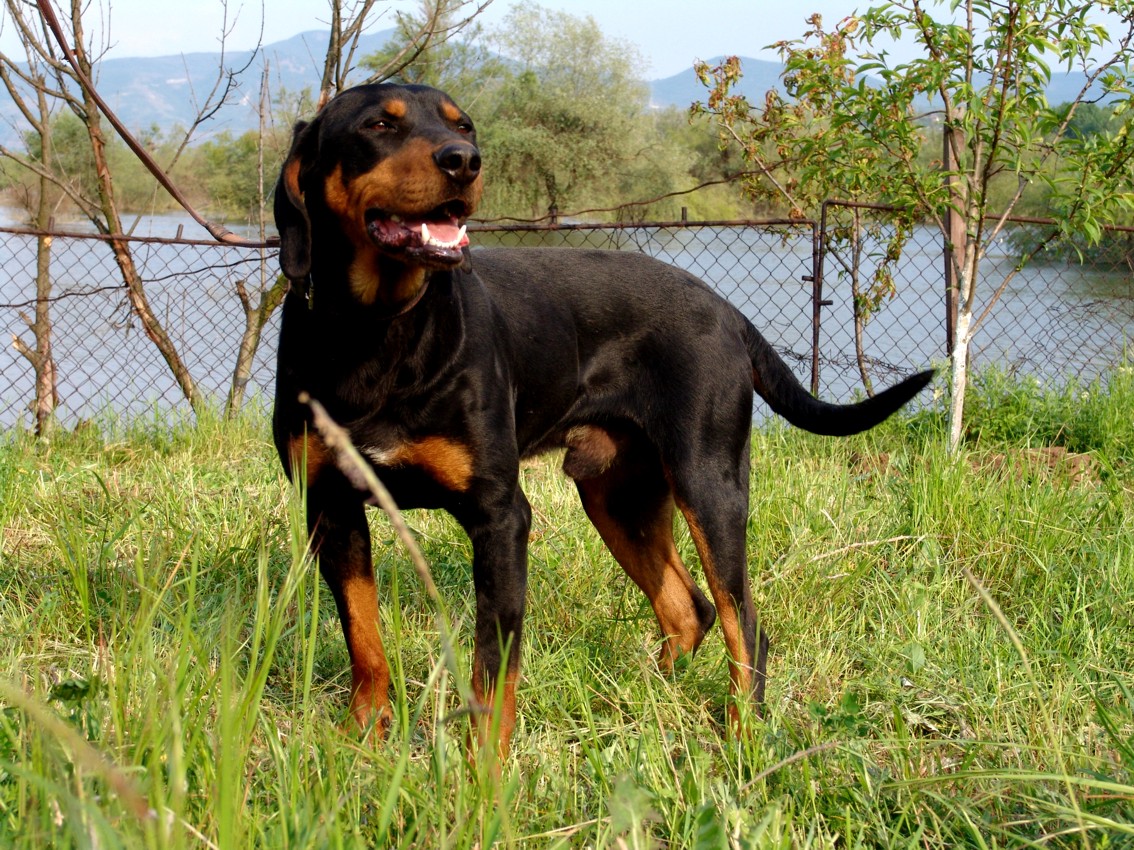
- Manto: short (about 3 cm), hard and shiny, with dense undercoat; black anthracite with fire marks on extremities, chest, snout, under tail and two cinnamon spots on the inner corner of the eyes.
There are no official internationally published height or weight figures for the breed, as it lacks an FCI standard; Bulgarian sources describe it as “medium-sized” without setting values in centimetres.
Origin and history
The Bulgarian Hound comes from the region of Ludogorie, in northern Bulgaria, from where it also gets its full name in Bulgarian, the following paragraphs are inserted:(Ludogorie Bulgarian Hound).
Its closest relatives are other balkans hounds: the Greek hound (Greek Harehound), the Serbian hound and the Transylvanian hound, with which it shares type and function. It is recognized by the Bulgarian Kennel Federation (BRFK), an associate member of the FCI, but – as of 2023 – not as a breed by the FCI itself, which explains why it is virtually unknown outside its country. Bulgarian native breed preservation centres have been working on zootechnical studies to fix and document their exterior, a usual step on the road to wider recognition.
Curiosities
- Wild boar hunter by profession: although useful for other hair hunting, its recognized specialty is following and harassing the wild boar, one of the most demanding pieces.
- One of the three Bulgarian breeds recognized by the BRFK, in the company of the Bulgarian Shepherd Dog and the Karakachan.
- The name says it all.: gonche means “sawdust” or “rehale dog” in Bulgarian; bulgarian, Bulgarian.
- Dual genetic origin: research on the mitochondrial DNA of native Bulgarian dogs points to a lineage with two phylogenetic roots.
- Manufacturing mark: the two small cinnamon spots over the eyes, about the size of a hazelnut, are one of her aesthetic seals.
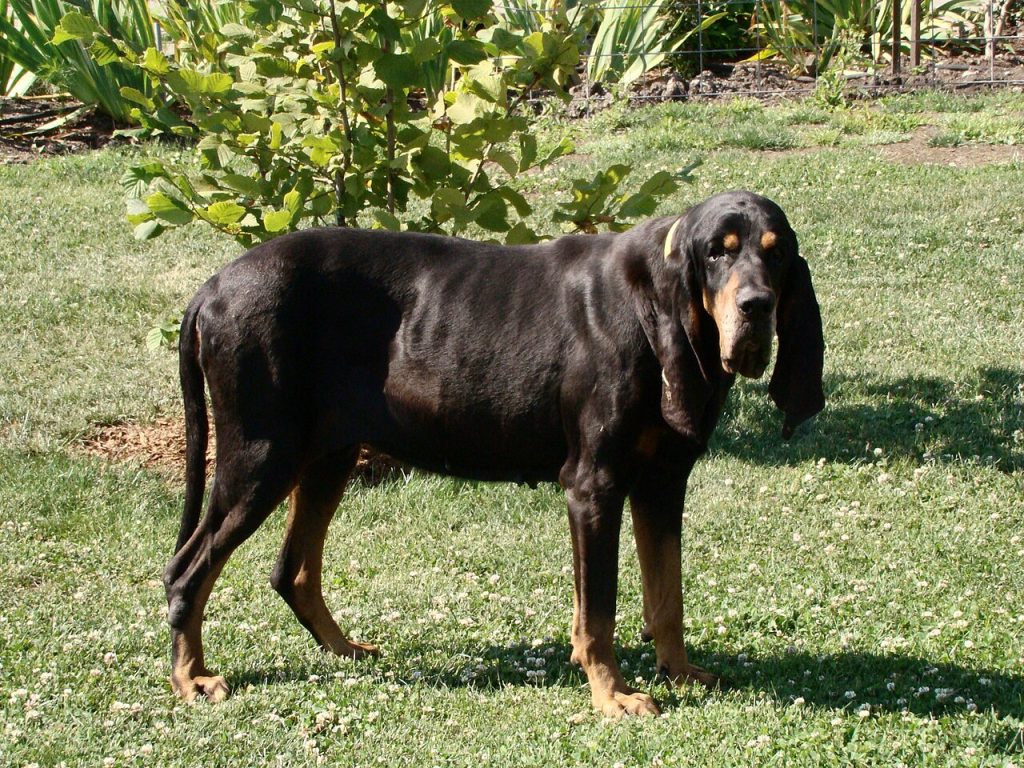
If you are attracted to the Bulgarian Hound for its nose and energy but want a more accessible breed, you will be interested in other hounds and tracking dogs with a similar profile: the tireless Beagle, the unmistakable Basset Hound, the tracking king Bloodhound and, among active hunting dogs, the athletic Dálmata.
Frequently Asked Questions About the Bulgarian Hound
Is the Bulgarian Hound recognized by the FCI?
No. As of 2023, the Bulgarian Hound (Bulgarian: Българско гонче, balgarsko gonche) is not listed in the FCI nomenclature. It is nationally recognized by the Bulgarian Kennel Federation (BRFK), which also considers it one of the country’s three indigenous breeds.
What is the Bulgarian Hound used for?
It is a hunting dog specialized in tracking wild boar, although it is also used with other pieces of hair. It combines an outstanding sense of smell, agility in finding and following the trail, great sense of orientation and an almost inexhaustible endurance.
Is he a good family dog?
It has a promising foundation: a balanced temperament, intelligence and a strong attachment to its owner, as well as a playful character.
Can he live in a flat?
It is not its ideal habitat. As a working dog, it needs intense exercise, olfactory stimulation, and often tends to ‘give voice’ when following a trail. On the floor it is viable only if it is guaranteed several long outings a day and mental work; a house with fenced terrain does it much better.
How much exercise do you need?
Many. We’re talking about a dog bred for long mountain journeys. The reasonable thing is one or two long walks a day, running, and especially activities that put his nose to work (trails, search games). Without that physical and mental wear and tear, he can get frustrated and become noisy or destructive.
What kind of coat care do you require?
Their coat is short (about 3 cm), hard and shiny, with a well-developed undercoat. Just a weekly brushing – a little more in the seedlings – and punctual baths. After each outing to the field it is advisable to check ears, pads and skin for ticks or wounds.
What color is the Bulgarian Hound?
The base color is anthracite black with fire marks (cinnamon).Cinnamon appears on the lower extremities and tail, chest, nose and under the tail, plus two small spots on the inner angle of the eyes.Small white marks on the fingers are allowed.
Do you get along with other dogs and pets?
With other dogs it usually works well: it is a hound used to hunting in collaboration. With small animals you have to be careful because of its strong prey instinct; coexistence with cats or other pets requires early socialization and supervision.