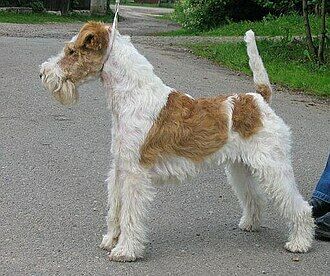
The Fox Terrier with Hard Hair(Wire Fox Terrier) is a small, compact and overwhelmingly energetic English terrier, bred to pull the fox out of its burrow. It gathers in a few kilos a remarkable intelligence, a bomb-proof courage and a white coat with unmistakable spots.
Is the hard-haired fox terrier for you?
Before you fall in love with their show dog image, you should know that behind that nice face is a working terrier with all the letters. This breed rewards the owner who is involved and punishes the one who underestimates it. Here’s an honest summary for you to decide.
In favour .
- Small and manageable, ideal even for floors.
- Very smart and quick to learn; brilliant at agility.
- Cheerful, playful and very close to his family.
- Brave and a good whistleblower without being a mindless barker.
- It’s a coat that barely changes and it’s pretty clean.
- A robust, long-lived breed with a good life expectancy.
Against
- Very high energy: you need daily exercise yes or no.
- Strong prey instinct towards cats and small animals.
- Stubborn and independent; not an obedient dog without a job.
- He tends to dig, chase and run away if he’s bored.
- The hardcoat requires periodic stripping to look good.
- He doesn’t like prolonged loneliness.
Character and temperament

If we had to summarize the Hardhaired Fox Terrier in two words, they would be energy and intelligence. It is an alert, lively and always ready for action dog, with an insatiable curiosity and a contagious optimism. It lives each day as an adventure and expects its family to stick to the plan.
That spark has a B-side: it gets bored easily, and when it gets bored, it seeks life. It was bred to think for itself inside a hole, away from the control of the hunter, so it’s an independent and resolute dog, not a submissive follower. It makes decisions, it insists, and if something interests it more than you at that moment, it will chase it.
With its people it is affectionate, communicative and tremendously loyal; it loves to participate in everything and hates to be on the sidelines. It is courageous to the point of recklessness: it does not impose a large dog or a new situation on it. Well socialized and cared for it turns out to be a balanced and very funny companion; neglected, it becomes nervous, barking and destructive. The difference, almost always, is made by the owner.
Coexistence: children, other pets, flat and loneliness
- With children: is a tireless and enthusiastic playmate, perfect for older children who understand how to handle it.
- With other dogs: can coexist well, especially if it socializes as a puppy, although some specimens (especially males) are territorial and not diplomatic with dogs of the same sex.
- With cats and small pets: here is its weak point. Its prey instinct is very strong; it will see an unknown rabbit, hamster or cat as something to chase. Coexistence with a cat is possible if they grow up together, but never 100 percent reliable.
- On the floor: fits nicely in size and, in fact, was a trendy urban pet. The key is not square footage, but exercise: a tired Fox Terrier is a quiet dog at home.
- In the face of loneliness: is not a dog to spend long hours alone. It needs companionship and encouragement; isolation results in barking, wrecking and anxiety.
Education and training
The hard-haired fox terrier is extremely smart, which is both a blessing and a snare: it learns good and bad at the same speed. That’s why education should begin the first day it comes home, with clear, consistent rules maintained by the whole family.
It responds to positive reinforcement, to rewards and to play; it closes in on imposition, screaming or boring repetition. Short, varied and fun sessions work much better than long and monotonous ones. It’s good to be patient with its stubbornness: it’s not that it doesn’t understand you, it’s that it’s calculating whether it pays to listen to you.
Two absolute priorities: the early socialization(people, dogs, noises, environments) to soften his character, and a it’s called solid., because his chase instinct can make him ignore your voice and shoot out after a cat or a bike.
Exercise and activity

This is a hard-working breed, and you can tell. It needs to spend body and head every day: as a reference, one or two hours a day between long walks, runs, pick-up and drop-off games and mental challenges. Without that release, all of its energy is redirected into behaviors you won’t like: digging the garden, barking, gnawing or trying to escape.
It is an athletic and resistant dog that enjoys demanding activities. The agility goes like a ring on its finger for its agility, speed and desire to learn; also the flyball, the olfactory games and the search work.
Always combine physical exercise with mental stimulation: interactive toys, food dispensers and small obedience challenges. A Fox Terrier that uses its head is a much easier Fox Terrier to have at home.
Care: fur and hygiene
The hard, dense and rough coat is the mark of identity of the breed, and keeping it well has its technique. The correct, especially in exhibition dogs, is the stripping or manual start of the dead hair, which retains the rough texture, brightness and intensity of the colors.
The usual alternative in companion dogs is the cutting by machine in the hairdresser, simpler and cheaper. It has an aesthetic cost: the hair becomes softer, curly and faded in color, and gets dirty more easily. It is a perfectly valid option if you are not going to expose the dog.
Between hairdressing sessions, the rest of the care is simple: regular brushing to remove dirt and tangles, bathing only when necessary, checking and cleaning ears, cutting nails and frequent dental hygiene, an important point in small breeds.
Foodstuffs
The Fox Terrier needs a complete and high-quality diet, adjusted to its small size but high activity. Ideally, a balanced food adapted to its age (puppy, adult, senior), weight and exercise level, divided into two daily intakes for an adult.
Although it is an energetic dog that burns a lot, it is advisable to monitor the rations and, above all, the extra prizes: Being overweight in such a compact body strains your joints and reduces your quality of life. Better to reserve the treats to reward the workout and control the total amount of the day. Clean water is always available and, if you have any questions about quantities or type of diet, the safest thing to do is to consult your veterinarian.
Health and life expectancy
Together it is a rustic breed and longevity. A British study from 2024 placed its average life expectancy around 13.5 years, above the average of purebred dogs, and it is not uncommon for a well-kept specimen to exceed that figure.
As with any breed, the best medicine is prevention: regular veterinary checks, daily vaccination and deworming, weight control, dental hygiene and care for ears, eyes and skin.
A note about its tail: traditionally it was amputated (caudectomy) because it served as a handle to get the dog out of the hole.
Physical appearance

The Hardhaired Fox Terrier is a small, robust and very balanced dog, with an almost square silhouette that conveys strength and elegance at the same time.
Its head is elongated and fairly flat, with a powerful snout, dark, small and expressive eyes, and V-shaped ears bent forward. The beard and mustache, the result of the hard facial hair, give it that unmistakable classic terrier look.
The main distinguishing feature is the coat: hard, dense and rough, almost wired, with a softer inner layer. The predominant color is the white, on which brown (fire) spots appear on the face and ears and, very often, a black “riding chair” or a large dark spot on the back, in addition to other black or brown markings on the body.
Origin and history
The hard-haired fox terrier was born in Inglaterra by fox hunting enthusiasts. It is believed to be descended from an ancient, now extinct, rough-haired, black coat and fire working terrier native to regions such as Wales, Derbyshire and Durham. Its mission was clear: to get into the hole to get the fox out and allow the pack and hunters to continue hunting.
Although it shares a name and family air with the Smooth-haired Fox Terrier, it is considered that both varieties developed separately and that their ancestors are not the same; over time they were crossed to fix the dominant white and a more defined head on the hard-haired variety. The term “fox terrier” was used generically in the 19th century for a group of small burrow hunters, and modern standardization started around 1875-1876 with the first registrations in the British Kennel Club.
The breed had illustrious godfathers: Queen Victoria is said to have had one, and her son, King Edward VII, owned a hard-haired fox terrier named Caesar. But its leap to world fame came in the 1930’s, when the film made it an icon and it became fashionable as an urban companion dog. Later, changes in the way of life and the difficulty of maintaining a native-born hunter in the city caused its popularity to decline, although it retains a loyal hobby and a huge prestige in the world of exhibitions.
Curiosities
- Film star: Asta, the dog from the The Thin Man(The Accused’s Dinner) film series, was a Hardhaired Fox Terrier and skyrocketed the breed’s popularity in the 1930s.
- Milú is one of them: Tintin’s faithful companion, Milou (Snowy/Milou), is a white Fox Terrier.
- And also IDEFIX: the puppy of Obelix in the Asterix adventures is inspired by this breed.
- King of Westminster: is the breed with the most Best in Show titles at the prestigious Westminster Kennel Club show, with 15 wins, more than any other.
- Dog of presidents and geniuses: historical owners include King Edward VII and physicist Albert Einstein, who had a Fox Terrier named Chico.
- He likes water: unlike many terriers, many enjoy swimming.
If you are attracted to the sparkling, hardworking nature of this breed, you may also be interested in other terriers of the same family and similar temperament. Take a look at the Jack Russell Terrier, another small hunter of inexhaustible energy; the towering Airedale Terrier, known as the ” king of terriers “; the Lakeland Terrier, very similar in appearance and mantle; and the brave Irish Terrier. They all share that unmistakable terrier spirit.
Frequently Asked Questions About the Fox Terrier
Is the Fox Terrier a good dog for beginners?
It can be, but with nuances. It is very affectionate and learns quickly, although its very high energy, its hunting instinct and its independent character require constancy, daily exercise and clear rules from a puppy. An active first-time owner willing to educate it will enjoy it; someone who is looking for a calm and undemanding dog is not his profile.
How long does a hard-haired fox terrier live?
It is a long-lived breed. A British study from 2024 estimated an average life expectancy of 13.5 years, above the average for purebred dogs. With good nutrition, exercise and veterinary checkups it is common to reach 14 or 15 years.
Do you get along with other dogs and cats?
It can get along well with dogs if it socializes early, although some males are territorial. With cats and small pets it is more complicated: it was bred to chase prey and retains a strong prey instinct.
Do you need a lot of exercise?
Yes. It is a working dog with a high energy level and a very low threshold for boredom. It needs at least one or two hours a day between walks, play and mental stimulation.
Do you lose a lot of hair?
Its hard coat almost does not change if it is kept by stripping (manual starting of dead hair). If you resort to machine cutting it loosens a little more and the hair becomes softer, but it is still a fairly clean breed and less allergenic in terms of shedding.
Is it hard to train?
He’s very intelligent, so he learns fast, but he’s also stubborn and independent. He doesn’t respond well to imposition or monotonous repetition. Positive reinforcement works, short and varied sessions and starting early. Well-motivated excels in obedience and, above all, agility.
Can he live in a flat?
Yes, because of its size it fits perfectly in a flat, and in fact it was a very popular urban pet. The condition is to cover its need for exercise and companionship: it is not a dog to be left alone for many hours. If it spends energy daily, inside the house it is calm and balanced.
How tall and how much does a hard-haired fox terrier weigh?
It is a small and compact terrier. The height at the withers should not exceed 39 cm. The males weigh between 7,7 and 8,6 kg and the females between 6,8 and 7,7 kg, approximately. Despite its contained size it is a strong, athletic and very resistant dog.