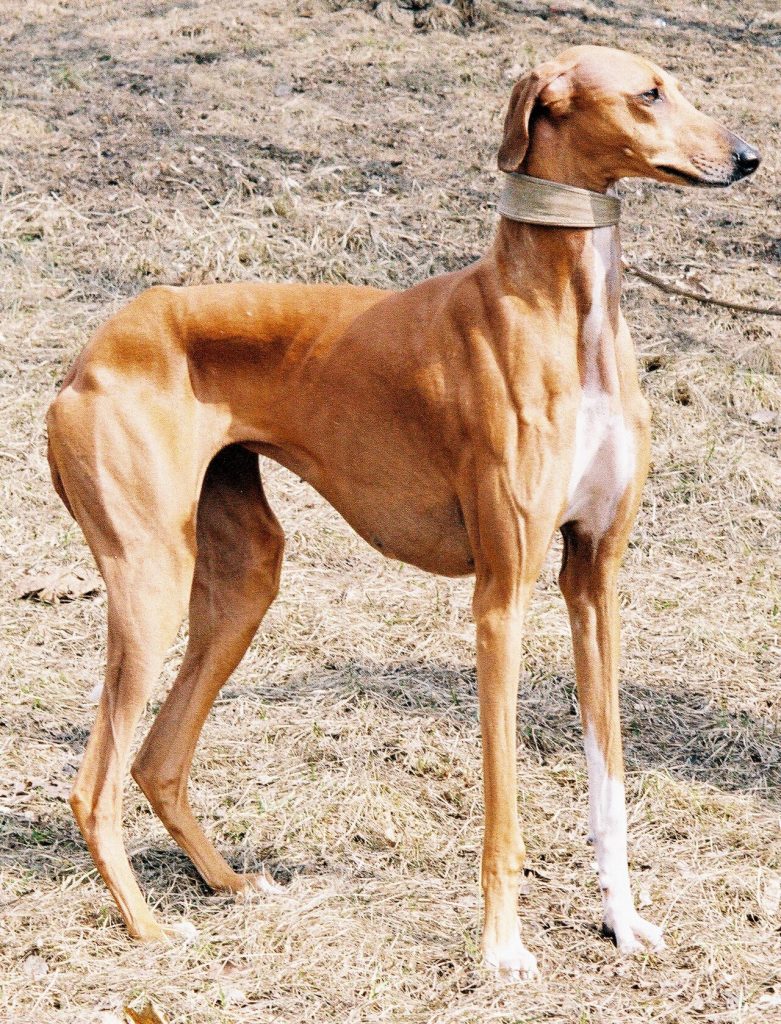
The Azawakh is an African hare native to the Sahel, between Mali, Niger and Burkina Faso, where for centuries it has accompanied nomadic peoples as a gazelle hunter and, above all, as a camp guard. Extremely thin, with musculature and skeleton marking under a very thin skin, the Azawakh is not a parlor greyhound: He’s an austere dog, loyal to his family and deeply reserved with strangers. If you’re looking for a stylish, athletic companion with a strong one-on-one bond, this guide tells you everything you need to know before living with an Azawakh.
Is the Azawakh for you?
The Azawakh is a fascinating breed, but also very specialized. It does not fit into any home: it requires space to run, an owner who understands its independence and a lot of patience with its natural suspicion of the unknown. Before falling in love with its pattern, it is advisable to look honestly at its lights and shadows.
In favour .
- Clean, almost odorless and with minimal mud: the short coat requires almost no care.
- He has a very strong and loyal bond with his family; he is especially attached to one or two people.
- Born athlete: ideal companion for running, doing canicross or lure coursing.
- Quiet and discreet at home once he’s spent his energy.
- Excellent watchdog: warns of anything new without needing to be overly noisy.
To be taken into account
- Very strong hunting instinct: difficult coexistence with cats and small animals.
- Reserved and suspicious of strangers; needs early and constant socialization.
- Independent: does not respond to training by blind obedience.
- Very sensitive to cold and humidity; suffers from continental or rainy climate.
- It requires intense daily exercise and a fenced and safe environment to release it.
Character and temperament

The Azawakh has a temperament that distinguishes it from other hares. While a Greyhound or Whippet is usually sociable and docile, the Azawakh is above all a the guardian. In its homeland its main function was not to hunt, but to protect the camp and cattle, and that instinct is still very much alive: it is an alert, territorial and deeply protective dog with its own.
With his family he is affectionate, attentive and almost feline in his way of seeking physical contact: He likes to sleep close to his people and develops a very close emotional bond, often with one particular person. With strangers, on the other hand, he is reserved and aloof; he is not unreasonably aggressive, but neither does he seek affection from just anyone. Don’t expect an Azawakh to greet visitors effusively: Normally, he watches them from a distance until he decides they’re not a threat.
It’s a sensitive, proud, intelligent dog that reads its owner’s body language and mood very well, and that sensitivity makes it wonderful for those who know how to respect it, but it’s also vulnerable to harsh methods.
Coexistence: children, other pets, flat and loneliness
With children. The Azawakh can get along well with children in the family, especially if it grows up with them, but its reserved character and physical delicacy demand respect.
With other pets. Here is its major limitation. Its chase instinct is very powerful, and it can spot cats, rabbits, or small dogs as prey, especially in motion. It can get along well with other dogs, preferably medium or large, with which it has been raised since puppyhood: In fact, it’s a very pack-oriented breed and enjoys canine company. But bringing a cat into the home when the Azawakh is an adult is usually risky.
Life on the floor. Surprisingly, it can adapt to a floor as long as it is guaranteed intense daily exercise. At home it is quiet and rested, looks for its warm corner and sleeps a lot. The problem is not the indoor space, but to cover its enormous need to run outdoors.
Soledad. is a dog that wants to be with his family, not relegated to a yard. If you spend many hours outside, it is not the ideal breed.
Education and training

Raising an Azawakh is not like raising a German Shepherd or a Labrador. It is not a dog that lives to please or that responds to traditional training based on repetition and obedience. He’s independent, thinks for himself and decides if your proposal is worthwhile. That’s why positive reinforcement – rewards, play, patience and bonding – is the only path that works; coercive methods block it.
The key piece is the early socialization. From puppyhood he must know people, noises, environments, other dogs and varied situations so that his natural suspicion does not lead to fear or reactivity. A well socialized Azawakh is aloof but balanced; one who is not can become frightened or too suspicious.
It is advisable to approach education with short, motivating sessions and without frustration. The call (recall) is especially important and at the same time difficult: as soon as it detects movement, its instinct of pursuit can more than any order. For safety, it is most prudent to release it only in fenced areas.
Exercise and activity

The Azawakh is an endurance and speed athlete built for the desert. It can reach peaks close to 60-65 km/h and possesses remarkable endurance, the result of the harsh selection of the Sahel, where only the fittest specimens survived.
Ideally, you should combine long walks with free-running sessions in secure, fenced spaces where you can stretch your gallop. It is an excellent companion for runners and greatly enjoys activities such as lure coursing(bait chase) or canicross, which channel its hunting instinct in a controlled manner. An Azawakh that spends its energy is a calm, at-home dog; one that doesn’t can become nervous or destructive.
However, its thinness and almost non-existent hair make it very sensitive to cold: in winter it needs a coat and avoids exercise in the rain or cold temperatures.
Care: fur and hygiene
Here the Azawakh is of minimal maintenance. Its coat is short, thin and very sticky, almost non-existent in the belly. It does not need hairdressing or elaborate brushing: a rubber glove or cloth once a week is enough to remove the dead hair and give shine.
The rest of the hygiene is the usual for any dog: checking and cleaning the ears, monitoring the nails (they are partly cut by activity, but it is advisable to check them) and maintaining good dental hygiene with regular brushing.
The important point is not the hair, but the heat protection. Having so little body fat and such a light coat, it passes cold easily. A warm cot, blankets and a coat to go out in winter are not a luxury, but a real need of the breed.
Foodstuffs
The Azawakh is a naturally thin dog, and that slenderness is part of its standard: the ribs and the bone structure under the skin should be appreciated.
A high-quality diet, appropriate to your age, weight and activity level, meets your needs perfectly. An adequate intake of protein is needed to keep your muscles dry and to divide the ration into two meals a day. As with all deep-chested hares, the risk of gastric torsion requires a key precaution: Avoid strenuous exercise just before and after eating, and do not allow yourself to eat or drink cravingly after a run.
Always have fresh water available, especially after exercise, and adjust the amounts by observing your body – the African Greyhound should look athletic, never skeletal or curly.
Health and life expectancy
The Azawakh is, in general, a rustic and healthy breed, the result of a very demanding natural selection in its homeland.
Still, you have to know their predispositions. It is associated with epilepsy, gastric torsion(dilatation-volvulus of the stomach, a vital urgency typical of deep-breasted dogs), spondylosis and certain autoimmune problems. As with other hares, it may also show sensitivity to certain anesthetics, something that should always be discussed with the veterinarian. And, above all, its poor tolerance to cold: It’s not a disease, but it’s a first-rate well-being factor.
Going to responsible breeders who do health checks, keeping veterinary checks and vaccinations up to date, and protecting it from the cold are the best guarantees of a long and full life.
Physical appearance
The Azawakh is the elegance made of a dog. Tall and stylized, it gives the impression of extreme finesse: its skeleton and “dry” musculature (flat, not bulging like that of the Greyhound) are transparent under a very thin skin.
- Altura: males 64 to 74 cm; females 60 to 70 cm at the withers (slightly higher heights are allowed if harmony is not compromised).
- Peso: males approximately 20 to 25 kg; females 15 to 20 kg.
- Cabeza: long, thin and chiseled, with flat skull, straight snout and dark almond or amber eyes.
- Orejas: high insertion, thin and triangular, drops stuck to the skull.
- Cola: long, thin and low, finished in a characteristic white brush.
- Pelaje: is very short and thin, in lionsky tones ranging from light sand to dark brown, also spotted, red and masked.
Its gait is light, flexible and elastic, with a double-suspension gallop that is one of the breed’s hallmarks.
Origin and history
The Azawakh is a dog of very ancient origins, bred for centuries in the Sahelian zone of Mali, Niger and Burkina Faso. Its name comes from azawagh valley, a dry basin of that region. Although it is usually associated with the tuareg people – who know it as “oska” or i went– it was also bred and owned by other peoples such as the Peul, the Bella and the Hausa.
On their land, the Azawakh fulfilled a dual essential function for nomadic life: Keeper of the camp and the cattle, and hunter of gazelles and racing hares. The extreme harshness of the Sahelian environment did the rest: Only the strongest, fastest and most independent specimens survived, forging the rusticity and autonomy that define the breed. Unlike other more solitary hares, the Azawakh hunts in packs and knocks down prey with its hindquarters once it has exhausted it.
Genetically it is more closely related to the Sloughi than to the Saluki. It arrived in Europe in the second half of the 20th century and, although still a rare breed, has a growing group of enthusiasts.
Curiosities
- Its name comes from azawagh valley, in the middle of the African Sahel.
- For the Tuareg it was not a commodity: traditionally it was not for sale., but was given as a sign of honor and friendship.
- Unlike most hares, its primary function was not hunting, but camping.
- It has an excellent memory: it is able to recognize peers after long periods of separation.
- He loves the heat and hates the rain; he usually sleeps in packs with other dogs for warmth and company.
- Their double-suspension gallop – in which the body is “in the air” twice per stride – is a rarity shared with only a few hares.
If you are attracted to the Azawakh for its athletic elegance and greyhound character, you may be interested in other related breeds such as the Greyhound, the agile Whippet, the versatile Vizsla, or the imposing Gran Danés.
Frequently Asked Questions about Azawakh
Is the Azawakh a good family dog?
It can be in the right family: active homes, with experience, without small animals and where it does not spend many hours alone. It is loyal and affectionate to its owners, but reserved with strangers and not suitable for anyone looking for a sociable and pleasant dog with everyone.
How long does an Azawakh live?
Their life expectancy is about 12 years, and with proper care, proper diet, and protection from the cold, many survive.
Does the Azawakh get along with cats?
Their hunting instinct is very strong and tends to chase small animals in motion. Coexistence with cats is difficult, especially if the dog becomes an adult; it is somewhat more viable if they are raised together from puppies, but it is never guaranteed.
How much exercise does the Azawakh need?
It needs daily intense exercise: long walks plus free running sessions in fenced areas. It is ideal for running, canicross or lure coursing. An Azawakh that spends its energy is quiet at home.
Why is the Azawakh so thin?
Its thinness is normal and part of the breed standard: you should see the ribs and bone structure under a very thin skin. It is a hare of “dry” musculature, not a malnourished dog. You should not try to fatten it.
Is the Azawakh cold?
Yes, very much so, with almost no fur and very little body fat, it is very sensitive to cold and humidity, in winter it needs a coat to go out, a warm bed and avoid exercise in rain or cold temperatures.
Is it easy to train the Azawakh?
It’s not easy in the classic sense. It’s independent and doesn’t live to obey, so it responds poorly to traditional methods. It works with positive reinforcement, patience, short sessions and, above all, very careful early socialization.
Where does Azawakh originate from?
It is an African hare native to the Sahel region, between Mali, Niger and Burkina Faso.