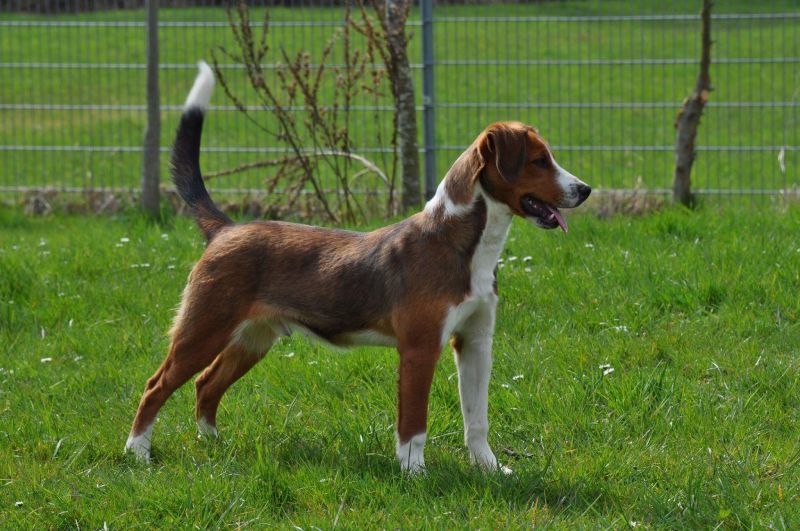
The Austrian Pinscher is a robust, medium-sized Austrian farm dog, bred for centuries to keep stables rat-free, drive cattle and watch the house. Today it is one of the rarest breeds in Europe: It was on the brink of extinction and survives thanks to a recovery program sustained by just a handful of breeding specimens. If you’re looking for a rustic, sober, guarded but unusual companion, here’s everything we know about the Austrian Pinscher with verified data.
Is the Austrian Pinscher for you?
The Austrian Pinscher is not a saloon dog or an easy choice to get. He ‘s a field dog: vigilant, full of energy, attached to his family and wary of strangers. It fits very well in a house with land and active people who value a wary guard and a rustic companion; it does not fit well in a sedentary life, in a noisy city or in the hands of someone who is only looking for a quiet and decorative dog. Before dreaming of one, remember also that it is a very rare breed and practically impossible to find outside Austria.

In favour .
- Born guardian and warner: alert without uncontrolled aggression.
- Rustic, healthy and tough, made for the outdoors.
- Very loyal and devoted to his family, playful and affectionate at home.
- Smart and sharp, eager to do things.
- Easy-to-maintain coat, with no hairdressing demands.
- Medium size and manageable, without becoming a large dog.
Against
- Extremely rare: almost impossible to get outside Austria.
- Lots of energy and need for daily activity; gets bored quickly.
- It tends to bark and warn: it’s not the quietest dog.
- Reserved with strangers; needs early socialization.
- It’s not ideal for small apartments or sedentary people.
- Territorial and guard instinct that needs to be channeled well.
Character and temperament
The breed standard describes the ideal Austrian Pinscher as a playful, lively and alert dog, and as an “incorruptible guardian”. That phrase sums up his essence well: It is a farm dog that takes very seriously the surveillance of its territory and its people, but at home it is affectionate, funny and very close to the family. He is not a cold or aloof dog; rather, he seeks out contact and enjoys being a part of home life.
With strangers, however, he is naturally reserved and suspicious. It is not usually an aggressive dog for no reason, but it does bark at anything new and remains on guard until it is sure that there is no danger. Interestingly, and despite its origin as a hunter of rats and vermin, the standard notes that the modern Austrian Pinscher lacks a marked hunting drive, making it more manageable than its rural past suggests.
It is, in short, a balanced, self-confident and characterful dog that needs a consistent and present owner. Well guided, it is a pleasant companion in both rural and suburban areas; mismanaged, its energy and guarding instinct can turn into excessive barking or stubbornness.
Coexistence: children, other pets, flat and loneliness
With children. The Austrian Pinscher is playful and loyal, which makes it a good companion for families with children as long as it has grown up with them and the basic rules of coexistence between dogs and small are respected.
With other pets., having been bred as a farm dog who lived with horses, cows and other poultry, usually tolerates the company of other animals well if socialized from puppyhood.
On the floor. is not his ideal environment. He is a dog accustomed to the outdoors and space, with a tendency to warn of everything he hears; in a small flat and without enough outlet he can become frustrated and become barking.
Soledad. is a dog attached to his family and his territory, so it is not good to spend many hours alone. Prolonged loneliness, coupled with his energy, is a recipe for boredom, barking and destructive behavior. He needs company, routine and something to do.

Education and training
The Austrian Pinscher is intelligent and alert, but he also has the independence of a working dog accustomed to making decisions on his own on the farm. This means he learns fast, but he doesn’t obey for the sake of obeying: It needs reason and consistency. Positive training, with rewards, play and short sessions, yields much better results than imposition or monotonous repetition.
The absolute priority in a puppy of this breed is the early socialization: introduce him to people, dogs, animals, noises and different situations during his first months so that his guardian instinct becomes security and not excessive fear or distrust.
It is a dog that enjoys having a job or a goal: obedience, olfactory games, agility at an amateur level or simply clear routines at home.
Exercise and activity
This is a farm dog with plenty of energy. It is not content with a short walk a day: it needs real daily exercise, combining long walks, running, play and, if possible, some mental challenge. It especially enjoys the countryside, smelling and activities in which it can run and explore.
His activity level is medium to high. A sports owner or an outdoors family is the perfect setting; a person who can only offer short walks around the block will leave you dissatisfied. When he is expending his physical and mental energy, the Austrian Pinscher relaxes and rests quietly at home; when he is not, he looks for entertainment on his own, and it is rarely something we enjoy.
Care: fur and hygiene
The Austrian Pinscher has a double coat, with short to medium hair and an inner coat that protects it from the elements. It is a coat designed for work, not for hairdressing: its maintenance is simple.
It does not need frequent bathing; bathing it only when it is really dirty is enough, so as not to damage the natural protection of its skin. As with any dog, a basic hygiene routine should be maintained: checking and cleaning ears, cutting nails when necessary and maintaining dental hygiene with regular brushing. It is a rustic dog and not demanding in this section, ideal for those who do not want canine aesthetic complications.
Foodstuffs
As a medium-sized, active, muscular dog, the Austrian Pinscher needs a complete and balanced diet, adjusted to its age, weight and, above all, its actual activity level.
The most sensible thing to do is to divide the food into two daily servings, use a quality feed or diet appropriate to your size, and maintain a healthy weight, avoiding the overweight that punishes the joints of any active dog. Water always fresh and available, and prizes counted within the daily total, especially if you use it in training. For specific questions about quantities or type of diet, the reference is always your veterinarian.
Health and life expectancy
The Austrian Pinscher is a rustic dog, bred for generations for its functionality and endurance rather than its appearance, which usually translates into a healthy and robust constitution. It’s good to be honest with an important nuance: no formal health data on the breed have been collected, precisely because of its small population. Good health is, in fact, one of the stated goals of the breeding program in Austria, where each crossing is carefully planned to preserve both the type and the robustness of the specimens.
Coming from a very small genetic base, controlling inbreeding is one of the great concerns of breeders. Otherwise, like any dog, it benefits from regular veterinary checkups, daily vaccination and deworming, weight control, and good dental hygiene. As for longevity, there are no official statistics of the breed; due to its medium size and rustic character, it is usually attributed a life expectancy in the usual range of healthy medium dogs, around 12-14 years, but it is advisable to take it as an estimate and not as a consolidated data.
Physical appearance
The Austrian Pinscher is a strong, compact dog, of normal proportions and rustic appearance. According to the current standard it measures around 42 to 50 cm at the cross, although historically smaller specimens have been described, and its weight is around the 12 to 18 kg. Compared to the German Pinscher, it is heavier, coarser and more rectangular in shape: It’s clearly a farm dog, not a stylized show dog.
It has a characteristic head described as “pear-shaped” and button ears, bent forward. The tail, long, carries it high and curved, giving it that lively and alert air so typical of the breed.
The the mantle is double ., from short to medium-length, comes in various colours: yellow, red or black and fire, usually with white spots on the face, chest, legs and tail tip.

Origin and history
The Austrian Pinscher is descended from an old type of farm pinscher spread throughout the Austrian countryside, a mixture of German pinschers and local dogs that for centuries worked on rural farms as a rat catcher, cattle guard, boyer and guard dog.
In the late 19th century, as the modernization of the countryside gradually rendered these dogs functionless, the type began to disappear. In the early 20th century, Emil Hauck, interested in an ancient type of native dog that H. von Meyer had identified in 1843 with the name of Fish of the species Gallus gallus(“swamp dog”, a type of dog, not a real species), located in the Austrian field specimens that he considered survivors of that breed. In 1921 he began a serious breeding program to recover and fix the type, and in 1928 the Canine Club of Austria (Österreichischer Kynologenverband) officially recognized the breed with the name Österreichischer Kurzhaarpinscher(Austrian Shorthaired Pinscher), to distinguish it from the Schnauzer, which was then called “hardhaired pinscher”.
World War II almost wiped out the race. In the 1970s only a single registered dog remained, called Diokles of Angern. By crossing it with other dogs of the old pinschero type that were still in the field (the “Landpinschern”), the breed was rescued from the brink of extinction. Even so, it is still very rare: The association Arche Austria (Arche Austria), dedicated to preserving endangered native breeds, lists it as very vulnerable, with only 6 to 12 breeding animals that are raised with extreme care to preserve their health and type.
Today the breed is recognized in their country by the Österreichischer Kynologenverband and, internationally, by the Federación Cinológica Internacional (FCI), which includes it in the Pinscher section of Group 2. Since 2006 it is also recognized by the United Kennel Club of the United States, curiously within the Terrier Group, in memory of its career as a rat hunter.
Curiosities
- Only one dog was close to disappearing forever: in the 1970s only Diocles of Angern, the basis of the entire breed today, was registered.
- Its original name, Österreichischer Kurzhaarpinscher, was chosen in part to differentiate it from the Schnauzer, which was then known as the “hard-haired pinscher”.
- The FCI classifies it among the Group 2 pinschers, but the US UKC put it in the Terrier Group because of its reputation as a mouse hunter.
- Despite its past as a scavenger, the current standard describes it as a hunting-inclined a little dog.
- It is one of the rarest dog breeds in Europe: finding one outside Austria is almost an odyssey.
- It is linked to the theory of Fish of the species Gallus gallus, a supposed ancestral swamp dog described in the 19th century that inspired its recovery.
If you are attracted to the rustic, alert and guard profile of the Austrian Pinscher, you may be interested in other breeds with a similar look. You can continue exploring with the Dóberman, another member of the pinscher family; the Rottweiler, also a boyer and guard of origin; the Border Collie, if what you value is energy and working intelligence; or the Beagle, a mid-sized, similarly sized family companion.
Frequently Asked Questions about the Austrian Pinscher
Is the Austrian Pinscher a good family dog?
Yes, within his profile. He is loyal, playful and very attached to his own, and gets along well with children if he grows up with them. Of course, he needs an active family, present and willing to give him exercise and socialization; he is not a quiet couch dog.
Does he bark a lot?
As a good guard dog, it barks at anything new in its territory. It is not aggressive without reason, but it is advisable to work on barking control from a puppy if you live in an environment with neighbors nearby.
Can he live in a flat?
It is not ideal. It is a farm dog accustomed to space and the open air, with energy and a tendency to bark. In a small apartment it can become frustrated. It adapts much better to a house with a garden or to a rural or suburban environment.
How much exercise do you need?
Its activity level is medium-high: it needs real daily exercise, with long walks, runs, games and some mental stimulation.
Is it hard to educate?
It’s intelligent and it learns fast, but it’s also independent, it responds very well to positive reinforcement and consistent norms, and it responds poorly to imposition, and the key is early socialization and short, motivational sessions.
How long does he live and how is his health?
It is a rustic and robust dog, although there are no formal health data due to its small population. It is attributed a longevity typical of healthy medium dogs, around 12-14 years, as an estimate.
Why is the Austrian Pinscher so rare?
Because it was on the brink of extinction after World War II: in the 1970s there was only one recorded specimen left. The breed recovered from him and some old-type dogs, but its population is still minimal, with only a few dozen breeding specimens, almost all in Austria.
How is it different from the German Pinscher?
The Austrian Pinscher is heavier, rougher and more rectangular in shape than the elegant and stylized German Pinscher. It is a functional farm dog, with a “pear-shaped” head, button ears and a high tail, in contrast to the slimmer and sportier appearance of its German relative.