The Ratonero Bodeguero Andaluz is a small-medium Spanish terrier, nervous and very white, which was born between the barrels of the Marco de Jerez to do a very specific job: Clean the cellars of rats and mice. Behind that image of a tireless hunter is a cheerful, cunning, family-loving dog who in the last few decades has moved from the backyard to the couch without losing a shred of his spark. If you’re looking for an agile, alert and mischievous companion, the Andalusian Bodeguero Mousecatcher has plenty of cards for you to fall in love with; but it’s good to know where you’re getting yourself into before you step in.
Is the Andalusian Mousetrap for you?
Before you give up on your tricolor face, be honest: the Andalusian Bodeguero Mouse Dog is a working dog in a compact body. It needs to spend its head and legs daily, and is grateful to be attached to its people. It is not a decorative dog or a quiet stuffed animal: it is pure energy with a very vivid hunting instinct. Here you have, in the cold, its lights and its shadows.
In favour .
- Manageable size: fits well on floors if given exercise.
- Very smart and very easy to motivate to learn.
- Short hair: minimal grooming maintenance.
- Very attached and affectionate to his family, good with kids.
- Rustic and usually healthy and long-lived.
- Cheerful, playful and with a charming clown dot.
To be taken into account
- Strong hunting instinct: chases cats, rodents and birds.
- Lots of energy; boring, barking and tangled.
- It can be barking and guarding if left unchecked.
- He can’t stand prolonged loneliness.
- Dig and dig with enthusiasm.
- Breed still uncommon outside Spain; few breeders.
Character and temperament

If we had to summarize the character of the Andalusian Bodeguero Mouse Dog in three words, it would be lively, intelligent and tenacious. It is an alert dog that seems to be always connected: it observes, calculates and reacts with surprising speed.
With his own, he is deeply loyal and affectionate. He loves contact, seeks the lap and becomes the shadow of his reference person. That affection has a B-side: he suffers when he is left alone for too long and may develop separation anxiety if you don’t work from a puppy. He is not an independent dog who is content to see you from a distance; he wants to be part of the plan.
It is bold to the point of recklessness and very self-confident, typical of terriers. With strangers he is usually reserved at first and warns with barking, which makes him an excellent alarm bell, though without the slightest intention of being a serious guard for his size. Well socialized, that initial suspicion quickly gives way to sociability. Mismanaged, it can become overly barking or nervous.
Coexistence: children, other pets, flat and loneliness

With children: is described by the breed club itself as a good family dog, friendly and good with the little ones. Its moderate size and playful character make it a great playmate.
With other pets: here needs some nuance. He usually gets along well with other dogs, especially if he shares games and walks. The problem is small animals: Hamsters, rabbits, birds and most especially other rodents and cats. Its hunting instinct is genuine, not a whim; it was selected for generations precisely to chase and catch prey. A cat raised as a puppy can be a good companion, but it is wise to present things wisely and never assume that it will ignore a moving prey.
On the floor:‘s compact size makes it perfectly suited for apartment living, with one non-negotiable condition: abundant daily exercise and mental stimulation. A tired Andalusian Bodegero Mousecatcher is a quiet dog at home; a bored one will seek entertainment on his own, usually in the form of barking, digging the couch or tangling with whatever he catches.
Soledad: is his Achilles heel. It’s not a race for someone who spends ten hours outside in a row. Gradually accustomed he can stay only a reasonable amount of time, but chronic loneliness takes an emotional toll on him. If you work a lot of hours outside, value a routine with intermediate walks, activity toys or company.
Education and training
Few races make the “teaching” part so easy and the “persuading” part so demanding. The Andalusian Bodegero Mouse is brilliant: He learns firsthand, connects concepts, and enjoys solving problems. That’s why he shines in obedience, agility and olfactory games. Intelligence, however, comes with terrier headdress: If you don’t see the logic or the prize, he’ll do the cost-benefit calculation and decide to ignore you.
The recipe that works is the positive reinforcement: rewards, play and a cheerful voice. He loves short, varied and fun sessions; long and monotonous repetitions bore and disconnect him. It is good to be consistent and coherent, because he is very clever in detecting inconsistencies and gaps in the rules. Hardness is counterproductive: a sensitive and proud terrier closes with screams and punishments.
Two fronts deserve specific work from puppyhood. The first is the early and wide socializing(people, dogs, noises, environments) to soften the natural suspicion of the unknown. The second is the call and self-control: with such a strong hunting instinct, a good response to the call and working indifference to moving prey is what will make the difference between letting go or not.
Exercise and activity
This is a natural athlete. The Andalusian Bodeguero Mouse has a high energy and an agility that takes away the hiccups: he jumps, runs, turns and gets into any hole with feline ease. It is not enough for him to take a short walk to go to the toilet; he needs to really spend, every day.
A good daily plan combines long walks with free runs in the safe zone, search and bring games and, above all, a lot of smell and head work. Search games, food puzzles, and positive exercise tire you out as much or more than exercise, and they are the best vaccine against boredom. Disciplines like agility, flyball, or tracking go like a ring on your finger and strengthen your bond.
If you have a garden, check the fence above and below, because an Andalusian Bodegero Mouse Hunter motivated by a trail finds (or manufactures) the exit with amazing ease.
Care: fur and hygiene

Good news for those who do not want to complicate: the maintenance of the Andalusian Bodeguero Mouse is one of the simplest in the canine world. Its hair is short, thin and dense, without woolly undercoat that flattens. With a weekly brushing with a cuff or rubber glove is enough to remove the dead hair and keep the mantle clean and shiny.
Bathing should be only necessary, when it is really dirty, with a soft shampoo so as not to dry out the skin.
The rest is the basic hygiene of any dog: checking and cleaning the ears (it carries them dropped on the tip, so it is advisable to monitor moisture and wax), cutting the nails when they ring when walking, and taking care of dental hygiene with regular brushing to prevent tartar.
Foodstuffs
The Andalusian Bodeguero Mouse does not have exotic dietary needs, but it does have an active dog metabolism. The important thing is to offer a complete and balanced diet, adjusted to its age, weight and actual activity level. A good quality feed, a well-measured ration or a diet supervised by the veterinarian meet perfectly.
Since it is a small-medium dog and very energetic, it is advisable to divide the food into two servings per day and, above all, monitor the quantities: Although usually kept fibrous by activity, overweight is a silent enemy that punishes joints and the heart. Keep an eye on the prizes during training, which are many: Take them off their daily rations. Fresh water always available and little else; it is an easy breed to keep fit if the basic logic of “in-out” is respected.
Health and life expectancy
The Andalusian Bodeguero Mouse Dog is, as a whole, a rustic and healthy dog. No specific hereditary diseases associated with the breed have been documented, something uncommon and attributed to its functional origin and a selection that always prioritized the ability to work over extreme aesthetics.
The most frequently mentioned veterinary detail is cryptorchidism(non-descended testicle) in males, which is not uncommon and should be checked. You also benefit from the usual preventive care: daily vaccination and deworming, dental checkups and maintaining an adequate weight. As such an active and curious dog, the most frequent visits are usually for bumps, cuts or small mishaps in his adventurous life rather than for breed pathologies.
There is no official figure set by the standard, but references to the breed and similar-sized terriers place its life expectancy around 12-15 years, and it is not uncommon for well-kept specimens to surpass it.
Physical appearance
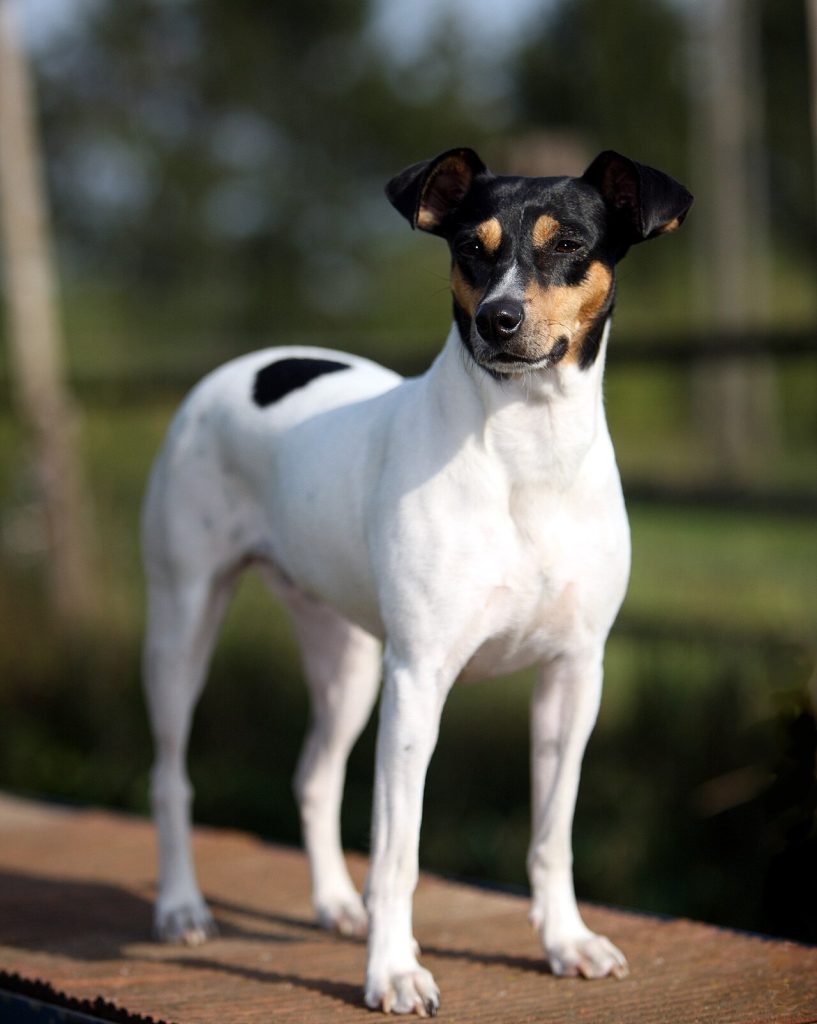
The Andalusian Bodeguero Mouse Dog is a medium-sized, agile, thin and athletic dog, with a silhouette reminiscent of a stylized Jack Russell Terrier and longer legs; in fact, it has sometimes been called “the Spanish Jack Russell”. The cross is positioned, according to the standard, between the 37 and 43 cm, being ideally about 40 cm in males and 38 cm in females, with a light weight, usually around the 6 to 8 kg.
The head is triangular, with a semi-flat skull and a long snout. The eyes are very dark and vivid, and the ears, of high insertion, fall folded forward at the tip.
The facial markings combine fire, white and black in the characteristic tricolor pattern, with fire-colored eyebrows and, almost always, a black melanous mask on the head.
Origin and history
The story of the Andalusian Bodegero Mouse is written, literally, in wine. The breed was born in the province of Cádiz, in the so-called Marco de Jerez (Jerez de la Frontera, Sanlúcar de Barrameda and El Puerto de Santa María), by the hand of the English wine merchants who settled there at the end of the 18th century and the beginning of the 19th. Those traders brought in their terriers – mostly the smooth-haired Fox Terrier, and later some Toy Terrier were also crossed – which were mixed with the local dogs from blocks and cellars.
The objective was purely practical: to get rid of the rats and mice that were hiding in the barrels and threatening the stocks. The result was an extraordinarily gifted dog for hunting rodents, which soon achieved great homogeneity. The white color was chosen on purpose, to distinguish the dog in the gloom of the cellars. That’s where his full name comes from. wine maker for Jerez’s cellars and mousetrap for his dam.
The official recognition came late, but it did. In 1993, the first club of the breed was formed and a standard was drawn up; in 2000, the Spanish Ministry of Agriculture and the Royal Canine Society of Spain recognized it as a Spanish native breed, and its breed prototype was published in the BOE in 2001, framed in Group III (Terriers), section 1.a, large and medium size. The definitive boost came in september of 2024, when the International Canine Federation (FCI) accepted it as an independent breed, finally opening the doors to world cynophilia.
Curiosities
- Cultural heritage of Jerez: in September 2020, the City Council of Jerez de la Frontera unanimously declared the Andalusian Ratonero Bodeguero “Intangible Cultural Heritage” of the city, for its value and its historical link with the wineries.
- The Spanish Jack Russell: its resemblance to the Jack Russell Terrier is such that that nickname has accompanied it outside our borders, although it is a different and more stylized breed.
- From Andalusia to Finland: even before its recognition by the FCI, the Kennel Club of Finland accepted as early as 2012 that the breed participate in its events, an early example of its international projection.
- White is not aesthetic, it’s functional:‘s light coat was selected to be seen in the darkness of the cellars; a precious glimpse of how the work shapes a breed’s appearance.
- Also called Bodeguero Jerezano: in its homeland is known by several affectionate names, and in English it has been translated as Andalusian Terrier or Sherry Terrier, in reference to Jerez wine.
If you are attracted to the Andalusian Bodeguero Mouse Terrier for its mixture of terrier intelligence, energy and manageable size, you may also be interested in other breeds with a similar profile. Take a look at the Yorkshire Terrier, another compact and lively terrier; the nimble and hardworking Border Collie if you are looking for an inexhaustible brain; the sporty Beagle, nosey and familiar hound; or the sleek Whippet, another light and loving runner.
Frequently asked questions about the Andalusian Bodeguero Mouse
Is the Andalusian Bodeguero Mouse Dog a good dog for the floor?
Yes, its medium to small size makes it suitable for flooring, but with one key condition: It needs plenty of daily exercise and mental stimulation. A well-worn specimen is quiet at home; a bored one tends to bark and tangle.
Do you get along with children and other dogs?
The breed club describes it as good with children, and it usually gets along well with other dogs.
How much exercise do you need a day?
It is a high-energy dog: it needs long walks, free runs and, very importantly, olfactory work and mind games.
Is it hard to educate?
It learns very quickly because it’s very intelligent, but it has the typical terrier stubbornness. It works very well with positive reinforcement, short and varied sessions, and consistency.
How long do you live and what health problems do you have?
It is a rustic and long-lived breed, with a life expectancy of about 12-15 years.
Does it lose a lot of hair and is it hard to maintain?
The maintenance is minimal. She has short, dense hair; a weekly brush is enough. She loosens her hair moderately and only needs baths when she’s really dirty.
Why is it called “bodeguero”?
Because his original job was to hunt rats and mice in the cellars of the Marco de Jerez (Cádiz).
Is it officially recognized as a breed?
Yes. Spain recognized it as an autochthonous breed in 2000 and the Royal Canine Society of Spain manages its genealogical book. In September 2024 the International Cinological Federation (FCI) accepted it as an independent breed in Group 3 (Terriers).