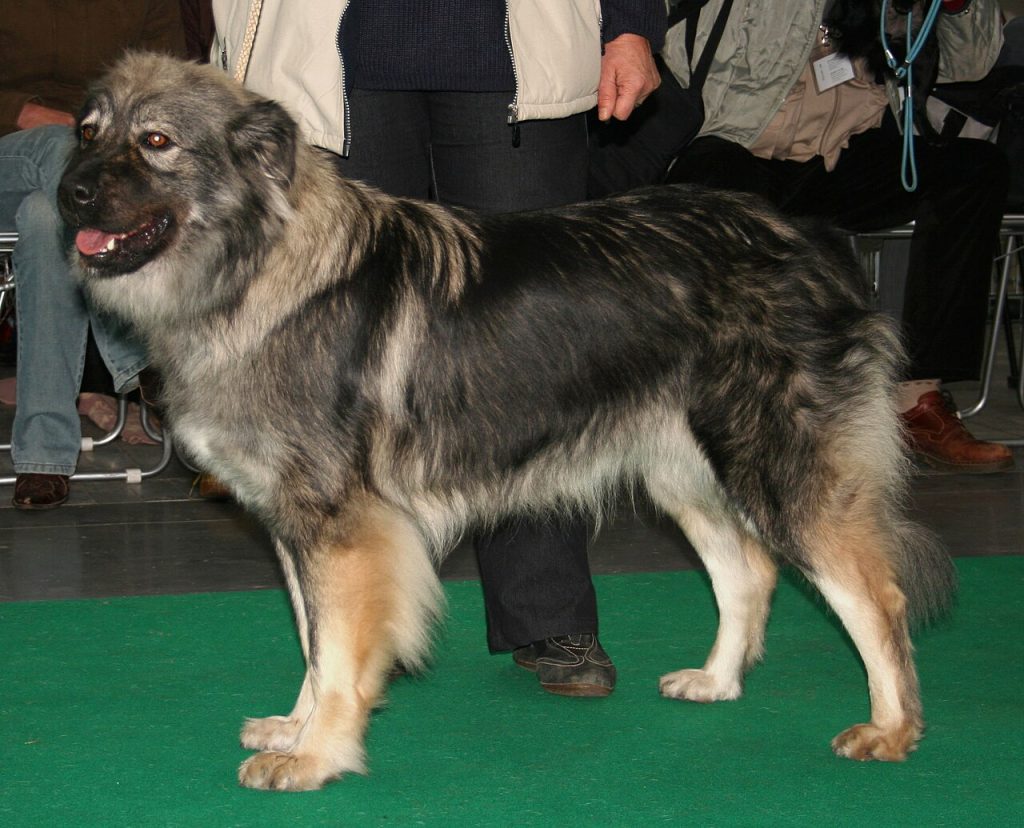
The Shepherd of Karst is a robust, iron-gray-coated Slovenian mountain dog bred for centuries to protect herds on the harsh karst plateaus. It is the only internationally recognised breed of Slovenian origin and remains rare outside the Balkans. Beneath his appearance as a gentle bear beats a brave, independent guardian deeply loyal to his family, with a character demanded of an experienced owner. If you’re looking for a serene but self-assured watchdog, the Karst Shepherd deserves to be known.
Is the Karst Shepherd for you?

The Karst Shepherd is a medium to large cattle guard dog with a distinctive personality. It is not a breed for everyone: it was selected to think and decide for itself in the face of predators, not to obey orders without hesitation.
In favour .
- Exceptional guardian: vigilant, courageous and deterrent without being aggressive for nothing.
- Very loyal and devoted to his family and “his” territory or herd.
- Rustic and resistant: it withstands cold and harsh weather conditions well.
- Quiet and balanced at home when he’s well socialized.
- Moderate exercise needs compared to other shepherds.
Against
- Independent and dominant: not a dog for beginners.
- He’s suspicious of strangers; he requires early and intense socialization.
- Guard instinct that can lead to barking and territoriality.
- It sheds a lot of hair, especially in spring and autumn.
- Rare breed: hard to find, with few serious breeders.
Character and temperament
The breed standard describes the Karst Shepherd as a dog of firm temperament and strong individuality, wary of strangers. He’s a born guardian: calm and observant in his daily life, but decisive and courageous when he perceives a real threat to his family, his home or his livestock. It is not a nervous or overreacting dog; its safety comes precisely from centuries of selection as an autonomous protector of the herd.
With his own, he’s calm, smart and surprisingly affectionate. It gives itself completely to its owner and to its territory, and is able to defend them with all its might. That same delivery has a counterpart: It’s a strongly individual animal that doesn’t trust strangers systematically and tends to make its own decisions. He doesn’t seek to please at any price like a Labrador; he expects you to earn his respect.
This balance between calmness and firmness makes the Karst Shepherd a reliable companion for those who understand and respect their guardian nature. In inexperienced hands, however, their independence and territorial instinct can become a problem. Each dog is an individual and temperament varies, but the bottom line is maintained: dignity, composure and unwavering loyalty.
Coexistence: children, other pets, flat and loneliness
With children. Well socialized and raised from puppyhood within the family nucleus, the Karst Shepherd can be an excellent and patient family member, even protective with the children of the house.
With other pets. As a dog bred to live with cattle, it usually tolerates other animals well if it grows up with them. Early socialization with other dogs is key, as males can be dominant with mates of the same sex. Its instinct is more to protect than to chase, which helps in coexistence.
On the floor. is not the ideal breed for a small flat. It is an outdoor dog by vocation, accustomed to open spaces and patrolling a territory. It is best suited to a house with a garden or plot, where it can exercise its role as a watchdog. On the floor it would need a lot of exercise and stimulation, and its tendency to bark at the unknown can generate conflicts with neighbors.
Soledad. tolerates loneliness better than many companion dogs, thanks to its independent nature, but it is still a strong bonding dog.
Education and training
Raising a Karst Shepherd is an exercise in patience and consistency. He is not a difficult dog because he lacks intelligence – on the contrary, he is very clever – but because he reasons: If he doesn’t see the meaning of an order, he questions it. It responds fatally to harsh or coercive methods, which only get you in a band or suspicious. Training should be based on positive reinforcement, mutual respect and perseverance.
The early and intense socialization is, without exaggeration, the most important point of your entire education. Like all large guard dogs, the Karst Shepherd must be socialized from a very young age: With people if it’s going to be a companion dog, and with cattle if it’s going to be a guard dog. A puppy that is exposed to many environments, noises, people, and animals during its first few months grows into a confident adult; one raised in isolation may become overly suspicious or reactive.
It is advisable to establish clear and fair rules from the first day, without falling into severity. This dog needs a calm and credible leader, not an authoritarian boss. Because of its dominant and independent character, owners with previous experience in guard breeds are strongly recommended.
Exercise and activity
Although it is an athletic and hardy dog, the Karst Shepherd does not have the overwhelming energy of a Border Collie or a German Shepherd of working lines.
He’s in his element in the countryside, the mountains or a wide plot, where he can walk, explore and exercise his guardian instinct. It enjoys cool weather thanks to its dense mantle, so winter outings are no problem. Just like your body, your mind needs occupation: mental stimulation – having a territory to patrol, smells to investigate, work to do – is as important as physical exercise to avoid boredom.
Care: fur and hygiene
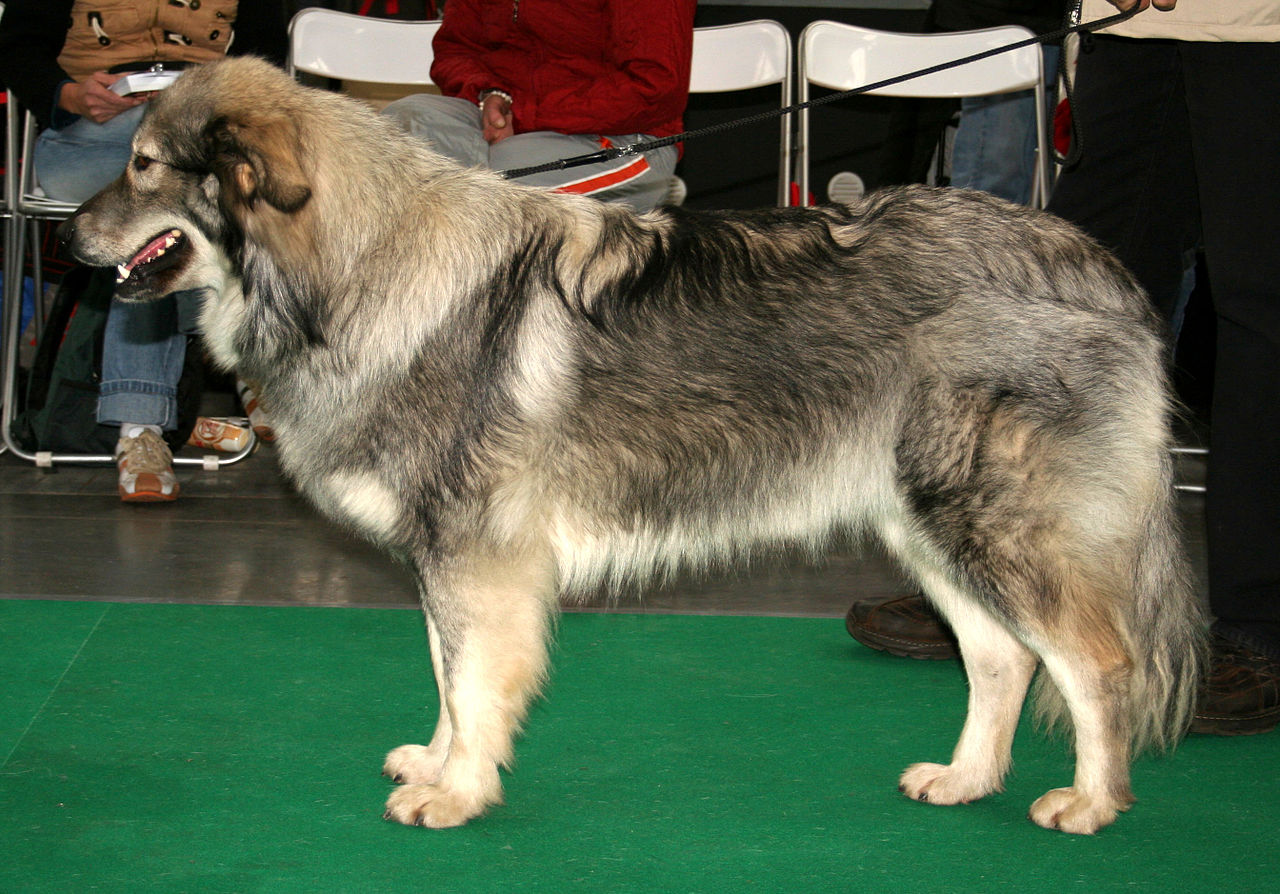
The Karst Shepherd has a thick and fairly long coat, about 14 cm, with an abundant and soft inner wool that protects it from the elements.
The big warning is the it moves.: Like a good two-coat dog, it sheds a lot of hair, and the seasonal spring and autumn mowing is especially intense. At such times it is advisable to brush daily to control the amount of hair in the house. Other than that, their hygiene is simple: Bathing only when really necessary so as not to damage the natural protection of the mantle, periodic checks of ears, nails and teeth, and little else. It’s a rustic, realistically maintained breed.
Foodstuffs
As a medium to large-sized dog with a strong build, the Karst Shepherd needs a complete and quality diet, adjusted to its weight, age and activity level.
During the puppy stage, a specific feed for large breeds is appropriate, which controls growth and takes care of joint development. In the adult, the key is to monitor the amount to avoid overweight, especially if you live with a moderate level of exercise: The extra pounds punish the joints of any dog of this size. Water always clean and available, and adjustment of rations according to more or less work and according to the season. If you have any doubts about quantities or specific diets, it is best to consult your veterinarian.
Health and life expectancy
The Karst Shepherd is, in general, a rustic and healthy dog, the result of centuries of natural selection in a demanding environment. It’s not a breed over-exploited by fashion, which has helped maintain a relatively robust genetic base. As with all large dogs, the main point of surveillance is the joints: problems such as hip and elbow dysplasia, common in breeds of this size, should be controlled by responsible breeders testing the breeders.
The dense coat protects it from the cold but can make it sensitive to extreme heat. Regular veterinary checkups, daily vaccination, deworming, and dental care complete a sensible health plan. Their life expectancy is around 11-12 years, within the expectation of a dog of their size.
Physical appearance

The Karst Shepherd is a medium-sized but strong and compact dog, slightly longer than tall. The males measure between 57 and 63 cm at the cross and the females between 54 and 60 cm; the weight ranges between 30 and 42 kg in males and between 25 and 37 kg in females, with the females generally somewhat smaller and lighter.
Its most distinctive feature is the iron grey coat, long, bumpy and with internal lanilla, often with darker hues that give it a shaded look. The abundant hair on the neck forms a kind of mane that gives it a bearlike appearance. The head is broad, with the skull somewhat longer than the snout (13-14 cm versus 11-12 cm). His nose, eyelids and lips are black. The almond-shaped eyes are brown or dark brown and convey a calm and intelligent expression. The ears, medium in size, are not erect but dropped and glued to the head. The tail is long, with a slight hook at the tip, and resembles a sabre. The denture is strong, with a scissor bite.
Origin and history
The Karst Shepherd takes its name from the Karst (Kras) plateau in Slovenia and the karst landscape that extends from the Gulf of Trieste to the Dinaric Alps, reaching parts of Croatia, Italy and Bosnia. Their ancestors accompanied the shepherds of the region since ancient times, most likely brought by ancient nomadic peoples dedicated to herding. There are several hypotheses about its origin: The most widely accepted theory links it to the ancient Asiatic-type molluscs that came to Europe through Greece.
The earliest known written mention is notable: as early as 1689, scholar and ethnographer Johann Weikhard von Valvasor described the shepherd dogs of the Pivka area as strong and courageous animals.
Already in the 20th century, when these landrace dogs began to document themselves as a modern breed, they were first called Shepherd of Illyria(1939). After years of effort by Slovenian canine scientists, the breed was officially recognized in 1968 by the International Canine Federation as a Slovenian breed, becoming the only canine breed of Slovenian origin with international recognition. It is classified by the FCI in Group 2, Section 2.2 (Mountain-type molosoids), with the number 278. By the end of World War II, very few examples remained, which partly explains their current rarity.
Curiosities
- The only Slovenian pride. is the only internationally recognised dog breed originating in Slovenia, a true national symbol.
- His name comes from the stone. The term “karst” (kras in Slovenian) gives name to the geological phenomenon of karst relief worldwide, and this breed bears his name.
- Documented in the 17th century. Already in 1689 appears described by Valvasor, proof of its antiquity as a dog of the region.
- He used to be called the Shepherd of Illyria. shared a name with the current Šarplaninac until both breeds were officially separated.
- Breed at risk. With populations estimated at around 600-700 specimens in 2008, it is considered a numerically sparse breed in need of conservation.
- Recognition in the United States has been exported to the United States, where it is recognized by the United Kennel Club as a guard dog.
If you are attracted to the Karst Shepherd’s serene and rustic guard profile, you may be interested in other guard and mountain breeds with a similar character. Pastor Alemán Cane Corso Gran Danés San Bernardo
Frequently Asked Questions About the Karst Shepherd
Is the Karst Shepherd a good family dog?
Yes, as long as it is raised as a puppy within the family nucleus and socializes well. It is calm, loyal and protective with its owners, and even patient with the children of the house.
Is he an aggressive dog?
The Karst Shepherd is wary of strangers and a courageous guardian, but balanced and serene when well socialized. Their courage is activated in the face of real threats, not impulsively.
How tall and how much does a Karst Shepherd weigh?
Males measure between 57 and 63 cm at the withers and weigh 30 to 42 kg; females measure between 54 and 60 cm and weigh 25 to 37 kg. It is a medium-large dog, of strong and compact build.
Do you lose a lot of hair?
It has a dense double coat with abundant inner wool, so it sheds a lot of hair throughout the year and very intensely in spring and autumn moult. It needs brushing several times a week, daily in moult season.
Do you adapt well to living in a flat?
It’s not ideal. It’s an outdoor dog, used to open spaces and watching territory. It’s much better off in a house with a garden or plot. On the floor it would need plenty of exercise and stimulation, and its tendency to bark at the unknown can cause problems.
Where does the Karst Shepherd originate from?
It is originally from Slovenia, specifically from the Karst (Kras) plateau. It is the only canine breed of Slovenian origin recognized by the International Canine Federation, which made it official in 1968.
How long does a Karst Shepherd live?
Its life expectancy is around 11-12 years, something common in dogs of its size. It is a rustic breed and quite healthy; veterinary checks and weight control help to take care especially of its joints.
Is it easy to train?
It is very intelligent but independent: it reasons on orders and responds poorly to harsh methods. It needs positive reinforcement, consistency and, above all, intense early socialization.