Microchip and badge: the identification that saves your dog’s life
No owner thinks their dog is going to get lost… Until the door locks badly, a firecracker scares him, or the harness gives out at the worst possible moment. At that moment, the difference between a scare of hours and a permanent loss is usually reduced to two very cheap things: The microchip of the dog and a simple plaque on the collar. The data is compelling: In a study of more than 7,700 shelter animals, dogs with microchips returned to their families 52.2 percent of the time, compared with 21.9 percent of those without. More than double. Here we tell you how it works, what the law requires in Spain, what you must put on the plate and the mistakes that ruin the whole system.
What is the microchip and how does it work (no, it doesn’t carry GPS)
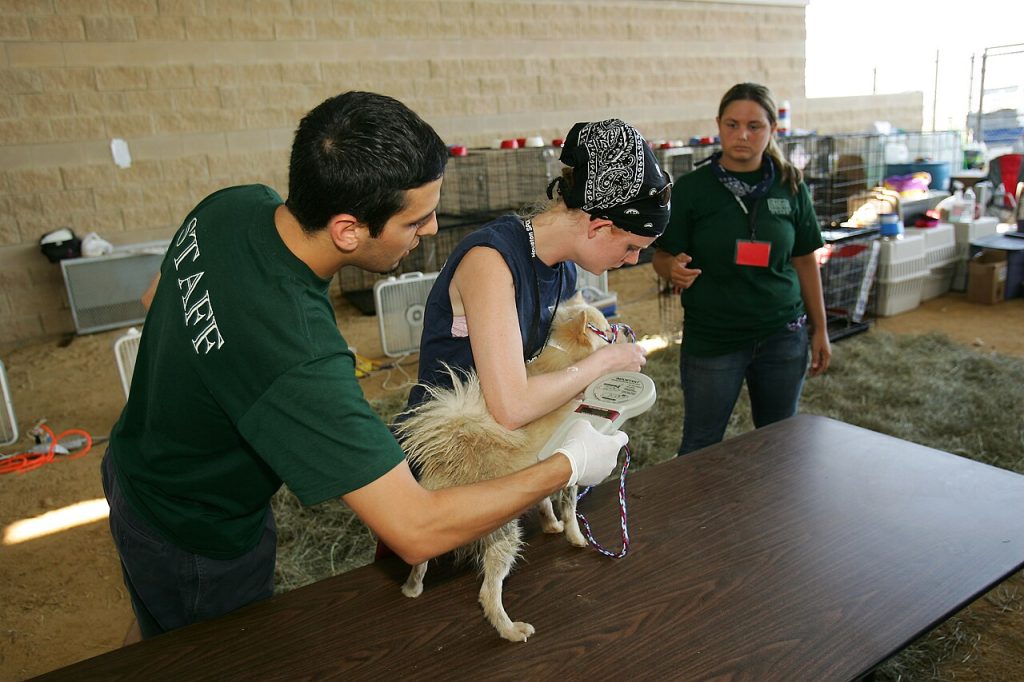
The microchip is a transponder the size of a grain of rice that is implanted under the dog’s skin. It does not carry a battery or emit anything by itself: it is a passive device that is activated only when a reader scans it by radio frequency. At that moment it returns a unique 15-digit number, a kind of ID of your dog for life.
In Europe, the chips follow ISO 11784 and ISO 11785 standards and operate at 134.2 kHz, ensuring that any veterinarian, protector or police officer with a standard reader can read them.
The most common misunderstanding should be made clear: the microchip is not a GPS tracker.. You can’t open an app and see where your dog is. The chip only “talks” when someone scans it, and what it says is a number that links to a database that contains your contact information. That’s why the whole system has three legs: implanted chip, updated registration and, as visible and immediate reinforcement, the collar plate.
The data: why the microchip multiplies the options for going home
The landmark study was led by veterinarian Linda Lord (Ohio State University) with 53 shelters in 23 states and more than 7,700 animals.
- The without microchip dogs were returned to their owners the 21,9% times.
- The with microchip dogs came home the 52,2% times: more than double.
- In cats, the difference was even more stark: from 1.8% to 38.5%.
And one key detail: when a chip-infested animal couldn’t be returned, the primary cause was a wrong phone or unsubscribe in the database.
Is microchipping compulsory in Spain?
In Spain the identification with microchip is compulsory for all dogs, and the Law 7/2023 on the protection of the rights and welfare of animals consolidated it at the state level (extending it also to cats and ferrets).
Key points to know:
- The implantation must be done by a authorised veterinarian, which also registers the chip number alongside your data in the identification register of your autonomous community.
- The autonomous registers are coordinated through the REIAC(Spanish Pet Identification Network), so that a dog lost in another community can also be located.
- A dog must be handed over identified at any sale or adoption, and the timing for chipping a puppy depends on your community (in many, before 3 months).
- Not identifying your dog is punishable: depending on the case and the autonomous community, fines can range from From 500 to 10,000 euros.
- For travelling in the European Union, the ISO microchip is an essential requirement alongside the European passport and the current rabies vaccine.
If your dog is of a breed with a traveling and escapist soul like the Husky Siberiano, capable of jumping fences or digging film-worthy tunnels, the chip is not a paperwork: it is your ticket home.
How and when to implant: Does it hurt? Is it safe?
Implantation is a one-minute procedure. The veterinarian injects the chip with a hypodermic needle, usually on the left side of the neck or between the shoulder blades, depending on the convention of each country. It requires no surgery or anesthesia. and the discomfort is comparable to that of a vaccine.
Is the microchip safe?
According to the AVMA, adverse reactions are rare. The most common is the migration of the chip from the implantation point (it moves a little under the skin), something that does not harm the dog but that is convenient to control so that the reader finds it. Other side effects such as inflammation, infection or chip failure are rare. The practical recommendation is simple: ask your vet to check that scan the chip once a year is still reading correctly and in place.
There have been isolated cases, mostly in laboratory animals, but the veterinary consensus is clear: the benefit of identification far outweighs that remote risk.
Registration: the step that almost everyone neglects
A microchip without updated data is just a number floating under the skin: the reader will say “15 digits” and the database will respond with a phone that no longer exists.
Your log checklist, in three steps:
- Check that he’s been discharged. When you chip (or adopt), ask for the protection of the autonomous register and verify that the chip number is associated with your name.
- Update me on any changes. New mobile? Moving? Dog changing owners? Report it to the registry (usually through your vet) as soon as possible.
- Check once a year. Chip reading at the annual review and a look at whether the data is still correct.
The typical case of failure is adoption: dogs such as the Galgo Español, which unfortunately fills protectors in Spain, often arrive at their new family with the chip still in the name of the previous owner or protector.
The badge: your first line of defense
The microchip is unfalsifiable and permanent, but it has an obvious limitation: it needs a reader. The plate, on the other hand, can read it any neighbor in minute one., without taking the dog anywhere. That is why veterinarians insist: the chip does not replace the plate, nor the plate the chip. They are equipment.
What a good badge should wear:
- Your phone., and if two numbers fit (yours and another family member’s), better.
- The phrase “I have a microchip”. or “I’m chipped”: deter anyone who might keep it and guide anyone who finds it.
- Check it every few months: plates wear out and an unreadable plate is a plate that doesn’t exist.
- The name of the dog is optional. Some prefer not to put it so that a stranger cannot call them with confidence; it is a personal decision, the essential thing is the phone.
Adapt the plate to the dog: For mini races like the Chihuahua or the Yorkshire Terrier look for small and light plates that don’t bother you; for tireless trackers like the Beagle, which is able to follow a smell to the village next door, two plates (collar and harness) are worth more than none. And don’t make the mistake of thinking, “My dog won’t run away”. Even the most homely, like a good-looking Labrador Retriever, can get scared off a night of firecrackers.
Microchip, board and GPS: what each contributes
The three systems do not compete, they complement each other.
| The system | What is it? | Strengths | Restrictions |
|---|---|---|---|
| Microchip | Permanent identification under the skin | Mandatory, unforgeable, lifetime, legal proof of ownership | Requires reader and updated data; does not locate in real time |
| Placa | Visible identification on the collar | Immediate reading by anyone, very cheap, solves most scares in hours. | It can be lost, worn or removed |
| Localizador GPS | Electronic device on the collar | Real-time position from the mobile | Battery and fee, lost with the necklace; not legal identification |
The winning combination for dogs with a tendency to run away (a Jack Russell Terrier behind a rabbit doesn’t care about reasons) is the triple: registered chip + readable plate + GPS on the collar. But remember the hierarchy: the GPS is an extra; the chip and the plate are the base.
What to do if your dog gets lost (or finds one)
If you lose him, act quickly and in this order:
- Go back to where you last saw him. and leave him scent references (one of your clothes, his blanket).
- Call your vet and your community registry. to notify loss: thus the chip is marked as “lost animal” and will jump the alert as soon as someone scans it.
- Notice to shelters, shelters and clinics in the area, and to the local police: these are the places where the found dogs arrive.
- Move search to local networks and groups of lost pets with recent photo and specific area.
- Check your records. same day: if your phone in the database is not the current one, fix it immediately.
If you find a dog, bring it to any local veterinary clinic, shelter or police for a scan: the reading is free, takes seconds and activates the machine to locate its family.
Common errors that render the chip useless
- Believing the chip carries GPS and trust: no one will warn you if your dog doesn’t reach a reader.
- Not updating the phone after changing your number or moving in: system failure number one.
- Not to make the change of ownership when adopting or taking in a chipped dog.
- Take off his necklace “because he’s home” just before the door slam, or on vacation, when there’s more risk of loss.
- Never check the chip.: an annual reading detects migrated or unreadable chips in time.
- Carrying the worn-out plate until the phone is no longer readable.
- Delaying the puppy chip: puppies and new adoptees are just the ones who run away the most, because they are not yet bonded to the new home.
Frequently Asked Questions
Does the dog’s microchip have GPS on it, and can I track it from my cell phone?
No. The microchip is a passive device without a battery: it only returns an identification number when a reader scans it closely. It does not allow to locate the dog in real time. If you want GPS tracking, you need a separate locator on the collar, which complements (but never replaces) the chip.
Does it hurt to microchip a dog?
The implantation is done with a hypodermic needle and the discomfort is similar to that of a vaccine. It does not require surgery or anesthesia and lasts a few seconds.
How much does it cost to microchip a dog in Spain?
As a guide, it is usually between 25 and 60 euros, including implantation and registration, although it varies depending on the clinic and the autonomous community.
Can the microchip fail or move?
Adverse reactions are rare; the most common is that the chip migrates slightly from the implantation point, without harming the dog. Reading errors are rare. As a precaution, ask your veterinarian to scan the chip at the annual check-up to confirm that it is working and still traceable.
What do I do with the microchip if I adopt a dog that was already chipped?
You must process the change of ownership in the registry of your autonomous community, usually through a veterinarian, so that the chip is associated with your name and phone.
Is the Spanish microchip good for traveling abroad?
Yes. The chips implanted in Spain comply with ISO 11784/11785 standards, which are required for travel in the European Union together with the European pet passport and the current rabies vaccine.
The microchip and the badge are probably the 50 euros best invested in your dog’s entire life. implanted chip, daily data and readable badge: with those three things, the worst day of your life as an owner has plenty of tickets to stay in a bad time with a happy ending.