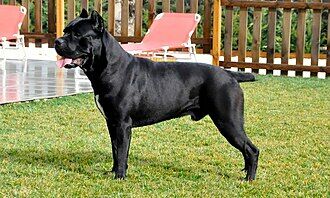
The Cane Corso is an imposing Italian moose, athletic and deeply attached to his family. Beneath that resounding appearance lurks a balanced, intelligent, and loyal watchdog, capable of changing from a watchful watchdog to a quiet companion in a matter of seconds. It’s not a race for everyone: The Cane Corso needs an owner with experience, time and a firm but kind hand. If you give him that, you’ll have one of the most reliable protectors there is.
Is the Cane Corso for you?
Before you fall in love with his demeanor, you should be honest with yourself. The Cane Corso is a dog of large size, strong and with a very marked guarding instinct. That makes him a magnificent companion for the right person and a serious problem for those who underestimate him. Here you have the unadorned balance.
In favour .
- Natural guardian, deterrent and very protective of his family.
- Extraordinarily loyal and attached to his people.
- Very clever: he learns quickly if the education is consistent.
- Short hair, easy to maintain and not bad-smelling.
- Balanced and quiet at home when he’s well socialized.
- Versatile: serves as a guard, work and companion dog.
To be taken into account
- It’s not for first-time owners. It requires leadership and experience.
- Early socialization is essential or it can become reactive.
- His physical strength requires absolute control of the belt.
- In several countries it is classified as a restricted breed or PPP.
- He needs daily exercise and constant mental stimulation.
- It sucks and, for its size, it’s a considerable expense.
Character and temperament
The Cane Corso is, above all, a balanced dog. Courageous without being nervous, confident without being fussy, it combines a very strong protective instinct with a remarkable capacity for self-control. It is not a dog that barks about everything or that seeks conflict: it observes, evaluates and only acts when it perceives a real threat. That serenity is precisely what distinguishes a good specimen from a badly brought up one.
With his family, he is affectionate, calm, and surprisingly sensitive. It forms an intense bond with its owners and follows them around the house like a silent shadow; many owners describe it as a “velcro” dog that needs to be close to its owners. With strangers, however, it maintains a natural reserve: polite but distant, always assessing the intentions of those who approach his territory or his people.
It is a dog of enormous intelligence, which has two faces. On the one hand, it learns easily and enjoys having a task; on the other, if it is bored or detects insecurity in its owner, it will make its own decisions. The Cane Corso needs a calm and consistent leader, not a screaming sergeant or a permissive owner. Serene firmness and coherence are the basis of everything.
Coexistence: children, other pets, flat and loneliness
- With children: is well socialized, usually tolerant and protective of the children in the house, whom it tends to care for.
- With other dogs: can coexist with other dogs if it has been socialized since puppyhood, although some males show dominance with congeners of the same sex.
- With other pets:‘s guarding instinct is high. Raised alongside cats or other animals it can accept them as part of its pack, but towards unfamiliar animals it can activate prey instinct.
- On the floor: can live in an apartment as long as it gets its three or four daily outings and enough exercise. It is not a hyperactive indoor dog; it values the quantity and quality of the walk more than square meters.
- In the face of loneliness: due to its strong attachment, does not like to spend many hours alone. Prolonged isolation can lead to anxiety, tearing or barking.
Education and training
Training the Cane Corso is not optional: it is a need for safety. A dog of this size and temperament must respond reliably to basic commands and walk on a leash without pulling. The good news is that its intelligence and desire to please the family make the task much easier, provided it starts early.
The early socialization is the key piece. During the first few months of life it must be exposed, in a controlled and positive way, to people, other dogs, noises, environments and various situations. A well-socialized Cane Corso distinguishes between normal and threatening; one who is not can become suspicious or reactive, and in a dog of 50 kilos that is a real risk.
It works much better with positive reinforcement, short sessions and clear, consistent rules than with punishment-based methods, which only breed mistrust in such a sensitive breed. The consistency of the whole family is essential: If one person allows you something that another person forbids you, the dog will exploit the incoherence. Due to its nature, it is highly recommended to have a trainer with experience in molluscs.
Exercise and activity
The Cane Corso has an average energy level: it is not a tireless athlete like a border collie, but it is also not a sedentary dog. It needs daily physical activity to stay in shape and mentally healthy.
As a good working dog, it is grateful to have “a purpose”. Search games, food puzzles, and exercises that stimulate its sense of smell tire it as much as a long walk, and bring it balance.
It is advisable to moderate high-impact exercise during growth, since repeated jumps and intense runs in puppies of large breeds can damage the forming joints.
Care: fur and hygiene
One of the great advantages of the Cane Corso is its ease of maintenance. Her hair is short, dense, and lustrous, requiring no hairdressing or complicated care. A gentle brushing two or three times a week is enough to remove dead hair, distribute the skin’s natural fat, and, in the process, strengthen the bond with a good massage. It loses some hair, but much less than the long-coated breeds.
The rest of the hygiene is the usual: Bathing only when it’s really dirty so you don’t dry out your skin, checking and cleaning your ears to prevent infection, and cutting your nails when you need to. Special attention should be paid to the dental hygiene: In this breed, a sloppy mouth promotes periodontal disease, which can eventually affect organs such as the heart, kidney or liver. Regular tooth brushing is an investment in health, not a whim.
Foodstuffs
As a large and muscular dog, the Cane Corso needs a high-quality diet, rich in protein of good provenance and adjusted to its age, weight and activity level.
For the same reason, it is advisable to avoid strenuous exercise just before and after meals, and to watch that the dog does not swallow too quickly. During the puppy stage it is advisable to use a feed formulated for large breeds, which controls the growth rate and protects the joints. Keeping the Cane Corso at its ideal weight is key: Overweight punishes hips and elbows that are already prone to problems.
Health and life expectancy
The Cane Corso is a robust dog, but like any large breed it carries certain predispositions. The most important are hip and elbow dysplasia, patellar dislocation and retinal dysplasia. It also has a higher than average susceptibility to eye problems such as entropy, ectropion and prolapse of the nictitating gland (the so-called “cherry eye”), as well as to gastric dilation-torsion, hypothyroidism, idiopathic epilepsy and otitis. Vaginal hyperplasia can occur in females.
Life expectancy is around 9 to 11 years, within the expectation of a mollusk of its size. An international study of specimens from 25 countries put the average at about 9 years, with variations according to coat color. For your dog to reach its full potential, it is essential to go to a reputable breeder who tests the health of the breeders (especially of the hips and elbows), keeps up with veterinary checks, and takes care of weight and diet.
Physical appearance
The Cane Corso is a dog-type mollusk: strong and muscular, but with an athletic elegance that distinguishes it from heavier molluscs. The males measure between 64 and 68 cm at the cross and the females between 60 and 64 cm; the weight is around 45-50 kg in males and 40-45 kg in females.
The head is large and typically moldy, with a well-marked stop and a wide, square snout, clearly shorter than the skull. The eyes, oval and well apart, convey an attentive and watchful expression; the iris is as dark as possible depending on the color of the mantle. The ears are triangular and fallen in their natural shape, although traditionally they have been cut in some countries (a practice now banned or disused in much of the world).
The mantle is short, dense and bright. Several colors are allowed: black, different shades of gray (lead, clear or slate), lions in its light and dark variants, the characteristic Formentino (lions with gray mask) and the atigrate. Small white spots on the chest, feet and nose are tolerated. The skin is thick and quite adjusted to the body.
Origin and history
The Cane Corso is an Italian breed with very ancient roots. It is considered a direct descendant of the Canis pugnax, the moose of Ancient Rome used in war and guard duties.
For centuries it was a versatile dog of the Italian countryside, spread mainly in the south of the peninsula (Puglia, Calabria, Lucania and other regions), where it was employed as a guard of farms and herds, in the big hunt of prey such as wild boar, as a boyer dog and even as an escort.
The collapse of the floors agricultural system in the 1960s almost made it disappear: The dogs became very scarce. The modern breed comes from selective breeding, begun about 1980, of a few surviving specimens. In 1983 the Società Amatori Cane Corso was founded to recover it. Official recognition came later: the Italian Kennel Club (ENCI) admitted it in 1994, the International Kennel Federation accepted it provisionally in 1996 and definitively in 2007, and the American Kennel Club recognised it in 2010.
Curiosities
- Its name is pronounced “káne korso” in Italian, and the correct plural is corsican dogs.
- It is a close relative of the neapolitan Mastiff, another large Italian moose, although the Cane Corso is more athletic and lighter.
- Formentino, its lilac color with grey mask, owes its name to the color of wheat (“wheat” in Italian).
- To register, his standard requires him to pass a test of character: he must show calmness in the face of harmless strangers, indifference to gunfire, and firm defense of his owner in the face of aggression.
- It was so close to extinction that its recovery is considered one of the great canine rescues of the 20th century.
- In several countries it is listed as a potentially dangerous or restricted breed, so it may require a license, insurance and the use of a muzzle and leash in public.
If you are attracted to the character of the Cane Corso, you may be interested in other guard and mole-type breeds with which it shares family air. Its closest relative is the Neapolitan mustard, with an even more resounding appearance. Rottweiler Doge of Bordeaux Bullmastiff
Frequently asked questions about the Cane Corso
Is the Cane Corso a dangerous or aggressive dog?
It is not aggressive by nature: a well-bred and socialized specimen is balanced and calm. However, its size, strength and guarding instinct mean that poor socialization and education can lead to serious problems.
Can the Cane Corso live on one floor?
Yes, as long as you are provided with three or four daily outings and enough physical and mental exercise. Inside the house it is quite quiet, so you value the quality of the walks more than the space available. What you do not tolerate well is spending many hours alone.
How long does a Cane Corso live?
Good genetics, regular veterinary checkups, weight control, and proper diet help them reach their full potential.
Is the Cane Corso good with children?
Due to its size and power, the coexistence with the youngest must always be supervised, and it is advisable to teach children to treat the dog with respect.
How much exercise does a Cane Corso need?
It needs daily physical activity – three or four walks – combined with mental stimulation such as olfactory games, obedience or food puzzles.
Is it easy to train the Cane Corso?
It is very intelligent and learns quickly, which makes it easy to train, but it requires a consistent and experienced owner. It responds better to positive reinforcement and clear rules than to punishment. It is not the most suitable breed for someone who has his first dog.
Is the Cane Corso considered a potentially dangerous breed?
In several countries and jurisdictions it is listed as a potentially dangerous or restricted breed due to its physical potency. This may involve the obligation of a licence, liability insurance and the use of muzzle and leash in public spaces.
How much does a Cane Corso weigh and measure?
Males measure between 64 and 68 cm at the withers and weigh between 45 and 50 kg; females measure between 60 and 64 cm and weigh between 40 and 45 kg. It is a large, muscular but agile dog.