The Clumber Spaniel is the largest and heaviest of the English Spaniels: A quiet, heavy, deeply affectionate hunting dog with a huge, melancholy head. Brought up in England to lift and collect pieces in thick undergrowth, today he is above all a serene and loyal companion. If you are looking for a calm, homely, and personable Spaniel, the Clumber Spaniel deserves your attention. It is also one of the native British breeds listed as vulnerable due to its small numbers.
Is the Clumber Spaniel for you?
Before you fall in love with that noble face, you should know what you’re committing to. The Clumber Spaniel is a mild-tempered dog with a low level of indoor drama, but it’s also large, sloppy and needs a patient owner with its independent character.
In favour .
- Quiet, balanced temperament and very affectionate with his family.
- Tremendously loyal and attached to his people; enjoys being with you.
- It barks little: it’s a discreet dog, not a scandalous guard.
- Quiet at home: he loves the couch as much as the country.
- Excellent sense of smell and alert mind; great collector in difficult terrain.
- Sociable and kind once he gains confidence.
To be taken into account
- He drools a lot over his fallen bellies.
- It loosens hair moderately and requires frequent brushing.
- Stubborn and independent – training requires patience.
- Predisposition to joint problems (dysplasia, herniated disc).
- Very sensitive to heat; always needs shade and water.
- Reserved and distant with strangers until he comes into confidence.
Character and temperament

If you had to summarize the Clumber Spaniel in three words, it would be sweet, loyal and dignified. It is a dog of leisurely manners, almost gentlemanly, that rarely causes scandals. With its family it is incredibly affectionate and enjoys constant company: it doesn’t care whether it is lying at your feet in the living room or crawling in the mountains, what it really cares about is being with you.
With strangers the register changes. It is neither aggressive nor fearful, it is simply reserved and a little distant: it observes, evaluates and, once it decides that someone is trustworthy, it relaxes completely. That same calm head explains why it is not a barking dog; it warns the fair, so as a guardian it is more decorative than effective. Its natural role is that of companion within the home.
It does, however, have a very funny house brand: the “Trophy mentality”. Clumber loves to carry things in his mouth most of the time – a toy, a sock, the first thing he catches – a direct inheritance from his job as a collector. It is endearing, but care must be taken not to swallow what it carries. He also has his own criteria: He’s not a subservient dog, but an opinionated, curious and playful companion, especially a puppy.
Coexistence: children, other pets, flat and loneliness
The balanced nature of the Clumber Spaniel makes it a very portable domestic dog, provided that its particularities are respected.
- With children:‘s patience and gentle temperament are well suited to family life. As with any dog of its size, it is advisable to supervise play with the youngest and teach children to respect their rest times.
- With other dogs: tends to be somewhat reserved at first and prefers to take his time before trusting another dog.
- With other pets: is sociable, but remember that it is still a hunting dog with a very fine sense of smell; presentations with small animals should be done with the head up.
- On the floor:‘s low activity level indoors makes it surprisingly adaptable to a floor, provided you take it out every day.
- Soledad: is a very attached dog; it tolerates lonely moments, but it is not made to spend the whole day without company.
Education and training
The Clumber Spaniel is intelligent and learns well, but it has own ideas. Do not expect the enthusiastic and rapid obedience of a Border Collie: this dog decides if the proposal convinces him. That is why training works much better from motivation than from imposition.
The keys are positive reinforcement, short sessions and a lot of patience.. Reward with food, play or that thing he likes to carry in his mouth, and avoid harsh methods: with such a sensitive and dignified dog, harshness only creates blockages. Early socialization – people, noises, other animals, environments – is especially important to soften his natural reserve with strangers.
He takes advantage of his instincts: smelling and collecting games come naturally to him and strengthen the bond.
Exercise and activity

To clear up a misunderstanding, the Clumber Spaniel seems – and is – a quiet and somewhat lazy dog at home, happy to take a nap on the couch. But it is still a hunting dog with good stamina: in the field it is slow compared to other spaniels, but tireless, with a constant jog and a lot of depth.
This translates into a need for moderate but daily exercise: quiet walks, olfactory exploration and some play are enough to keep him happy and fit.
Two important warnings derived from its physique: first, the heat: the Clumber is very sensitive to high temperatures and, without shade and water, dehydrates easily; in summer, exercise at first and last minute; second, the joints: due to its predisposition to dysplasia and back problems, it is advisable to moderate jumps, stairs and sudden efforts, especially during growth.
Care: fur and hygiene
The Clumber Spaniel’s coat is dense, smooth, silky and weather resistant, with longer fringes on the ears, belly and legs. It is cute, but requires maintenance. It sheds hair at an average rate throughout the year, so a frequent brushing(several times a week) is indispensable to avoid knots and keep loose hair at bay around the house.
The great theme of this breed is the i ‘m drooling. Its fallen bellies make it drool a lot, especially after drinking or eating; whoever is looking for an unpolluted dog should keep it in mind.
The rest of the hygiene is the usual with an extra point of attention: checking and cleaning the large and fallen ears to prevent infection, taking care of the eyes(the breed is prone to eyelid problems), cutting the nails and maintaining good dental hygiene.
Foodstuffs
The Clumber Spaniel easily gains weight is a heavy-boned dog with a great appetite and a tendency to take life easy. Weight control is not an aesthetic detail: every extra pound punishes already delicate hips and a spine.
A complete, high-quality diet, divided into two daily servings and measured amounts, is ideal. Watch the rewards (they add up to far more calories than it seems) and avoid feeding just before or after intense exercise in deep-breasted dogs.
Health and life expectancy
The Clumber Spaniel is, unfortunately, a breed with a number of specific health problems that is worth knowing before adopting. A British study from 2024 placed its life expectancy around 12.3 years, slightly below the average of purebred dogs.
The most important points to monitor are:
- Dysplasia of the hip: is one of the great Achilles’ Heels of the breed. It has historically had some of the worst average scores and a very high percentage of affected specimens; responsible breeding with tested dogs has been key to reducing it.
- Herniated disc (back): due to its long and short body, can suffer protrusions of the intervertebral discs, with pain and even mobility problems in severe cases.
- Temporary juvenile colic: being large and fast-growing dogs, between the ages of 6 and 12 months they can temporarily limp as the bone finishes forming.
- Eyelid problems: entropy (eyelid inward) and ectropion (eyelid outward), which irritate the eye and sometimes require surgery.
- Sensitivity to heat: without shade and water overheats and dehydrates easily.
- Blocked anal glands and, in some individuals, hypothyroidism or sensitivity to anesthesia.
- Reproducción: females usually have complicated deliveries and it’s not uncommon for them to need a C-section.
The best prevention is to go to a serious breeder who will carry out the relevant health tests (hip, eyes), keep the dog at his weight, take care of his joints and do regular veterinary checks.
Physical appearance

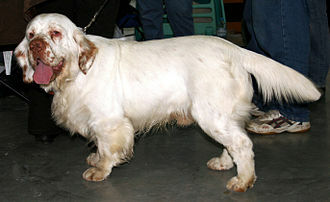
The Clumber Spaniel is the larger and heavier spaniel, with an unmistakable silhouette: long, low and massive body, strong bone. Despite being the largest of the spaniels, it is not a tall dog – it measures between 43 and 51 cm to the cross – but rather rectangular and round.
Its hallmark is the head: huge, broad, melancholy and somewhat dreamy, often described as “melting”. It has a square snout, droopy bellies – hence the drooling – and large, fallen, hair-covered ears in the shape of a vine leaf.
The coat is dense, smooth, flat and weather resistant, with fringes on the ears, belly and legs. The color is predominantly white with lemon, orange or brown markings, especially around the eyes and at the base of the tail.
Origin and history
The history of the Clumber Spaniel before the mid-19th century is uncertain and moves between two theories. The most romantic claims a French origin: During the Revolution, the Duke of Noailles is said to have given his valuable doghouse of spaniels to the Duke of Newcastle, in Clumber Park, in Nottinghamshire (England), to save them. The other theory advocates a British development from old breeds of spaniels, possibly with crosses with hounds such as the Basset Hound.
What’s clear is where the name comes from: of Clumber Park itself, where the Duke’s ranger, William Mansell, is credited with having developed and improved the breed. He soon became a dog of the aristocracy and, most especially, of the british royalty: Prince Albert, consort of Queen Victoria, was a big fan, as was his son King Edward VII – who raised them at Sandringham – and, later, King George V. Queen Victoria herself fondly mentions them in her diary in 1840.
The breed was exhibited in England from 1859 and soon crossed the Atlantic: It came to North America in 1844 and in 1884 was one of the first ten breeds recognized by the American Kennel Club. The Primera Guerra Mundial was nearly wiped out when breeding stopped, until King George V relaunched a line in 1925. Today the British Kennel Club considers it a vulnerable native breed, with less than 300 annual registrations.
Curiosities
- Dog of kings. Few breeds can boast as many godparents of British royalty: Albert, Victoria, Edward VII and George V.
- The biggest of the spaniels. Its massive body and heavy bone distinguish it from any other dog in its family.
- A born collector. His “trophy mentality” pushes him to always go with something in his mouth.
- The star of Crufts. has won the Crufts Best in Show, the world’s most prestigious dog show, including a triumph at its 1991 centenary edition.
- A vulnerable breed. shares the UK “vulnerable native breed” label with other uncommon spaniels such as the Field Spaniel or Sussex Spaniel.
- The silent hunter. works without barking, with a very fine sense of smell and a wide muzzle that allows it to charge pieces of different sizes.
If you are attracted to the Clumber Spaniel because of its calm nature and spaniel demeanor, you may be interested in other breeds in the same family or of similar temperament. Take a look at the English Cocker Spaniel and English Springer Spaniel, two more agile hunting spaniels; the Field Spaniel, another vulnerable native related breed; or the Cavalier King Charles Spaniel, a much smaller but equally affectionate companion spaniel. If what you’re looking for is a family-friendly cash register, compare it to the Golden Retriever as well.
Frequently Asked Questions About the Clumber Spaniel
Is the Clumber Spaniel a good family dog?
Yes. It is a sweet, loyal and very affectionate dog with its people, calm inside the house and patient, which fits well with family life. It is convenient to supervise the game with small children and give them their space to rest. With strangers it is reserved but not aggressive.
How much exercise does a Clumber Spaniel need?
A moderate but daily amount. Although it is calm and somewhat lazy at home, it is still a hunting dog with good resistance: walks, olfactory exploration and some play are enough for it.
Does he lose a lot of hair and drool?
It sheds hair at a moderate rate year-round and needs frequent brushing, and yes, it drools a lot for its fallen bellies, especially after drinking or eating.
Is it easy to train?
It is intelligent, but has an independent character and is somewhat stubborn, so it does not obey as immediately as other breeds. It works very well with positive reinforcement, short sessions, patience and early socialization; harsh methods are counterproductive.
How long does a Clumber Spaniel live?
Their life expectancy is around 12-13 years. A British study from 2024 placed it at about 12.3 years on average, somewhat below the average of purebred dogs.
What health problems does the breed have?
It is prone to hip dysplasia, herniated disc, temporary juvenile limping during growth, eyelid problems (entropion and ectropion), heat sensitivity, blocked anal glands and, in females, complicated births.
Is it a rare breed or hard to find?
The British Kennel Club classifies it as a vulnerable native breed, with fewer than 300 new registrations a year, along with other minority spaniels such as the Field Spaniel and the Sussex Spaniel.
Does the Clumber Spaniel bark a lot?
He barks little; he is a quiet and quiet dog, more a household companion than a guard-dog. He warns of what is right, but his gentle disposition does not make him a good watcher.