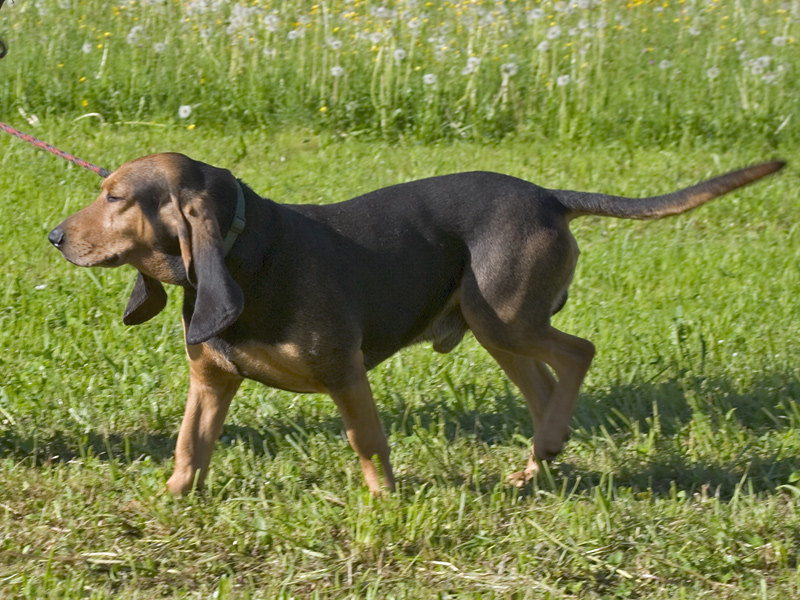
The Bruno of the Jura is a medium-sized Swiss hound, bred for centuries to track game in the steep Jura mountains, right on the border between Switzerland and France. With its extraordinary sense of smell, its large, wrinkled head and its long dangling ears, it is a natural working dog: tenacious, resilient and able to follow a trail almost erased by rocky terrain. Outside the world of hunting it is a little-known breed, but those who live with a Jurassic Bruno discover a noble, affable and deeply nose-guided companion.
Is that Bruno del Jura for you?
The Jurassic Brown is not a dog for everyone. It is a purebred hunting dog, with an olfactory drive that governs it and an enormous need for movement. Before you fall in love with its ears and its melancholy gaze, it is advisable to look honestly if it fits into your life.
It suits you if…
- You are a very active person or family, lover of the countryside and hiking.
- You can offer him one or two long hours of daily exercise with sniffing in between.
- You’re looking for a noble, sociable, well-balanced dog at home once it’s out of the house.
- You live in a rural setting or with a well-fenced garden.
- You’re attracted to tracking and hunting, or sniffing sports.
Maybe it’s not your breed if…
- You lead a sedentary life or spend many hours away from home.
- You live in a small apartment and you’re worried about the deep barking.
- He’s your first dog and you’re looking for easy obedience without distractions.
- You can’t secure a serious fence: when it catches a trail, it leaves.
- You live with rabbits, cats or other small animals loose.
Character and temperament

The Bruno del Jura combines two souls that should be understood. On the one hand, it is a pack dog, gregarious and good-natured, who enjoys company and rarely shows aggression. On the other hand, it is a passionate hunter, with absolute concentration when working a trail and a determination that makes it go forward where other dogs surrender.
At home, once its exercise quota has been met, it is usually a calm, balanced and very attached dog to its people. It is not nervous or excitable at base; it has the serene calmness of hounds.
Its great peculiarity is independence. It was selected to make decisions on its own miles from the hunter, and that is noticeable: it thinks, decides and sometimes does deaf ears. It is not stubbornness or lack of intelligence, but the character of a dog accustomed to work alone. Whoever understands it, respects it; whoever expects a dog waiting for every order, is frustrated.
Coexistence: children, other pets, flat and loneliness
With the children, the Bruno del Jura is usually patient and affectionate.
With other dogs it is understood wonderfully: the herding instinct makes it sociable and less conflicted. Things change with small animals. Cats, rabbits or rodents activate their tracking and chasing instinct, so coexistence requires early socialization and, still, supervision.
As for the floor, it is not its ideal habitat. It can adapt if it exercises a lot, but its powerful voice and its tendency to express itself by howling can generate neighborhood conflicts.
Education and training
Training a Bruno del Jura is an exercise in patience and strategy. It’s an intelligent dog, but its independence and nose play against classic obedience. When it catches an interesting smell, the world disappears and you with it.
The keys to working with this breed are simple but demanding:
- Positive reinforcement: rewards, food and play.
- Short and motivating sessions, avoiding the boring repetition.
- Called from a puppy, worked with great patience and always with high-value reinforcement.
- Early socialization with people, dogs and varied environments.
- Channeling the smell: search and trace games that tap into your natural talent instead of fighting it.
It’s not the most recommended breed for a beginner looking for an effortlessly obedient dog, but for someone who enjoys sniffing, the Bruno del Jura is a brilliant student at his craft.
Exercise and activity

Here is the key to all the coexistence with this breed: the Bruno del Jura needs a lot of exercise. It was bred to ride for hours on the slopes of the Jura following tracks on rocks and brush, and that tireless endurance is still there.
The ideal is to offer him at least one or two hours a day of quality activity. And not every walk is worth it: what really satisfies him is using his nose. Hiking, long walks in the countryside, tracking games, mantrailing or olfactory sports are his glory. A dog who has worked on the olfactory returns home exhausted and happy.
For safety reasons, it is advisable to release it only in fenced or heavily controlled areas: when it catches a trail, it can travel miles without responding to the call.
Care: fur and hygiene
As far as maintenance is concerned, the Bruno del Jura is a thankful dog. His hair is short, dense and smooth., easy to care for: with a weekly brushing to remove the dead hair is enough to keep it in good condition.
The point that demands the most attention is the ears. Its long and hanging pavilions ventilate poorly and retain moisture, which favors otitis and infections. It is advisable to check and clean them regularly, especially after outings in the field or water.
The rest of the hygiene is the usual: baths only when necessary, control of nail growth and regular dental care.
Foodstuffs
The Bruno del Jura is an active and muscled dog, so its diet must support this energy expenditure. A complete and quality diet, adjusted to its age, weight and actual activity level, is the most recommended. In the hunting season or of much exercise, the caloric needs rise; in periods of calm, it is advisable to moderate so that it does not get fat.
As a good dog, it is usually voracious and not selective, so it is important to control rations and not abuse rewards to avoid overweight, which would punish its joints. Divide the food into two servings daily and, in deep-breasted dogs, avoid intense exercise just before and after eating.
Health and life expectancy
The Bruno del Jura is a rustic and robust breed, the result of centuries of functional selection for hunting rather than for aesthetics.
That said, he shares the logical precautions of the long-eared and active-living hounds. ear infections s are the most sensitive spot because of the shape of their ears, so periodic checkup is key. As with any medium-sized, active dog, it is advisable to monitor the joints and maintain a healthy weight. Regular veterinary checks, daily deworming and vaccination complete the picture of a breed that is generally healthy and long-lived.
Physical appearance

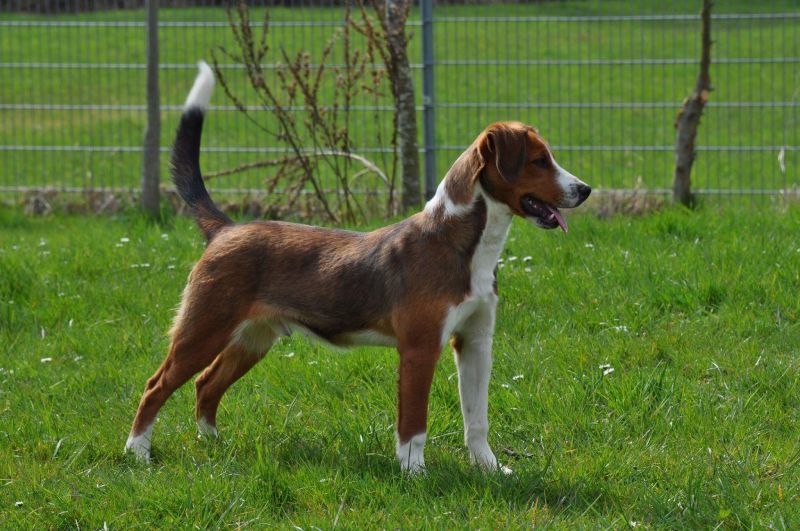
The Bruno del Jura is a medium-sized hound of solid construction and harmonious proportions, measuring around 43-58 cm to the cross and weighing between 15 and 20 kg, with a muscular body and deep chest that betray its athletic vocation.
Its most characteristic feature is the head: wide, with marked stop, abundant wrinkles and a serious and sweet expression at the same time. It is precisely that wider, wrinkled head that distinguishes it from other Swiss hounds and recalls its kinship with the St. Hubert dog. The ears are long, thin, and very hanging, inserted low; the eyes convey that melancholy look so typical of tracking dogs.
The the mantle is short, dense and smooth. The most common color is the black and fire, with the characteristic black coat or chair on a lion-like background, although it also appears in two-tone brown.
Origin and history
The history of the Bruno del Jura goes back to the roots of the Swiss Hound, a tracking dog documented in the region from very early times: representations in Roman mosaics from ancient Helvecia are preserved in Avenches. For centuries, these dogs gained a reputation among hunters for their exceptional ability to follow the hare, and between the 15th and 18th centuries they also achieved great popularity among French and Italian hunters.
The Bruno del Jura descends, like its relatives, from the legendary st. Hubert’s dog, common ancestor of a large part of the European hounds. It was developed in the Jura mountain range, on the Franco-Swiss border, a rocky and demanding terrain that shaped a resistant dog with a very fine smell.
Until the late 19th century, Swiss hounds were considered to be one diverse breed. In 1881, a prominent Swiss cynologist studied numerous specimens and established the existence of distinct varieties; in 1889 standards were set for several of them. Over time four varieties became recognized within the Swiss hound (Schweizer Laufhund): the Jura, the Bern, the Lucerne and the Schwyz. The Bruno del Jura is the variant of the Jura, most closely related to the San Huberto due to its broad, wrinkled head.
Curiosities
- Two hounds from the Jura. Historically there were two types in the region: the Bruno and the heavier San Huberto type.
- The nose of the elite. It is prized by local hunters for its ability to follow very faint tracks over rocks and rough terrain, where other dogs get lost.
- French kinship. is related to the neighboring French hounds, all descended from the St. Hubert dog, which explains the debate over their nationality.
- They’re a hunting breed. is still, above all, a working dog: outside Switzerland and France it is very rare to see it, and almost always in the hands of tracker hunters rather than families.
- No aim at all. Unlike many hounds, its coat lacks white spots, a detail that helps identify it.
If you are attracted to the noble and olfactory nature of the Bruno del Jura, you may be interested in other dogs and tracking dogs of similar temperament. Take a look at the Bloodhound, its direct relative and tracking master; the popular Beagle, a manageable-sized sociable hound; the Basset Hound, with its unmistakable ears; or the Teckel (Dachshund), another hunting dog guided by smell and tenacity.
Frequently asked questions about Bruno del Jura
Is the Bruno del Jura a good companion dog?
It may be, but it is good to be clear about its origin. It is a hunting dog bred to work independently and with a very high olfactory motivation. As a companion it needs firm hand, patience and, above all, a lot of exercise and mental stimulation. In the hands of someone active and constant it is a gentle and calm dog at home; in a sedentary home it tends to get frustrated.
How tall and how much does a Bruno del Jura weigh?
It is a medium-sized dog. It is usually around 43-58 cm at the withers and between 15 and 20 kg in weight, with the males somewhat larger than the females. It is a compact and muscular dog, heavier than its slender silhouette suggests.
How long does the Bruno del Jura live?
Its life expectancy is about 12-13 years, a normal number for a dog of its size. It is a rustic breed and not prone to serious hereditary problems, so with good nutrition, exercise and veterinary checkups it usually survives well into old age.
Do you get along with children and other dogs?
Yes. It is a pack dog, sociable with its congeners and usually tolerant and good with children. It is advisable to monitor the game for its enthusiasm and to monitor the coexistence with small pets (cats, rabbits), because its tracking and pursuit instinct is very developed.
Do you need a lot of exercise?
It was bred to follow tracks for hours on end through rocky, steep terrain. It needs at least one or two hours of long activity daily, preferably with smell in between: field trips, hiking, hunting games. Without that outlet, it gets bored and can become vocal or destructive.
Is it hard to train?
It is intelligent, but independent and very nose-guided: when it catches a trail, it disconnects from the rest. It is not the easiest dog for a beginner. It responds well to positive reinforcement, short, motivational sessions, and a call worked out from a puppy. Obedience under olfactory distraction is its most demanding subject.
Can he live in a flat?
It’s not ideal. It tolerates living on the floor if it gets a lot of daily exercise, but its deep barking and its tendency to express itself with its voice can be a problem in communities. A house with a well-fenced garden, in a rural or peri-urban setting, fits much better with its nature.
Is the Jurassic Brown a rare breed?
Yes. It is a rare hound even in Switzerland and France, where it is kept mainly as a tracking hunting dog. Outside the Alps and Jura it is very difficult to find, and almost always in the hands of hunters rather than families.