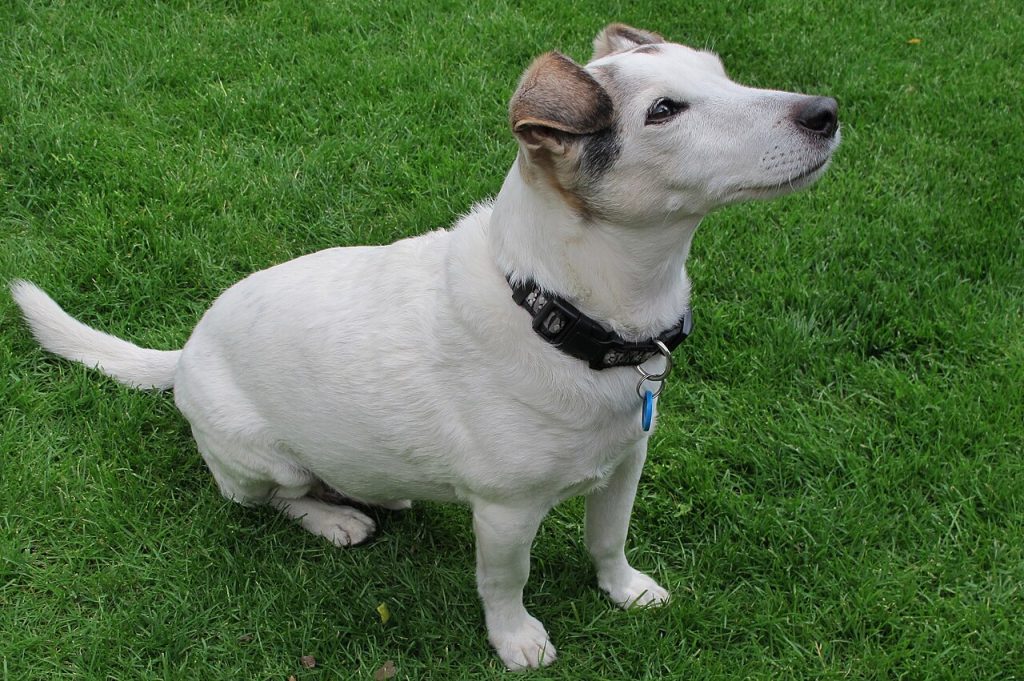
The Parson Russell Terrier is a small-sized English terrier, almost always white with spots, tireless and brave, bred in his day to go underground after the fox and today has become a sporty, cheerful and surprisingly athletic companion. It is the long-legged, square-shaped variety of the Russell family, with plenty of energy and a head so alert that it demands that its owner live up to it. If you’re looking for a quiet couch dog, this isn’t your dog; if you want a tireless partner to run, play and learn tricks, the Parson Russell Terrier may be just what you need.
Is the Parson Russell Terrier for you?
Before you fall in love with that waking face, let’s be honest: the Parson Russell Terrier is a working dog with hunting instincts tucked into a small body. That brings wonderful things and other things you need to know how to handle. Here’s the raw summary.
In favour .
- Huge energy and endurance: perfect for active people running, cycling or dog sports.
- Very smart and quick to learn; brilliant at agility and flyball.
- Handled size (5-8 kg) that fits in any home.
- Simple coat to maintain, barely a hairdresser.
- Loving, playful and loyal to his family.
- It’s usually long-lived and robust for its size.
Against
- He needs a lot of exercise; if he gets bored, he breaks things.
- Strong prey instinct: bad companion for cats, rodents or birds without careful socialization.
- Stubborn and independent; not an “easy” obedience dog.
- He can bark and dig more of the bill.
- He does not tolerate the harsh treatment of very young children.
- Boring him or leaving him alone for too long is looking for trouble.

Character and temperament
If we had to describe the Parson Russell Terrier in one word, it would be fearless. This terrier gives it his all in everything he does: when he works or plays he is tenacious, stubborn and brave to the point of recklessness; when he is at home with his own he transforms into a lush, loving and always ready to party dog. That double face – fierce on the outside, tender on the inside – is the essence of the breed.
We’re talking about a dog with a contained dose of energy that never seems to run out. It’s alert, curious, and loves to do mental work. A boring Parson is a problematic Parson: he gets bored quickly, and that boredom translates into holes in the garden, bitten furniture, or persistent barking. It’s not evil; it’s a brain and a body that demands action.
The breed standard calls for shyness to be considered a defect, though not to be confused with submission, which is accepted. I mean, the ideal Parson is confident, sociable and fearless. Open aggression toward other dogs is not part of a good character and, in fact, disqualifies you from exhibitions. Well bred and socialized, it is a balanced, friendly dog with a great desire to live.
Coexistence: children, other pets, flat and loneliness
With children: The Parson Russell Terrier can get along very well with children, as long as they are old enough to respect it. It is playful and with inexhaustible energy, the ideal companion for an afternoon of play in the park.
With other pets: here needs to be careful. The Parson gets along well with other dogs if socialized as a puppy, and he even gets along well with horses – a legacy of his hunting days on horseback. The problem is small animals: Its prey instinct is very strong and cats, rabbits, hamsters or birds can awaken the hunter in it. With patience and early introductions, coexistence with a cat is possible, but it is never advisable to trust completely.
On the floor: by size fits in any home, but don’t be fooled: it’s not a “quiet” floor dog. You can live in an apartment perfectly yes, you are. guarantees you plenty of exercise every day. Without that daily drain, a small flat with a boring Parson is a recipe for disaster.
Soledad: is a very affectionate breed and does not tolerate prolonged loneliness. Leaving it alone for many hours without stimulation usually leads to anxiety, barking and destructive behavior. It is a dog for families who spend time at home or who can take it everywhere.

Education and training
Just because the Parson Russell Terrier is smart doesn’t mean it’s obedient. In fact, that intelligence comes with a good dose of stubbornness and independence. It was bred to work alone underground, making its own decisions away from the guide, and that spirit is still there. That’s why it’s not the most recommended breed for someone who’s never had a dog.
The key is in the positive reinforcement: rewards, play and food work much better than toughness. With a terrier, any method based on force or punishment only breeds a closed or defiant dog. Sessions should be short, varied and fun to keep their attention before they get bored.
The early socialization is non-negotiable: the sooner he gets to know people, other dogs, noises and different environments, the better his adult character will be. Equally important is directing his energy and instinct towards something productive. Teaching him to bring the ball, to look for hidden objects or to start him in agility is not a luxury, it is a necessity for his mental balance.
Exercise and activity
If there’s one thing that defines this breed, it’s this. The Parson Russell Terrier needs intense daily exercise, not a leisurely walk around the block. It’s a dog built for speed and endurance, with an athletic silhouette designed to follow a horse through hours of hunting. All that machinery takes fuel in the form of activity.
Going out for a run, riding a bike with him, throwing him a frisbee or a ball and teaching him to return it are activities that come to him like a ring on his finger: he spends energy, exercises the body and strengthens the bond with his owner.
A well-exercised Parson is a happy, quiet at home and well-behaved dog. A Parson who doesn’t burn his energy becomes a machine for digging holes, nibbling on the couch and barking. The rule is simple: the more you fatigue him in a healthy way, the better dog you’ll have.
Care: fur and hygiene
There are three recognized types of coat: smooth(smooth), tough(rough) and broken(broken, intermediate, with some longer hair on the head, face, legs or body).
A weekly brushing is sufficient to keep the coat clean and control the baldness. Hard-haired specimens may require trimming(manual pulling of dead hair, or stripping) a couple of times a year to maintain the correct texture, especially if it is exposed.
The rest of the hygiene is that of any responsible dog: checking and cleaning the ears to prevent infection, cutting the nails when they don’t wear out on their own, and paying attention to dental hygiene with proper brushing or biting.
Foodstuffs
As a small but tremendously active dog, the Parson Russell Terrier needs a quality diet to sustain its rhythm. A balanced diet, rich in animal protein from good sources and adjusted to your actual activity level, is the best basis. It’s not the same a Parson who competes in agility several times a week as one who just walks: the ration must be tailored to each individual’s expenditure.
Although it may seem impossible with so much movement, a Parson who eats too much and exercises too little may gain weight, and overweight punishes his joints. Divide food into two daily servings in the adult, respect puppy guidelines according to his growth stage, and always have fresh water available.
If you have any questions about a particular diet, quantity, or change of feed, it is wise to consult your veterinarian, who can adjust the feed to your dog’s age, weight, and health.
Health and life expectancy
The Parson Russell Terrier is, in general, a robust and long-lived dog. A British study from 2024 attributed a life expectancy of 13.8 years to it, above the average of pure breeds (12.7 years) and half-breeds (12 years).
That said, the breed carries a number of hereditary problems that are worth knowing about, especially related to eyes. The most characteristic is primary lens dislocation, caused by a recessive mutation in the ADAMTS17 gene: The Parson is one of the most affected breeds. Other eye disorders that may occur are juvenile cataracts, corneal dystrophy, progressive retinal atrophy and posterior vitreous detachment.
Outside the eyes, the breed may exhibit deafness and dislocation of the kneecap. There is also a hereditary form of atrophy(called myelopathy or hereditary ataxia) recognized in the Russell terrier group for more than half a century; in 2014 the KCNJ10 gene was identified as responsible for spinocerebellar ataxia that is usually accompanied by myochemistry and sometimes seizures. For all these reasons, the best prevention is to go to a responsible breeder that crosses only between specimens with known genealogy and genetic and ophthalmological tests that declare them free of these conditions.

Physical appearance
The Parson Russell Terrier gives an impression of balance, agility and flexibility. Its most distinctive feature from the Jack Russell is that it has the noticeably longer legs: the height at the withers is approximately equal to the length of the body, giving it a virtually square, light and athletic silhouette.
It measures between 33 and 36 cm to the cross and weighs around 5 to 8 kg, with a narrower size range than the Jack Russell. It is a predominantly white dog, with black, brown, lemon (mustard) or tricolor spots, preferably limited to the head or the birth of the tail.
The standard is demanding: Defects include an out-of-range height, erect ears, brown or liver-coloured nose, prognatism or enognatism of the jaw and brindle spots. A curious detail of the trial in exhibition is that the judge must be able to embrace the dog’s chest with both hands behind the elbows, with the thumbs on the cross; the size is not measured, but the correct shape of the chest is checked, designed so that the dog could enter the burrows.
Origin and history
The story of the Parson Russell Terrier is inseparable from that of a real character: the the Reverend John “Jack” Russell is here., born in 1795 in Dartmouth (Devon, England) and nicknamed “The Sporting Parson”, the sporting shepherd. A clergyman by profession and a passionate hunter, he dedicated his life to breeding and selecting terriers capable of accompanying hounds and going underground after the fox. In 1819 he bought from a milkman a small white and fiery dog named Trump, which became the basis of his breeding program.
By 1850 their dogs were recognized as a well-defined type of Fox Terrier. In 1894 Arthur Blake Heinemann founded the Devon and Somerset Badger Club and drafted the breed’s first standard, this time geared towards badger hunting.
The official recognition came late. Refounded the club in 1983 to achieve this, the British Kennel Club recognised the breed on 9 January 1990 as a variety of the Fox Terrier, with the name Parson Jack Russell Terrier. The Federación Cinológica Internacional (FCI) was provisionally accepted on 2 July 1990 and as a definitive breed, already under the name Parson Russell Terrier, on 4 June 2001. In the United States the American Kennel Club first recognized it as a Jack Russell Terrier in 1997 and adopted its current name in 2003. Within the FCI it belongs to Group 3 (Terriers), a section of large and medium sized terriers.
Curiosities
- The Parson Russell and the Jack Russell share a history going back to the 1980s; the Parson is the exposure variety, with longer legs and more uniform sizes, while the Jack admits greater size variation.
- Uggie(2002-2015), a trained Parson Russell Terrier, was a movie star: he appeared in The Artist and Water for Elephants(both 2011).
- Sykes(2001-2019) was another British Parson actor, known as “Harvey” in some famous commercials and for his appearances in the series Midsomer Murders, as well as being an agility champion.
- The surname Russell became so closely associated with these terriers that his name transcended that of the Reverend himself, who was also one of the founding members of the British Kennel Club in 1873.
- The test of “two hands” around the chest in exhibitions is a direct reminder of its original function: a chest that two hands could embrace was a chest that fit through a fox’s burrow.
If you are attracted to the Parson Russell Terrier’s sparkling, hardworking nature, you may want to compare yourself with other high-energy or spirit terrier breeds before making a decision. Check out the Border Collie, the king of intelligence and canine sport; the Beagle, another energetic nose-to-ground hunter; the small and determined Teckel, also bred for burrowing; or the fast and sleek Whippet if you like compact athletics.
Frequently Asked Questions about the Parson Russell Terrier
What’s the difference between the Parson Russell Terrier and the Jack Russell Terrier?
They share a common origin and history dating back to the 1980s. The Parson Russell is the most common variety, with the longest legs, a more square silhouette (high as long) and a narrower and more uniform size range.
Is he a good dog for families with children?
Yes, as long as the children are old enough to treat him with respect, he’s playful and has endless energy, but as a good terrier, he doesn’t tolerate rough treatment.
Do you get along with cats and other pets?
With other dogs and horses it usually gets along well. With cats and small animals (rodents, birds, rabbits) you have to be careful: its prey instinct is strong. Coexistence with a cat is possible if it socializes from a puppy, but it is not advisable to trust completely.
How much exercise do you need a day?
A quiet walk is not enough for him: he needs intense daily activity (running, cycling, throw-and-bring games, dog sports).
How long does a Parson Russell Terrier live?
It is a long-lived breed. A British study from 2024 estimated an average life expectancy of 13.8 years, above the average of pure breeds. With good care many exceed that figure.
What health problems are more common?
Particularly eye disorders: the primary dislocation of the lens is the most characteristic, along with juvenile cataracts, corneal dystrophy and retinal atrophy.
Is it hard to educate?
It is very intelligent, but also stubborn and independent, so it is not the easiest breed for beginners. It responds to positive reinforcement with short, fun sessions; harshness is counterproductive.
Can he live in a flat?
Yes, the size fits perfectly, but it only works if you guarantee it intense exercise every day.