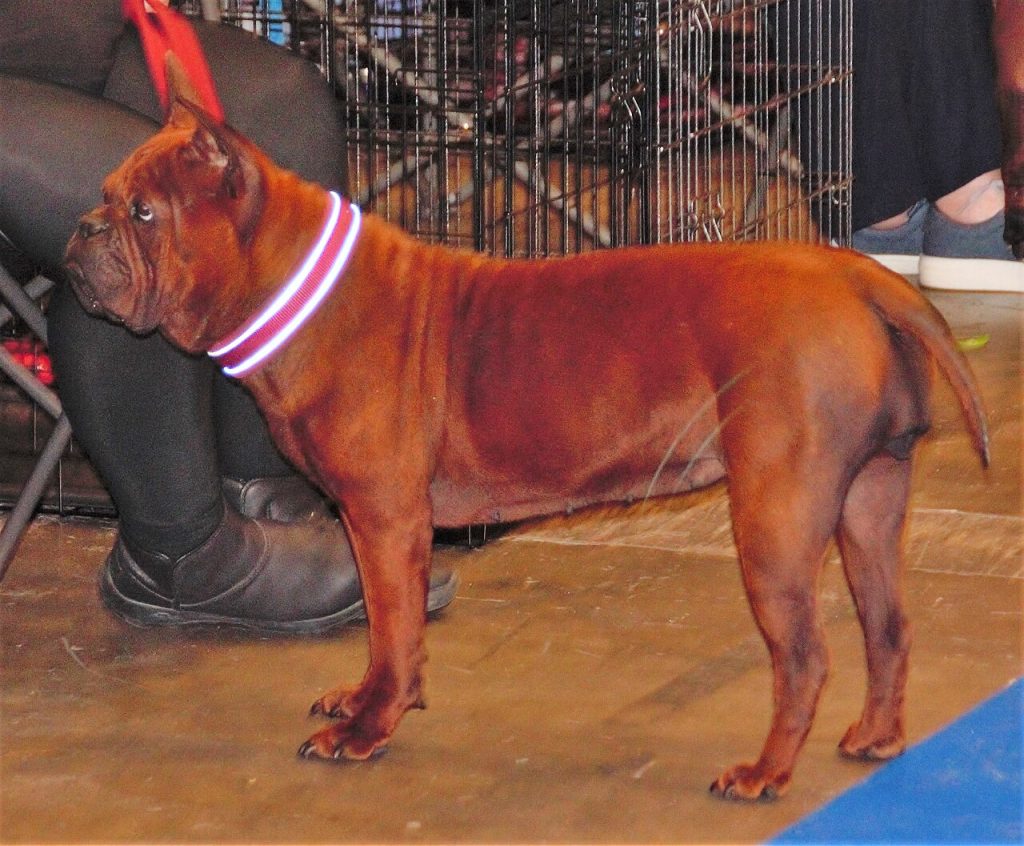
The Chongqing dog is one of the oldest and rarest dog breeds on the planet: a rustic molluscoid born in the mountains of eastern China, bred for centuries as a hunter and guardian, and instantly recognizable by its short reddish fur, dogo-like wrinkled face, blue-black tongue, and that short, stiff tail that the Chinese describe as a “bamboo cane”. If you’re looking for a brave, fiercely loyal guard dog with a strong personality, this living jewel of Chinese canine lore deserves to be thoroughly explored.
Is the Chongqing Dog for you?
The Chongqing Dog is not a breed for everyone. He’s a deep-seated guardian with a domineering personality and a working dog history that still runs through his veins. It shines with an experienced owner who values its unwavering loyalty; it may prove excessive for one seeking a quiet, complacent mate. Before you fall in love with her exotic looks, weigh the good and the demanding:
In favour .
- Natural guardian, brave and deterrent without the need for aggressive training.
- Extreme loyalty and strong attachment to his family, including children.
- Healthy, rustic dog with few hereditary diseases and good longevity.
- Short coat with minimal maintenance.
- Intelligent, alert and with a great sense of smell inherited from his hunter past.
To be taken into account
- Dominant and territorial character: requires leadership and early socialization.
- Strong prey instinct: watch out for other small animals.
- Brachycephalic face: sensitive to heat and intense exercise with moisture.
- Extreme rarity: very hard to come by and expensive outside China.
- Not suitable for first-time owners or no time for it.
Character and temperament

If we had to summarize the Chongqing Dog’s character in three words, it would be brave, loyal and territorial. It is an extroverted, self-assured dog with an almost unflappable confidence that comes from its long history as a guard and hunter in hostile terrain. It is not a nervous or barking dog: it observes, calculates, and acts calmly.
He is deeply affectionate and protective of his family. He develops an intense bond with his people and, once he has accepted you as his, his loyalty is total. That same intensity explains his other face: the distrust of strangers. The Chongqing watches, evaluates who approaches and does not give away its trust. Well socialized, he’s perfectly capable of distinguishing between a welcome visit and a real threat, but his default instinct is to protect.
Added to this is a marked prey instinct and a remarkable olfactory ability, a direct inheritance from its hunting origins. It is a dog that enjoys exploring, tracking and solving “problems”, and that needs mental stimulation in addition to physical to be balanced. Bored or without leadership, its strong character can become stubborn.
Coexistence: children, other pets, flat and loneliness
With the children, the Chongqing Dog is usually surprisingly good. Despite its tough appearance, it tends to be tolerant, patient and protective of the little ones in its own family. As always with a large and powerful dog, coexistence must be supervised and it is advisable to teach children to respect their spaces and rest.
Their strong prey instinct allows small dogs, cats and other small animals to awaken their hunting side, especially if they have not grown up with them.
As for the floor, the Chongqing can adapt if it gets enough exercise and, above all, company: He’s a dog who wants to be close to his own. Even so, its watchful nature fits better in a house with a yard or plot to guard. He can’t stand prolonged loneliness.: A Chongqing man who spends too many hours alone gets bored, frustrated and may develop undesirable behaviors. It’s not the race for those who spend the day outside.
Education and training
Training a Chongqing Dog requires consistency, calm and serene authority, never toughness. It is intelligent and learns quickly, but its independent and dominant nature means that it will not obey “because it does”: it needs a reference that it trusts and respects. The key is to start early, be fair and always keep the standards the same.
The early socialization is, in this breed, non-negotiable. Exposing it as a puppy to people, noises, environments and other animals in a controlled and positive way makes the difference between a balanced guard dog and an overly suspicious dog. Its protective instinct already comes from the factory; what you have to work on is self-control and confidence.
Positive reinforcement works very well with him, as long as the reward is worthwhile and the sessions are short and varied so as not to bore an awake mind. Coercive methods, on the other hand, clash head-on with his pride and are often counterproductive.
Exercise and activity
The Chongqing Dog is a medium-sized working dog, not a sprinter or marathon runner, but needs quality daily activity. One or two long walks, time exploring and sniffing, and some play are usually enough to keep him fit and in good spirits.
There is an important caveat: due to its brachycephalic face(relatively short muzzle and marked stop), it tolerates heat and humidity worse than a long-snouted dog. It is advisable to avoid intense exercise in the hottest hours, carry water and watch for signs of fatigue or hot flashes.
Care: fur and hygiene

One of the great practical advantages of the breed is how unpretentious its coat turns out to be. It is short, rough and quite sparse, reddish-brown or black in color, and maintained with very little: a weekly brushing to remove dead hair and baths only when needed.
Chongqing ‘s real care is in his the face. Folds and facial wrinkles, along with relatively thin skin, require periodic checking: Keep folds clean and dry to avoid irritation or dermatitis. The basic routine of any dog is also appropriate: check and clean the ears (upright and natural insertion), brush your teeth regularly, monitor your eyes and cut your nails when necessary. Their poorly protected skin also requires care from the sun and rubbing.
Foodstuffs
As a muscular and active dog of medium size, the Chongqing Dog needs a complete and balanced diet, with a good intake of quality protein that supports its muscle mass.
watch your weight is appropriate: Although it is an athletic dog, overweight punishes its joints and, in a brachycephalic dog, further complicates heat and stress tolerance. Always fresh and available water, gradual feed transitions, and avoiding vigorous exercise right after eating (especially in deep-breasted dogs) are sensible guidelines. When in doubt, the veterinarian is the best person to fine-tune your nutrition plan.
Health and life expectancy
One of the best news of this breed is its rusticity. Being an indigenous dog shaped over centuries by natural selection and work, and not by intensive breeding in search of extreme traits, the Chongqing generally exhibits good health and few serious hereditary diseases.
That said, there are points to pay attention to. His brachycephalic conformation involves some respiratory sensitivity to heat and strain, so he needs to be protected from the high temperatures. facial wrinkles and fine skin can cause dermatological problems if left untreated. As with any dog of robust constitution, it is advisable to maintain a healthy weight to take care of the joints. Regular veterinary checkups, vaccination, and daily deworming complete the picture of a dog that, properly cared for, usually causes little discomfort.
Physical appearance
The Chongqing Dog is a medium-sized, compact and muscular molosoid, of powerful appearance without reaching the corpulence of large mastiffs. As a reference guide for breeders, it usually moves around 35-50 cm at the cross and 20-25 kg, with males somewhat larger than females; it is not a breed with a closed international standard, so there is some variability.
His identification mark is head: square, wide, with a very marked stop !, short snout and facial folds that give it a serious and unmistakable gesture. The tongue and mucous tend to blue and black, a trait shared with other ancient Chinese breeds. The ears are small and naturally erect, uncut. The coat is short, rough and sparse, in reddish-brown or black tones. And the final signature is the tail: cut and carried upright and stiff, traditionally described as a “bamboo cane”.
Origin and history

The Chongqing Dog is literally a dog of antiquity. It belongs to the tugou group, the native Chinese dogs, and is thought to have emerged as early as han Dynasty(about 206 BC). C. – Two hundred and twenty dollars. C.). The most astonishing evidence of its antiquity is the ceramic figurines and statuettes with its unmistakable silhouette found guarding tombs in the Jiangbei area of Chongqing, dated to the same period: The Chinese buried their dead with the image of this guardian more than 2,000 years ago.
It developed as hunting and guard dog in the mountainous areas of eastern Sichuan and the present-day municipality of Chongqing, a versatile dog capable of tracking and hunting pieces ranging from rabbits to wild boars, and even small bears, in addition to guarding the house and family.
It was almost wiped out in the 20th century by the Chongqing accelerated urbanization and historical upheavals, which reduced its population to a critical minimum, placing it among the most endangered breeds in the world.
Curiosities
- Its Chinese name is 重庆犬(Chongqìng quǎn), literally “Chongqing dog”.
- It is considered one of the the rarest dog breeds in the world, with very few surviving specimens.
- The stiff and short tail in the shape of a “bamboo cane” is so characteristic that it is used to identify race even on Han statuettes from two millennia ago.
- It shares the blue-black tongue with other ancient Chinese breeds such as the Chow Chow and the Shar Pei.
- It is related to the Chuandong Hound, with which it shares foundational core within the tugou.
- Its upright ears are natural: they are not cut or modified.
If you are attracted to the Chongqing Dog for its mix of brave guard and loyal companion, you may be interested in other protective breeds, ancient roots, or dogos. Check out the Chow Chow, another Chinese blue-tongued gem; the towering Cane Corso as a molosoid guard; the versatile Akita from the Orient; or the balanced Bóxer, with its brachycephalic face and strong family attachment.
Frequently Asked Questions About the Chongqing Dog
Is the Chongqing Dog a dangerous or aggressive dog?
It is not an aggressive dog for free, but it is a serious keeper: territorial, distrustful of strangers and with a strong instinct to defend his family. With early socialization and a owner who sets the rules, it is balanced and reliable.
How long does a Chongqing Dog live?
It is a remarkably long-lived breed for its size and build: it usually lives between 12 and 15 years, and it is not uncommon for it to reach the age of 15.
Does the Chongqing Dog get along with children?
Yes. Despite its tough appearance, it is known for its attachment and tolerance to the children of its own family, whom it tends to protect. As with any large and strong dog, coexistence must be supervised and the child must be taught to respect the animal.
Can you get it outside of China?
It is one of the rarest dog breeds in the world. It was on the verge of extinction and, although since the seventies it has recovered, its number is still very low and most specimens are in China.
Does the Chongqing Dog need a lot of exercise?
It needs quality daily activity: long walks, exploration and play, consistent with its origin as a hunting and guard dog. It is not an extreme endurance athlete, but neither is it a couch dog.
Why does the Chongqing Dog have a blue-black tongue?
The bluish or black pigmentation of the tongue and mucous membranes is a peculiarity of several ancient Chinese breeds and is considered typical of the type.
What’s the coat like and how much care does it need?
The hair is short, rough and scant, reddish-brown or black in color. Maintenance is minimal: a weekly brushing and sporadic baths are enough. What does require attention are the folds of the face and fine skin, which should be checked and kept clean and dry.
Can the Chongqing Dog live on one floor?
It can adapt to a flat if given enough exercise and company, as it is very attached to its family. However, its territorial and vigilant nature fits better in a house with a yard or land that it can guard.