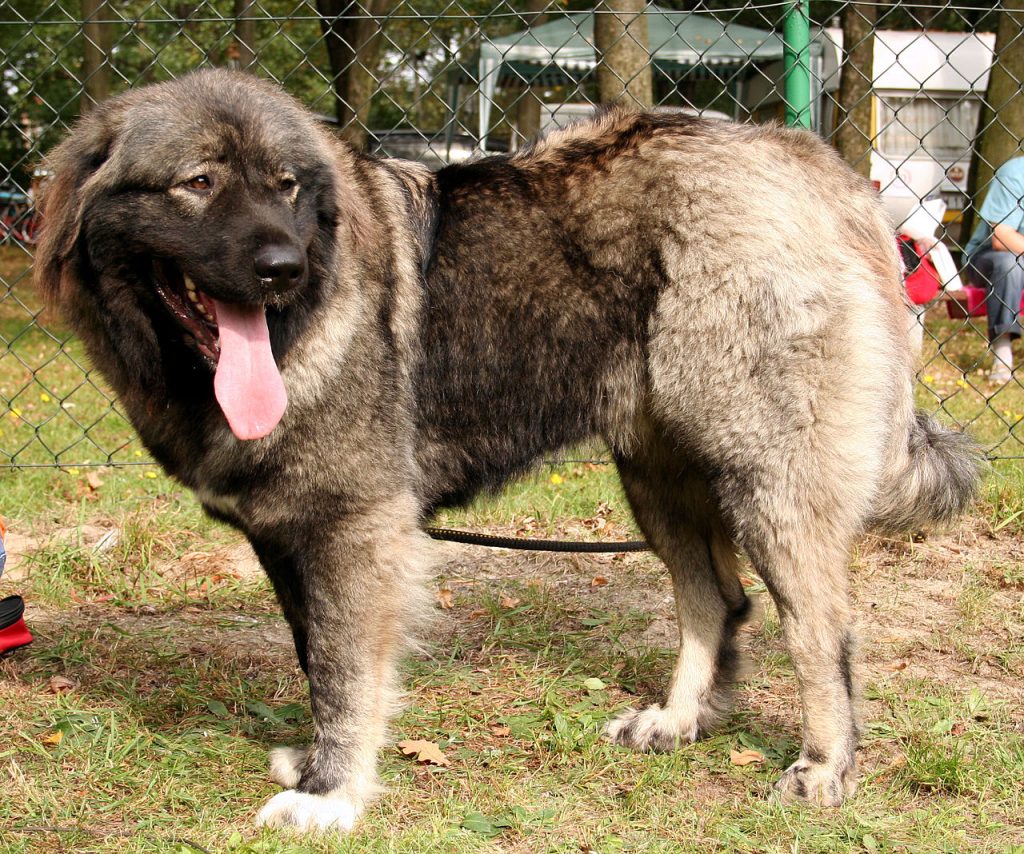
The Shepherd of the Caucasus is one of the most impressive livestock watchdogs in the world: A giant mole born in the Caucasus Mountains to fight wolves and protect herds and property. Courageous, independent and deeply territorial, it is not a pet for just anyone, but a working dog that demands experience, space and serious socialization from puppyhood. If you’re attracted to their bearish demeanor and unyielding loyalty, this guide tells you all about living with a Shepherd of the Caucasus.
Is the Caucasian Shepherd for you?
Before you fall in love with her looks, you should be very honest. The Caucasian Shepherd is a giant sized guard dog, with an extreme protective instinct and a will that does not bend to the first. It shines in skilled hands, on a seriously fenced estate and with a family that understands what’s at stake; in a flat or with a first-time owner it can become a real security problem.
In favour .
- Unparalleled guardian: deterring and protecting like few races.
- Loyal and devoted to his family, very close to his owner.
- Balanced and quiet at home when he’s well-behaved.
- Resistant to cold and hard work outdoors.
- Independent: doesn’t need to be on top of you all day.
Against
- Territorial and distrustful of strangers; requires a lot of socialization.
- Huge size and strength: difficult to handle if out of control.
- Stubborn and independent; not obedient “blindly”.
- Not suitable for beginners or small floors.
- Restricted or banned in some countries by its potential guardian.
Character and temperament

The temperament of the Caucasian Shepherd is that of a born guardian: powerful, confident and with protective reflexes surprisingly fast for his size. It is not an aggressive dog because it is; it reacts forcefully only when it senses a threat to its family, home, or herd. The rest of the time he is usually calm, almost phlegmatic, observing his territory calmly.
He’s a dog who trusts his own instincts. It develops an intense bond with its owner, but is rarely completely submissive: If your judgment tells you that you must act, you may disobey an order. That independence, inherited from centuries of solitary work in the mountains against herds of wolves, is just what made him valuable as a watchdog and, at the same time, what makes him a demanding dog. A good specimen shows a stable temperament; both shyness and uncontrolled aggressiveness are considered serious defects in the breed.
Coexistence: children, other pets, flat and loneliness
With the children in the family The Caucasian Shepherd is usually careful and protective, but does not perceive them as its “owners” and, due to its size, any coexistence with minors must always be supervised.
With other pets can coexist if reared from puppyhood with them, especially with animals you consider part of “your flock”. However, with strange dogs, especially of the same sex, it tends to be dominant. The floor is not his place: needs space, preferably a plot or fenced estate to patrol. It tolerates solitude and outdoor life well thanks to its fur, but it cannot tolerate total social isolation: A Caucasian Shepherd ignored and out of touch with his family becomes more reactive and difficult to control.
Education and training
Training a Caucasian Shepherd is not about turning him into an obedient competition dog, but about achieving a balanced giant, sociable as much as possible and under control.
The early socialization is the most important and non-negotiable point. As a puppy, he must know people, noises, animals, and various situations to learn to differentiate between normal and the real threat. Without that work, their territorial instinct can explode at any stimulus. It is advisable to rely on positive reinforcement, short and consistent sessions, and in many cases on the help of a professional accustomed to guardian breeds. Solid basic obedience (impulse control, calling, walking on a leash without pulling on a leash) is essential for sheer safety.
Exercise and activity

Despite its size, the Caucasian Shepherd is not a hyperactive athlete: its energy level is moderate. It was bred to conserve strength and react explosively when needed, not to run marathons.
What it really needs is a territory to patrol and a function. A fenced-in plot on which it can walk around its perimeter keeps it much more satisfied than any ball game. During growth, in addition, you should avoid strenuous exercise, jumping and stairs: as with any giant dog, its joints are delicate until the skeleton matures.
Care: fur and hygiene
The Caucasian Shepherd wears a very dense double coat, with a woolly inner coat that insulates it from the extreme cold of the mountain. There are varieties of long, intermediate and short hair; the long hair forms melena, “pants” and a leafy tail.
Basic maintenance is brushing: once or twice a week on a regular basis, and daily during seasonal mowing, which in this breed are abundant. In spring and autumn it sheds an enormous amount of undercoat. It does not need frequent bathing; just bathe it when it is really dirty so as not to spoil the natural protective layer. As always, you should check and care for your ears, teeth and nails regularly. Traditionally, the ears were cut off, although today more and more specimens are kept intact and many countries prohibit this practice.
Foodstuffs
A dog of this size needs a quality diet, formulated for giant breeds and adjusted to its age, weight and actual activity. It’s not just the quantity that’s important, it’s the balance. adequate protein intake and strict calorie control, because the Caucasian Shepherd is prone to obesity, a serious problem that puts a strain on joints already demanded by their volume.
During the puppy and growth phase, a specific large/giant breed feed, with the correct calcium-phosphorus ratio, is recommended for slow and healthy skeletal development. It is advisable to divide food into two daily servings instead of one and to avoid exercise right after eating, as a precaution against gastric torsion, a risk in large dogs with deep breasts. Water always fresh and available.
Health and life expectancy
The Caucasian Shepherd is a rustic and hardy dog, but it shares the vulnerabilities of giants. Among the most frequently cited problems are hypoplasia of the hip, obesity and certain heart problems. As with other breeds of large size and deep chest, the risk of gastric torsion should also be monitored. Choosing puppies from breeders who have hip tests and breeder checks makes a big difference.
There are conflicting data on life expectancy. References from 2020 placed her around the 10 – 11 years, a reasonable figure for a dog of her size. A study published in 2024 calculated a median of just 5.4 years – the lowest among the breeds analyzed – although with a very small sample (only 22 dogs), so it should be taken with caution. In practice, a well-bred Caucasian Shepherd, with controlled weight and good care, usually lives for about a decade.
Physical appearance

The Caucasian Shepherd is a plump-looking mollusk with strong bones and a powerful musculature that gives it a bear’s silhouette. It’s a big to giant dog: its weight is around 45 to 70 kg and the height at the withers is approximately between 63 and 75 cm. The standard marks preferred heights of about 67 – 70 cm in females and 72 – 75 cm in males, with record lows of 64 cm in females and 68 cm in males; the breed does not set an upper size limit.
The head is broad and massive, with a serious expression and watchful gaze. The coat supports several colors – gray, lionskin, reddish, black, white and combinations with spots – being very typical the gray tones with white markings.
Origin and history
The Caucasus Shepherd comes from the Caucasus mountain range, that cultural crossroads between the Black Sea and the Caspian Sea that spans the territories of Georgia, Armenia, Azerbaijan, Dagestan and southern Russia. For centuries, these dogs accompanied local shepherds as livestock guards, defending their flocks from wolves and thieves in harsh conditions. Hence his size, his armored coat and his resolute character.
There are notable regional variations – Azerbaijan’s taller and lighter, Dagestan’s smaller and more compact, Chechnya and Ingushetia’s huge and robust – and Georgian specimens are generally considered to be the most uniform and representative. During the 20th century, Soviet breeders selected these varieties to establish the modern breed; Russian cynologist Aleksandr Mazover was one of the first to scientifically describe it. The Fédération Cynologique Internationale was officially accepted in 1984, under the sponsorship of the Soviet Union. Along with the South Russian Shepherd and the Central Asian Shepherd, it is part of the so-called “Troika” of large Russian shepherd dogs.
Curiosities
- Its Russian name, the following paragraphs are inserted:(кавказская овчарка), literally means “Caucasus shepherd dog”; the term “ovcharka” was popularized in the West, although among some peoples of the Caucasus it is not considered the most appropriate.
- Its multi-layered coat is not just a coat – it cushions bites, a real advantage over the wolves it faced.
- Historically it was employed as a guard dog, and even in bear hunting; today it is still used as a guard dog in prisons in Russia.
- Because of its powerful protective instinct it is banned in Denmark and subject to restrictions elsewhere.
- The Armenian Gampr is considered a related variety, possibly older than the modern Caucasian Shepherd.
If you are interested in large moles and guard dogs, you may want to compare the Caucasus Shepherd with other breeds of similar character and size: the sturdy Cane Corso, the colossal Mastín Inglés, the versatile guard Rottweiler, and the rescue giant San Bernardo.
Frequently Asked Questions About the Caucasus Shepherd
Is the Caucasian Shepherd a dangerous dog?
It is not aggressive for free, but it is a powerful guard with an extreme protective instinct. In inexperienced or unsocialized hands it can be a real risk. Well bred, socialized and controlled, it is a balanced dog that reacts only to genuine threats.
Is it suitable for first-time owners?
No, its size, strength, independence and strong territorial instinct make it unsuitable for beginners. It needs an owner with experience in guardian breeds, able to transmit serene leadership and ensure its socialization.
Can he live in a flat?
The Caucasian Shepherd needs space and, preferably, a fenced-in plot to patrol. It tolerates outdoor life and the cold well, but the floor is limiting and can increase its reactivity.
How much does he weigh?
Its weight is usually between 45 and 70 kg, with males slightly outnumbering the others.
Do you get along with children and other pets?
With the children of his family he is usually careful, but because of his size the coexistence must always be supervised.
How much exercise do you need?
Less than it looks: its energy is moderate. It needs quiet daily walks and its own space to move. During growth, it should avoid intense exercise to protect its joints.
How long does a Caucasian Shepherd live?
References vary: around 10 – 11 years according to 2020 data, while a 2024 study estimated a much lower median, although with a very small sample.
Does it need a lot of hair maintenance?
Its double coat requires brushing once or twice a week and daily during spring and autumn mowing, which are very abundant.