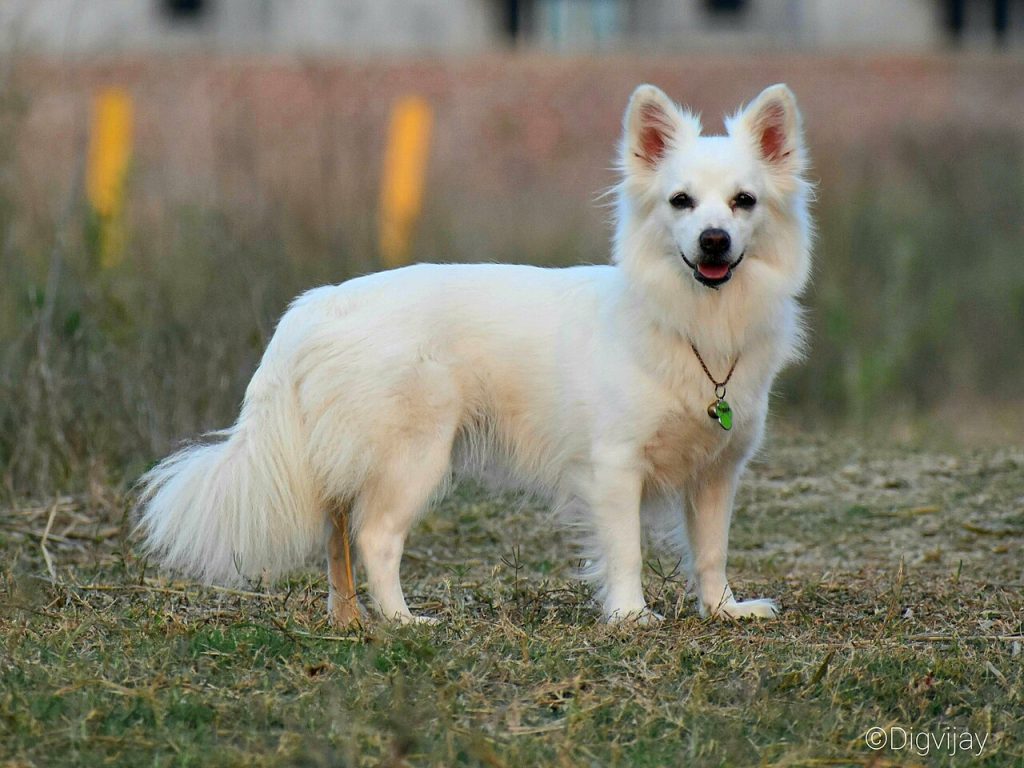
The Indian spitz is a small, white, raspy-looking dog that was during the 1980s and 1990s one of the most popular dogs in India. Spitz-type and closely related to the German Spitz, it combines an expressive face, a loving character and an ease of coexistence that make it an ideal household companion for flats and families. If you are looking for a cheerful, adaptable, reasonably maintained dog, the Indian Spitz deserves to be well-known.
Is the Indian Spitz for you?
The Indian Spitz became famous for a very practical reason: it is one of the easiest dogs to own. It is small, clean, learns quickly and adapts to both an apartment and a large house. However, it is not a dog for everyone. These boxes help you decide at a glance.
It’s a good fit if…
- You live in an apartment or a city and you want a small, adaptable dog.
- You’re looking for a loving, cheerful, sociable family companion.
- You prefer a dog with moderate exercise needs.
- You like a dog that’s sharp, smart and easy to train.
- You want a good ⁇ timbre ⁇ : let me know what’s going on at home.
Think about it if…
- You can’t stand the hair. It’s double-layered and dull with the heat.
- You’re looking for a quiet dog; it tends to bark and warn.
- You spend a lot of time outdoors. Prolonged solitude is not good for you.
- You don’t want to brush regularly or take care of your coat.
- You want a breed with an internationally recognized FCI standard and pedigree.
Character and temperament

The Indian Spitz has the personality typical of domestic and friendly Spitz dogs: he is alert, curious, very attached to his family and with an unusual facial expression that gives him a friendly and communicative air.
It is a cheerful and sociable dog, enjoying being close to people and participating in house life. It is not a distant or difficult dog: on the contrary, much of its fame in India came precisely from how pleasant it is to live with it. As a good spitz, it is also alert and vocal, which makes it an excellent warning dog despite its small size.
That same liveliness has a B-side: if it gets bored or left without stimulus, it can become barking or somewhat restless. It is a dog that appreciates company, play and a routine that keeps it entertained.
Coexistence: children, other pets, flat and loneliness
This is where the Indian Spitz shines. It is considered one of the easiest dogs to get along with of all the Indian breeds, and it shows in everyday life. It is a family dog par excellence: sociable, affectionate and just the right size to move comfortably around a floor.
With children, its friendly and playful character fits well, always with the usual supervision and respect towards any small dog. With other pets, a good socialization from a puppy makes coexistence much easier. On the floor, its small size and its adaptability make it ideal: it is as comfortable in a small apartment as in a house with a garden, whenever you go for a walk.
The point to watch is the loneliness. It is a dog very attached to its people, so long days alone are not his thing: they can lead to barking from boredom or anxiety. If you spend many hours outside, it is convenient to organize company, half-day walks or enrichment at home.
Education and training

The Indian Spitz inherited much of its intelligence and adaptability from the German Spitz, and that translates into an easy-to-train dog. In fact, it is considered one of the easiest dogs to teach to defecate outside and to train in basic commands, something that contributed to its enormous popularity as a house dog.
It responds very well to positive reinforcement: rewards, play and a cheerful voice work much better than harshness, which in a sensitive and vocal dog like this only generates more barking and distrust.
He’s a smart dog who gets bored with repetition, so short, varied, fun sessions work better than long, monotonous ones.
Exercise and activity
One of the advantages of the Indian Spitz is that its exercise needs are moderate. It is not a high-performance sports dog nor does it demand hours of running: with one or two daily walks and some playing time it covers its energy expenditure and stays balanced.
This makes it very compatible with urban life and with owners who cannot devote the entire morning to the dog. But “moderate” is not “none”: He needs to go out every day, smell, explore and move. An Indian Spitz without a walk or stimulation tends to get bored, and a bored Spitz usually barks. Combining walking, playing, and some mental exercise (smelling toys, orders, hiding prizes) is the ideal recipe.
Because of their coat and heat-adapted origin, it is advisable to avoid intense exercise in the sunniest hours and look for cooler stretches of the day.
Care: fur and hygiene

The coat is the part that demands the most attention. The Indian Spitz has a double coat: a longer outer coat and a dense undercoat. Although the dog likes to stay clean, it needs regular brushing to keep the hair in good condition and avoid tangles, especially in the ears, which have thick hair on the outside and also on the inside.
To reach the undercoat you need a proper brush (type double row or specific double mantle); a surface brush is not enough.
The it moves. is intense when the heat comes, because, true to its European heritage, it lets loose the thick winter undercoat as do other spitz (Pomerania, Samoyed, Japanese Spitz). In those times it’s time to brush more often. One piece of advice: not shave thoroughly double-coated, because the hair can regrow in patches. In addition to fur, maintain basic hygiene of ears, eyes, teeth, and nails.
Foodstuffs
The Indian Spitz is a small and rustic dog, without exotic dietary needs. The important thing is a complete and balanced diet, suitable for its size, age and activity level, and divided into the doses that correspond according to the stage (more frequent in puppies, twice a day in adults as usual).
Having a moderate energy expenditure, it is a dog with a certain tendency to gain weight if overfed or rewards are abused. Watching your rations, avoiding table food, and maintaining a proper weight are key to your long-term health. Always-available fresh water is especially important in an abundantly coated dog that lives in warm climates. If you have any doubts about the quantity or type of diet, it is best to follow your veterinarian’s instructions.
Health and life expectancy
The Indian Spitz is a rustic dog, selected for generations to withstand the heat of the Indian summers, which gives it a reputation for being hardy and healthy.
The health problem that is specifically attributed to it is an increased risk of corneal ulcer(lesion in the cornea of the eye). That’s why you should pay attention to your eyes and see your veterinarian if you notice any signs of eye discomfort, redness, watering, or rubbing your dog’s face. Apart from that, taking care of ears and skin under the coat and maintaining the usual prevention guidelines (vaccinations, deworming, weight control) is enough for a dog that usually gives few problems.
Physical appearance
The Indian Spitz is a small dog of unmistakably spitz silhouette. Very similar to the German Spitz, it is somewhat shorter at the cross and of lesser weight.
The head has a tapered snout that is longer than the Pomeranian and a triangular, pointed and erect ears, with abundant hair on the outside and inside, which gives it that characteristic fox look. The eyes show the visible iris and can be greenish or bluish, providing a very communicative expression.
As for the size, two types are usually distinguished: the Small Indian Spitz(about 22-25 cm at the cross and about 5-7 kg) and the Large Indian Spitz(about 35-45 cm and about 12-20 kg).
Origin and history
The Indian Spitz was introduced by the British in India during the 19th century and is believed to be descended from the German Spitz. After years of selective breeding, a dog capable of withstanding the heat of Indian summers was achieved that retained the intelligence and adaptability of its European ancestor.
His big moment came on the ’80s and ’90s. The strict import regulations of the Indian government made it very difficult and expensive to import dogs of other breeds, so many families opted for local and indigenous breeds. The Indian Spitz, economical, adaptable and easy to keep, became one of the most popular dogs in the country. With time and openness to other breeds (such as the Pug or Lhasa Apso) its presence decreased, but it is still highly prized as an affordable and friendly family dog.
Curiosities
- In India, many Indian Spitz are called directly ⁇ Pomerania ⁇ , despite being distinct breeds: it is probably the most widespread name confusion in the country as far as dogs are concerned.
- An Indian Spitz named Redo rose to fame playing ⁇ Tuffy ⁇ , the dog from the hit Bollywood romantic comedy Hum Aapke Hain Koun..!(1994).
- Its popularity was partly a result of politics: it was born as an “affordable dog” just when importing foreign breeds was almost impossible in India.
- Its white color comes from spitz originally bred for cold; although in India such cold does not exist, the color was liked and maintained.
- It is classified within the group of utility dogs, the same functional family to which many domestic spits belong.
If you are attracted to the Indian Spitz, you probably also enjoy other spitz-type breeds or small, adaptable dogs. You can continue exploring with the Samoyedo, which you remember for its white coat; the Chow Chow, another spitz with a marked personality; the Carlino (Pug), with whom you shared a sign in Indian homes; or the Siberian Husky, a much larger spitz but with the same Nordic root.
Frequently Asked Questions About the Indian Spitz
Are the Indian Spitz and the Pomeranian the same breed?
I’m not going to. They are close relatives of the spitz type and are constantly confused in India, to the point that many Indian Spitz are called ⁇ Pomerania ⁇ on the street, but they are distinct breeds. The Indian Spitz is larger and heavier, has a more conical and elongated snout, more pointed ears and a somewhat less dense coat, while the Pomeranian is a toy dog (rarely over 3-4 kg), with a flatter face and thicker coat.
How long does an Indian Spitz live?
As a small and rustic dog, adapted for generations to the warm climate of India, it usually enjoys a long life, in the usual range of breeds of its size. There are no official FCI figures for this breed, so it is prudent to talk about a typical longevity of a healthy small dog, supported by good nutrition, moderate exercise and regular veterinary checkups.
Is he a good dog for floors and for families?
The Indian Spitz is small, very adaptable, and is considered one of the easiest dogs to get along with among the Indian breeds: it learns quickly to defecate outside, is well-behaved, and is just as comfortable in a small flat as in a house with a garden.
Does the Indian Spitz shed a lot of hair?
Yes. It has a double coat and, due to its European heritage, changes the undercoat with the arrival of heat, just like other spitz such as the Pomeranian or Samoyed. Outside of the coats it maintains a moderate fall. Regular brushing with a brush capable of reaching the undercoat controls loose hair and prevents knots.
What color is the Indian Spitz?
The most common, and classic image of the breed, is the milky white. There are also brown or cream-colored specimens, and very rarely a combination of white and black similar to that of the Pomerania.
Do you need a lot of exercise?
Not too much: it is a moderate needs dog. With one or two walks a day and some play covers its energy expenditure. That makes it very manageable in the city, but “moderate” does not mean “none”: without activity or stimulation it can get bored and become barking or restless.
Does he bark a lot?
With early socialization, sufficient exercise, and without leaving him alone and bored for long hours, the barking is kept at reasonable levels.
Can you shave an Indian Spitz in the summer to keep it warm?
It is not advisable to have a double coat, shaving a dog thoroughly with curly hair can cause the hair to grow later irregularly and in patches, in addition to leaving the skin more exposed.