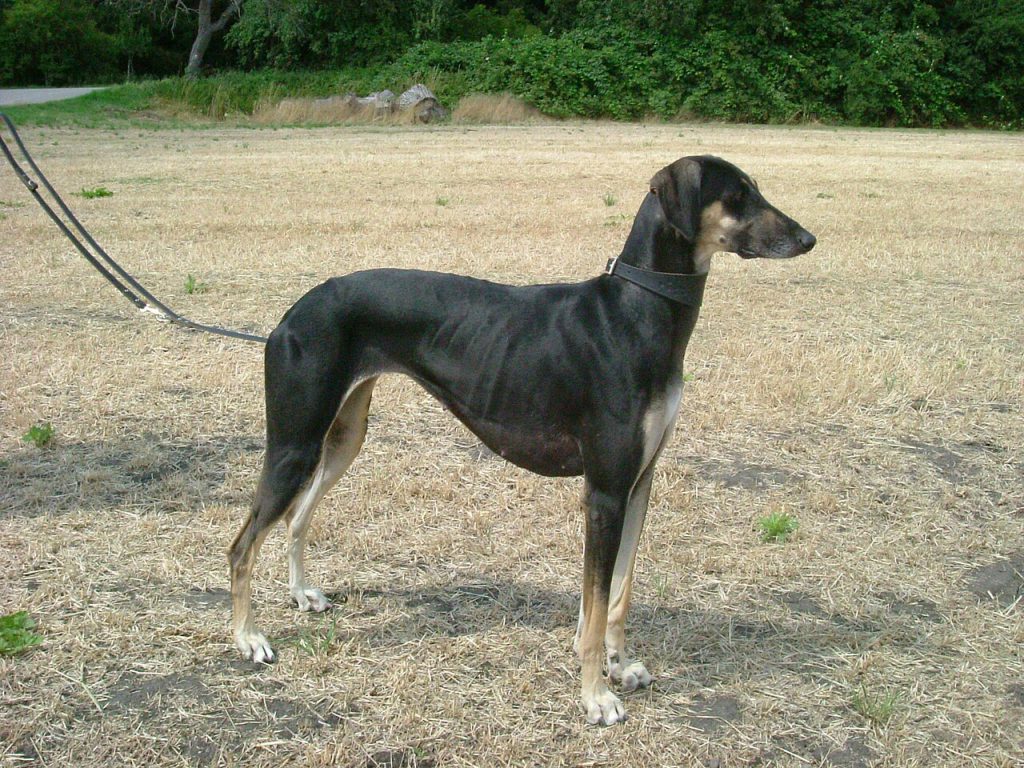
The Sloughi is one of the oldest and most elegant hares in the world: the North African Greyhound, bred for centuries by Berbers and nomads of the Sahara to hunt in plain sight over sand. Reserved, loyal and of an almost melancholy nobility, he is a dog who gives himself completely to his family but demands space, respect and miles of gallop. If you’re looking for a quiet, clean, athletic companion with a hunter’s soul, this is your dog; if you’re looking for a sociable stuffed animal, the Sloughi will surprise you.
Is the Sloughi for you?

The Sloughi is not a dog for everyone. It’s a primitive hunting breed that bonds intensely with its owner since puppyhood, but keeps a reserve against strangers and a prey instinct that doesn’t go away with training. Before you fall in love with its image, look honestly at whether your life fits with theirs.
Points in favour
- Loyal and deeply attached to his family.
- Clean, quiet and quiet inside the house.
- Short hair: minimal maintenance.
- Athletic, tough and heat-resistant.
- Robust genetic health and remarkable longevity.
- Good warning dog – alert and somewhat territorial.
Points to Consider
- Very high hunting instinct: danger with small prey.
- Reserved with strangers; needs early socialization.
- It requires free running, not just walking.
- Sensitive: sinks with harsh methods.
- Sensitive to anesthesia and certain drugs.
- It’s not ideal for small apartments without planned exercise.
Character and temperament
The Sloughi has a character that its breeders describe with one word: nobility. It is a dog of class and grace, with a dignified and somewhat distant attitude reminiscent of that of an aristocratic greyhound. The look of its dark eyes is soft, thoughtful and melancholy, and that expression well sums up its temperament: sensitive, intelligent and observant.
With his family he’s another dog. It becomes extraordinarily attached to its owner from a very young age and develops a close, almost shadowy bond. A well-bred and socialized Sloughi is stable, attentive and extremely affectionate at home. Outside of it, he is reserved with strangers and expects that same reserve from those around him: She doesn’t appreciate people who are too effusive or invasive, and she’s slow to open up to new friends.
Unlike many purely hunting sighthounds, the Sloughi is very alert and territorial, a trait that made it valuable to the Berbers not only as a hunter, but as a fearless guard of the camp.
Coexistence: children, other pets, flat and loneliness

With children: Sloughis accustomed to children are excellent with them. The key is in early socialization and in teaching the little ones to respect the dog. Being sensitive, it does not tolerate rough treatment well, but more than returns the affection of a quiet family.
With other pets: here commands its hunting instinct, the highest in the canine world. A Sloughi can coexist wonderfully with cats, small dogs and other animals yes, you are. knows them from puppyhood and learns that they are not prey. With unfamiliar animals, especially moving and outdoors, your natural reaction will be to chase. With other dogs, poor socialization can make him shy or reactive, so work from puppyhood is nonnegotiable.
In the flat and lonely: is not the most suitable breed for a small floor unless the owner guarantees a daily exercise plan with free galloping. Indoors it is quiet and orderly, but needs to discharge energy outside. It tolerates human company well and prefers to be close to its people; lonely moments are better if it has run comfortably before.
Education and training
The Sloughi is intelligent and learns easily, but you have to understand how it works. Its character is tender and sensitive, and reacts badly to harsh correction: firm hand methods or physical punishment are not only ineffective, but especially harmful to a hare, which can shut down completely.
Positive reinforcement, patience and constancy are the only way. Socialization should begin early, involving not only new people but situations, environments, and other dogs, so that the puppy matures into a balanced adult. Like all sighthounds, it maintains a certain independence: Their obedience will never be mechanical or servile, and the call with a prey instinct activated is a permanent challenge that should be worked on from the start.
Exercise and activity
The Sloughi is an athletic dog, fast, agile and with enormous resistance to distance, qualities that made him a prized hunter in the Sahara. He needs ample daily exercise to cover his physical, emotional and mental needs.
Activities such as lure coursing(bait chase), running, and long walks on safe terrain go like rings on his finger. Watch out for letting him go: his speed and instinct can take him far behind a rabbit or cat in seconds, so he needs fenced spaces or really safe areas.
Care: fur and hygiene

Here the Sloughi is of a grateful simplicity. Its hair is short, fine and attached to the body, without fringes or abundant undercoat, so the maintenance is minimal: a weekly brushing with a glove or a soft brush is enough to remove the dead hair and keep the mantle shiny.
Like all dogs, it is advisable to check and care for ears, teeth and nails regularly. Due to its very low percentage of body fat and its very fine hair, the Sloughi is sensitive to cold: in cold climates it will appreciate a coat on winter walks and a soft bed to curl up.
Foodstuffs
The Sloughi is a dog of dry build, with long, flat musculature and very little fat: its slender appearance is normal and healthy, not a sign that it lacks food.
A complete, high-quality diet tailored to your age, size, and activity level is appropriate. As a sporting dog, he splits his rations well according to his actual expenditure. Since it is a deep-chested hare, it is advisable to take the usual precautions against gastric dilation-torsion: Avoid strenuous exercise just before and after meals and, if necessary, divide the ration into two daily servings. Fresh water always available, especially after exercise.
Health and life expectancy
The Sloughi has barely changed since ancient times and retains remarkably robust genetic health. Very few hereditary diseases affect the breed. The best documented are progressive atrophy of the retina (PRA) and some autoimmune disorders like Addison’s disease. The good news about ARP is that there is a genetic test with a simple blood sample, and responsible breeders use it to gradually remove it from the breeding lines.
Like all hares, the Sloughi is very sensitive to anesthesia and can also react to vaccines, pesticides and other medications, due to its low body fat. Therefore, routine treatments should be spaced over time rather than administered all at once, and a veterinarian familiar with sighthound characteristics is desirable. With good care, the breed tends to enjoy excellent health into old age, with a usual life expectancy of 12 to 16 years.
Physical appearance
The Sloughi is a robust but elegant and racial hare, with harmonious lines and well-proportioned limbs, back and tail. Its head is long and refined, with sloping ears, and it resembles a slightly shorter and more compact greyhound. The musculature is “dry”, with flatter and longer muscles than those of other hares such as the Whippet, even in good shape. The upper line is practically horizontal and merges with a slightly inclined groove; the tail is long, low and with an upward curve at the tip.
Males measure about 66 to 72 cm at the withers and weigh about 22 to 28 kg; females, 61 to 68 cm and 18 to 24 kg. The eyes are ideally dark brown, sometimes amber, with that characteristic melancholy expression. The coat, short and fine, ranges from sandy to sandy red, red or mahogany, and may have a black coat, black mask and black ears. According to the standard, only a small white spot on the chest is allowed; extensive white spots are not allowed.
Origin and history
The Sloughi is a very ancient breed, rooted for centuries in North Africa: Morocco – where the FCI recognizes it as a country of origin – , Algeria, Tunisia, Libya and Egypt.
Its history is lost in time. Neolithic cave paintings in Algeria and representations in Egyptian tombs and hieroglyphs show slender dogs with drooping ears that point to the remote origins of this type of greyhound; some ancient fragments, from around 3000 BC. C., you already remember a Sloughi. For generations it was the dog of the nomads and Berbers of the Sahara, who used it to hunt hare, fox, jackal, gazelle and other prey in plain sight, and also as a brave camp guard. The Sloughi was accepted by the FCI in 1998 and recognized by the American Kennel Club on January 1, 2016, where it competes in the greyhound group.
Curiosities
- It is one of only two African hares recognized by the FCI (the other being the Azawakh, with which it is probably related, and not the Saluki despite the resemblance).
- Their melancholy expression is so characteristic that it is part of the breed’s standard.
- Despite its elegance, it is not a frail or timid dog: it was bred as both a hunter and a guard.
- Indoors it is almost feline: silent, clean and very quiet, a stark contrast to its explosive running.
- Its tolerance to drought and heat, inherited from the desert, is one of its most prized traits.
- The American Kennel Club recognized it very late, in 2016, despite being one of the oldest breeds in existence.
If you are attracted to the Sloughi, you may be interested in other hares and noble dogs of similar temperament. Discover the Greyhound, the fast Whippet, the stylish Vizsla and the imposing Doberman Pinscher, another alert and territorial dog.
Frequently asked questions about the Sloughi
Is the Sloughi a good dog to have in a flat?
It is not their ideal environment. The Sloughi is a working hare bred to gallop through the desert, so it needs daily outings where it can run hard. At home it is quiet and clean, almost feline, but without that physical outlet it becomes frustrated. It can live on the floor only if the owner commits to abundant and frequent exercise; otherwise, a house with space is better.
Does the Sloughi get along with children?
Yes, when it has grown up with them or has been socialized since puppyhood. Sloughis accustomed to children are excellent with them, affectionate and patient.
Can the Sloughi live with cats or other small dogs?
It can, but with conditions. Its prey drive is extremely high due to centuries of selection to chase prey. If it is raised from a puppy alongside cats or small dogs and learns that they are part of the family, coexistence works. With unfamiliar animals outside the home, its reaction will be to chase.
How much exercise does a Sloughi need a day?
It needs intense daily exercise: long walks plus, ideally, opportunities to gallop freely and safely several times a week. It doesn’t require more hours than other dogs of its size, but it does require quality: real running.
Is the Sloughi easy to train?
It is intelligent and learns quickly, but in its own way. It responds to positive reinforcement and kind treatment; harsh methods or punishments block it and damage its character. Like all hares, it is independent and its obedience will never be mechanical: you have to earn its trust.
What is the Sloughi’s life expectancy?
It is a long-lived and genetically robust breed. With good care it usually enjoys excellent health until old age, with a life expectancy of around 12-16 years, common in hares.
Is the Sloughi sensitive to anesthesia?
Yes, like most hares, their low body fat percentage makes them especially sensitive to anesthesia and they can also react to vaccines and other drugs.
How is the Sloughi different from the Saluki or the Greyhound?
Although they share a family and probably a common ancestor, they are not the same breed. The Sloughi is the hare of North Africa (Morocco, Algeria, Tunisia, Libya), with short hair and no fringes, unlike the Saluki of the Middle East, which usually has feathers on its ears and tail.