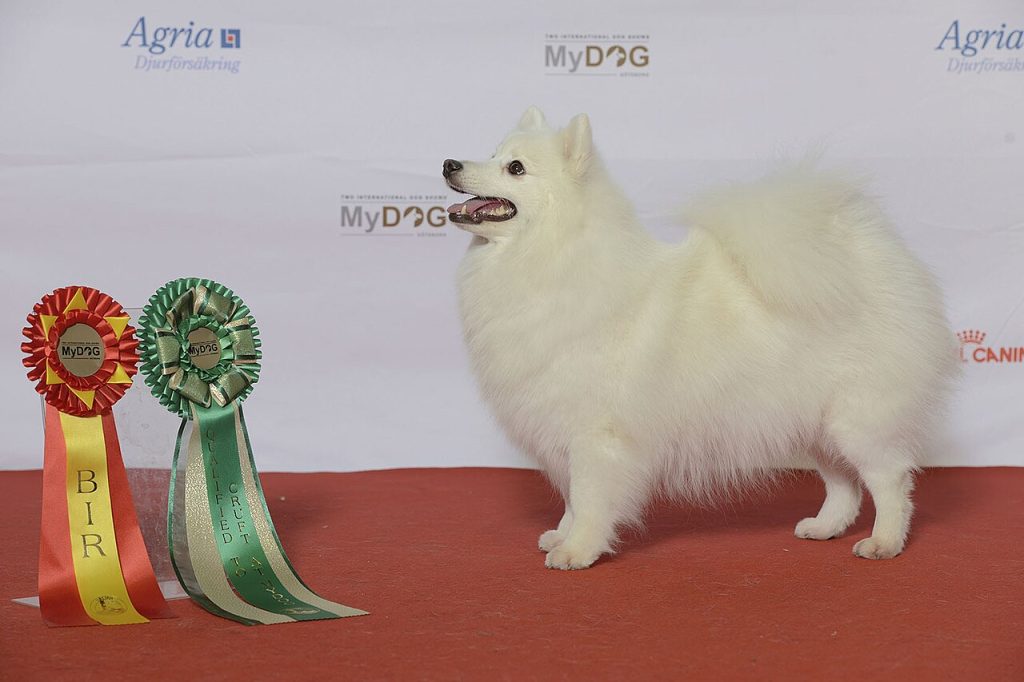
The Spitz Japonés is a small spitz-type dog, with a pure white coat, a feathered tail over its back and that characteristic wakeful, smiling expression. Cheerful, loyal, and intelligent, it was bred in Japan as a companion dog and today conquers families halfway around the world for its balanced character, manageable size, and a coat that, against all odds, is surprisingly easy to maintain. If you are looking for a loyal, sociable, clean companion for home life, the Japanese Spitz deserves your full attention.
Is the Japanese Spitz for you?
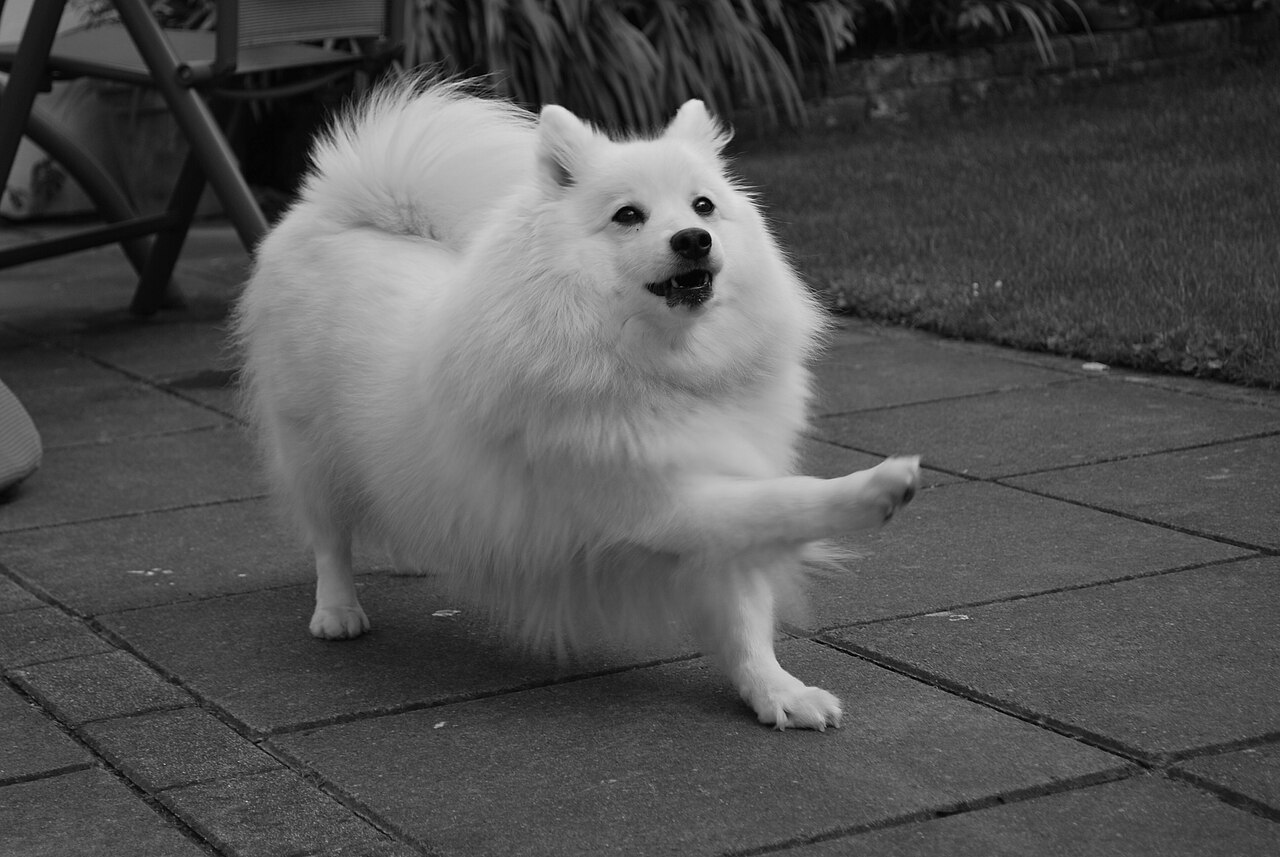
Before you fall in love with that stuffed face, you should know if its way of being fits into your life. The Japanese Spitz is a companion dog by vocation: it wants to be with you, participate in family life and receive attention. In return, it will give you loyalty, joy and very few headaches. Here’s an honest summary of its lights and shadows.
In favour .
- Cheerful, affectionate and very family-oriented.
- Excellent with children and a good dog for the elderly.
- Small and manageable, ideal for flooring.
- Self-cleaning coat: the dirt comes off by itself.
- Intelligent and obedient, he learns easily.
- Reliable alarm dog for his size.
- Healthy, long-lived breed with few genetic problems.
To be taken into account
- He doesn’t like prolonged loneliness.
- It tends to bark to warn; you have to educate the warning.
- Strong seasonal changes in spring and autumn.
- It needs regular brushing to prevent knots in the undercoat.
- He may be reserved or domineering with other dogs if he is not socialized.
- Its white coat requires attention to tear to avoid staining.
Character and temperament
Active, loyal and awake: That sums up the temperament of the Japanese Spitz. It is a courageous and affectionate dog, deeply devoted to its family, to the point that it is considered an ideal companion for both older people and children. Despite its modest size, it has character and composure, and it does not hesitate to sound the alarm when someone approaches the house, making it a surprisingly effective watchdog.
Above all, it’s a companion dog that lives by and for human contact. It thrives when it is an active part of daily life and suffers when it is left out or alone for many hours. He’s intelligent, playful, attentive and obedient, with an almost proverbial loyalty to his own. That balance of cheerfulness, docility, and a touch of courage is precisely what has made it so popular outside Japan.
Coexistence: children, other pets, flat and loneliness

With children. is one of its great strengths. The Japanese Spitz stands out for being especially affectionate and tolerant with children, with whom it is usually playful and patient.
With other pets. is well socialized from puppyhood, cohabits without problems. It should be borne in mind that some specimens have a somewhat dominant character and can be reserved with other dogs, so early and positive socialization is key to a relaxed coexistence.
On the floor. Its small size, cleanliness, and moderate exercise needs make it well suited for apartment living, provided it has its daily walks and playtimes.
In the face of solitude. is its weak point. Being such a family-oriented dog, it does not like to spend many hours alone; if it is bored it may develop barking or anxiety. If you work outside all day, value leaving stimuli, company or someone to look after it.
Education and training
The Japanese Spitz is a grateful learner. Its intelligence, its obedient disposition and its desire to please make it learn quickly when trained with kind and positive methods, based on rewards, play and patience. It responds poorly to abruptness: it is a sensitive dog that closes with harsh treatment.
The two educational priorities are the early socialization– exposing him from puppyhood to people, noises, other dogs and various situations so that he grows up safe and balanced – and the handling of barking, teaching him a “silence” command and preventing warning the stranger from becoming a habit.
Exercise and activity
It is not a hyperactive dog, nor does it require marathon days of exercise, but it is also not a cushion. It needs moderate daily activity: a couple of walks, playtime and, if possible, some free running in a safe environment, because it loves to run. It enjoys the outdoors and the shared activity with its family.
A good athlete within his size, he channels his energy wonderfully into games of search, obedience or agility. Meeting his physical and mental needs is also the best recipe to prevent boredom and barking.
Care: fur and hygiene

Although it looks like a demanding stuffed animal, the Japanese Spitz is surprisingly easy to care for. Its coat has an almost non-stick texture – often compared to Teflon – so that mud and dirt, when dried, fall off on their own or are removed with a brush.
The ideal routine is a thoroughly brushed twice a week with a spiked brush that reaches down to the undercoat, to prevent the formation of knots. During the spring and autumn seasonal seedlings it is advisable to intensify brushing, removing the dead undercoat before any bathing. The bathrooms must be just the necessary ones: Washing it too much dries out the skin. Complete hygiene with ear checks, nail trimming and gentle eye contour cleaning to prevent tearing from staining white hair.
Foodstuffs
As a small and active dog, the Japanese Spitz benefits from a quality, complete and balanced diet tailored to its size, age and activity level.
The key is the moderation: being a small dog, overweight comes quickly and punishes its joints, especially delicate due to its predisposition to knee dislocation. Divide the daily ration into several intakes, control treats and always have fresh water available. If you have any questions about specific quantities or diets, your veterinarian is the best reference.
Health and life expectancy
The Japanese Spitz is a healthy breed, with very few genetic problems, and that robustness is one of its greatest advantages.
Its main point of surveillance is dislocation of the kneecap, a patellar dislocation frequent in small breeds. You may also develop crying, most often from too narrow tear ducts, allergies or stress, and rarely from a serious eye problem. A late-onset progressive atrophy of the retina(PRA-rcd4) has also been identified in the breed. Going to a responsible breeder who performs health tests and keeps veterinary checks up-to-date is the best way to enjoy a long-lived, fit mate.
Physical appearance
The Japanese Spitz is a small dog with an almost square body, deep chest and a compact and harmonious silhouette. Its most unmistakable feature is the plain white double coat: a long outer hair that separates from the body on a soft, dense undercoat, with a longer mane around the neck and a spectacular plumage-like tail curled over the back. The hair is shorter on the face, ears and front of the legs.
The head, wide and wedge-shaped, ends in a pointed snout and small, erect triangular ears. The eyes, large, oval and dark, slightly oblique, contrast beautifully with the white of the mantle, as do the nose, lips and eye edges, of a deep black. In terms of size, the Japanese reference (adopted by the FCI) places males between 30 and 38 cm to the cross, with females somewhat smaller, and an approximate weight of 6 to 12 kg. Other clubs handle slightly different ranges, but always describe it as a dog clearly older than the Pomeranian.
Origin and history
The Japanese Spitz is a relatively young breed, forged in Japan during the 1920s and 1930s. Breeders started from white German Spitz, originally brought from northeastern China, which were first exhibited at a dog show in Tokyo in 1921. Between 1925 and 1936 several small white spits were imported from different parts of the world and crossed with the developing specimens, with the aim of perfecting the breed.
The definitive standard was drafted after World War II and was accepted by the Japan Kennel Club. The breed gained popularity in Japan in the 1950s and was soon exported to Sweden; from there it reached England, where the Kennel Club recognized it in 1977. Today it is widespread in Australia, India, the United States and much of the world, recognized by most major dog clubs. The American Kennel Club still does not fully recognize it – it included it in 2019 in its Foundation Stock Service – partly because of its resemblance to the Pomeranian, the American Eskimo Dog and the Samoyed.
Curiosities
- Its coat is often compared to the teflon: dirt does not stick, making it one of the easiest white dogs to keep clean.
- Some experts trace its remote origins back to the Samoyedo, while others relate it to the great German spitz.
- Despite looking like a delicate show dog, he is a good athlete and shines in agility.
- It’s a manual alarm dog: small, but with a clear voice to warn of any visitors.
- Its large oval eyes are traditionally described as being shaped like a ginkgo seed.
If you are attracted to the Nordic air and white coat of the Japanese Spitz, you may want to compare its character with that of other related breeds before deciding. Check out the Samoyedo, its large cousin with an unmistakable smile; the sturdy Husky Siberiano, another working Nordic spitz; the spectacular Chow Chow of oriental origin; or the sleek Akita, another canine emblem of Japan.
Frequently Asked Questions About the Japanese Spitz
Does the Japanese Spitz bark a lot?
It tends to bark to warn of the arrival of strangers, because it is an excellent alarm dog despite its size. It is not a compulsive barker by nature, but if it is bored, spends too much time alone or no one corrects the warning, the barking can become a habit. With early socialization, exercise and teaching a “silence” command, the problem is well controlled.
Does the Japanese Spitz shed a lot of hair?
The good news is that its coat has an almost non-adhesive texture: the dirt comes off by itself and a brushing a couple of times a week is enough to keep it clean and knot-free.
Is he a good dog for a flat?
Yes, it is a small, clean, family-oriented dog with moderate exercise needs, which makes it well suited to living on the floor. It does, however, need daily outings, playtime and companionship: it is a companion dog that does not tolerate prolonged solitude.
Is the Japanese Spitz good with kids?
It is one of its great virtues. It is described as especially affectionate and patient with children, cheerful and playful. As with any breed, you have to supervise the treatment of small children and teach them to respect the dog, but its balanced character makes it a good family companion.
How long does a Japanese Spitz live?
It is a healthy and long-lived breed. A British study in 2024 placed its life expectancy at about 13 years, above the average of purebred dogs. With good nutrition, exercise and veterinary care, many specimens easily exceed that figure.
Is it hard to take care of your white hair?
Its coat is relatively dry and has a texture that repels dirt; the mud, as it dries, falls off or is easily brushed. With a thorough brushing twice a week to avoid knots in the undercoat and baths only when necessary, it maintains an impeccable white.
What health problems does the breed have?
The most commonly cited problem is kneecap dislocation, typical of small breeds. It may also present with tearing (often from narrow tear ducts or allergies) and, less commonly, a late-onset progressive retinal atrophy (PRA-rcd4).
Is the Japanese Spitz the same as a Pomeranian or a Samoyed?
No, even if they look alike. The Japanese Spitz is larger than the Pomerania and quite smaller than the Samoyed. It shares with them the Nordic air and white coat, but it is a breed of its own, developed in Japan in the 20th century from several white spitz.