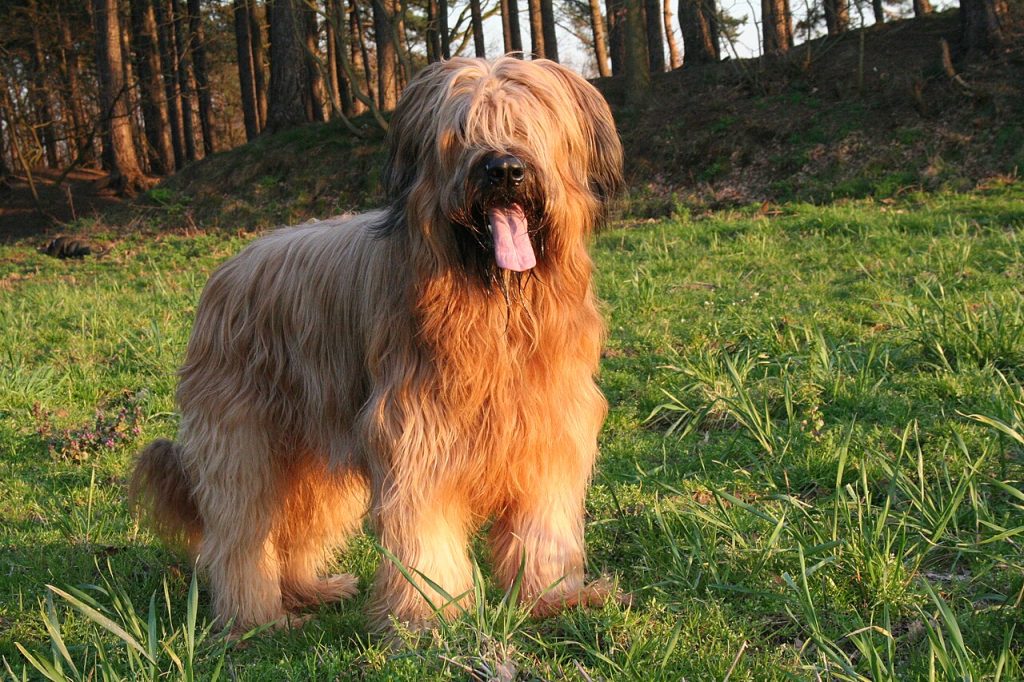
The Shepherd of Brie(French Shepherd of Brie, internationally known as Briard) is one of the oldest French shepherd dogs: a large, hairy and deeply loyal herder, able to manage several hundred sheep on his own and, at the same time, become the loving shadow of his family. Behind that distinctive bang is an intelligent, sensitive, and highly-characterized dog who doesn’t fit in with just anyone. In this guide, you’ll find everything you need to know about Brie’s Shepherd before you share your life with one.
Is that Brie’s Shepherd for you?
The Brie Shepherd is a real sheepdog: it needs a job, a close bond and someone who understands its sensitivity. It is not an ornamental dog or a low-maintenance companion. Before you fall in love with its coat, weigh honestly what it asks in return.
In favour .
- Incredibly loyal and attached to his family; he lives to be with you.
- Very intelligent and obedient when brought up with respect.
- Excellent guard: vigilant, courageous and deterrent without being basically aggressive.
- Versatile: shepherding, obedience, agility, tracking, therapy or hiking.
- Good with the kids in his family if he grows up well socialized.
Against
- Lots of daily physical and mental exercise: not suitable for sedentary life.
- Its long hair requires frequent and constant brushing to avoid knots.
- Reserved with strangers and a protective instinct to channel.
- Sensitive and stubborn – harsh treatment blocks or makes you suspicious.
- He has a hard time with prolonged loneliness; he suffers if he is left alone for many hours.
In short, the Brie Shepherd shines with active, present, patient owners willing to invest time in education, exercise, and grooming.
Character and temperament
The best way to describe the Brie Shepherd is as “a heart wrapped in hair”. It is a one-owner dog in the broadest sense: it gives itself completely to its family and forms intense bonds.
It is cheerful, playful and often retains a mischievous streak well into maturity. But he ‘s also an extraordinary dog: perceives people’s moods, is affected by the tensions in the home and reacts fatally to voices and punishments. With his people he is affectionate and demonstrative; with strangers he is reserved and observant, evaluating before trusting. This alertness, coupled with its courage, makes it a natural guard that will bark and intervene if it senses a threat, although it is not an easy dog to bite.

Coexistence: children, other pets, flat and loneliness
With children: The Brie Shepherd is usually patient and protective with the little ones of his own family, whom he tends to “shepherd” and care for.
With other pets:, if grown with other dogs and cats, can get along well, although its herding instinct leads it to chase and group together what moves.
Floor or house: can live on the floor if it gets the exercise it needs, but it’s much better off with access to a garden or long outings to the countryside.
Soledad: here is its greatest weakness. The Brie Shepherd is so attached that it feels very bad to be alone for many hours; it can develop separation anxiety, barking and destructive behaviors. It needs to be an active part of the house life.
Education and training
The Brie Shepherd is very intelligent and learns quickly, but his intelligence is accompanied by a stubborn and self-critical vein: he does not obey “because he does”, but because he trusts you.
The early socialization is essential: the more he knows about puppies (people, dogs, noises, environments), the more balanced and confident he will be as an adult, avoiding that his guardian instinct leads to excessive distrust.
Training in obedience, shepherding, agility, tracking or intelligence games are not a whim, but a necessity: a Brie Shepherd with a busy mind is a happy and manageable dog.
Exercise and activity
This is a high-energy, high-endurance working dog that needs at least one and two hours of daily exercise, combining long walks, running, play and, above all, mental stimulation.
Enjoy activities that challenge your mind and body: hiking, dog sledding, herding, agility, obedience, mantrailing or simply games of seek and bring. A Brie Shepherd that doesn’t burn its energy will channel it on its own, usually in the form of barking, garden holes or debris. The good news is that once he’s satisfied with his exercise, home is quiet and he’s content to be near his family.

Care: fur and hygiene
The coat of the Brie Shepherd is its hallmark and its most demanding of maintenance. It is a long – at least 7 cm – rough and dry, “like that of a goat” hair, with a thinner inner layer.
The ideal is to brush several times a week thoroughly, almost daily, reaching down to the skin to untangle tangles before they become compact knots. The bath is given only when it is necessary. Unlike many breeds, it does not shed or peel: their natural coat is respected. The dog’s characteristic eye-covered bangs are part of the standard; many owners pick them up or trim them slightly for the dog’s comfort.
The rest of the care is the usual: checking and cleaning the ears (hairy and prone to accumulating dirt), cutting the nails – eye to the other, of circular cross-section of the hind legs, a typical feature of the breed – , maintaining dental hygiene and keeping an eye on the eyes under the fin.
Foodstuffs
As a large and active dog, the Brie Shepherd needs a quality diet, adapted to its age, weight and activity level, with a good intake of protein and a correct balance of fats and minerals.
In large breeds and deep-chested breeds split the food into two servings a day is advisable and avoid intense exercise just before and after eating, as a precautionary measure against gastric dilation-torsion. During the puppy’s growth it is especially important to use a suitable feed for large breeds, which controls the rate of bone development. If you have any questions about quantities or diet, it is best to consult your veterinarian.
Health and life expectancy
The Brie Shepherd is generally a rustic and robust dog. His life expectancy is around 12-13 years; a 2024 study placed his median longevity at around 12.6 years, very close to the average of all breeds.
Like all breeds, it has some predispositions that should be known and for which there is evidence in responsible breeders:
- Dysplasia of the hip: common in large dogs; controlled by selecting breeders with good X-rays.
- Hereditary eye problems: the breed is historically associated with a retinal dystrophy / congenital night blindness (CSNB).In fact, the Brie Shepherd was the protagonist of a scientific milestone: in 2001 the blindness of several puppies was partially reversed by gene therapy.
- Gastric dilation-torsion (torsion of the stomach): risk present in large deep-chested dogs; hence the pattern of splitting meals.
- Otros: may cause minor thyroid or eye problems; periodic veterinary checks help to detect them early.
Acquiring the puppy from a serious breeder who tests the parents’ health is the best investment in the dog’s future well-being.

Physical appearance
The Brie Shepherd is a large dog, of solid and proportionate build, muscular but agile, with a rectangular silhouette and an elegant demeanor under its abundant coat.
The head is strong and elongated, covered with hair that forms eyebrows, beard and mustache, and the characteristic bang that falls over the eyes. The expression is frank and thoughtful. The coat, long and of goat texture, may be of various colours: black, grey, blue or maroon (fauve), the latter sometimes with a carbonate hue (mixture of black hairs). White is not allowed. A unique feature required by the standard is the other, of circular cross-section on the hind legs, located very low, close to the foot.
Origin and history
The Brie Shepherd is one of the oldest French shepherd breeds. It takes its name from the Brie region, in north-central France, although its use was widespread over large areas of the country. For centuries it was the versatile dog of the French countryside: it guided and grouped flocks, prevented sheep from invading crops and vineyards, and defended livestock from thieves and predators.
The first written mention of Brie herding dogs is usually attributed to the late 18th century. At the end of the 19th century, the cynologist Pierre Mégnin clearly distinguished between the short-haired Beauce dog – today’s Beauceron – and the long-haired Brie, the Briard. The breed was presented at the first dog show in Paris in 1863 and, following the creation of the French book of origins, the first Shepherd de Brie listed was Sans Gêne, in 1885. The first standard was drafted in 1897.
The 20th century was bittersweet. The breed served in the French army as a sentry, a messenger, and a tracker of wounded – its fine ear reportedly enabled it to locate fallen soldiers – but the two world wars decimated its numbers. After recovering, the Brie Shepherd was officially recognized by the Fédération Cynologique Internationale in 1954. With the mechanization of the countryside, the dog moved from the herd to the home and, between the seventies and eighties, experienced a huge popular boom in France.
Curiosities
- The legend links him to historical figures such as Charlemagne or Napoleon, and fame is attributed to him from the French court, although many of those tales are more tradition than documented history.
- In 2001, three Shepherd de Brie puppies blinded by a disease similar to Leber’s congenital amaurosis regained some vision thanks to a pioneering gene therapy, a breakthrough that paved the way for treatments in humans.
- Their other, of circular cross-section on the hind legs are so distinctive that their absence is considered an elimination foul in the breed standard.
- It is related to other French shepherds such as the Beauceron and the Berger Picard.
- The characteristic bangle is not only aesthetic: it protects the dog’s eyes from the sun, rain and vegetation during herding work.
If you are attracted to the Brie Shepherd for his intelligent and loyal herding character, you may also be interested in other breeds with similar abilities. Check out the Pastor Alemán, the tireless Border Collie, the versatile Pastor Australiano or the stylish Collie, all herding dogs with a lot to offer active families.
Frequently Asked Questions About the Brie Shepherd
Is the Brie Shepherd a good family dog?
Yes, it is well socialized, loyal, affectionate, and very protective of its family, patient with the children of the household, and a reliable guardian.
How much exercise does a Brie Shepherd need?
It is a high-energy herding dog that requires between one and two hours a day of physical activity combined with mental stimulation: long walks, running, play and obedience or herding work.
How much does it cost to maintain your hair?
Its long, rough coat needs to be thoroughly brushed several times a week, almost daily, to avoid knots.
How long does a Brie Shepherd live?
Their life expectancy is around 12-13 years. A 2024 study placed their median longevity at around 12.6 years, very close to the canine average.
Is it easy to train?
It is highly intelligent and learns quickly, but it is also stubborn and sensitive. It responds excellently to positive reinforcement, consistency and patience, and poorly to harsh treatment or yelling. Early socialization is key.
Can you stay alone for many hours?
The Brie Shepherd is very attached to his family and has a hard time with prolonged loneliness; he may develop separation anxiety, barking, and destructive behaviors.
What color is the Brie Shepherd?
Their hair can be black, gray, blue or fawn, the latter sometimes with a carbonate hue.
What are the double spurs of Brie’s Shepherd?
It is a distinctive feature and required by the breed standard: its absence is considered an elimination foul.