The Redbone Coonhound is an American hunting dog unmistakable by its coat of a deep, uniform red. Raised in the southern United States to track and corner raccoons in the trees – and able to stand up to larger prey such as bears and cougars – it combines a portentous nose, great stamina, and a gentle temperament at home. It is an athletic, sociable, noisy dog that shines with active families and outdoors. In this guide you’ll find everything you need to know about the Redbone Coonhound before you share your life with him.
Is the Redbone Coonhound for you?
The Redbone Coonhound is a wonderful dog for the right home, but it doesn’t fit into any lifestyle. Before you decide, be honest about the time, space, and energy you can give it. This summary will help you know if this breed and you make a good match.
In favour .
- Loving, balanced and loyal to his family.
- Sociable with other dogs; bred to hunt in the jaguar.
- Very low-maintenance short coat.
- High endurance: ideal companion for running, hiking and crawling.
- Rustic breed and usually healthy.
- Good with kids in an active environment.
Against
- Strong and frequent howling: poor fit in flats with neighbours.
- He needs 1-2 hours of daily real exercise.
- Very strong tracking instinct, tends to go after a scent.
- Independent; perfect obedience is not his thing.
- He gets bored and frustrated if you leave him alone too long.
- Long ears that require regular cleaning.
Character and temperament

The Redbone Coonhound has a very defined double personality: in the field it is a tireless, courageous and determined hunter; at home it is a calm, affectionate and very attached dog to its own.
It is a sociable dog by nature, not prone to aggression and quite balanced emotionally. Its expression, often described as supplicant by the look of its brown eyes, reflects well its friendly temperament. It enjoys human company and does not take well prolonged solitude: it is a dog that wants to be with its people.
At the same time, it retains the independence typical of tracking hounds. When its nose catches an interesting smell, it goes into hunting mode and can disconnect from everything else. It’s not stubbornness, it’s genetics: it’s designed to follow a trail with determination for hours. Understanding that nature is key to living with it without frustration.
Coexistence: children, other pets, flat and loneliness
With children: is a patient and affectionate dog that usually gets along very well with the little ones, especially if it grows up with them.
With other dogs:, due to its past as a jaguar hunter, tends to be sociable and enjoy canine company.
With cats and small animals: here you have to be careful. His hunting instinct can be activated with cats, rodents or poultry. If he lives with them from puppyhood and socializes well, the relationship can work, but it is advisable to monitor and not take it for granted.
On the floor: is not its ideal habitat. Its powerful howling and its need for exercise make it difficult in an apartment, especially with close neighbors. It is best suited to a house with a fenced garden, although the garden never replaces walks.
Soledad: is a dog that needs company. If it spends many hours alone each day, it tends to get bored, howl and look for undesirable exhaust valves. It’s not the breed for someone who’s out all day.
Education and training

Raising a Redbone Coonhound is a mixture of intelligence and patience. It is an alert dog that learns quickly and wants to please, but drags the independence of hounds and a nose that constantly distracts it. To expect from it the mechanical obedience of a shepherd is a mistake: you have to work with its character, not against it.
Positive reinforcement is the method that works best. Rewards, food and play motivate far more than toughness, which with this sensitive breed is counterproductive. Short, frequent and fun sessions yield more than long and repetitive ones.
Two priorities deserve special attention. The first, the called: Given its tracking impulse, training a reliable ven is essential and difficult, so it is best to reinforce it from puppyhood and not rely on open areas. The second, the early socialization with people, dogs, environments and noises, which settles its natural good character. Channeling your sense of smell with tracking games or nose sports is also an excellent way to stimulate your mind.
Exercise and activity
The Redbone Coonhound is a working dog with remarkable endurance, bred to trail for hours over mountains and marshes. It needs at least one or two hours a day of real physical activity: long walks, running, hiking, swimming or tracking games.
A Redbone that does not expend its energy becomes a problem: howling, restless, destructive and compulsive behaviors. On the contrary, a well-exercised specimen is calm and pleasant at home. It is a breed that rewards the active lifestyle and punishes sedentary lifestyle.
It loves the water and swims very well, something that its breeders sought to be able to follow trails through rivers and wetlands. Taking advantage of this taste for water is a great way to exercise it.
Care: fur and hygiene
In terms of grooming, the Redbone Coonhound is a comfortable breed. Its hair is short, smooth and attached to the body, although rough enough to protect it from weeds during hunting. A weekly brushing is enough to keep the coat healthy and remove dead hair; the muzzle is moderate.
Bathing is only necessary occasionally or after a particularly dirty field day.
The point that demands the most care are their long and sloping ears. Because they do not ventilate well, they retain moisture and dirt and are prone to infections, especially if the dog swims or works in humid areas. They must be checked and cleaned regularly.
Foodstuffs
The Redbone Coonhound needs quality food, proportionate to its activity level. Being an athletic and resistant dog, a working or very active specimen burns a lot of calories and requires an adequate energy and protein intake; on the other hand, a more homemade Redbone can easily get fat if overfed.
Ideally, a balanced diet adapted to your age, weight and wear and tear, divided into two meals a day instead of one.
Monitoring weight is important: an overweight dog loses agility and loads its joints. It adjusts rations to its actual expenditure and uses some of its food as a reward in training.
Health and life expectancy

The Redbone Coonhound is a rustic and generally healthy breed, the result of a selection focused for generations on functionality and working ability rather than extreme aesthetics.
As with all deep-chested dogs, the risk of gastric torsion(dilatation-volvulus) should be kept in mind, a veterinary emergency that can be prevented by splitting meals and avoiding abrupt exercise after eating.
Their long, droopy ears make them prone to otitis and ear infections if not checked regularly. With a proper hygiene routine, exercise, a balanced diet, and regular veterinary checkups, the Redbone usually remains active and healthy for many years.
Physical appearance
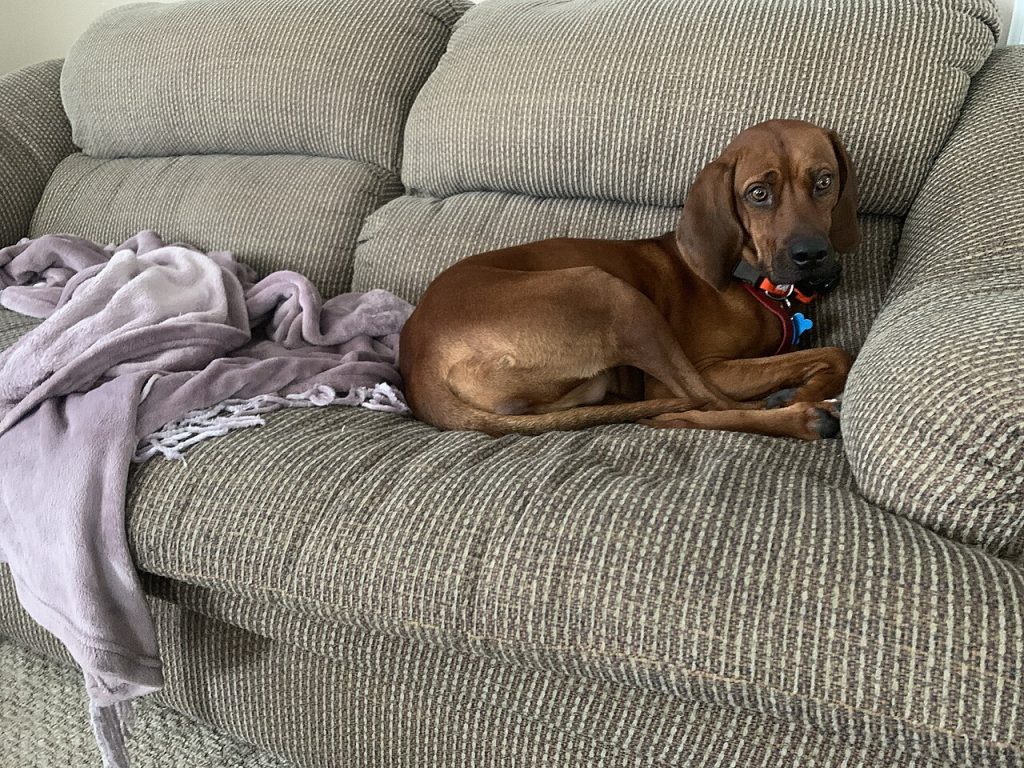
The Redbone Coonhound is a slender, muscular and well-proportioned dog, with the classic type of coonhounds: long, straight legs, deep chest, and head and tail that it carries high and proudly when working or exhibiting.
Tamaño: males measure between 56 and 69 cm at the withers, and females slightly less, between 53 and 66 cm. The weight usually ranges between 20 and 32 kg, always proportionate to the bone structure of the individual and preferably for athletic specimens compared to the heavier ones.
A small amount of white is allowed on the chest, between the legs or on the feet. The nose is usually black and prominent, and it is not uncommon to have dark pigmentation on the snout and around the eyes, which is known as a mask.
Rasgos: eyes range from dark brown to hazel, preferring darker tones, with that characteristic pleading expression. The ears are long and sloping, and stretched almost to the tip of the snout. Its large legs, described as catlike for their compactness and padding, adapt to all types of terrain. And his voice deserves a special mention: A powerful, sonorous howl, described by fans as sweet.
Origin and history
The Redbone Coonhound is a genuinely American breed whose origins go back to the southern United States, before the American Civil War. Its genetic basis comes from hounds brought by immigrants.
Around 1840, Irish foxhound and bloodhound lines were added, and it is believed that this Irish contribution may be the origin of the white markings that sometimes appear on the chest and feet of today’s Redbones.
The name Redbone comes from an early breeder, Peter Redbone, from Tennessee, although much of the breeding work was done in Georgia.
The breeders followed a selective program aimed at producing a hound that was skilled at cornering the hunt in the trees, courageous against large animals such as bears and pumas, agile at tracking in the mountains or marshes, and able to swim when needed. The United Kennel Club recognized it in 1902 – the second coonhound breed to do so, after the Black and Tan – and the American Kennel Club did the same in 2010.
Curiosities
- The Redbone Coonhound is famous in popular culture thanks to the children’s novel Where the Red Fern Grows(1961), by Wilson Rawls, starring two dogs of this breed.
- Their hunting strategy is not to subdue the prey, but to corner it in a tree (treeing) and warn the hunter to approach with their howling.
- It is credited with a cold nose: the ability to follow tracks older and more difficult than other breeds.
- It was the second coonhound recognized by the United Kennel Club, in 1902, only behind the Black and Tan Coonhound.
- It swims very well and enjoys water, a quality purposely sought after to be able to trawl through rivers and wetlands.
- Its breeders selected it both for its hunting ability and for its striking uniform red coat, something unusual among coonhounds, chosen almost always solely for its ability to work.
If you are attracted to the Redbone Coonhound because of its smell, energy, and houndlike character, you may be interested in other related breeds. The Bloodhound is one of its ancestors and the king of tracking; the Basset Hound shares the deep voice and nose instinct in a lower format; the Beagle is another sociable, family dog of smaller size; and the Vizsla shares that combination of athleticism, endurance, and family attachment. Browse their charts to compare and find your ideal dog.
Frequently Asked Questions About the Redbone Coonhound
Is the Redbone Coonhound a good family dog?
Yes. It is affectionate, balanced and good with children when it grows up with them and gets enough exercise. Its main demand is not character, but daily activity: a boring Redbone can become noisy and destructive. In an active home it is a kind and loyal companion.
Does he bark or howl a lot?
Yes. As a sled dog bred to corner prey in trees, it has a deep, sonorous, prolonged howl that is part of its nature. It is not the ideal dog for a flat with noise-sensitive neighbors. Exercise and enrichment reduce howling from boredom, but do not completely eliminate that characteristic voice.
How much exercise do you need a day?
It is a working dog with great endurance: it needs at least one to two hours a day of real physical activity (long walks, running, tracking, swimming). Without that wear and tear it accumulates energy and frustration.
Can you keep it loose in the field?
Its tracking instinct is so strong that when it catches an interesting smell, it can disconnect from the call and chase it for miles. In unfenced areas, it is advisable to use a long strap or long-line and work hard on the call before considering full freedom.
Do you get along with other dogs and pets?
With other dogs, it is usually sociable, since it was bred to hunt in jaura. With cats and small animals you have to be careful: its hunting instinct can be activated. Early socialization and coexistence from puppy helps a lot, but it is advisable to supervise.
How long does a Redbone Coonhound live?
Around 11 to 12 years, a typical longevity of a medium to large size dog. It is a rustic and fairly healthy breed; with good nutrition, exercise and veterinary checks it usually remains active for many years.
Is it easy to educate?
It is intelligent and wants to please, but has the independence of hounds and a nose that easily distracts it. It responds well to positive reinforcement, constancy and short sessions.
How much hair does it shed and what care does the mantle need?
Their hair is short, smooth, and low in maintenance. They let their hair down moderately and just brush weekly and bathe occasionally.