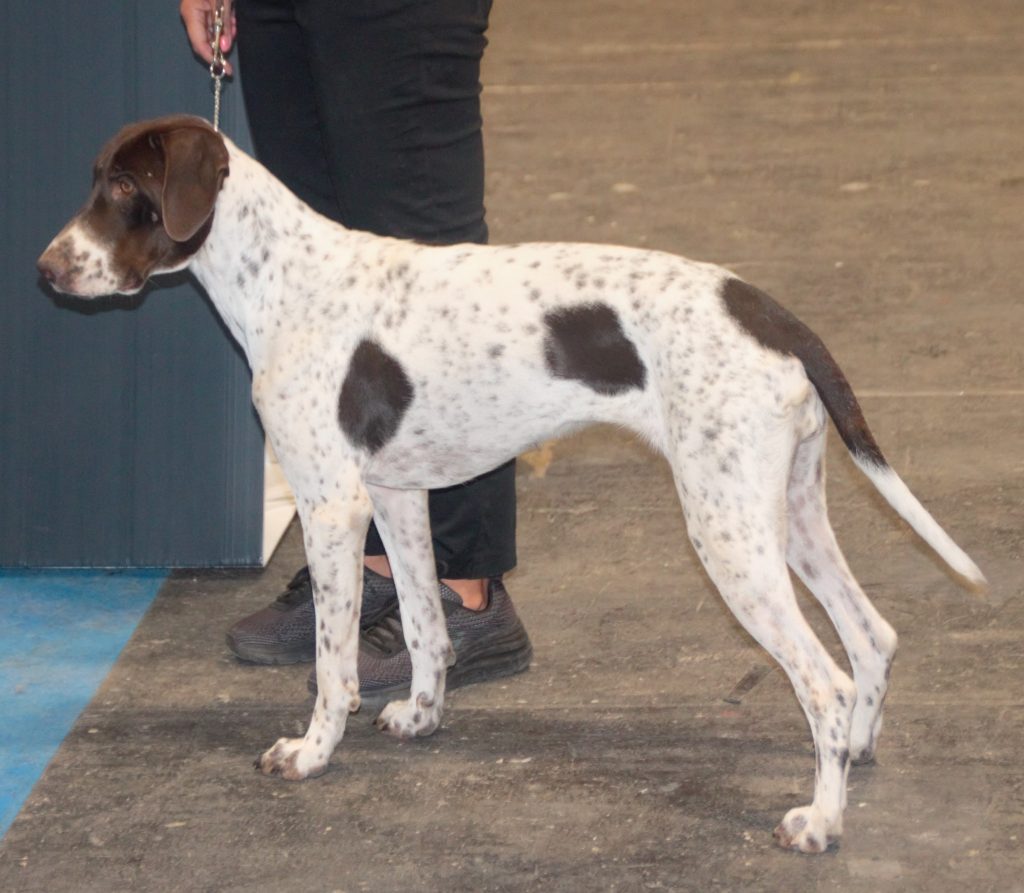
The Old Danish Show Dog(Danish: old Danish hønsehund, and internationally known as Old Danish Pointer) is a medium-sized, white, brown-spotted sighthound breed bred in Denmark since the 18th century to spot game birds.
Is the Old Danish Show Dog for you?

The Old Danish Show Dog is a root hunting dog, and that sets everything else apart. It fits wonderfully with active families who live in the countryside or in a terraced house, who enjoy the outdoors and who want a quiet companion doors in but tireless doors out. Not a dog to look for a couch pet and shortcuts: Your body and your head need work.
In favour .
- Quiet and stable inside the house
- Very loyal and balanced with his family
- Short coat of simple maintenance
- Intelligent and cooperative, easy to motivate
- Excellent sense of smell and sample instinct.
- Good with kids if you’re well socialized.
To be taken into account
- Not suitable for floors or small courtyards
- He needs plenty of exercise every day.
- You may get bored and restless without activity
- Very rare breed: difficult to find
- Strong hunting instinct for birds
- It requires space and long outings.
Character and temperament
The first impression of the Old Danish Show Dog is that of a quiet and stable dog, which conveys calmness but also determination and courage. He ‘s not a nervous dog or a barking dog . His temperament is rather reflective, and that serenity is one of his hallmarks. In the field work it advances slowly, without haste, always attentive to its guide and performing its sample task discreetly, without disturbing the terrain or raising the game prematurely.
That balance carries over into home life. At home, he is a surprisingly calm dog who knows how to sit and is rarely a burden. He is affectionate and loyal to his family, and he enjoys the company of people. A curiosity of the breed is the marked contrast between the sexes: the male is powerful and substantial, while the female tends to be lighter, more lively and, according to the Danish breeders, somewhat more capricious.
Coexistence: children, other pets, flat and loneliness
With children. The stable and patient character of the Old Danish Show Dog makes it a good family dog, able to get along well with children when it has been socialized since puppyhood.

Con otras mascotas. Suele llevarse bien con otros perros, sobre todo si se cría en grupo, algo natural en una raza pensada para trabajar en jaurías grandes o pequeñas. Su fuerte instinto hacia las aves de caza, en cambio, exige prudencia con pájaros domésticos, gallinas o mascotas pequeñas.
Flat and lonely. has one major limitation: it is not a dog suitable for floors or small yards. It needs ample space and exits, and a too small environment frustrates it. It also does not tolerate prolonged solitude; it is a dog that wants to be with its people and participate in family life.
Education and training
The Old Danish Show Dog is intelligent and very cooperative, two traits that greatly facilitate its education. Its show instinct comes from the factory, and naturally tends to maintain contact with its guide during work, which translates into an attentive and easy to drive dog. It responds especially well to positive reinforcement, short sessions and consistency.
It is advisable to start early with socialization and basic obedience, taking advantage of the puppy’s willingness to learn. Being a working dog, it is grateful if it is given tasks: search, point, collect objects or any exercise that combines smell and collaboration.
Exercise and activity
Outside the home, the Old Danish Show Dog is fast and active, and needs plenty of exercise to be balanced. A couple of short walks are not enough: it asks for long walks, free running in a safe environment and, if possible, activities that stimulate its sense of smell. It is the kind of dog that does wonders accompanying a hunter or a very active person who goes out daily to the countryside.
Mental stimulation is as important as physical stimulation. Search games, tracking, and scent work keep it happy and help channel its energy. An Old Danish sample dog that does not get enough exercise may become restless and develop annoying behaviors out of sheer boredom; with proper activity, however, it is a calm and pleasant dog in the home.
Care: fur and hygiene
One of the practical advantages of the breed is its ease of maintenance. The coat of the Old Danish Show Dog is short and attached to the body, white with brown spots, and does not require hairdressing or elaborate care.
The rest of the hygiene is the usual routine of any dog: bathing only when necessary, periodic inspection and cleaning of the ears (important in hunting dogs that get into the weeds), regular tooth brushing and cutting nails when they do not wear themselves out.
Foodstuffs

Como perro de tamaño medio, activo y musculado, el Antiguo perro de muestra danés necesita una alimentación completa y de calidad, ajustada a su nivel real de actividad. Un ejemplar que trabaja en el campo o que hace mucho ejercicio tiene un gasto energético alto y requiere una ración acorde, mientras que un perro con vida más tranquila debe comer menos para no ganar peso.
It is advisable to divide the food into two servings a day and avoid intense exercise just before or after eating, a precaution especially relevant in deep-breasted dogs. It is advisable to monitor the body condition and always keep fresh water available.
Health and life expectancy
The Old Danish Show Dog is, in general, a rustic and functional dog, the result of a work-oriented rather than aesthetic breeding.
As with any medium-sized dog, watch out for the most common problems of these breeds, such as joint dysplasia or ear problems in dogs with droopy ears who work outdoors. The best prevention is to go to responsible breeders who do health tests, keep vaccinations and deworming up to date, take care of weight and carry out regular veterinary monitoring throughout the dog’s life.
Physical appearance
The Old Danish Show Dog is a dog of strong build and medium proportions, with a solid and balanced image. Its most striking feature is its marked sexual dimorphism: the male is clearly more powerful and substantial than the female, who is lighter and slimmer. Males measure 54 to 60 cm at the withers and weigh 30 to 35 kg; females measure 50 to 56 cm and weigh 26 to 31 kg.
The mantle is short and its characteristic color is white with brown spots, a pattern that immediately identifies it. The head is proportionate, with middle insertion ears that drop to the sides, and the expression conveys that mixture of calmness and attention that defines the breed. On the whole, it is a functional dog, without exaggeration, built to move about the countryside with resistance and without fright.
Origin and history
The history of the Old Danish Show Dog dates back to about 1710, in Denmark. The tradition attributes its creation to Morten Bak, a man from Glenstrup, near the towns of Randers and Hobro, who over the course of about eight generations crossed local dogs, possibly descended from old Spanish show dogs, with large spotted farm dogs, until a pure breed of white and brown specimens was established. Those dogs were called Bakhounds or Old Danish Pointers.
The breed descends, therefore, from the old trunk of Spanish show dogs that spread throughout Europe, and its function was linked from the beginning to the hunting of birds. Its Danish name, old Danish hønsehund, literally means “Old Danish bird of prey dog”, in reference to its ability to point out galliforms such as pheasants and partridges. That is why the English translation sometimes used, “Old Danish Chicken Dog”, is considered incorrect or mistranslated. Today the breed is recognized by the FCI in Group 7, Section 1, within the continental show dogs.
Curiosities
- Its name has nothing to do with temperament: hynsehund alludes to its ability to spot game birds, not a “chicken-like” character.
- The sharp contrast between males and females is so characteristic that the Danish standards themselves highlight it as one of the charms of the breed.
- It is a calm indoor dog and quick and active outdoors, an unusual combination among hunting dogs.
- In April 2026 he was admitted to the Foundation Stock Service of the American Kennel Club, a step toward his recognition in the United States.
- It is still a very rare breed even in its native Denmark, making it a rarity outside Scandinavia.
If you are attracted to the Old Danish Show Dog for its quiet, hardworking show dog side, you may be interested in other hunting and sniffing breeds with similar profiles. You can compare it to the Pointer, a stylish specimen specialist; the versatile Vizsla, another large-nosed mainland hound; the energetic Weimaraner; or the classic Cocker Spaniel, a more manageable-sized hunting dog.
Frequently Asked Questions About the Old Danish Show Dog
Is the Old Danish Show Dog a good family pet?
Yes. It is a calm and stable dog inside the house, affectionate and balanced with its family, as long as it covers its daily exercise needs. Its serene character and loyalty make it a good companion for active homes with space.
Can the Old Danish Show Dog live on one floor?
It is not the ideal breed for a flat or small yard. It is a medium-sized hunting dog that needs space and wide outdoors. It is surprisingly calm indoors, but requires discharging energy outside every day.
How tall and how much does the Old Danish Show Dog weigh?
The males measure between 54 and 60 cm at the withers (preferably above 56 cm) and weigh 30 to 35 kg. The females measure between 50 and 56 cm (preferably above 52 cm) and weigh 26 to 31 kg. It is a race with marked sexual dimorphism.
Where does the Old Danish Show Dog originate from?
Its origin dates back to 1710, when Morten Bak of Glenstrup (near Randers and Hobro) crossed local dogs, possibly descended from old Spanish show dogs, with farm dogs for eight generations to establish a white and brown breed.
Is the Old Danish Show Dog easy to train?
Yes, within reason, it’s an intelligent, cooperative dog with a great instinct for display, who works by maintaining constant contact with his guide, responds very well to positive reinforcement and consistent education from puppyhood.
How much exercise does the Old Danish Show Dog need?
It’s a fast and active outdoor dog that needs several long walks a day, with free running and mental stimulation. Without enough exercise, it can become restless or develop undesirable behaviors.
How much hair do you shed and what skin care do you need?
Its coat is short and easy to maintain. A weekly brushing is enough to keep it in good condition and control the moult. It does not require hairdressing or complex care, only basic checks of ears, teeth and nails.
Is the Old Danish Show Dog a rare breed?
Yes, it is a rare breed even in its native Denmark and virtually unknown outside Scandinavia. It is recognized by the FCI in Group 7 and in April 2026 was admitted to the Foundation Stock Service of the American Kennel Club.