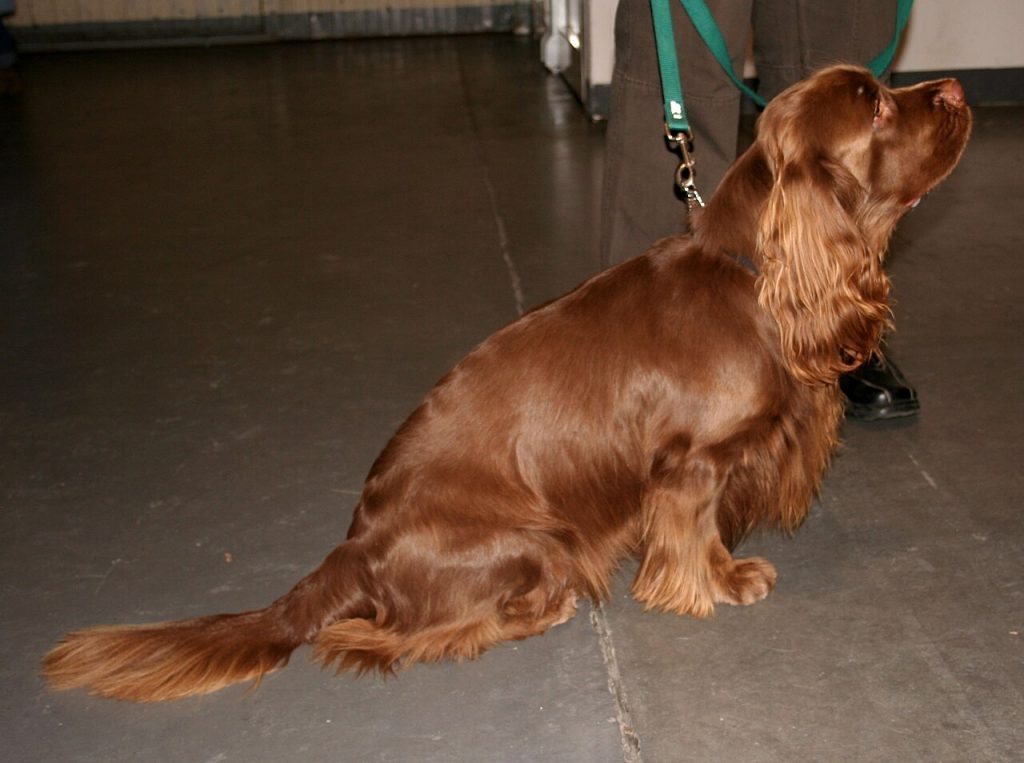
The Sussex Spaniel is one of the oldest and rarest hunting dogs in existence: Short, sturdy, swinging and with that unmistakable golden liver coat. Born in the English county of Sussex to work among the densest brush, today he is above all a quiet, affectionate family companion with a clownish streak. If you’re looking for a dog that’s serene, attached and classically English, here’s everything you need to know about the Sussex Spaniel before you decide.
Is the Sussex Spaniel for you?

The Sussex Spaniel is a dog of calm temperament and very attached to his family. It is not hyperactive or nervous: it fits well with those who are looking for a balanced companion, tolerant of children and happy to be close to people. Instead, it is a rare and difficult to find dog, somewhat stubborn when educating and with a predisposition to certain health problems that should be known in advance.
In favour .
- Quiet, serene and sociable character.
- Excellent with the kids and very close to the family.
- Moderate exercise needs: a daily walk is sufficient.
- Good candidate for a therapy dog because of his gentle temperament.
- Manageable size and adaptable to a floor if taken out daily.
To be taken into account
- Very scarce breed: hard to get and waiting list.
- Stubborn in training; requires patience and gentle firmness.
- I’m prone to back problems, ears and certain heart conditions.
- Long coat that requires almost daily brushing.
- It may drool and snore; bark or “sing” easily when tracked.
Character and temperament
If there’s one thing that defines the Sussex Spaniel, it’s its calmness. It’s a slow-paced, thoughtful dog that keeps its energy and enthusiasm in check, with a clownish point that delights those around it. It loves to be around people: it seeks contact, sticks to its family, and simply enjoys being in the same room as its owners.
Beneath that good-natured appearance is a dog with working roots. He is hardworking, tenacious, and dedicated to the tasks assigned to him, and he can be quite protective of his own. He’s not an effusive or outrageous dog at home, but he keeps his instinct: in the field tends to “quadratize” the terrain naturally and is able to trail with stubbornness. In fact, it is the only spaniel that howls or “voices” when it catches the trail of a piece, a trait that was purposely selected in its origins.
That mixture of sweetness and stubbornness is his signature– devoted and loyal to the point of becoming a one-person dog in many homes, but also stubborn enough to test the patience of his handler.
Coexistence: children, other pets, flat and loneliness
With children: is one of its great virtues. The Sussex Spaniel is excellent with the little ones in the house as long as they respect it. Its playful character and its patience make it a safe companion for families, although as with any dog it is advisable to supervise the game with very young children.
With other pets:‘s sociable temperament and her origin as a pack dog make it easy to get along with other dogs.
On the floor:‘s medium-low size and quiet pace make it adaptable to apartment life, as long as its daily walk is covered.
In the face of loneliness: is a very attached dog that enjoys human presence. It does not take well to spend many hours alone; in homes where no one is around all day it can get bored or become dependent. It is a breed for whom you can dedicate time.

Education and training
Here comes the challenge. The Sussex Spaniel is intelligent but remarkably stubborn, so its upbringing requires more perseverance than toughness. Ideally, start as a puppy with a firm but kind hand: clear rules, short sessions, and plenty of positive reinforcement. A well-behaved Sussex grows into a loyal and devoted pet; a permissive and boundless one can become stubborn and difficult to handle.
Early socialization is key: exposing him to people, noises, other dogs and different situations during his first few months will prevent shyness and give him confidence. It responds well to food as a reward and to a calm tone; it is frustrated by abrupt or repetitive methods. As a hunting dog he is, he enjoys smelling and searching games, which also channel his head and mental energy.
Exercise and activity
The Sussex Spaniel has moderate exercise needs. It is not a tireless athlete: a daily dose of activity, a good walk and some play are enough to keep it happy and fit. Its natural rhythm is more of a “quiet jog” than a frantic run.
That said, it retains the functionality of a working dog, so it appreciates activities that stimulate its sense of smell: tracks, search games, walks in the countryside where you can snoop freely. Combining moderate physical exercise with mental stimulation is the best recipe for a balanced Sussex. It is advisable not to overdo it on puppies or on specimens with back problems, avoiding jumps and sudden efforts that punish their spine.
Care: fur and hygiene

The coat of the Sussex Spaniel is abundant, smooth or slightly wavy, lustrous and silky, with fringes on the chest, legs and ears and an undercoat that functions as an excellent thermal insulator against cold and moisture. That beautiful coat demands maintenance: It is recommended to brush almost daily to avoid knots and remove dead hair, paying special attention to the freckles and the ear area.
ears are a critical point. Being long, fallen and lobular, they retain moisture and dirt, which makes them prone to infections (otitis externa). They should be checked and cleaned regularly. feet, very hairy, also require attention to avoid accumulations and discomfort.
Foodstuffs
The Sussex Spaniel must eat a complete and balanced diet, adapted to its age, size and activity level. Being a dog of compact structure and calm rhythm, it tends easily to overweight, something that must be closely monitored: the extra kilos directly punish its back and joints, already a sensitive point in the breed.
The wise thing is to divide the daily ration into two meals, measure the quantities, limit prizes, and avoid leftovers. A good-quality feed or a diet supervised by a veterinarian, water always available, and regular body weight control are the basis for keeping a Sussex healthy for many years.
Health and life expectancy
The Sussex Spaniel is a sturdy dog, but as a closed and small breed it carries certain predispositions that every future owner should know:
- Studies by the Orthopedic Foundation for Animals placed the breed among the most affected, although its compact nature means it often does not become severely disabling.
- Intervertebral disc herniation (disc syndrome) is characterized by: the disc bulges or ruptures into the spinal canal and compresses the spinal cord. It can go from simple back pain to paralysis. It’s one of the reasons to watch your weight and avoid sudden jumps.
- External ear recurrent ear infections due to their long and droopy ears, treatable with hygiene and, if necessary, veterinary medication.
- Cardiopatías: highlights pulmonary valve stenosis (the most common congenital heart defect in the breed), persistent ductus arteriosus and, more rarely, tetralogy of Fallot.
- Complicated births: often require a C-section, and is generally considered a difficult breed to breed.
With regular veterinary checkups, weight control, ear and back care, and responsible breeders testing the breeders, the Sussex Spaniel enjoys a long life for its size, in the usual range of medium spaniels (around 11-13 years).
Physical appearance
The Sussex Spaniel is a low, compact and elongated spaniel, almost rectangular in appearance and surprisingly heavy for its height. It usually measures between 33 and 41 cm at the cross (somewhat more the males than the females) and its weight is around 20-23 kg, not exceeding 21 kg according to the classic standard.
It has a broad skull with a well-marked stop, a powerful muzzle with a scissor bite, hazel eyes and those broad, sloping, lobular ears typical of the spaniel, implanted at mid-height. The neck is moderately long and somewhat arched; the forelimbs, short and strong, with thick elbows; the trunk almost at ground level. All of this gives him a very characteristic gait, a rocking or panting that has become one of his hallmarks.
Its star feature is the colour: a unique golden liver coat that lights up towards the ends, exclusive to the breed.
Origin and history
The Sussex Spaniel takes its name from the county of Sussex, in southern England, where it was bred as early as the late 18th century. It is documented in Goodwood (West Sussex) around 1792 and is associated with Augustus Elliot Fuller, of Rose Hill (now Brightling Park). It was conceived as a hunting dog capable of working in difficult terrain and very dense weeds, and was purposefully selected to bark or “give a voice” warning the hunter of the piece, something uncommon in other spaniels. It was mainly used for hunting partridges and pheasants.
It is a very old breed, predating the extinct Norfolk Spaniel, the Field Spaniel and the English Springer Spaniel. It was one of the first breeds registered by the British Kennel Club when it was founded in 1872, and was among the first ten admitted by the American Kennel Club in 1884. Introduced to the public in London in 1862, it did not gain full recognition until 1895, and shortly thereafter the Sussex Spaniel Association was born.
The two world wars almost ended it. During World War II breeding was discouraged and the breed came close to extinction: In 1947 there were only ten registered in the English Kennel Club. She was rescued by English breeder Joy Freer, from whose dogs all modern Sussex Spaniels descend. American breeders also helped to recover it, crossing it in its day with the Clumber Spaniel, which gave it its current chubby and compact appearance compared to the lighter type of yesteryear. Today it remains one of the rarest spaniel breeds in the world.
Curiosities
- It’s the the only howling spaniel or gives voice by capturing the trace of a piece, a feature purposely selected in its origins.
- In 2009, a Sussex Spaniel named “Stump” (Clussexx Three D Grinchy Glee) won the Best in Show from the Westminster Kennel Club; at age 10, he became the oldest dog to achieve that title.
- The British Kennel Club lists it as vulnerable native breed: in 2008 only 56 puppies were registered in the whole of the UK.
- All present-day Sussex Spaniels descend from the few specimens that breeder Joy Freer preserved after World War II.
- Its golden liver color is exclusive to the breed: it does not exist in any other spaniel.
If you are attracted to the Sussex Spaniel because of its quiet nature and its classic English spaniel imprint, you may be interested in other related breeds with which it shares a history or temperament, such as the Cocker Spaniel, the Basset Hound for its short body and long ears, the Bloodhound tracker hound or the always versatile Golden Retriever.
Frequently Asked Questions About the Sussex Spaniel
Is the Sussex Spaniel a good family dog?
Yes, it’s a quiet dog, very attached to its own and excellent with children as long as they respect it, enjoys company and fits in well in homes where it can spend time with the family.
How much exercise does a Sussex Spaniel need?
Moderate needs. With a good daily walk and some play or olfactory stimulation it stays happy. It is not a hyperactive dog, but it is advisable to avoid overweight and sudden jumps on its back.
Is it hard to educate?
It is intelligent but stubborn. It requires consistency, short sessions and positive reinforcement from a puppy. With firmness, kindness and patience it becomes a faithful and obedient pet; without limits, it can become stubborn.
What health problems does the breed have?
The most common are hip dysplasia, intervertebral disc herniation, external otitis due to dropped ears and certain heart diseases such as pulmonary valve stenosis.
How long does a Sussex Spaniel live?
With proper care, it lives within the usual range of average spaniels, around 11-13 years of age.
What color is the Sussex Spaniel?
Its characteristic and exclusive color is the golden liver, which lights up towards the tips of the hair.
Can he live in a flat?
His medium-to-low size and quiet nature make him adaptable to an apartment, provided he’s taken out for a daily walk and has company.
Why is it such a strange breed?
It was on the brink of extinction in the two world wars; in 1947 there were only ten registered specimens left. Although it was recovered thanks to breeders such as Joy Freer, it is still one of the rarest spaniel breeds in the world and the British Kennel Club considers it a vulnerable native breed.