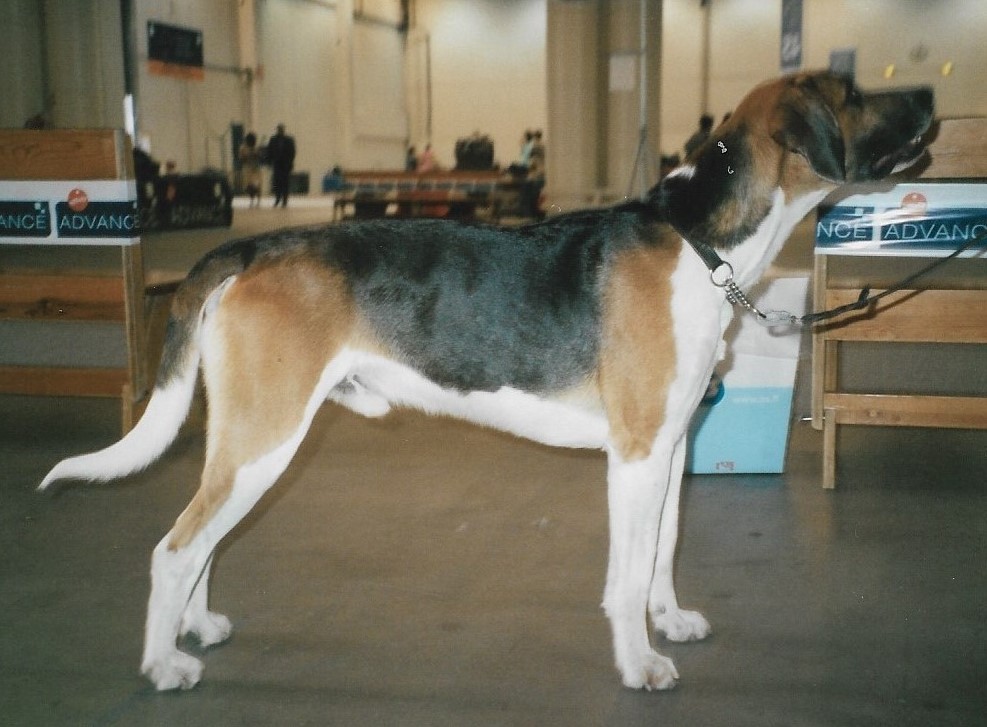
The Foxhound Inglés is the ultimate pack dog: a strong, tireless, deeply gregarious tracking dog bred for over two centuries in England to chase foxes in open country alongside riders on horseback. Athletic, with a powerful voice and extraordinary smell, it is one of the oldest hunting dogs and at the same time one of the least common as a pet. Before you fall in love with their nobility, you should understand that the English Foxhound is, first and foremost, a distance runner who needs company and miles.
Is the English Foxhound for you?
The English Foxhound is not a dog for just anyone. It was designed to work in groups, run for hours and follow a trail with absolute determination. Whoever adopts it inherits a sociable and good-natured athlete, but also a noisy, stubborn hound with an interesting smell and a need for exercise that few urban homes can meet. It is ideal for the countryside, active families and those who enjoy the outdoors.
In favour .
- Kind, tolerant and not aggressive.
- Extraordinarily sociable with other dogs.
- Resilient, rustic and generally robust in health.
- Short coat that barely needs maintenance.
- Good with kids and tireless running or biking buddy.
To be taken into account
- It needs a lot of daily exercise; it gets bored and crushed if it falls short.
- Loud voices and howling: not compatible with sticky neighbors.
- High tracking instinct: goes after a scent and ignores the call.
- He’s not an apartment dog or a one-eyed dog.
- Rare as a pet: few breeders and little habit of domestic life.
Character and temperament

The English Foxhound is a lively, daring dog with remarkable emotional balance. Centuries of cage breeding have selected a temperament that rejects aggression: A hound that fights or bites its mates is simply not suited to hunting in a pack, so the breed is by nature tolerant, cheerful and sociable. He is friendly and trusting with people, without the distrust typical of guard dogs.
That same genetics explains his two most striking traits. The first is the independence: Accustomed to working by his own nose, he’s not a dog who constantly looks at his guide waiting for orders, like a border collie would. The second is the the voice. The English Foxhound “sings” over the trail with a deep, melodious howl, and that tongue-splitting instinct does not go away at home. It is an emotionally stable dog and not nervous at all, but its manner belongs more to the world of work than to that of the living room.
Coexistence: children, other pets, flat and loneliness
With children, the English Foxhound is usually an excellent companion: patient, robust and playful, fits well into noisy families and withstands the childish traits without problems.
Where it really shines is in the coexistence with other dogs. No medium-sized dog is so prepared for group life: It was bred to sleep, eat and run in packs of dozens, so canine sociability is part of its essence. With cats and other small pets things change: Their powerful hunting instinct can be activated by a running animal, so coexistence requires early socialization and caution.
As for the floor, it is not his place. He needs space, exercise and, above all, long outings; an apartment without a very serious activity plan condemns him to frustration. Neither does the loneliness: it is a gregarious animal that needs company, whether human or other dogs, and a bored Foxhound and alone for many hours tends to howl and look for trouble.
Education and training
Training an English Foxhound is an exercise in patience and realism. It is an intelligent dog, but its intelligence is oriented to tracking, not competitive obedience. It responds much better to positive reinforcement– prizes, food, play – than to harshness, which only gets it to close in on itself.
The big challenge is the called. When a foxhound catches an interesting smell, its brain goes into “trace mode” and the environment ceases to exist. Working the call from a puppy, generously rewarding each return and never punishing him when he returns are the keys to having some margin. Early socialization, basic good manners, and moderation of voice complete a fruitful educational program if approached with consistency and a sense of humor.
Exercise and activity

Here is the heart of the breed. The English Foxhound is an endurance athlete capable of working for several hours straight on very diverse terrains without rest. That background ability is not turned off because it lives in a house: it needs a lot of daily exercise, much more than most breeds, and a short walk to the block is not enough for it.
Long walks, running, accompanying someone running or cycling and, above all, opportunities to use the nose are the basis of their well-being. A Foxhound that does the exercise it asks for is a calm and balanced dog inside the house; a bored and energized Foxhound becomes noisy, destructive and difficult to handle. He’s the kind of dog who’s looking for a companion for outdoor adventures, not a sedentary life.
Care: fur and hygiene
In terms of grooming, the English Foxhound is the simplest. Its short, dense and hard coat repels dirt quite well and only needs a weekly brushing with a glove or bristle brush to remove dead hair and keep it shiny.
The ears does require attention: being long and fallen, it retains moisture and promotes otitis, so it is advisable to check and clean it regularly.
Foodstuffs
As a long-distance athlete, the English Foxhound needs a complete and quality diet, adjusted to a high level of activity. Ideally, a balanced food with good protein intake that supports its musculature and energy expenditure, divided into two daily intakes and always according to its age, weight and actual work.
Keep an eye on the physical condition: A field foxhound that barely exercises easily gets fat, and overweight punishes its joints. Because it is a deep-chested dog, many specialists recommend avoiding vigorous exercise just before and after meals as a precaution against gastric dilation. Fresh water always available and pecking control complete a sensible diet.
Health and life expectancy
The English Foxhound is, as a whole, a rugged and hardy breed, the result of centuries of selection for functionality rather than aesthetics.
Still, it is good to know the predispositions of an athletic dog and a dog with droopy ears. hypoplasia of the hip appears as in other medium and large breeds, so it is advisable to acquire from breeders who control their breeders. ear infections derived from dangling ears is the most frequent everyday problem, and as it is a deep-chested dog the risk of gastric torsion should not be neglected. Regular veterinary checks, weight control and daily deworming are the best guarantees of a long and healthy life.
Physical appearance
The English Foxhound is a medium-sized hound, of strong and harmonious construction, made to combine speed and endurance. Beagle
It measures approximately between 53 and 64 cm to the cross– males in the upper band and females somewhat smaller – and usually weighs between 29 and 34 kg, reaching the largest specimens close to 38 kg. The skull is broad, the snout long, and the ears low and drooped, in classic hound style. Its legs are straight and muscular, with rounded, almost cat-like feet, which explains its resilience on any terrain. The back is level and strong, and the tail, well inserted, is carried happily in the shape of a whip. The coat is short, dense and hard, and supports any hound color: the most typical is the tricolor (black, white and fire) or the bicolor combinations on a white background, such as lemon and white or fire and white.
Origin and history

The English Foxhound is one of the most documented dog breeds in the world. It is descended from the st. Hubert’s dog(Bloodhound) and the now extinct Talbot, and has been systematically bred more than two hundred years: the origin books of the breed date back to before 1800, when the English aristocracy began to carefully record their pack lines.
Its raison d’être was always the fox hunting on horseback, a tradition that organized British rural life for centuries. That is why the Foxhound was never conceived as an individual companion dog, but as part of a private pack maintained by the large hunting, where dozens of specimens lived, worked and reproduced together. During British rule in India, English Foxhounds were also exported to hunt the jackal; they were preferred to greyhounds because, being less fast, they offered a longer and sporty chase, although the heat greatly reduced their life expectancy. That history of the pack explains why, even today, it is a rare breed outside of the riding world.
Curiosities
- It is a direct cousin of the Foxhound Americano, derived from English examples brought to North America from the 17th century.
- Despite its long pedigree, it is listed among the less numerous breeds as a pet: it still lives almost always in hunting packs.
- When it follows a tongue trail with a melodious howl, hunters learn to recognize each dog by its voice.
- Its round, “cat-like” feet are one of the keys to its legendary endurance on all types of terrain.
- It shares an obvious resemblance to the Beagle, which is no coincidence: both belong to the same family of English hounds.
If you are attracted to the English Foxhound because of its sociable nature and passion for tracking, you may be interested in other related breeds in the same family or with similar needs: the inseparable Beagle, the quintessential tracker Bloodhound, the quiet Basset Hound and, at the extreme of speed, the fast Greyhound.
Frequently Asked Questions about the English Foxhound
Is the English Foxhound a good family dog?
It can be, and very well, in the right family: active homes, with space and time to give it plenty of exercise. It is kind, tolerant and excellent with children and other dogs. It does not fit, however, into a sedentary or apartment life.
How much exercise do you need?
A lot: a lot more than average. It’s designed to run for hours, so it needs long walks, runs, and opportunities to use its nose daily. A couple of short walks aren’t enough to keep it balanced.
Does he bark or howl a lot?
Yes, it has a powerful, melodious voice, and the instinct to “spit” on a trail is part of its nature. It is a noisy dog, not recommended for homes with very close neighbors.
Do you get along with other dogs and cats?
With other dogs it is one of the most sociable that exists, because it was bred to live in a pack. With cats it depends: its hunting instinct can be activated in front of a running animal, so it requires early socialization and supervision.
Is it hard to educate?
It is not a dog of competition obedience; it is independent and guided by its smell. It learns well with positive reinforcement, but the call is its great pending subject: at an interesting trail tends to ignore it, so the long leash is convenient in open areas.
How long does he live and how is his health?
It is a hardy and hardy breed, with a life expectancy of about 10 to 13 years. It is advisable to monitor the ears (otitis), control hip dysplasia and, by its deep chest, prevent gastric torsion.
How tall and how much does an English Foxhound weigh?
It measures approximately between 53 and 64 cm at the withers and weighs between 29 and 34 kg, with the largest males reaching close to 38 kg. It is a medium-sized hound, similar to a Beagle but considerably larger and robust.
Why is it such a rare breed as a pet?
Because it was never bred for the home, but to live and work in fox-hunting packs, there are few domestic-oriented breeders and its demands for exercise and companionship make it impractical for most urban homes.